
About Neuron
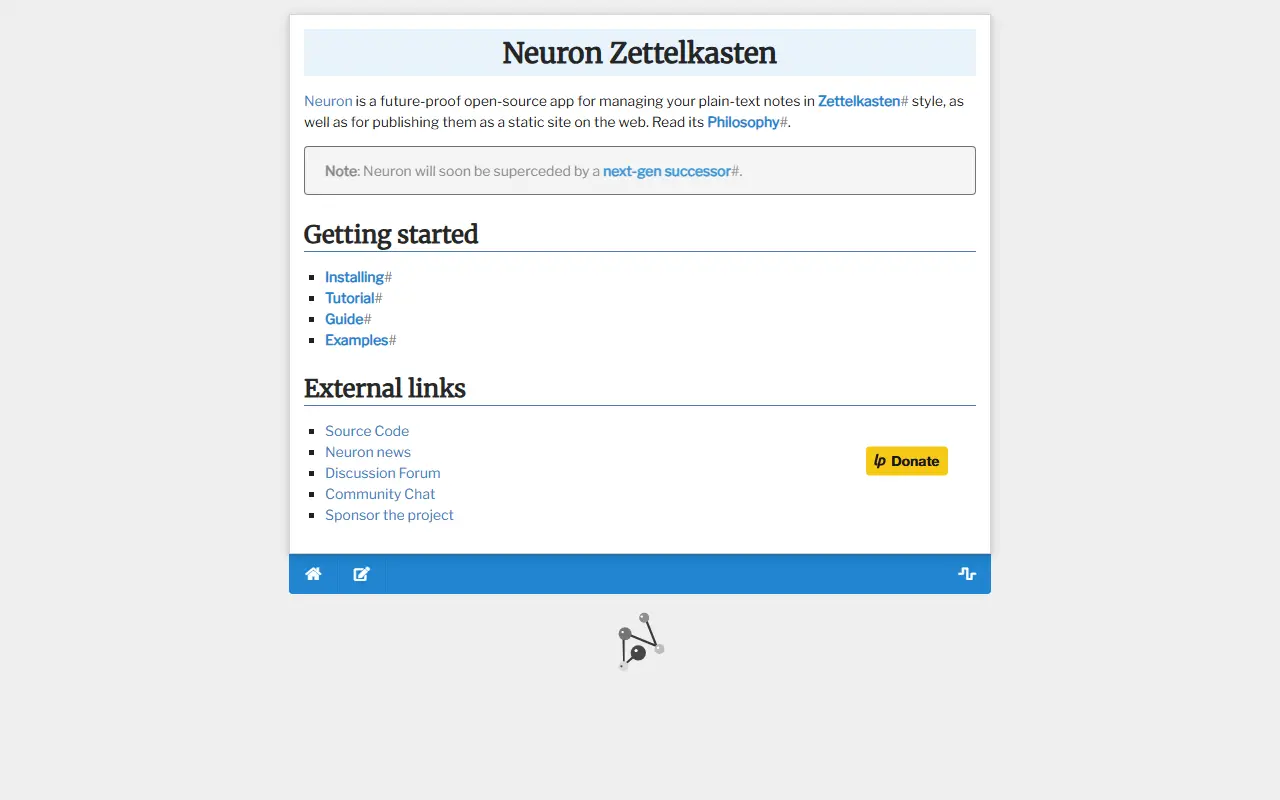
Neuron is a note-taking and publishing tool built around the Zettelkasten method. You keep a directory of Markdown files, connect them with a flexible linking syntax and hierarchical tags, and neuron can generate a static website from them, so private notes and a public digital garden can come from the same source files.
It is designed to be simple to use, with optional integrations for editors such as Emacs, Vim and VS Code. There is a template repository for publishing a neuron site with GitHub Pages, and the documentation site explains installation and philosophy. Neuron is written in Haskell and licensed under AGPL-3.0.
The README states that neuron is being superseded by Emanote, a successor project by the same author, and directs new users there. Neuron still works as a local tool run on your own machine, with discussion on GitHub and Matrix. It is mainly relevant to people who already maintain notes in neuron or who are interested in plain-text, link-based knowledge management.
Key features
- Directory of Markdown files as notes
- Zettelkasten-style linking syntax
- Hierarchical tagging
- Generated static website
- Optional editor integrations
- Template for GitHub Pages publishing
Good fit for
- →Keeping a Zettelkasten in plain text
- →Publishing notes as a static site
- →Maintaining an existing neuron notebook
- Built with
- Haskell
- Tags
- zettelkasten
- note-taking
- markdown
- static-site
- haskell
- knowledge-management
- publishing
- legacy
Neuron: questions and answers
- What is Neuron used for?
- Neuron is a Haskell app for plain-text Zettelkasten notes that also builds a static website, since superseded by its successor Emanote. It is a good fit for keeping a Zettelkasten in plain text, publishing notes as a static site and maintaining an existing neuron notebook.
- Is Neuron open source?
- Yes. Neuron is open source under the AGPL-3.0 licence. Its source code is on GitHub at srid/neuron and is written mainly in Haskell.
- Is Neuron free?
- Yes. Neuron is open source, so the software itself is free to use.
- Can I self-host Neuron?
- Yes. Neuron can be self-hosted on your own server or infrastructure; there is no official hosted version.
- What is Neuron an alternative to?
- Neuron is an open-source alternative to Obsidian and Roam Research. Other open-source alternatives to Obsidian include Foam, Tangent and Notabase.
- Is Neuron actively maintained?
- Yes. The most recent commit to Neuron was on 28 September 2026, and the latest release is 1.9.35.0, published on 11 August 2021. The project has 1.6k stars on GitHub.
Open-source alternatives to Neuron
See all
Foam
Note Taking
A personal knowledge management and sharing system for VSCode
OSSvs Roam Research★ 17k
Tangent
Note Taking
The Tangent monorepo.
Apache-2.0vs Obsidian★ 561
Notabase
Note Taking
A second brain for your knowledge, thoughts, and ideas.
AGPL-3.0vs Roam Research★ 913
Logseq
Note Taking
A privacy-first, open-source platform for knowledge management and collaboration. Download
AGPL-3.0vs Notion★ 45kInkstone
Note Taking
A self-hosted Markdown notebook that runs entirely on Cloudflare Workers.
OSSvs Obsidian★ 1.1k
Archivy
Note Taking
Archivy is a self-hostable knowledge repository that allows you to learn and retain inform
MITvs Obsidian★ 3.3k
SaaS alternatives to Neuron
See all
Obsidian
Note Taking
Obsidian is a free, flexible note-taking app for private notes, with plugins, linked notes and optional paid Sync and Publish services.
SaaS
Roam Research
Note Taking
Roam Research is a note-taking tool for networked thought that links notes into a graph while feeling like a simple bulleted outline.
SaaS
Scrintal
Note Taking
Visual note-taking and knowledge mapping tool using connected cards on a canvas
SaaS
Supernotes
Note Taking
Card-based note app with real-time collaboration
SaaS
Tana
Note Taking
Outliner-based knowledge workspace with supertags and AI features
SaaS
Amplenote
Note Taking
Notes and tasks app with backlinks and calendar scheduling
SaaS