
 Heptabase
 Tana
Tana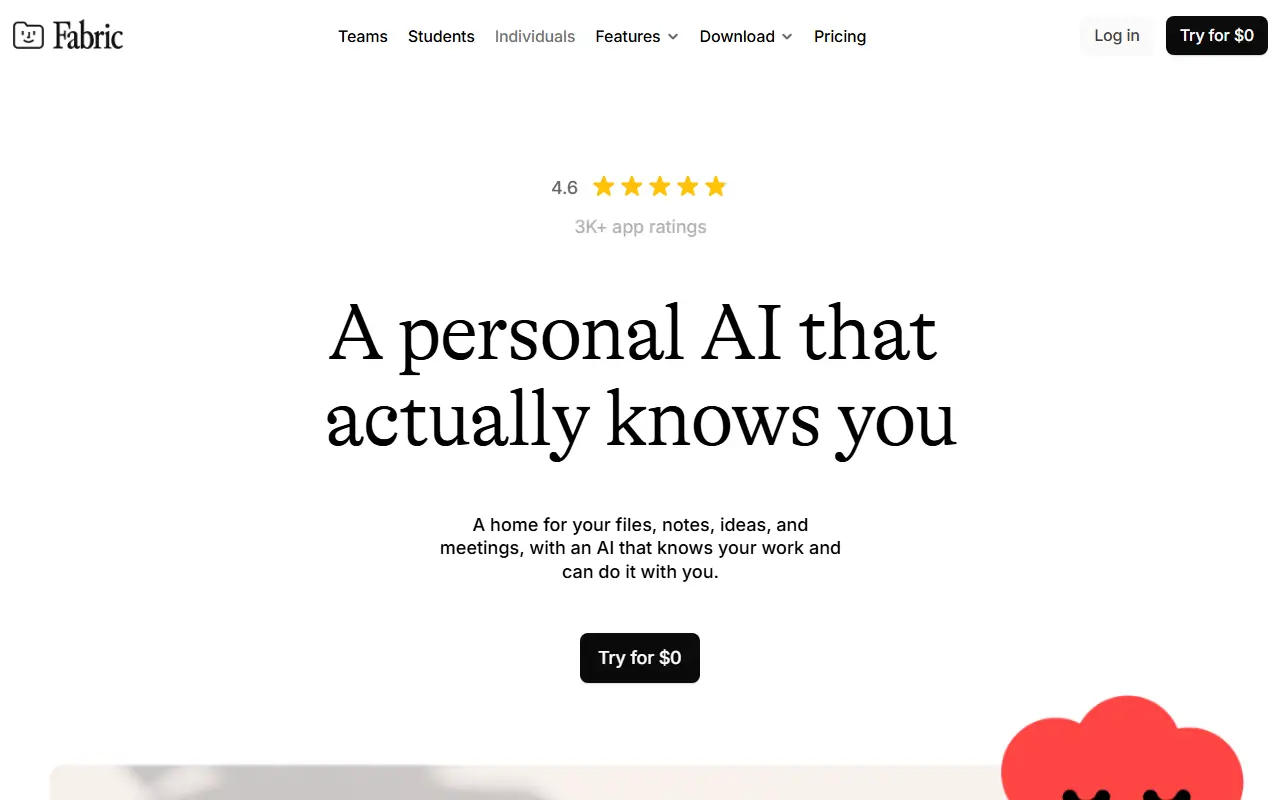
About Fabric
Fabric is a commercial AI workspace that keeps files, notes, ideas and meeting records in one place and attaches a personal AI to that material. The vendor describes it as an assistant that knows a user's projects, files and ideas, aimed at thinkers, researchers, designers and teams.
Capabilities named on the site include search across everything stored, integrations with many other apps, publishing of finished pages, an AI memory that grows as the workspace fills, multiplayer collaboration, an infinite canvas for visual thinking and agents that carry out tasks in connected tools.
Fabric is hosted software with a free way to start and a separate pricing page for individual plans. It suits people who collect a lot of reference material and want an AI that can draw on it when they write, plan or research.
Key features
- Unified space for notes, files and meetings
- Personal AI with memory of your work
- Search across stored content
- Infinite canvas for visual thinking
- Publishing of pages
- Multiplayer collaboration
- AI agents connected to other apps
Good fit for
- →Researchers organizing sources and notes
- →Designers building moodboards from saved material
- →Small teams sharing a knowledge workspace
- Tags
- ai-workspace
- note-taking
- knowledge-management
- research
- canvas
- ai-agents
- file-organization
Fabric: questions and answers
- What is Fabric used for?
- Fabric is a commercial AI workspace that keeps notes, files, ideas and meetings together with a personal AI for thinkers, researchers, designers and teams. It is a good fit for researchers organizing sources and notes, designers building moodboards from saved material, and small teams sharing a knowledge workspace.
- How much does Fabric cost?
- Paid plans for Fabric start at $8 per seat per month, and there is no free plan.
- Is Fabric open source?
- No. Fabric is proprietary (closed-source) software and can't be self-hosted. Open-source alternatives to Fabric include SiYuan, AppFlowy and AFFiNE.
- What are some alternatives to Fabric?
- Fabric competes with Notion, Mem and Obsidian. For open-source options, see Enlisted's ranked list of open-source Fabric alternatives.
Open-source alternatives to Fabric
See all
SiYuan
Note Taking
思源笔记 - 隐私优先的个人知识管理系统,支持 Markdown 排版、块级引用和双向链接
AGPL-3.0vs Notion★ 47k
AppFlowy
Note Taking
AppFlowy is the AI collaborative workspace where you achieve more without losing control o
AGPL-3.0vs Notion★ 77k
AFFiNE
Note Taking
There can be more than Notion and Miro. AFFiNE(pronounced [ə‘fain]) is a next-gen knowledg
OSSvs Notion★ 73k
NoteGen
Note Taking
Capture first. Organize later. A local-first Markdown app that turns scattered records int
GPL-3.0vs Mem★ 13k
Blinko
Note Taking
An open-source, self-hosted personal AI note tool prioritizing privacy, built using TypeSc
GPL-3.0vs Google Keep★ 11k
EdgeEver
Note Taking
Open-source, AI-native knowledge base & Evernote alternative with native MCP. Zero-cost on
AGPL-3.0vs Evernote★ 2k
SaaS alternatives to Fabric
See all
Notion
Note Taking
Notion is an AI-enabled workspace for notes, docs, wikis and projects, with agents, meeting notes and search across connected apps.
SaaS
Mem
Note Taking
AI-assisted note app that organizes and surfaces notes automatically
SaaS
Obsidian
Note Taking
Obsidian is a free, flexible note-taking app for private notes, with plugins, linked notes and optional paid Sync and Publish services.
SaaS
Evernote
Note Taking
Evernote is a note-taking app for capturing notes, documents and web clippings and keeping them organized and searchable across devices.
SaaS
Capacities
Note Taking
Object-based notes where pages are typed items linked into a graph
SaaS
Reflect
Note Taking
Networked notes app with backlinks, calendar integration and AI features
SaaS