 TrackMedia
 TrackRev

 Papago
 Unbabel
About Mosesdecoder
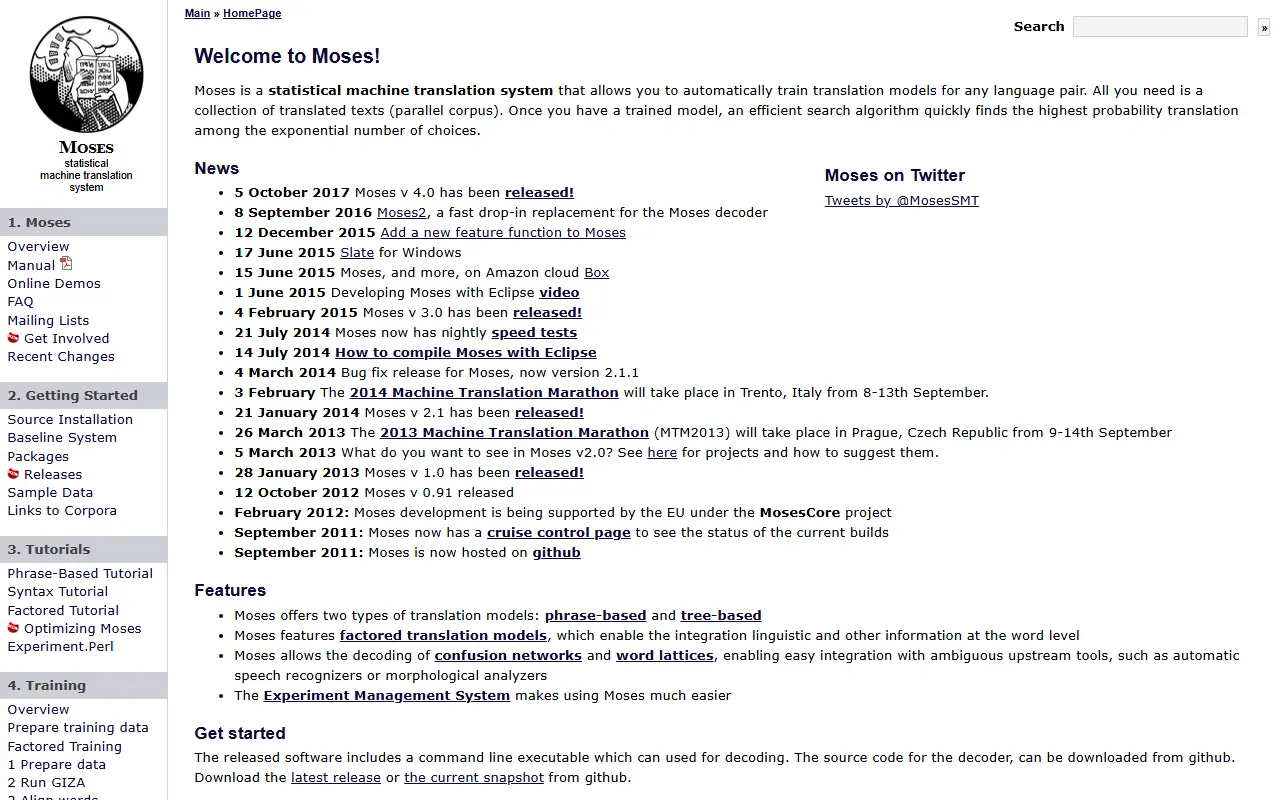
Moses is a statistical machine translation system. Given a collection of translated texts, called a parallel corpus, it trains a translation model for any language pair, then uses an efficient search algorithm to find the highest-probability translation among many choices.
It offers phrase-based and tree-based translation models, as well as factored models that bring linguistic information in at the word level. It can decode confusion networks and word lattices, which makes it easier to connect with upstream tools such as speech recognizers.
The site's documentation covers installation, a baseline system, tutorials, training steps from word alignment to tuning, and a Moses2 decoder. The latest release announced on the page is version 4.0 from October 2017.
The site is organised as a manual with getting-started pages, tutorials for phrase-based, syntax and factored models, a training section, and advanced topics such as incremental training, domain adaptation and Moses as a service. Mailing lists, a FAQ, online demos and a development section help those who want to get involved.
Key features
- Trains translation models for any language pair
- Efficient search for the best translation
- Phrase-based and tree-based models
- Factored translation models
- Decodes confusion networks and word lattices
Good fit for
- Training translation models
- Machine translation research
Mosesdecoder: questions and answers
- What is Mosesdecoder used for?
- Mosesdecoder is a statistical machine translation system that trains translation models for any language pair from parallel text. It is a good fit for training translation models and machine translation research.
- Is Mosesdecoder open source?
- Yes. Mosesdecoder is open source under the LGPL-2.1 licence. Its source code is on GitHub at moses-smt/mosesdecoder and is written mainly in Roff.
- Is Mosesdecoder free?
- Yes. Mosesdecoder is open source, so the software itself is free to use.
- Can I self-host Mosesdecoder?
- Yes. Mosesdecoder can be self-hosted on your own server or infrastructure.
- What is Mosesdecoder an alternative to?
- Mosesdecoder is an open-source alternative to Google Translate, Microsoft Translator, iTranslate and Amazon Translate. Other open-source alternatives to Google Translate include Argos Translate, LibreTranslate and Translate Shell.
- Is Mosesdecoder actively maintained?
- The most recent commit to Mosesdecoder was on 28 March 2025. The project has 1.6k stars on GitHub.
Open-source alternatives to Mosesdecoder
See all
Argos Translate
Localization
Open-source offline translation library written in Python
MITvs Google Translate★ 6.6k
LibreTranslate
Localization
Free and Open Source Machine Translation API. Self-hosted, offline capable and easy to set
AGPL-3.0vs Google Translate★ 18k
Translate Shell
Open source
:speech_balloon: Command-line translator using Google Translate, Bing Translator, Yandex.T
Unlicensevs Google Translate★ 7.5k
Weblate
Localization
Web based localization tool with tight version control integration.
GPL-3.0vs Crowdin★ 6.2k
Tolgee
Localization
Developer & translator friendly web-based localization platform
OSSvs Crowdin★ 4.2k
Lingo.dev
Localization
Open-source localization engineering tools. Connects to Lingo.dev localization engineering
Apache-2.0vs Lokalise★ 5.4k
SaaS alternatives to Mosesdecoder
See all
Google Translate
Localization
Free machine translation for text, documents, websites and speech
SaaS
Microsoft Translator
Localization
Machine translation service and apps from Microsoft
SaaS
iTranslate
Localization
Mobile translation and voice translator app
SaaS
Amazon Translate
Localization
Neural machine translation service from AWS
SaaS
Google Cloud Translation
Localization
Machine translation API from Google Cloud
SaaS
Systran
Localization
Machine translation software and API for enterprises
SaaS