
About Marmite
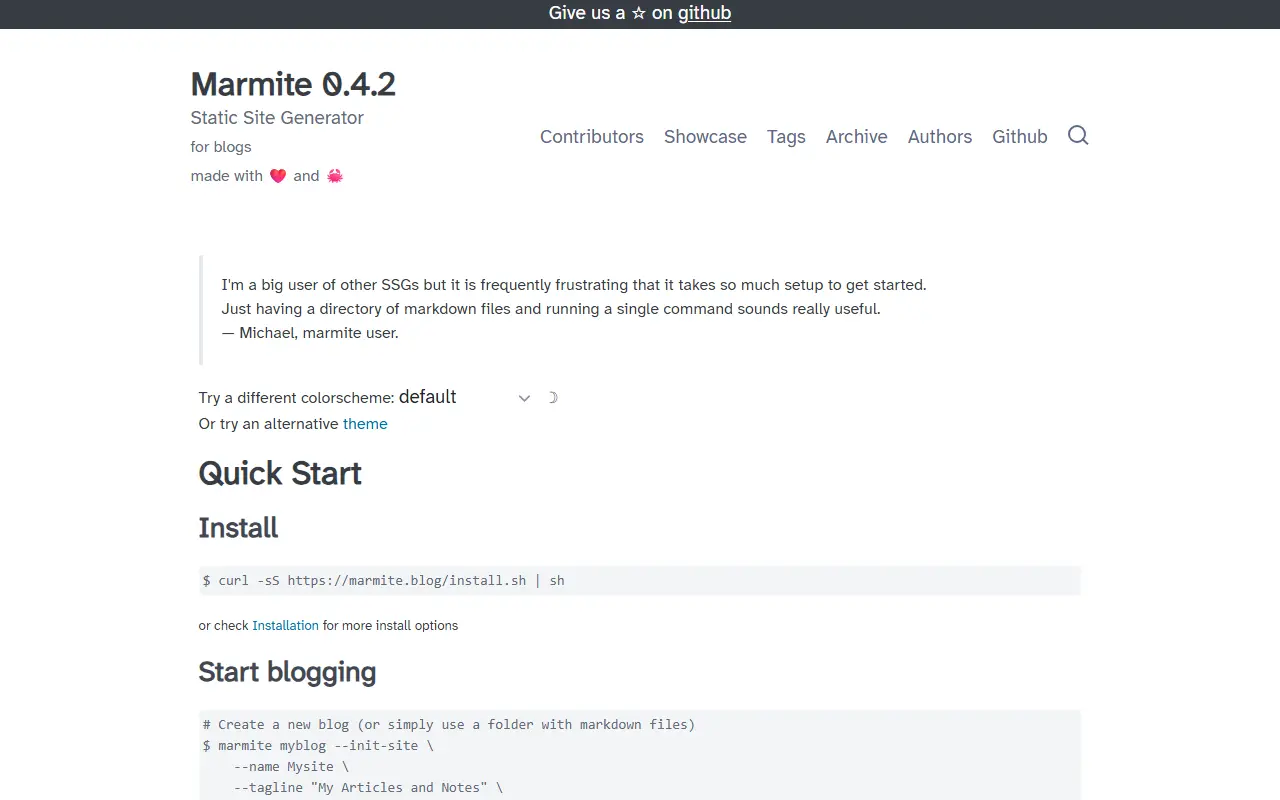
Marmite, short for Markdown makes sites, is a deliberately simple static site generator for bloggers. Point it at a directory of Markdown files and a single command renders a complete static site, removing the setup work that many other generators require before you can publish your first post.
It reads the .md files, parses them with CommonMark, extracts optional metadata from front matter or the filename and writes an HTML page for each one, copying static and media folders along the way. Posts are distinguished from pages by a date attribute, and content can be organized with tags, authors with profile pages, streams, series and languages for translations. Extras include GitHub-flavored Markdown, wikilinks, Obsidian-style links, callout alerts, backlinks, related content and RSS output.
Everything is embedded in one binary, the defaults need no configuration, and a marmite.yaml file allows optional tuning, including the Markdown parser. The output is flat HTML by default, with workspaces for multi-site layouts. Marmite is written in Rust and licensed under AGPL-3.0, and its author is upfront that it is meant to stay simple.
Key features
- Single embedded binary with zero config
- CommonMark and GitHub-flavored Markdown
- Front matter and filename metadata
- Tags, series, streams and multiple authors
- Wikilinks, Obsidian links and backlinks
- RSS feed generation
Good fit for
- →Personal blogs from Markdown notes
- →Simple multilingual blogs
- Built with
- Rust
- Tags
- static-site-generator
- markdown
- rust
- blog
- ssg
- cms
- rss
Marmite: questions and answers
- What is Marmite used for?
- Marmite is a single-binary static site generator written in Rust that turns a folder of Markdown files into a blog with no configuration. It is a good fit for personal blogs from Markdown notes and simple multilingual blogs.
- Is Marmite open source?
- Yes. Marmite is open source under the AGPL-3.0 licence. Its source code is on GitHub at rochacbruno/marmite and is written mainly in Rust.
- Is Marmite free?
- Yes. Marmite is open source, so the software itself is free to use.
- What are some alternatives to Marmite?
- Similar open-source tools in the CMS category include Zola, Hugo and Nesta CMS. SaaS products in the same category include BlogBowl, Blogsitefy and Voog.
- Is Marmite actively maintained?
- Yes. The most recent commit to Marmite was on 29 September 2026, and the latest release is 0.4.2, published on 31 July 2026. The project has 878 stars on GitHub.
Open-source alternatives to Marmite
See all
Zola
CMS
A fast static site generator in a single binary with everything built-in. https://www.getz
EUPL-1.2★ 17k
Hugo
CMS
The world’s fastest framework for building websites.
Apache-2.0★ 90kNesta CMS
CMS
File Based CMS and Static Site Generator
MIT★ 899
Notablog
CMS
Tell stories of your work with Notion
MIT★ 682
Bludit
CMS
Simple, Fast, Secure, Flat-File CMS
MITvs Blogger★ 1.5k
HTMLy
CMS
Simple and fast databaseless PHP blogging platform, and Flat-File CMS
GPL-2.0vs Medium★ 1.4k
SaaS alternatives to Marmite
See all
BlogBowl
CMS
Open-source blog and newsletter management platform
SaaS
Blogsitefy
CMS
Create SEO-optimized blogs on your own domain without relying on a third-party platform
SaaS
Voog
CMS
Website builder with online store and multilingual site features from Estonia
SaaS
1FoodMenu
CMS
One-page website builder for restaurants and food trucks with menu, hours and contact info
SaaSABHUB
CMS
No-code website builder and content management system for small and mid-size wineries
SaaS
Adobe Experience Manager
CMS
Enterprise content management and digital asset management for websites and brand content
SaaS