
About Ludwig
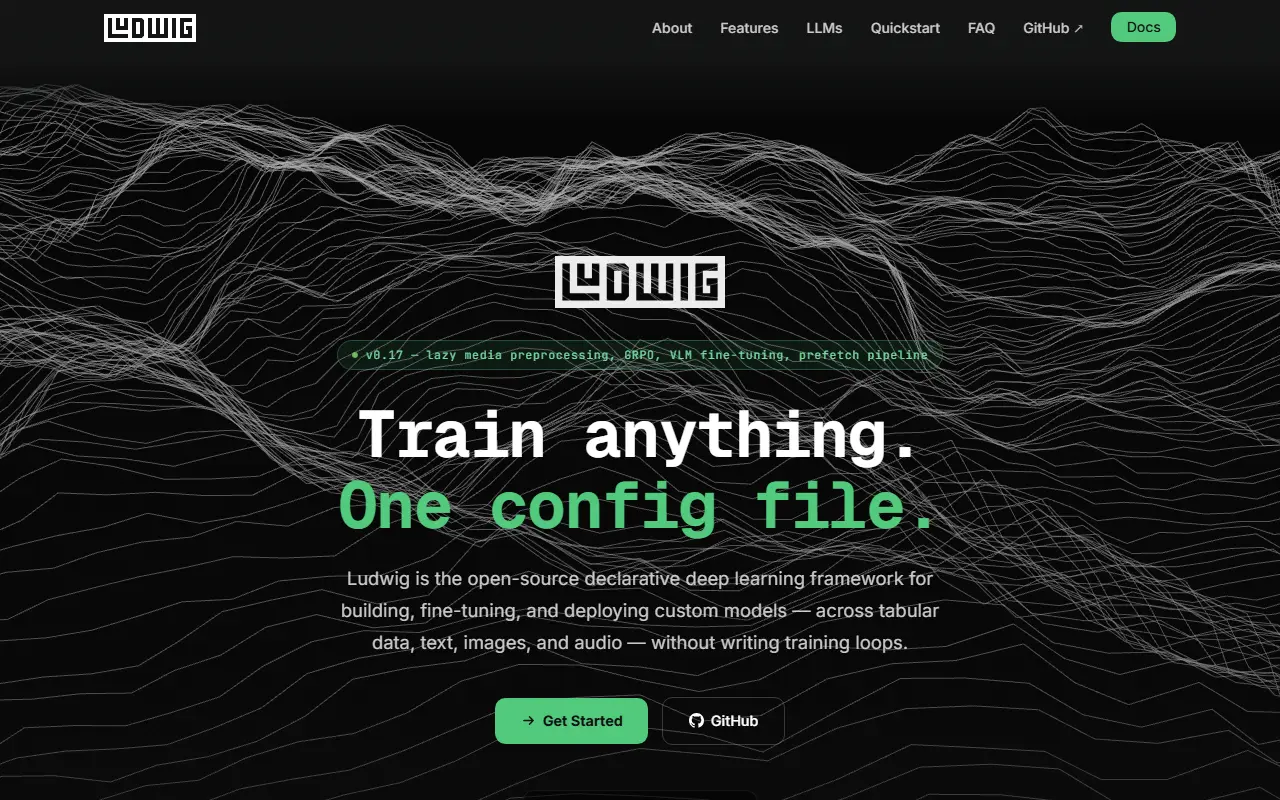
Ludwig is an open-source declarative deep learning framework for building, fine-tuning, and deploying custom models across tabular data, text, images, and audio. It is designed to reduce the engineering overhead of machine learning projects by allowing users to describe their model in a YAML file, which Ludwig then builds and runs.
The framework is built on PyTorch, integrates with HuggingFace and Ray, and is hosted by the Linux Foundation AI & Data. It aims to provide the simplicity of AutoML with the flexibility of raw PyTorch, offering expert-level control through configuration fields.
Key features
- Declarative configuration: Define the entire ML pipeline in a single validated YAML file, including preprocessing, encoders
- Multi-modal and multi-task: Mix tabular features, raw text, images, audio, and time series in a single model, and train multiple outputs
- LLM fine-tuning suite: Supports SFT, DPO, KTO, ORPO, and GRPO, with LoRA, QLoRA, DoRA, and VeRA, including 4-bit quantization and
- Scale without code changes: Add a backend like Ray to turn a local job into a distributed one without modifying the model code.
Good fit for
- Training custom LLMs and neural networks
- Fine-tuning large language models
- Building multi-modal models
Ludwig: questions and answers
- What is Ludwig used for?
- Ludwig is an open-source declarative deep learning framework that lets users define and train custom AI models using YAML configuration files, supporting tabular, text, image, and audio data. It is a good fit for training custom LLMs and neural networks, fine-tuning large language models, and building multi-modal models.
- Is Ludwig open source?
- Yes. Ludwig is open source under the Apache-2.0 licence. Its source code is on GitHub at ludwig-ai/ludwig and is written mainly in Python.
- Is Ludwig free?
- Yes. Ludwig is open source, so the software itself is free to use.
- Can I self-host Ludwig?
- Yes. Ludwig can be self-hosted on your own server or infrastructure.
- What is Ludwig an alternative to?
- Ludwig is an open-source alternative to H2O.ai. Other open-source alternatives to H2O.ai include Kubeflow, BentoML and MLflow.
- Is Ludwig actively maintained?
- Yes. The most recent commit to Ludwig was on 12 October 2026, and the latest release is v0.17.9, published on 16 August 2026. The project has 12k stars on GitHub.
Open-source alternatives to Ludwig
See all
Kubeflow
AI Tools
The Cloud Native AI Platform
Apache-2.0vs Together AI★ 16k
BentoML
AI Infrastructure
The easiest way to serve AI apps and models - Build Model Inference APIs, Job queues, LLM
Apache-2.0vs Amazon SageMaker★ 8.9k
MLflow
AI Infrastructure
The open source AI engineering platform for agents, LLMs, and ML models. MLflow enables te
Apache-2.0vs Weights & Biases★ 28k
Cortex
Monitoring & Observability
A horizontally scalable, highly available, multi-tenant, long term Prometheus.
Apache-2.0vs Arize AI★ 5.9k
TPOT
AI Infrastructure
A Python Automated Machine Learning tool that optimizes machine learning pipelines using g
LGPL-3.0vs DataRobot★ 10kChatTTS
AI Tools
A generative speech model for daily dialogue.
AGPL-3.0vs ElevenLabs★ 40k
SaaS alternatives to Ludwig
See all
H2O.ai
AI Infrastructure
AI platform for predictive and generative AI model building and deployment
SaaS
MLJAR
AI Tools
Private AI data lab for exploring data, running machine learning experiments, and building analysis tools
SaaS
Chatwise
AI Tools
Desktop AI chatbot supporting multiple LLMs with local data storage
SaaS
Forefront
AI Tools
Platform to fine-tune and inference open-source language models
SaaS
UBIAI
AI Tools
Fine-tune domain-specific LLMs for classification, retrieval, and reasoning
SaaS
AI-Mizu
AI Tools
Test and use several AI models such as Claude and GPT in one interface with pay-as-you-go use
SaaS