 TrackMedia
 TrackRev

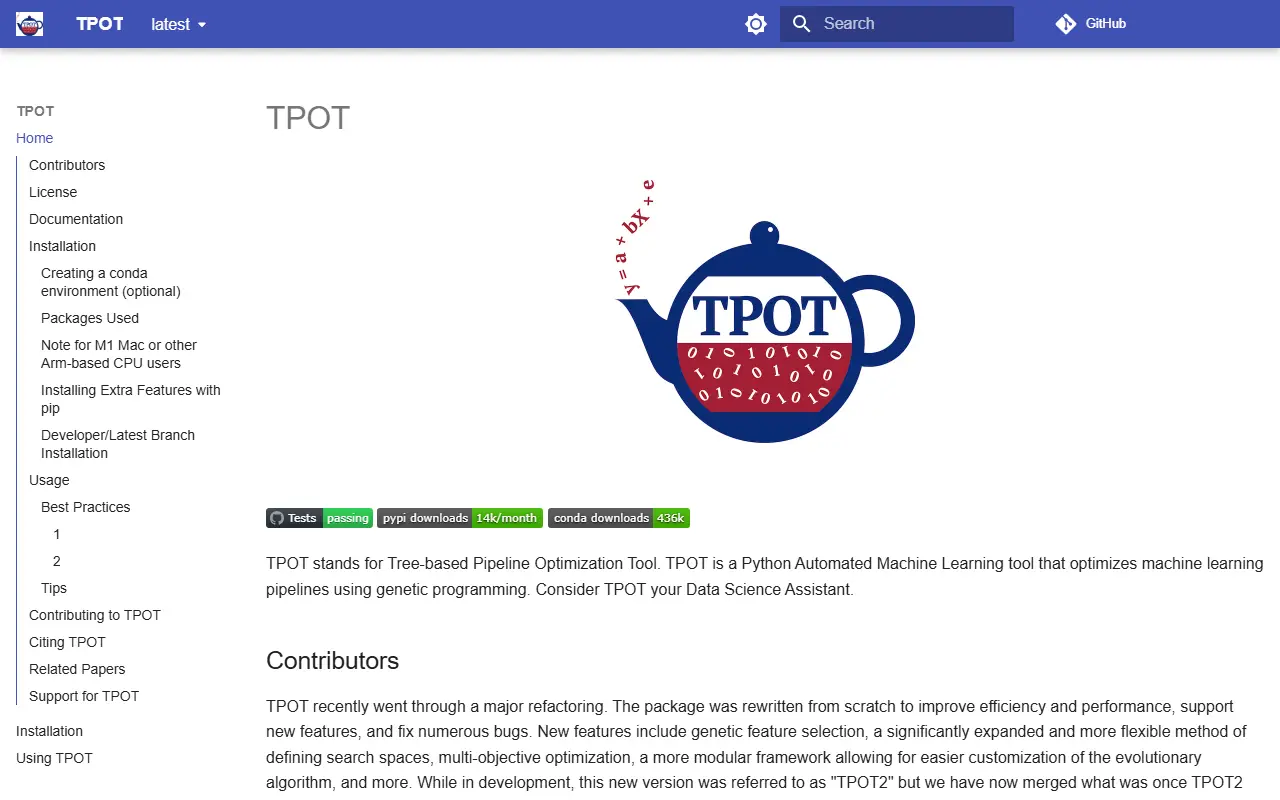
About TPOT
TPOT, which stands for Tree-based Pipeline Optimization Tool and is published by Epistasis Lab, is a Python automated machine learning library. It uses genetic programming to explore and optimize machine learning pipelines, automating steps such as model selection, feature engineering and hyperparameter tuning, and its authors describe it as a data science assistant.
The current version is a ground-up rewrite, previously known as TPOT2, aimed at better efficiency and performance. It adds genetic feature selection, a more flexible way to define search spaces, multi-objective optimization and a modular framework for customizing the evolutionary algorithm. The README cites an academic paper describing the graph-based implementation.
TPOT is released under the LGPL-3.0 license and installs as a Python package, with documentation on the project website. The present version was developed by a team at Cedars-Sinai. It is a library you run in your own Python environment rather than a hosted service.
Key features
- Genetic programming search over ML pipelines
- Automated model selection and hyperparameter tuning
- Genetic feature selection
- Flexible search space definitions
- Multi-objective optimization
- Modular evolutionary algorithm framework
- Built around scikit-learn pipelines
Good fit for
- Speeding up model selection for data scientists
- Automating baseline machine learning pipelines
TPOT: questions and answers
- What is TPOT used for?
- TPOT is a Python AutoML tool that uses genetic programming to search for and tune machine learning pipelines, built for data scientists working with scikit-learn. It is a good fit for speeding up model selection for data scientists and automating baseline machine learning pipelines.
- Is TPOT open source?
- Yes. TPOT is open source under the LGPL-3.0 licence. Its source code is on GitHub at EpistasisLab/tpot.
- Is TPOT free?
- Yes. TPOT is open source, so the software itself is free to use.
- What is TPOT an alternative to?
- TPOT is an open-source alternative to DataRobot, Dataiku and H2O.ai. Other open-source alternatives to DataRobot include MLflow.
- Is TPOT actively maintained?
- The most recent commit to TPOT was on 11 September 2025, and the latest release is v1.1.0, published on 3 July 2025. The project has 10k stars on GitHub, with 7 added in the last 30 days.
Open-source alternatives to TPOT
See all
MLflow
AI Infrastructure
The open source AI engineering platform for agents, LLMs, and ML models. MLflow enables te
Apache-2.0vs Weights & Biases★ 29k
Kubeflow
AI Tools
The Cloud Native AI Platform
Apache-2.0vs Together AI★ 16k
BentoML
AI Infrastructure
The easiest way to serve AI apps and models - Build Model Inference APIs, Job queues, LLM
Apache-2.0vs Amazon SageMaker★ 8.9k
Orange
Analytics
🍊 :bar_chart: :bulb: Orange: Interactive data analysis
OSSvs IBM SPSS Statistics★ 5.7k
Dvc
AI Tools
🦉 Data Versioning and ML Experiments
Apache-2.0vs Arize AI★ 16k
Ludwig
AI Tools
Low-code framework for building custom LLMs, neural networks, and other AI models
Apache-2.0vs H2O.ai★ 12k
SaaS alternatives to TPOT
See all
DataRobot
AI Infrastructure
Enterprise platform for building, deploying and governing AI and ML applications
SaaS
Dataiku
AI Infrastructure
Collaborative data science and AI platform for analysts, engineers and business teams
SaaS
H2O.ai
AI Infrastructure
AI platform for predictive and generative AI model building and deployment
SaaS
Domino Data Lab
AI Infrastructure
Enterprise MLOps platform for building, governing and deploying data science models
SaaS
IBM watsonx
AI Infrastructure
IBM AI and data platform for building and governing foundation-model applications
SaaSSAS Viya
BI & Dashboards
Cloud analytics and AI platform from SAS with visual analytics and model management
SaaS