
About Litestream
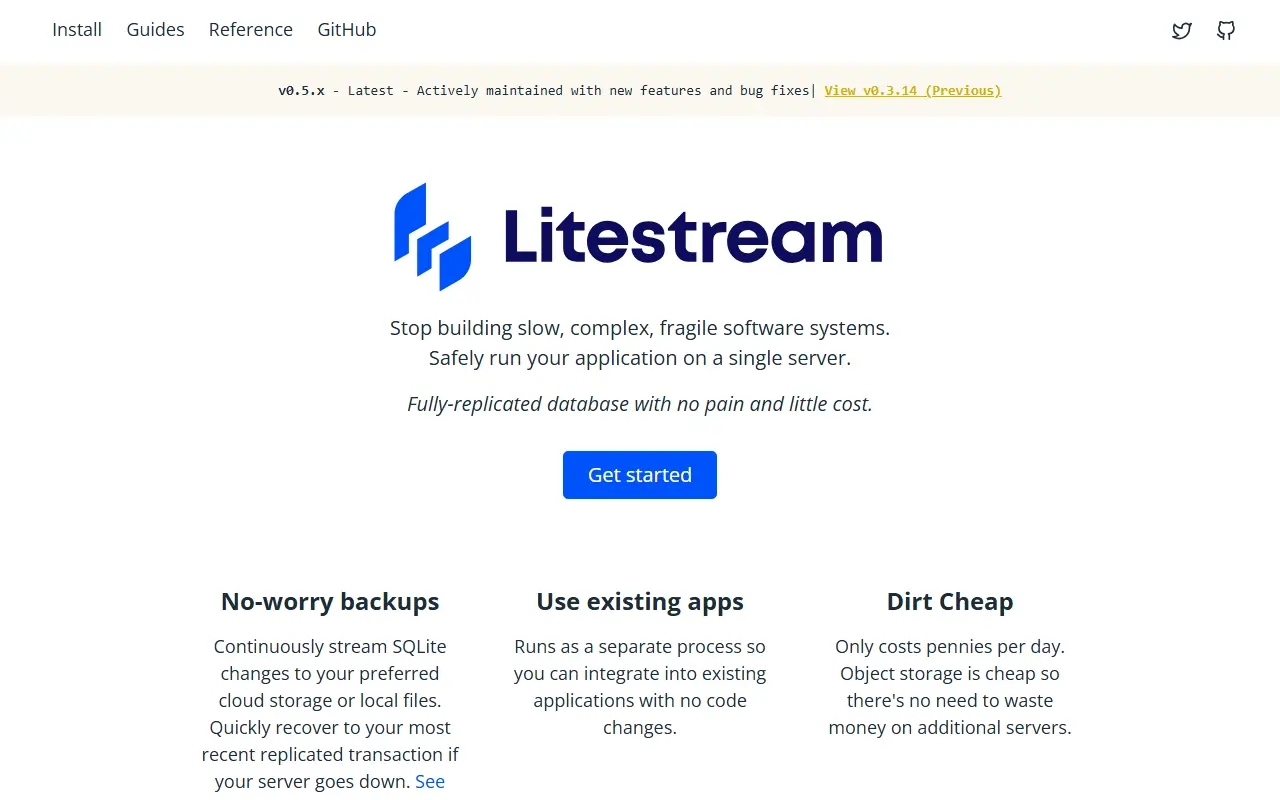
Litestream is a standalone disaster recovery tool for SQLite. It runs as a background process and replicates changes incrementally to another file or to S3, so a copy of the database is available if the original is lost. It communicates with SQLite only through the SQLite API, so it does not corrupt the database. The project is written in Go.
When replication starts, Litestream creates an internal lock table in the source database that it uses to coordinate synchronization around WAL checkpoints. The README says the table is expected and safe to leave in place, that it is part of the source schema and therefore appears in restored databases, and that a database under Litestream will not remain byte-identical to its earlier state. The table should not be dropped while Litestream is running.
Litestream is released under the Apache 2.0 license. Installation instructions and documentation are on litestream.io, bug reports and ideas go to GitHub Issues, and security vulnerabilities should be reported privately rather than in a public issue.
Key features
- Continuous replication of SQLite changes
- Replicates to another file or S3
- Runs as a background process
- Uses only the SQLite API
- Restore from replicated copies
Good fit for
- →Backing up SQLite-based apps
- →Disaster recovery for small production databases
- Tags
- sqlite
- replication
- backup
- disaster-recovery
- s3
- golang
- database
- streaming
Litestream: questions and answers
- What is Litestream used for?
- Litestream is a standalone disaster recovery tool that continuously replicates SQLite database changes to another file or S3 storage. It is a good fit for backing up SQLite-based apps and disaster recovery for small production databases.
- Is Litestream open source?
- Yes. Litestream is open source under the Apache-2.0 licence. Its source code is on GitHub at benbjohnson/litestream and is written mainly in Go.
- Is Litestream free?
- Yes. Litestream is open source, so the software itself is free to use.
- What are some alternatives to Litestream?
- Similar open-source tools in the Databases category include rqlite, libSQL and CloudNativePG. SaaS products in the same category include Cloudflare D1, KX kdb+ and Aerospike.
- Is Litestream actively maintained?
- Yes. The most recent commit to Litestream was on 25 September 2026, and the latest release is v0.5.17, published on 31 August 2026. The project has 14k stars on GitHub.
Open-source alternatives to Litestream
See all
rqlite
Databases
The lightweight, fault-tolerant database built on SQLite. Designed to keep your data highl
MITvs Cloudflare D1★ 18k
libSQL
Databases
libSQL is a fork of SQLite that is both Open Source, and Open Contributions.
MITvs Cloudflare D1★ 17k
CloudNativePG
Databases
The most popular Kubernetes Operator for PostgreSQL.
Apache-2.0vs Amazon RDS★ 9.4k
Materialize
Databases
The live data layer for apps and AI agents. Create up-to-the-second views into your busine
OSS★ 6.4k
KurrentDB
Databases
KurrentDB is a database that's engineered for modern software applications and event-drive
OSS★ 5.9k
Tile38
Databases
Real-time Geospatial and Geofencing
MIT★ 9.7k
SaaS alternatives to Litestream
See all
Cloudflare D1
Databases
Serverless SQLite-based database for Cloudflare Workers
SaaS
KX kdb+
Databases
Time-series database used for high-frequency market and sensor data analytics
SaaS
Aerospike
Databases
Real-time NoSQL database for low-latency, high-throughput applications
SaaS
Amazon Athena
Databases
Serverless interactive query service for analyzing data in Amazon S3 with SQL
SaaS
Amazon MemoryDB
Databases
Durable in-memory database service on AWS compatible with Valkey and Redis OSS
SaaS
Azure Data Explorer
Databases
Analytics service on Azure for exploring log, telemetry and time-series data with Kusto queries
SaaS