
About LinDB
LinDB is an open-source time series database that aims to provide high performance, high availability and horizontal scalability. It is built for storing and querying metrics and monitoring data, and its topics highlight cross-datacenter operation as a design goal alongside distributed storage.
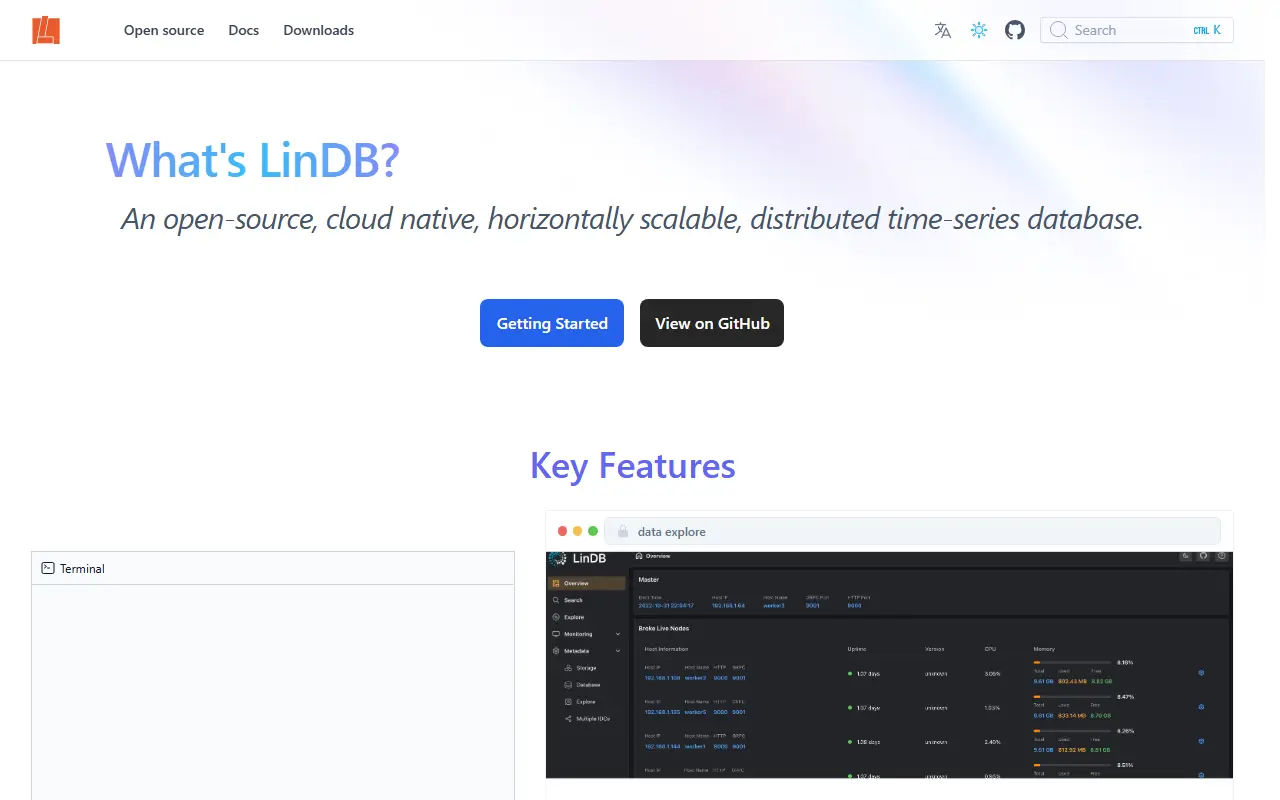
The project includes an admin web interface with overview and monitoring dashboards, replication state views, data exploration and query explain tools. Documentation covers key features, a guide, a quick start, design notes and architecture. Building from source requires Go, Make and Yarn, with the web console built separately from the core, and development includes a dev mode for the frontend.
LinDB is written in Go and licensed under Apache-2.0, and runs on infrastructure you manage. The repository enforces linting and tests through GitHub Actions and welcomes contributions. It suits engineering teams that collect large volumes of monitoring metrics and want an open-source, horizontally scalable store they can operate themselves.
Key features
- Distributed time series storage
- Horizontal scalability
- High availability design
- Admin web UI with dashboards
- Data explorer and query explain
- Replication state monitoring
Good fit for
- →Storing large volumes of monitoring metrics
- →Operating a metrics backend across datacenters
- →Replacing a single-node time series store
- Built with
- Go
- Tags
- time-series
- database
- metrics
- monitoring
- distributed
- go
- high-availability
- apache-2.0
- observability
LinDB: questions and answers
- What is LinDB used for?
- LinDB is a distributed time series database written in Go, designed for high performance, high availability and horizontal scaling of metrics workloads. It is a good fit for storing large volumes of monitoring metrics, operating a metrics backend across datacenters and replacing a single-node time series store.
- Is LinDB open source?
- Yes. LinDB is open source under the Apache-2.0 licence. Its source code is on GitHub at lindb/lindb and is written mainly in Go.
- Is LinDB free?
- Yes. LinDB is open source, so the software itself is free to use.
- Can I self-host LinDB?
- Yes. LinDB can be self-hosted on your own server or infrastructure.
- What are some alternatives to LinDB?
- Similar open-source tools in the Databases category include InfluxDB, GreptimeDB and CockroachDB. SaaS products in the same category include Azure Data Explorer, CockroachDB and KX kdb+.
- Is LinDB actively maintained?
- Yes. The most recent commit to LinDB was on 27 July 2026, and the latest release is v0.4.1, published on 16 August 2024. The project has 3.1k stars on GitHub.
Open-source alternatives to LinDB
See all
InfluxDB
Databases
Scalable datastore for metrics, events, and real-time analytics
Apache-2.0vs KX kdb+★ 32k
GreptimeDB
Databases
GreptimeDB open source: metrics, logs, and traces share one table model on a columnar engi
Apache-2.0vs Elastic★ 6.7k
CockroachDB
Databases
CockroachDB — the cloud native, distributed SQL database designed for high availability, e
OSSvs Google Cloud Spanner★ 33k
TDengine
Databases
High-performance, scalable time-series database designed for Industrial IoT (IIoT) scenari
AGPL-3.0vs KX kdb+★ 25k
Dgraph
Databases
high-performance graph database for real-time use cases
Apache-2.0vs Amazon Neptune★ 22k
rqlite
Databases
The lightweight, fault-tolerant database built on SQLite. Designed to keep your data highl
MITvs Cloudflare D1★ 18k
SaaS alternatives to LinDB
See all
Azure Data Explorer
Databases
Analytics service on Azure for exploring log, telemetry and time-series data with Kusto queries
SaaS
CockroachDB
Databases
Distributed SQL database with horizontal scaling, available as a managed cloud service
SaaS
KX kdb+
Databases
Time-series database used for high-frequency market and sensor data analytics
SaaS
Aerospike
Databases
Real-time NoSQL database for low-latency, high-throughput applications
SaaS
Amazon MemoryDB
Databases
Durable in-memory database service on AWS compatible with Valkey and Redis OSS
SaaS
Cloudflare D1
Databases
Serverless SQLite-based database for Cloudflare Workers
SaaS