
 RoboForm
 Sticky Password
 Google Password Manager
 Avira Password Manager
 Steganos Password Manager
 pCloud Pass
 Password Depot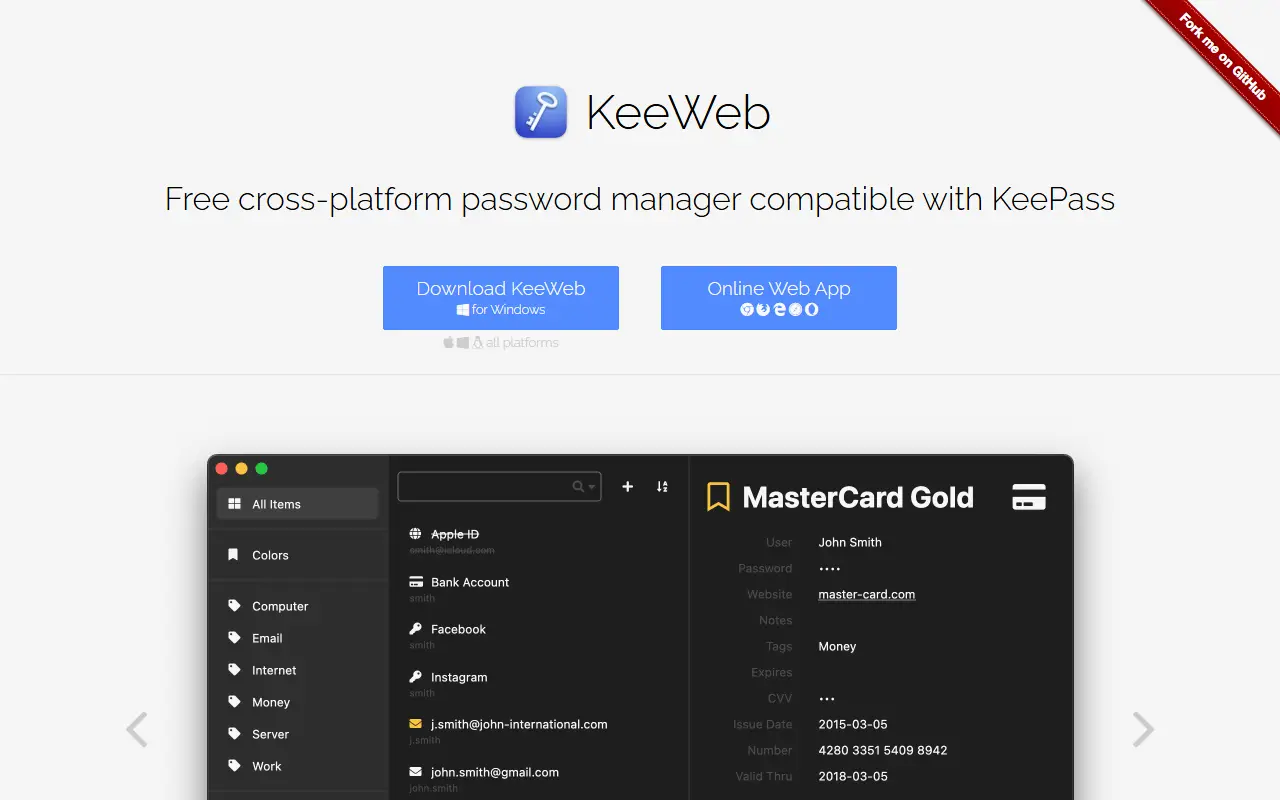
About KeeWeb
KeeWeb is a password manager that runs in a web browser or as a desktop application and works with kdbx database files created by KeePass, KeePassXC, and other compatible tools. You can open existing vaults or create new ones to store credentials. It supports Linux, Windows, and macOS and is built on Electron and JavaScript. The input lists its license only as other.
The README includes a thorough self-hosting guide using Docker and Docker Compose, with Traefik integration covering labels, dynamic and static configuration, certificate resolvers, entry points, a Cloudflare variant, and an Authentik integration. Other sections cover environment variables, volumes, Dropbox support, and building from source on each platform using Grunt or npm.
Because vault files stay in the standard kdbx format, users are not locked into the app. KeeWeb suits individuals and teams that already use KeePass and want a friendlier interface, or who want to host a web-based vault viewer on their own domain.
Key features
- Opens and creates KeePass kdbx databases
- Browser and desktop versions
- Windows, macOS, and Linux support
- Docker and Traefik self-hosting guides
- Dropbox sync support
- Build-from-source instructions
Good fit for
- →A friendlier interface for KeePass vaults
- →Self-hosting a web-based password vault viewer
- Tags
- password-manager
- keepass
- kdbx
- electron
- self-hosted
- security
- docker
- cross-platform
KeeWeb: questions and answers
- What is KeeWeb used for?
- KeeWeb is a free browser and desktop password manager that opens KeePass kdbx databases, with Docker self-hosting and builds for Windows, macOS, and Linux. It is a good fit for a friendlier interface for KeePass vaults and self-hosting a web-based password vault viewer.
- Is KeeWeb open source?
- Yes. KeeWeb is open source under a custom licence. Its source code is on GitHub at keeweb/keeweb.
- Is KeeWeb free?
- Yes. KeeWeb is open source, so the software itself is free to use under the terms of its own licence.
- Can I self-host KeeWeb?
- Yes. KeeWeb can be self-hosted on your own server or infrastructure.
- What is KeeWeb an alternative to?
- KeeWeb is an open-source alternative to Dashlane, Keeper, Enpass and 1Password. Other open-source alternatives to Dashlane include KeePassXC, AuthPass and Vaultwarden.
- Is KeeWeb actively maintained?
- The most recent commit to KeeWeb was on 8 May 2026, and the latest release is v1.18.7, published on 18 July 2021. The project has 13k stars on GitHub.
Open-source alternatives to KeeWeb
See all
KeePassXC
Password Management
KeePassXC is a cross-platform community-driven port of the Windows application “KeePass Pa
OSSvs Dashlane★ 29k
AuthPass
Password Management
AuthPass - Password Manager based on Flutter for all platforms. Keepass 2.x (KDBX 3 and KD
GPL-3.0vs Dashlane★ 2.8kVaultwarden
Password Management
Unofficial Bitwarden compatible server written in Rust, formerly known as bitwarden_rs
AGPL-3.0vs 1Password★ 68k
Bitwarden
Password Management
Bitwarden infrastructure/backend (API, database, Docker, etc).
OSSvs 1Password★ 20k
KeePassDX
Password Management
Lightweight vault and password manager for Android, KeePassDX allows editing encrypted dat
GPL-3.0vs Dashlane★ 7.4k
Padloc
Password Management
A modern, open source password manager for individuals and teams.
AGPL-3.0vs Dashlane★ 2.9k
SaaS alternatives to KeeWeb
See all
Dashlane
Password Management
Password manager with autofill, passkey support, dark web monitoring and a built-in VPN
SaaS
Keeper
Password Management
Password manager and privileged access tool for individuals, families and enterprises
SaaSEnpass
Password Management
Password manager that stores vaults locally and syncs through your own cloud account
SaaS
1Password
Password Management
Password manager for individuals, families and teams with shared vaults and passkeys
SaaS
LastPass
Password Management
Password manager with autofill, vault sharing and admin controls
SaaS
Norton Password Manager
Password Management
Password manager from Norton with autofill, a password generator and synced vault
SaaS