 TrackMedia
 TrackRev

About Guild
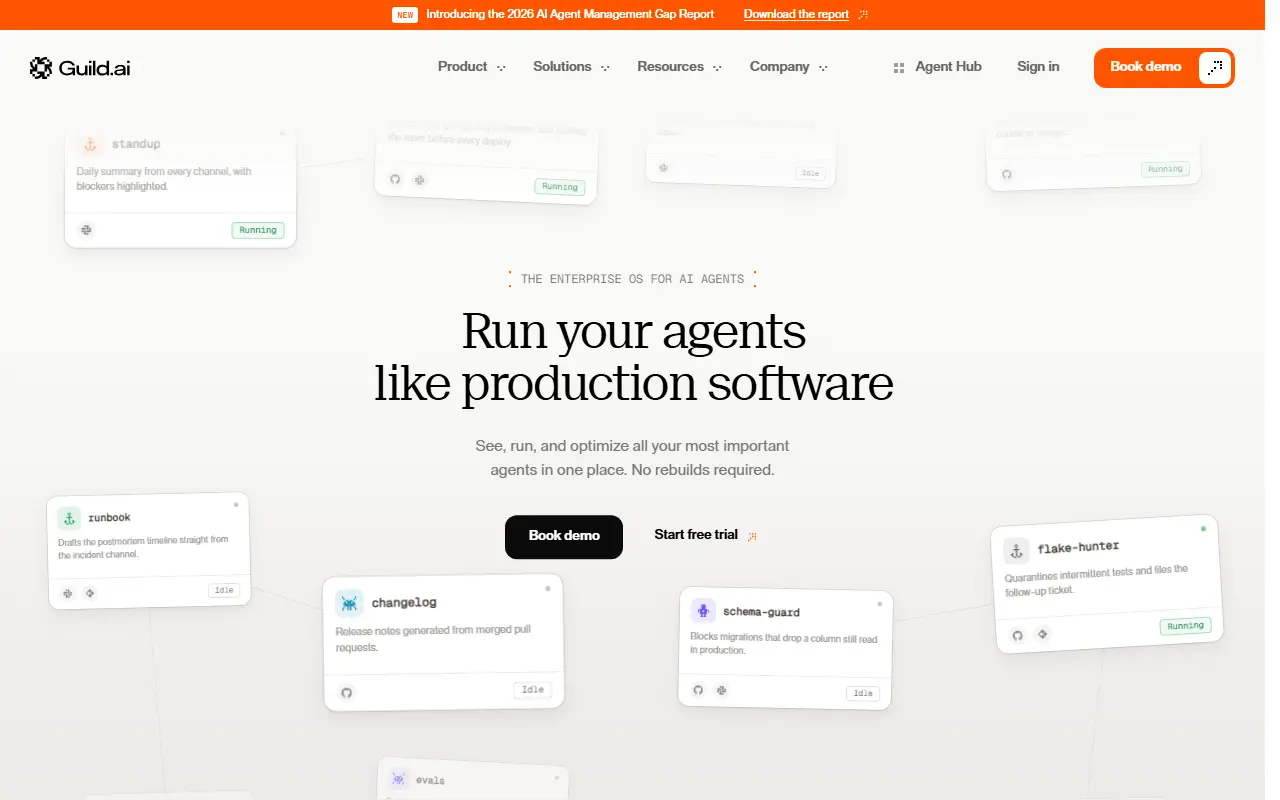
Guild is a control plane for AI agents that lets engineering teams manage, govern, and share every agent in production with security and observability. It provides a single place to see, run, and optimize agents without requiring rebuilds.
The platform addresses the problem of teams not knowing what agents are running, their costs, ownership, or failure behavior. It offers features for usage and spend tracking, agent cataloging, and secure connection management with scoped credentials and permissions.
Key features
- See usage and spend by agent, team, model, and provider with cost forecasting and budget setting
- Identify and catalog every agent across the organization regardless of where it was built or runs
- Control agent access with scoped credentials, permissions, policies, and human approval gates
- Run any agent on any model with a model-neutral platform that supports bring-your-own models and providers
- Deploy tracing and evaluations for monitoring, audit trails, and runtime understanding
- Optimizer finds cheaper models, leaner prompts, and unused tools, testing recommendations against evaluations
Good fit for
- Software Factory uses specialized agents to plan, build, test, and review bounded work, handing engineers a validated pull request
Guild: questions and answers
- What is Guild used for?
- Guild is a platform for engineering teams to run, monitor, and govern AI agents across an organization. It is a good fit for software Factory uses specialized agents to plan, build, test, and review bounded work, handing engineers a validated pull request.
- Is Guild open source?
- Yes. Guild is open source under the Apache-2.0 licence. Its source code is on GitHub at guildai/guildai and is written mainly in Python.
- Is Guild free?
- Yes. Guild is open source, so the software itself is free to use. A managed cloud version is also available.
- Can I self-host Guild?
- Yes. Guild can be self-hosted on your own server or infrastructure.
- What is Guild an alternative to?
- Guild is an open-source alternative to Weights & Biases and Comet. Other open-source alternatives to Weights & Biases include Dvc, MLflow and Opik.
- Is Guild actively maintained?
- The most recent commit to Guild was on 29 April 2025, and the latest release is 0.8.1, published on 11 May 2022. The project has 909 stars on GitHub.
Open-source alternatives to Guild
See all
Dvc
AI Tools
🦉 Data Versioning and ML Experiments
Apache-2.0vs Arize AI★ 16k
MLflow
AI Infrastructure
The open source AI engineering platform for agents, LLMs, and ML models. MLflow enables te
Apache-2.0vs Weights & Biases★ 29k
Opik
AI Infrastructure
Debug, evaluate, and monitor your LLM applications, RAG systems, and agentic workflows wit
Apache-2.0vs Weights & Biases★ 23k
Kubeflow
AI Tools
The Cloud Native AI Platform
Apache-2.0vs Together AI★ 16k
Polyaxon
Workflow Automation
AI Infra / AI Orchestration / AI Control Plane
Apache-2.0vs Amazon SageMaker★ 3.7k
labml
AI Infrastructure
🔎 Monitor deep learning model training and hardware usage from your mobile phone 📱
MITvs Weights & Biases★ 2.3k
SaaS alternatives to Guild
See all
Weights & Biases
AI Infrastructure
Experiment tracking, model registry and LLM evaluation for machine learning teams
SaaS
Comet
AI Infrastructure
Experiment tracking, model registry and LLM evaluation platform
SaaS
Artiforge
Developer Tools
Tool that gives AI coding agents project context to improve code generation
SaaS
Browserwire
Developer Tools
Developer API that gives AI agents and engineers structured, deterministic access to managed sandboxed browsers
SaaSCodeSandbox
Developer Tools
Cloud development environments and browser-based sandboxes for web projects
SaaS
Termi Protocol
Developer Tools
Control room that shows AI coding agents like Claude Code, Codex and Gemini working at desks in a 3D room
SaaS