 TrackMedia
 TrackRev

About labml
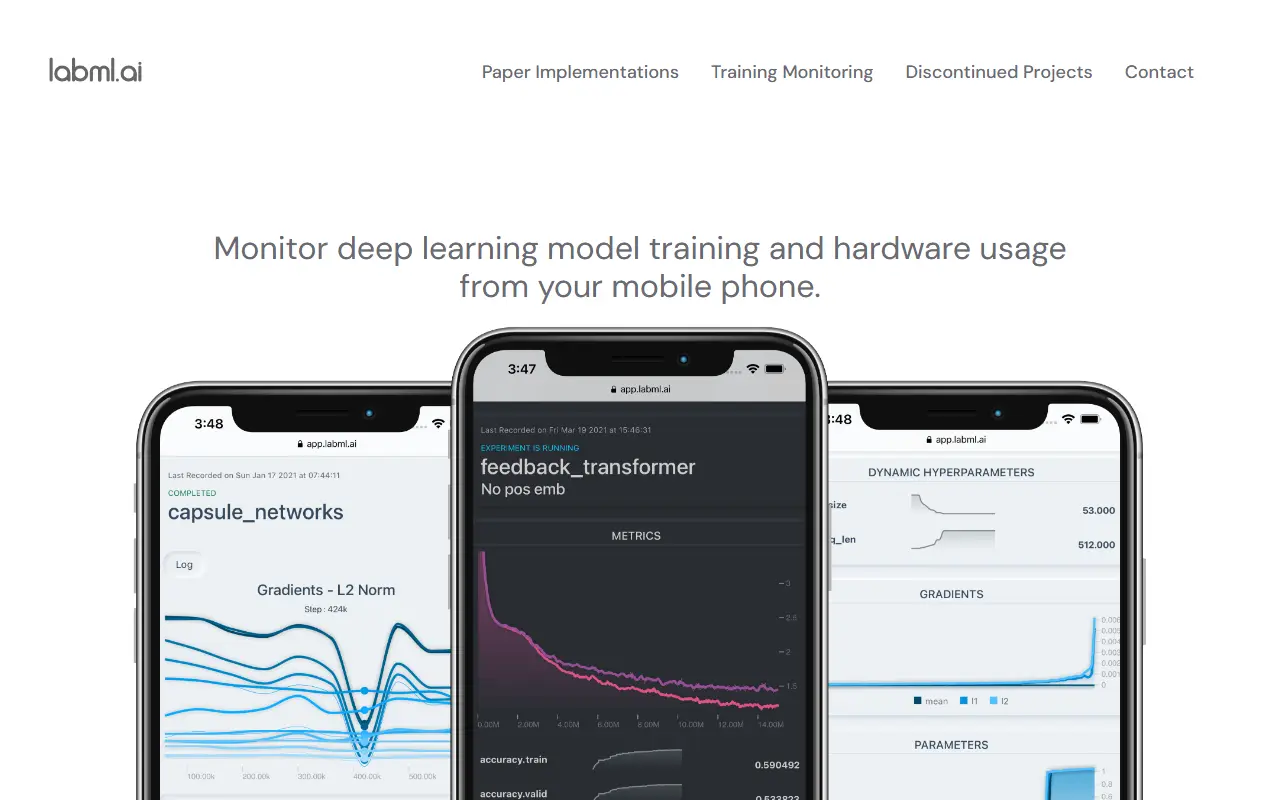
labml is an experiment-tracking and monitoring toolkit aimed at machine learning practitioners who want to check on long-running training jobs, including from their phone, without staying tied to a terminal or a single workstation. It integrates with common deep learning frameworks and tracks experiment metadata alongside training metrics.
With as little as two lines of code, it can track git commit information, configuration values and hyperparameters for an experiment, alongside the usual loss and metric curves, and it works with PyTorch, PyTorch Lightning, Keras, TensorFlow and fastai based on its listed topics. A single command also monitors hardware usage on any machine. An optional self-hosted experiments server, backed by MongoDB and optionally fronted by Nginx, provides the web interface for viewing experiments remotely, including from a mobile browser.
labml is written in Python and released under the MIT license. It is installed via pip, both for the monitoring client embedded in training scripts and for the self-hosted server component, and its documentation covers the Python API, custom visualizations and configuration management in more depth.
Key features
- Remote experiment and hardware monitoring
- Two-line integration into training scripts
- Tracks git commit, config and hyperparameters
- Works with PyTorch, Keras, TensorFlow and fastai
- Mobile-friendly web dashboard
- Self-hosted MongoDB-backed server
Good fit for
- Checking training progress from a phone
- Tracking experiment metadata across runs
labml: questions and answers
- What is labml used for?
- labml is a free, MIT-licensed open-source toolkit for monitoring deep learning training progress and hardware usage remotely, including from a mobile phone. It is a good fit for checking training progress from a phone and tracking experiment metadata across runs.
- Is labml open source?
- Yes. labml is open source under the MIT licence. Its source code is on GitHub at labmlai/labml and is written mainly in Python.
- Is labml free?
- Yes. labml is open source, so the software itself is free to use.
- What is labml an alternative to?
- labml is an open-source alternative to Weights & Biases, Comet and Valohai. Other open-source alternatives to Weights & Biases include MLflow, Kubeflow and Polyaxon.
- Is labml actively maintained?
- The most recent commit to labml was on 10 April 2025, and the latest release is v0.4.132, published on 27 August 2021. The project has 2.3k stars on GitHub, with 1 added in the last 30 days.
Open-source alternatives to labml
See all
MLflow
AI Infrastructure
The open source AI engineering platform for agents, LLMs, and ML models. MLflow enables te
Apache-2.0vs Weights & Biases★ 29k
Kubeflow
AI Tools
The Cloud Native AI Platform
Apache-2.0vs Together AI★ 16k
Polyaxon
Workflow Automation
AI Infra / AI Orchestration / AI Control Plane
Apache-2.0vs Amazon SageMaker★ 3.7k
Dvc
AI Tools
🦉 Data Versioning and ML Experiments
Apache-2.0vs Arize AI★ 16k
Opik
AI Infrastructure
Debug, evaluate, and monitor your LLM applications, RAG systems, and agentic workflows wit
Apache-2.0vs Weights & Biases★ 23k
Pachyderm
Data Pipelines & ETL
Data-Centric Pipelines and Data Versioning
Apache-2.0vs Databricks★ 6.3k
SaaS alternatives to labml
See all
Weights & Biases
AI Infrastructure
Experiment tracking, model registry and LLM evaluation for machine learning teams
SaaS
Comet
AI Infrastructure
Experiment tracking, model registry and LLM evaluation platform
SaaS
Valohai
AI Infrastructure
MLOps platform for automating machine learning pipelines and experiment tracking
SaaS
Arize AI
AI Infrastructure
Observability and evaluation platform for machine learning models and LLM applications
SaaS
H2O.ai
AI Infrastructure
AI platform for predictive and generative AI model building and deployment
SaaS
NVIDIA AI Enterprise
AI Infrastructure
Software suite of NIM microservices, frameworks and tools for running production AI
SaaS