8 open-source alternatives ranked by real activity

Open-source Valohai alternatives

A curated, ranked list of the 8 best open-source alternatives to Valohai.

The best open-source alternative to Valohai is MLflow. If that doesn't suit you, other good options are Dvc, Flyte, Kubeflow and CML.

Commercial alternatives to Valohai include Comet, H2O.ai, NVIDIA AI Enterprise and Domino Data Lab. See all 10.

Valohai alternatives are mainly AI tools, but some are also AI infrastructure tools and CI/CD & DevOps tools. 5 of them shipped code in the last 30 days, 8 can be self-hosted, and 8 use a permissive licence.

Last updated November 13, 2026 · ranked by GitHub stars, growth and recent commits

MLflow

MLflow is an open-source platform for debugging, evaluating and monitoring AI agents, LLM applications and machine learning models.

GitHub stars
29k
Last commit
yesterday
Latest release
v3.18.0
Licence
Apache-2.0
Self-hosted
Yes
Hosted version
Available
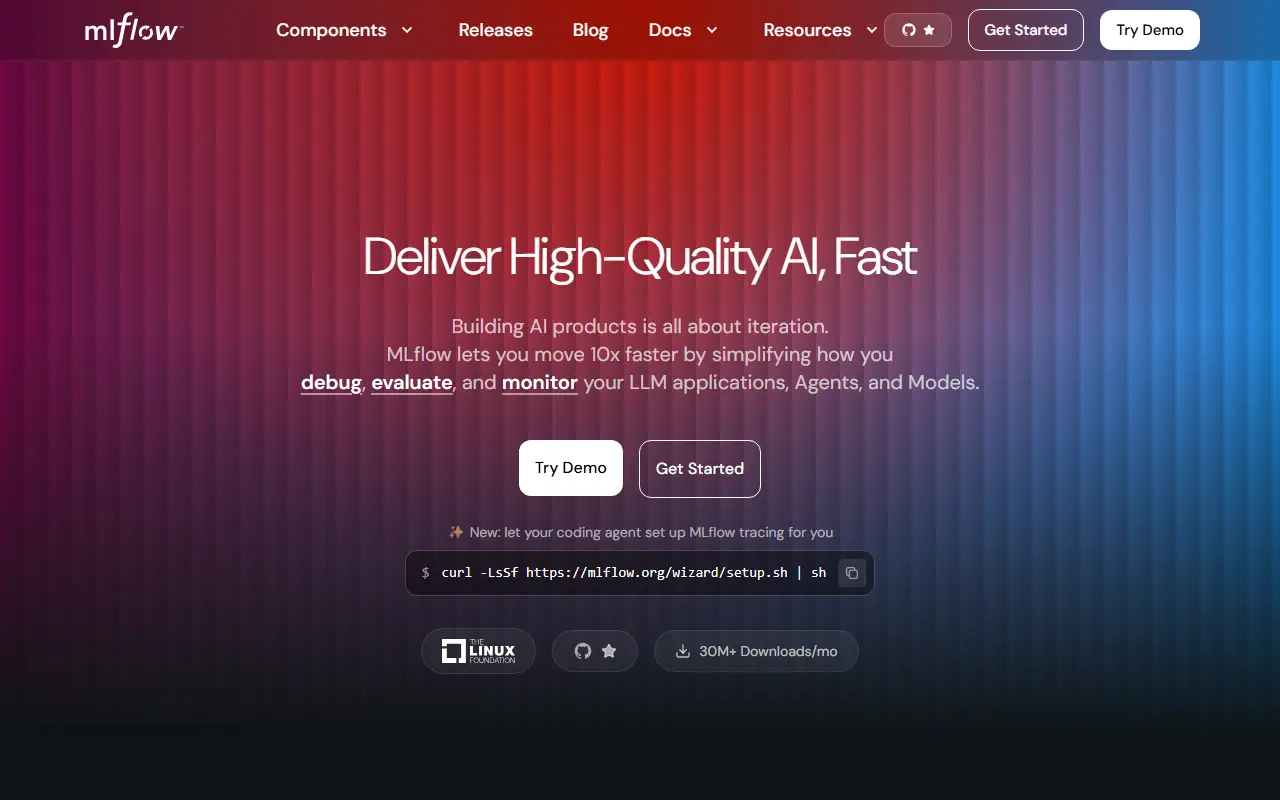
mlflow.orgMLflow homepage screenshot

MLflow is an open-source AI engineering platform for agents, LLM applications and ML models. It helps teams debug, evaluate, monitor and optimize AI applications in production while keeping control of costs and access to models and data. It is written in Python, released under the Apache-2.0 license, and has been developed since 2018, with topics covering MLOps, model management and LLMOps.

For LLM and agent work it offers production observability with traces, plus evaluation, prompt management and prompt optimization, and an AI Gateway that governs costs and model access. It works with Python, TypeScript and JavaScript, Java and other languages, and integrates with OpenTelemetry and MCP. Getting started means starting an MLflow server, enabling logging in your code and running it, then exploring traces and metrics in the web UI on port 5000. A setup wizard can connect to an MLflow server or a Databricks workspace and add tracing with a coding agent.

Key features

  • Tracing and observability for LLM apps and agents
  • Evaluation tools for models and agents
  • Prompt management and prompt optimization
  • AI Gateway for cost and model access control
  • OpenTelemetry and MCP integration
  • Web UI for exploring traces and metrics

Pricing: Free and open source under the Apache-2.0 license; the README also mentions connecting to a Databricks workspace.

Dvc

DVC is an open-source version control system for data science and machine learning projects that applies software engineering best practices to data management.

GitHub stars
16k
Last commit
4 days ago
Latest release
3.67.1
Licence
Apache-2.0
dvc.orgDvc homepage screenshot

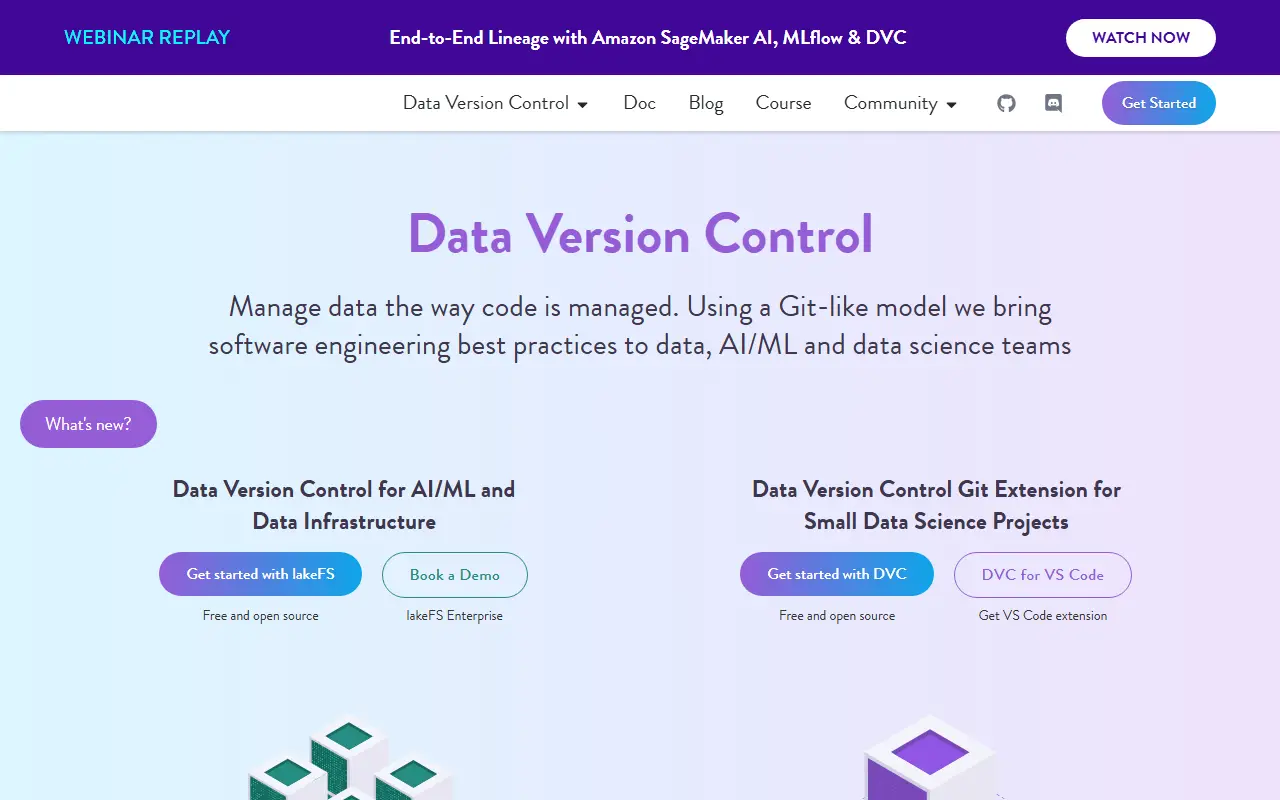
DVC is a free and open-source version control system designed for data science and machine learning projects. It uses a Git-like model to manage data, models, and experiments, bringing software engineering best practices to data teams.

The tool is intended for individual data scientists working on small projects, offering a Git extension that integrates with existing workflows. It also provides a VS Code extension for easier use.

Key features

  • Data version control using a Git-like model
  • Management of data, models, and experiments
  • Integration with Git for local workflows
  • VS Code extension available
Read more about DvcWebsiteGitHub#2 Valohai alternative

Flyte

Flyte is a durable AI runtime that orchestrates training, serving, and agent workloads with automatic failure recovery.

GitHub stars
7.8k
Last commit
yesterday
Latest release
v2.0.54
Licence
Apache-2.0
Self-hosted
Yes
Hosted version
Available
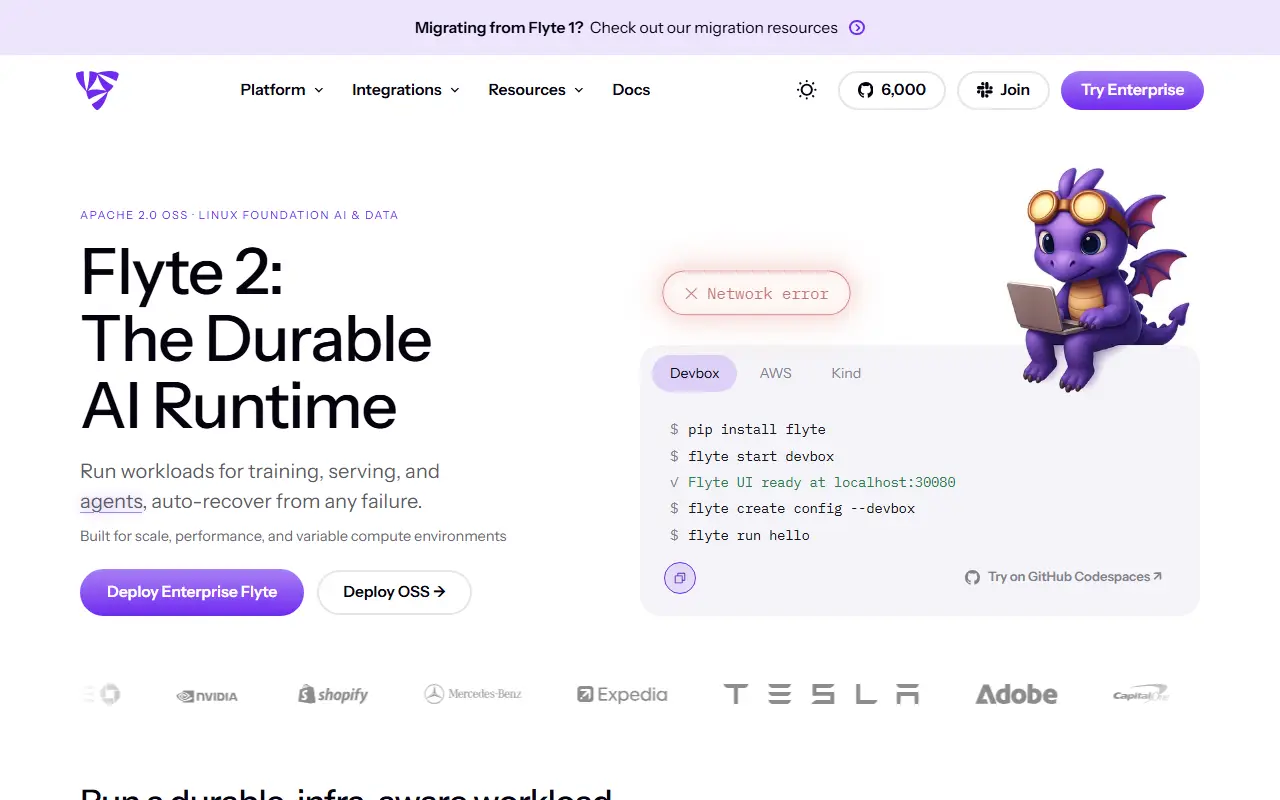
flyte.orgFlyte homepage screenshot

Flyte is a distributed orchestration platform for AI workloads, including training, serving, and agents. It runs on Kubernetes and supports writing workflows in pure Python with async/await, as well as other languages like Rust, Go, and TypeScript. The platform is designed to recover from infrastructure and code failures automatically.

Workflows are defined as plain async functions without DSL or YAML. A TaskEnvironment declares images, resources, secrets, and retry policies. The runtime records I/O for every step so that a crash resumes instead of restarting. The same code can run locally, on a devbox, or on a cluster.

Key features

  • Type-checked I/O between tasks using language-native types, files, DataFrames, and dataclasses
  • Native agents that wrap tools as tasks with traced LLM calls
  • Automatic recovery from API rate limits, network errors, OOM kills, node interruptions, GPU disappears, and code exceptions
  • Supports batch inference, fine-tuning, pretraining, and RL agent loops
  • Real-time model endpoints and dashboards served with the same Python API

Kubeflow

Kubeflow is an open source platform for deploying ML workflows on Kubernetes.

GitHub stars
16k
Last commit
1 mo ago
Latest release
redirect
Licence
Apache-2.0
Self-hosted
Yes
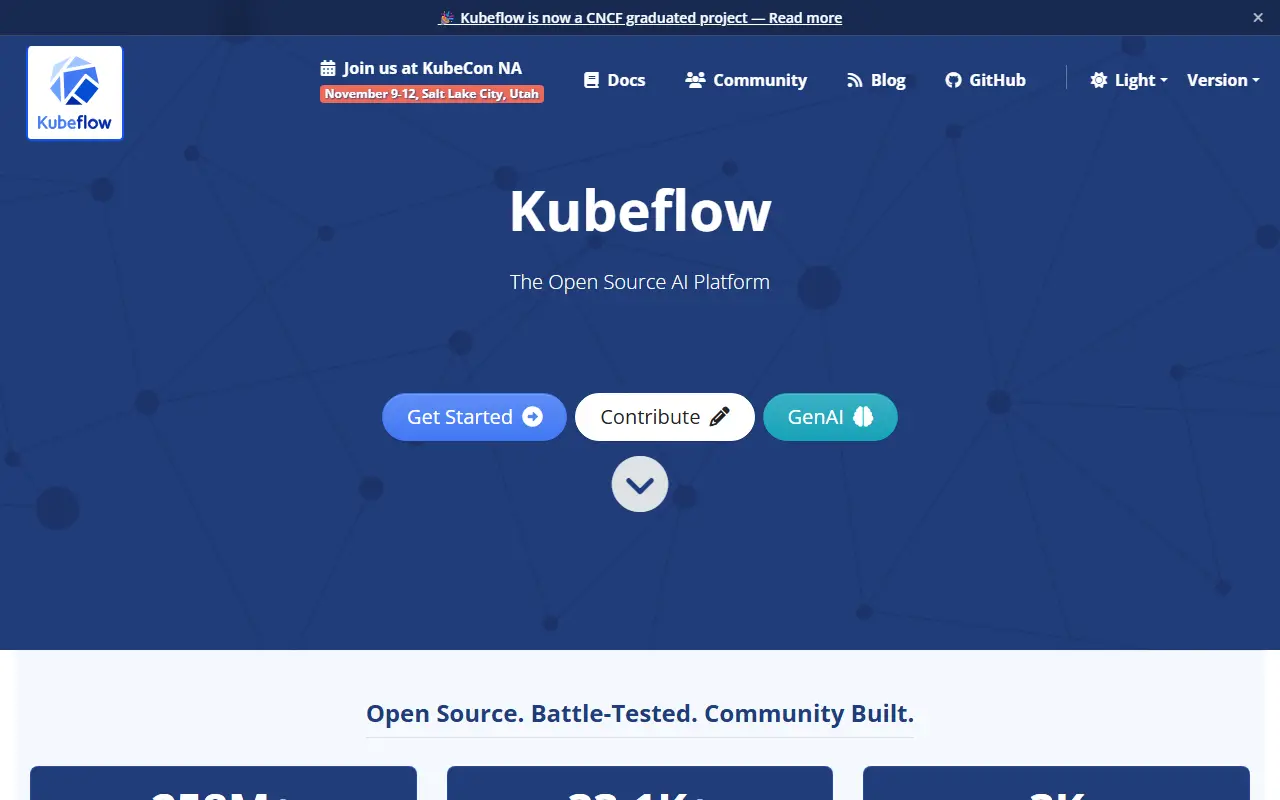
kubeflow.orgKubeflow homepage screenshot

Kubeflow is the Cloud Native AI platform composed of modular, open source projects that form a Kubernetes-native stack for data and AI workloads. It is designed for AI practitioners, platform administrators, and decision-makers who need modular, scalable, and extensible tools for data, AI/ML, and HPC use-cases.

The platform's mission is to bridge the Data, AI, and Cloud Native ecosystems, enabling teams to deliver more models, agents, and AI applications into production across the AI lifecycle. It is built by an open global community and aims to be the standard for Data & AI workloads on Kubernetes.

Key features

  • Runs workloads at any scale without requiring Kubernetes expertise
  • Portable across local laptops, on-premises, and any cloud
  • Manages hyperscale training jobs and high-throughput AI agents
  • Composable tools that can be mixed and matched across the AI lifecycle
  • Includes subprojects: Spark Operator, Notebooks, Trainer, Katib, and Hub

CML

CML (Continuous Machine Learning) is a free, Apache-licensed CLI tool that brings CI/CD practices to machine learning, automating training, evaluation and reporting.

GitHub stars
4.2k
Last commit
22 days ago
Latest release
v0.20.6
Licence
Apache-2.0
Self-hosted
Yes
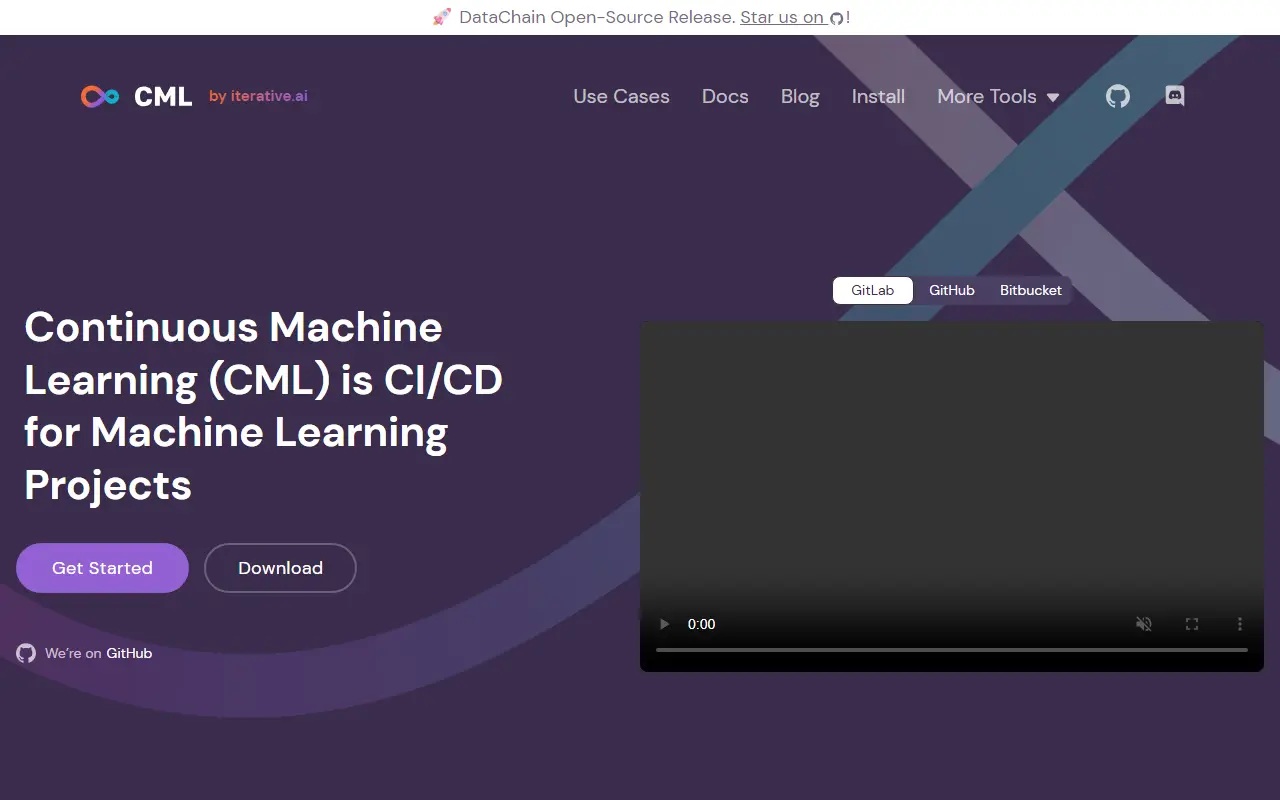
cml.devCML homepage screenshot

CML, or Continuous Machine Learning, is an open-source command-line tool for applying CI/CD practices to machine learning work, with a focus on MLOps. It is aimed at data science teams who want to automate workflows such as provisioning machines, training and evaluating models, and comparing experiments across a project's history, using the Git-based tools they already rely on.

It can train and evaluate models automatically on every pull request and generate a visual report of results and metrics directly in that pull request, following a 'GitFlow for data science' approach where GitLab, GitHub or Bitbucket track who changed models or data and when, often paired with DVC to version data and models outside of Git itself. CML needs no additional backend services, databases, or complex setup, working on top of existing GitHub Actions, GitLab CI or Bitbucket Pipelines infrastructure with either self-hosted or cloud runners such as AWS EC2 or Azure.

CML is written in JavaScript and released under the Apache-2.0 license. The project provides a Discord community and a YouTube tutorial series for hands-on MLOps guidance, alongside documentation covering setup for each supported Git platform.

Key features

  • Automated model training and evaluation in CI
  • Auto-generated pull request reports with metrics
  • Works with GitHub Actions, GitLab CI, Bitbucket Pipelines
  • Integrates with DVC for data and model versioning
  • No extra databases or backend services needed
  • Self-hosted or cloud runner support

Pricing: Free and open source under the Apache-2.0 license; it runs on your existing GitHub, GitLab or Bitbucket CI infrastructure.

Read more about CMLWebsiteGitHub#5 Valohai alternative

Polyaxon

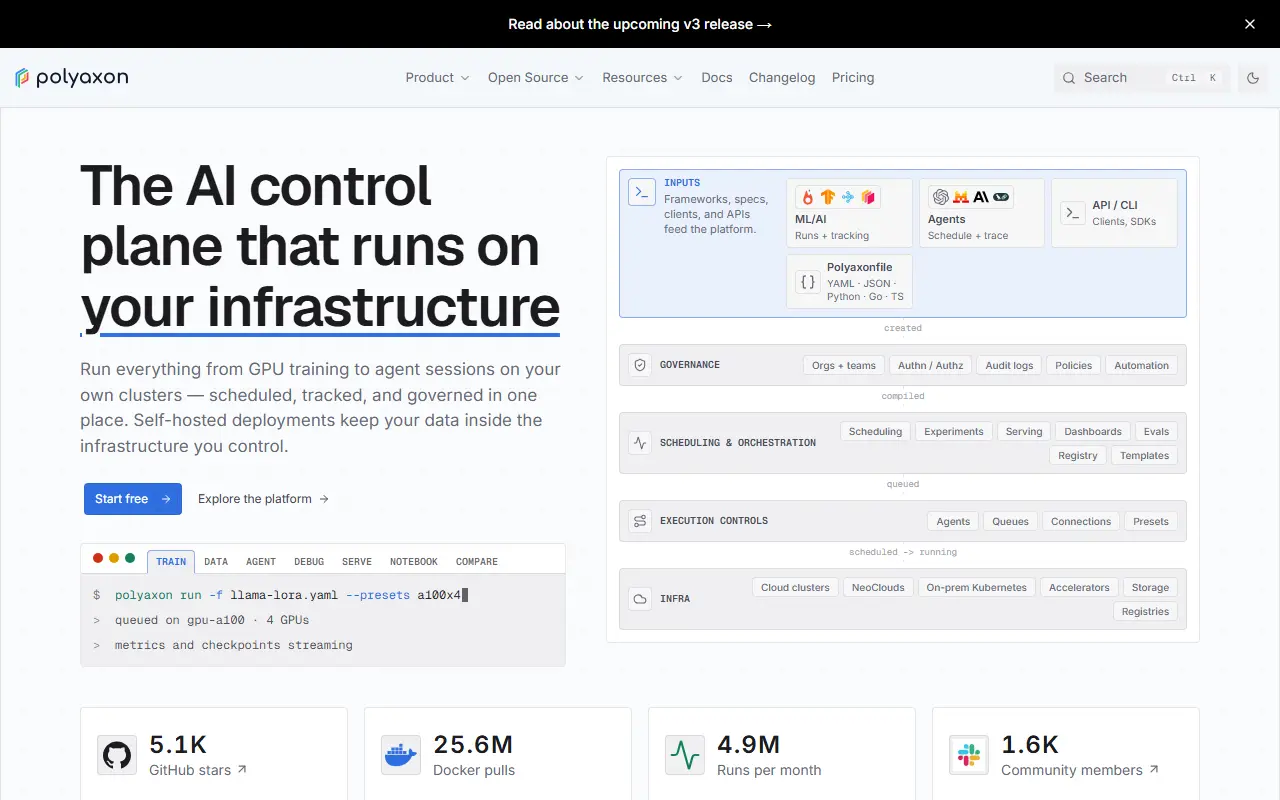
Polyaxon is an open-source AI control plane for Kubernetes that schedules, runs, debugs, observes, and automates AI/ML workloads, agents, and sandboxes on your own infrastructure.

GitHub stars
3.7k
Last commit
yesterday
Licence
Apache-2.0
Self-hosted
Yes
polyaxon.comPolyaxon homepage screenshot

Polyaxon is an open-source AI control plane designed to run on Kubernetes. It enables scheduling, tracking, and governance of AI/ML workloads, including GPU training, agent sessions, and sandboxes, all within self-hosted deployments. The platform supports training, services, and sandboxes using shared specs, queues, governance, and data connections.

It provides a unified interface for training and fine-tuning models, serving inference, running notebooks, and managing interactive sessions. Polyaxon integrates with various frameworks, clients, and APIs, and offers governance features such as organizations, teams, authentication, audit logs, and policies. It is suitable for teams that need to manage AI workloads on their own clusters and storage backends.

Key features

  • Scheduling and orchestration of runs, experiments, and batch jobs
  • Training and fine-tuning with support for LoRA and SFT
  • Services for serving, inference, notebooks, TensorBoard, and ML apps
  • Sandboxes with SSH, tmux, interactive, and background modes
  • Governance with organizations, teams, authn/authz, audit logs, and policies
  • Execution controls via agents, queues, connections, and presets

Pachyderm

Pachyderm is an open-source data pipeline and data versioning system on Kubernetes that tracks lineage and reruns pipelines when data changes.

GitHub stars
6.3k
Last commit
1 yr ago
Latest release
v2.12.2
Licence
Apache-2.0
Self-hosted
Yes

Pachyderm automates data transformations by combining pipelines with data versioning and lineage. Its pipelines are multi-stage and language-agnostic, process data in parallel, and work on any type of data.

Pipelines are data-driven: they trigger automatically when changes in the data are detected. Every change is versioned, giving an immutable record of where data came from. Storage uses standard object stores with automatic deduplication, and autoscaling and parallel processing are built on Kubernetes.

It runs across the major cloud providers and on-premises. The README suggests running it locally or deploying to AWS, GCE or Azure in about five minutes. The code is Go under Apache 2.0, and contributors sign a Contributor License Agreement. The project sends anonymised usage metrics by default.

Key features

  • Pipelines trigger automatically on data changes
  • Immutable lineage and versioning for any data type
  • Autoscaling and parallel processing on Kubernetes
  • Stores data in standard object stores with deduplication
  • Runs on major clouds and on-premises
  • Multi-stage, language-agnostic pipelines

labml

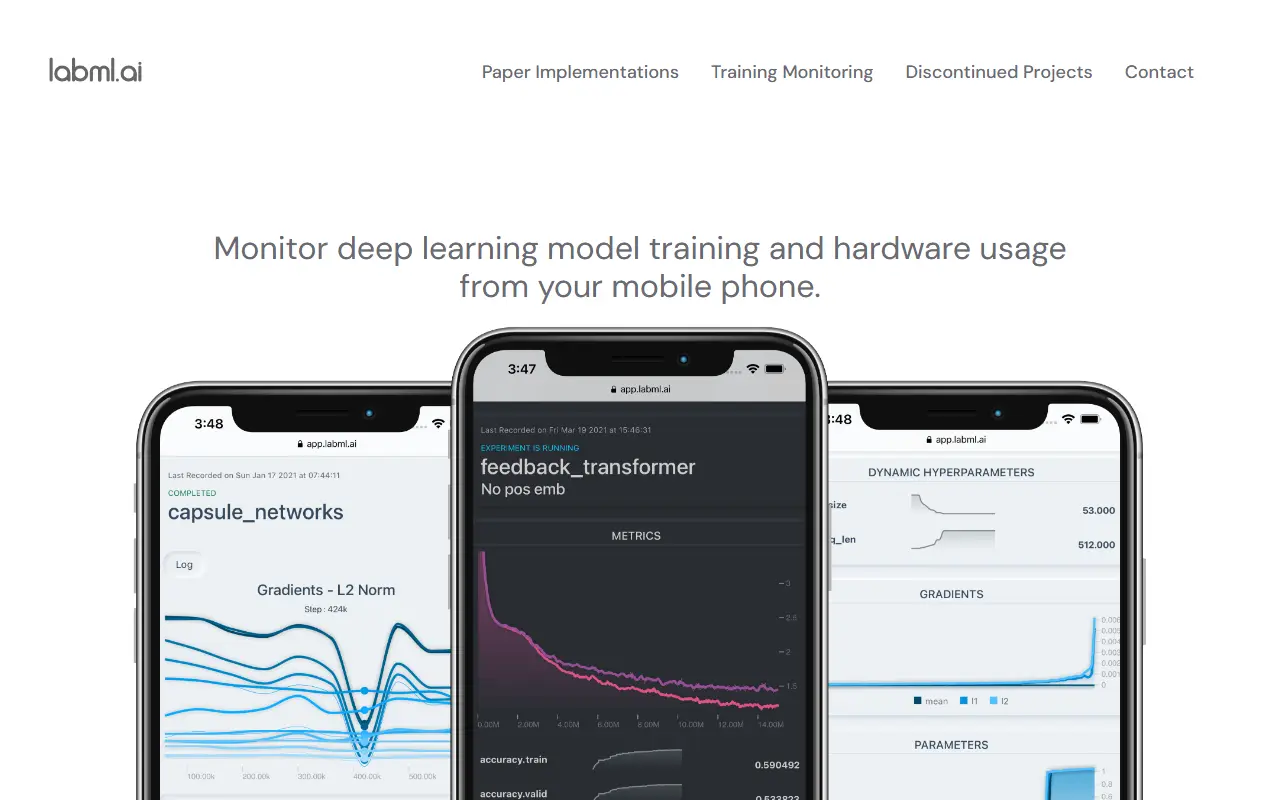
labml is a free, MIT-licensed open-source toolkit for monitoring deep learning training progress and hardware usage remotely, including from a mobile phone.

GitHub stars
2.3k
Last commit
1 yr ago
Latest release
v0.4.132
Licence
MIT
Self-hosted
Yes
labml.ailabml homepage screenshot

labml is an experiment-tracking and monitoring toolkit aimed at machine learning practitioners who want to check on long-running training jobs, including from their phone, without staying tied to a terminal or a single workstation. It integrates with common deep learning frameworks and tracks experiment metadata alongside training metrics.

With as little as two lines of code, it can track git commit information, configuration values and hyperparameters for an experiment, alongside the usual loss and metric curves, and it works with PyTorch, PyTorch Lightning, Keras, TensorFlow and fastai based on its listed topics. A single command also monitors hardware usage on any machine. An optional self-hosted experiments server, backed by MongoDB and optionally fronted by Nginx, provides the web interface for viewing experiments remotely, including from a mobile browser.

labml is written in Python and released under the MIT license. It is installed via pip, both for the monitoring client embedded in training scripts and for the self-hosted server component, and its documentation covers the Python API, custom visualizations and configuration management in more depth.

Key features

  • Remote experiment and hardware monitoring
  • Two-line integration into training scripts
  • Tracks git commit, config and hyperparameters
  • Works with PyTorch, Keras, TensorFlow and fastai
  • Mobile-friendly web dashboard
  • Self-hosted MongoDB-backed server

Pricing: Free and open source under the MIT license.

Commercial Valohai alternatives

Hosted, closed-source products that compete with Valohai.

Valohai alternatives: questions

What is the best open-source alternative to Valohai?
MLflow is the top-ranked open-source alternative to Valohai on Enlisted: MLflow is an open-source platform for debugging, evaluating and monitoring AI agents, LLM applications and machine learning models. Other strong options are Dvc, Flyte, Kubeflow and CML.
What are the best commercial alternatives to Valohai?
Comet, H2O.ai, NVIDIA AI Enterprise, Domino Data Lab and Azure Machine Learning are among the hosted, closed-source alternatives to Valohai listed on Enlisted, which lists 10 in total. Compare their pricing and features on each tool page.
Are these Valohai alternatives free?
All 8 are open source, so the code is free to use under its licence, and all of them can be self-hosted on your own server or computer. 2 also offer a paid or managed cloud version if you'd rather not host it yourself.
How is this list of Valohai alternatives ranked?
By a score built from GitHub stars, star growth over the last 30 days and how recently the code changed. 5 of these projects shipped code in the last 30 days. Data is refreshed daily, and nobody can pay to move up.

People also look for alternatives to…

View all