7,363 open-source and SaaS tools, with GitHub stats refreshed every day.

5 alternatives ranked by real activity

Open-source Comet alternatives

A curated, ranked list of the 5 best open-source alternatives to Comet.

The best open-source alternative to Comet is MLflow. If that doesn't suit you, other good options are Opik, BrowserOS, Browser Operator and labml.

Comet alternatives are mainly AI infrastructure tools, but some are also AI tools. 3 of them shipped code in the last 30 days, 5 can be self-hosted, and 4 use a permissive licence.

Last updated October 3, 2026 · ranked by GitHub stars, growth and recent commits

MLflow

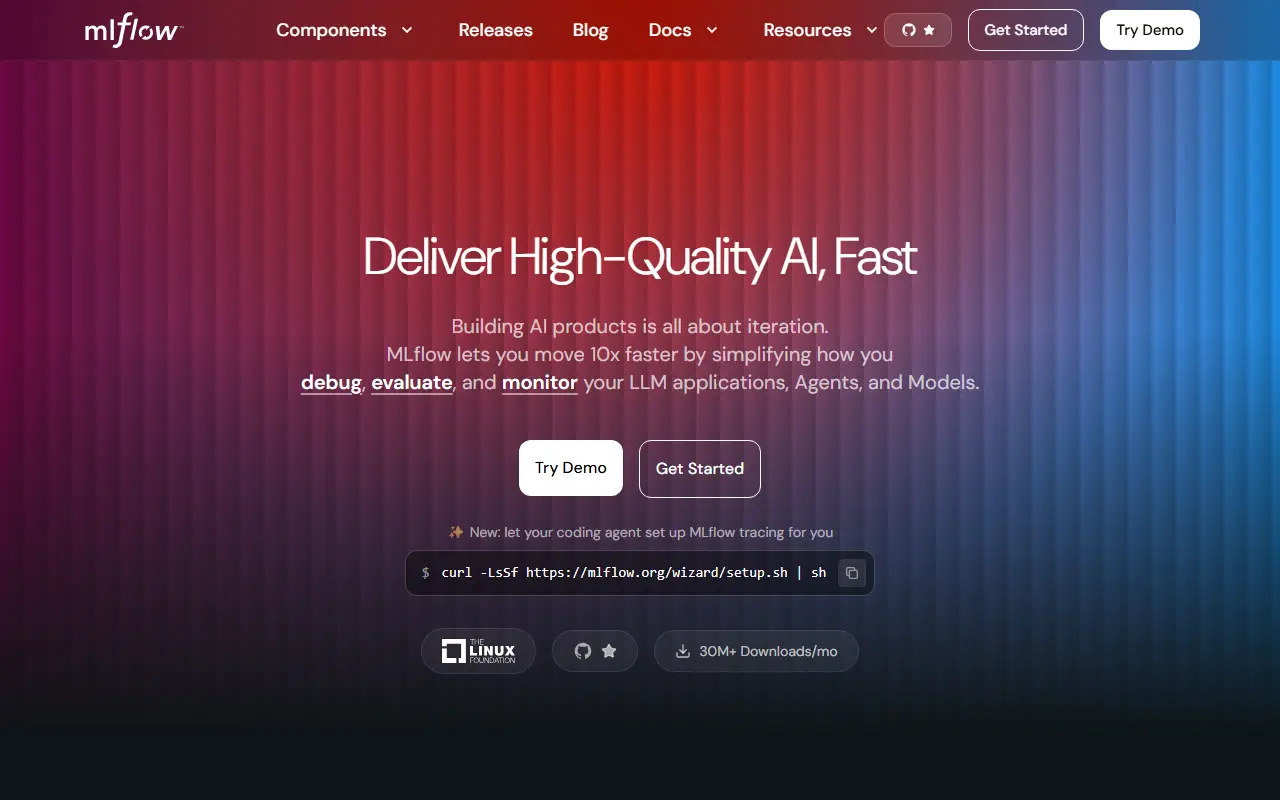
MLflow is an open-source platform for debugging, evaluating and monitoring AI agents, LLM applications and machine learning models.

GitHub stars
28k
Last commit
today
Latest release
v3.16.1
Licence
Apache-2.0
Self-hosted
Yes
Hosted version
Available
mlflow.orgMLflow homepage screenshot

MLflow is an open-source AI engineering platform for agents, LLM applications and ML models. It helps teams debug, evaluate, monitor and optimize AI applications in production while keeping control of costs and access to models and data. It is written in Python, released under the Apache-2.0 license, and has been developed since 2018, with topics covering MLOps, model management and LLMOps.

For LLM and agent work it offers production observability with traces, plus evaluation, prompt management and prompt optimization, and an AI Gateway that governs costs and model access. It works with Python, TypeScript and JavaScript, Java and other languages, and integrates with OpenTelemetry and MCP. Getting started means starting an MLflow server, enabling logging in your code and running it, then exploring traces and metrics in the web UI on port 5000. A setup wizard can connect to an MLflow server or a Databricks workspace and add tracing with a coding agent.

Key features

  • Tracing and observability for LLM apps and agents
  • Evaluation tools for models and agents
  • Prompt management and prompt optimization
  • AI Gateway for cost and model access control
  • OpenTelemetry and MCP integration
  • Web UI for exploring traces and metrics

Pricing: Free and open source under the Apache-2.0 license; the README also mentions connecting to a Databricks workspace.

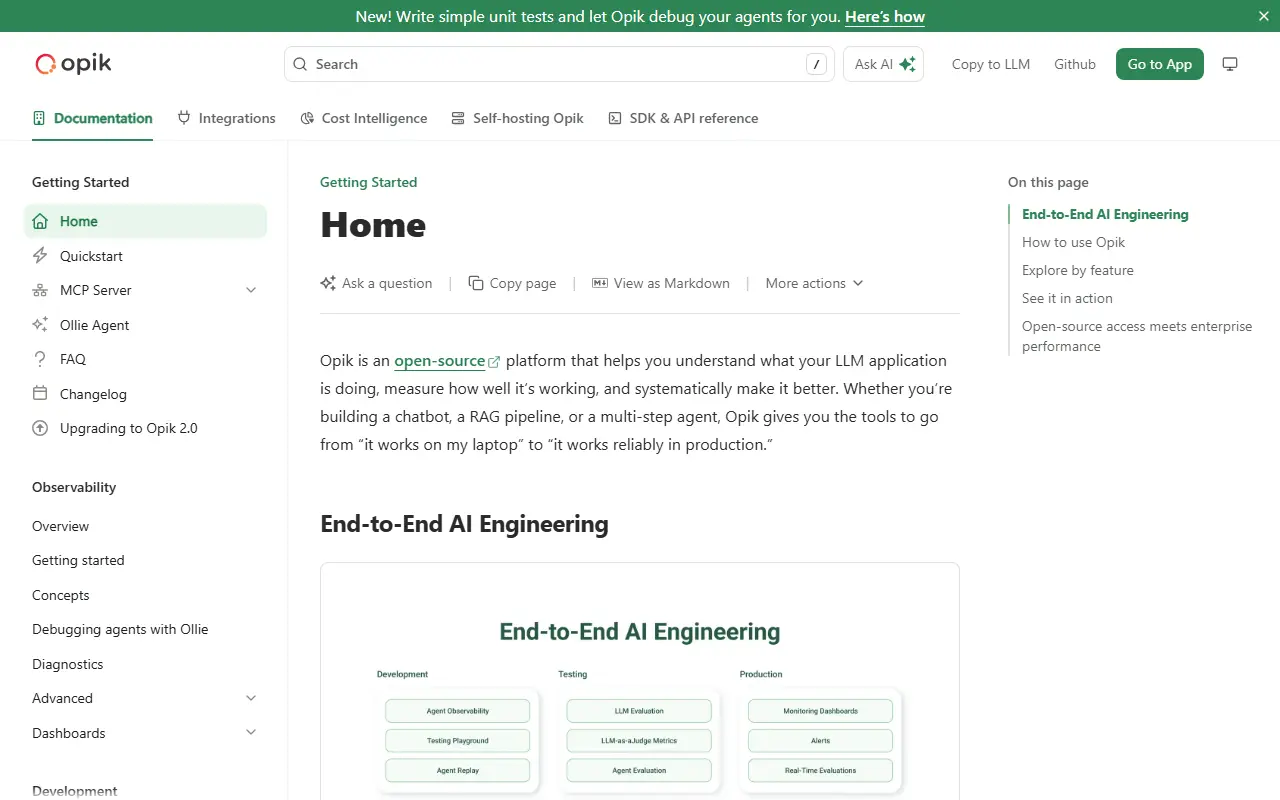
Opik

Opik is an open-source platform from Comet for tracing, evaluating and monitoring LLM applications, RAG systems and AI agents.

GitHub stars
22k
Last commit
today
Latest release
2.2.88
Licence
Apache-2.0
Self-hosted
Yes
Hosted version
Available
comet.comOpik homepage screenshot

Opik is an open-source LLM observability and evaluation platform built by Comet. It covers the application lifecycle starting with early traces during development and ending with production monitoring, for teams that build LLM apps and AI agents. The code is Python, licensed under Apache-2.0, and the README says the full platform is free to self-host. The project documentation lives on the Comet site.

Capabilities include deep tracing of LLM calls and agent activity including complete trace trees for agents with several steps and tool calls, and evaluation with datasets, experiments and LLM-as-a-judge metrics for tasks like hallucination detection, moderation and RAG assessment. An Agent Optimizer SDK improves prompts and agents, dashboards and online evaluation rules support production monitoring, guardrails help with safe AI practices, and a PyTest integration tests LLM pipelines on each commit. Integrations include frameworks such as LangChain, LlamaIndex and OpenAI clients.

Key features

  • Tracing for LLM calls and agent steps
  • Datasets and experiments for evaluation
  • Evaluation metrics using LLM-as-a-judge
  • Prompt and agent optimization SDK
  • Production dashboards and online evaluation
  • PyTest integration for CI checks

Pricing: Free to self-host, with a free hosted tier of 25k spans. Pro includes 100k spans with extra spans at $5 per 100k; Enterprise is custom.

BrowserOS

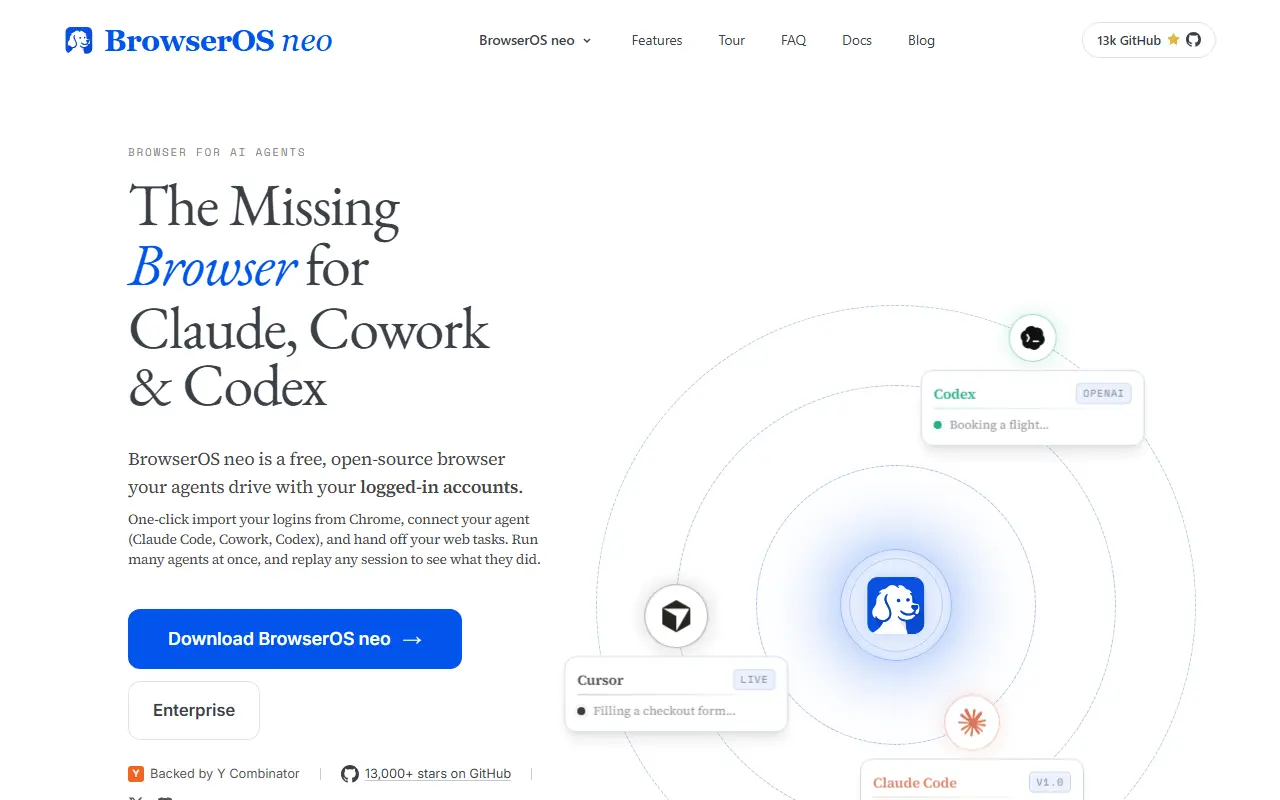
An open-source, Chromium-based browser built for AI agents, letting tools like Claude Code and Codex run web tasks in parallel with your logged-in accounts on your own machine.

GitHub stars
14k
Last commit
yesterday
Latest release
v0.50.5
Licence
AGPL-3.0
Self-hosted
Yes
browseros.comBrowserOS homepage screenshot

BrowserOS is an open-source browser designed to be used by AI agents. It is positioned as a secondary browser that sits alongside Chrome rather than replacing it, giving agents a place to carry out web tasks while you keep browsing normally. The project presents itself as an alternative to AI browsers such as ChatGPT Atlas, Perplexity Comet and Dia.

You can import logins, bookmarks and extensions from Chrome in one click so agents work with your real accounts, then connect agents such as Claude Code, Codex, Cursor or VS Code, which BrowserOS detects on your machine. Agents run in parallel in their own tabs. A live dashboard on the new tab page shows which site each agent is on, and every session is saved as a replayable video with a step-by-step action timeline.

Everything runs locally on your machine and the project is free under the AGPL-3.0 licence. Its topics point to local model tooling such as Ollama and LM Studio and it exposes tools through the Model Context Protocol. Typical tasks include posting to social media, clearing an inbox, updating a CRM or filing expenses. An enterprise offering is linked from the repository.

Key features

  • Chromium-based browser for AI agents
  • One-click import of Chrome logins and extensions
  • Auto-connects to Claude Code, Codex and Cursor
  • Parallel agents in separate tabs
  • Live dashboard of running agent tasks
  • Replayable session recordings with action timeline
  • Runs locally with MCP tools

Pricing: Free and open source under AGPL-3.0; the project also links to an Enterprise offering.

Browser Operator

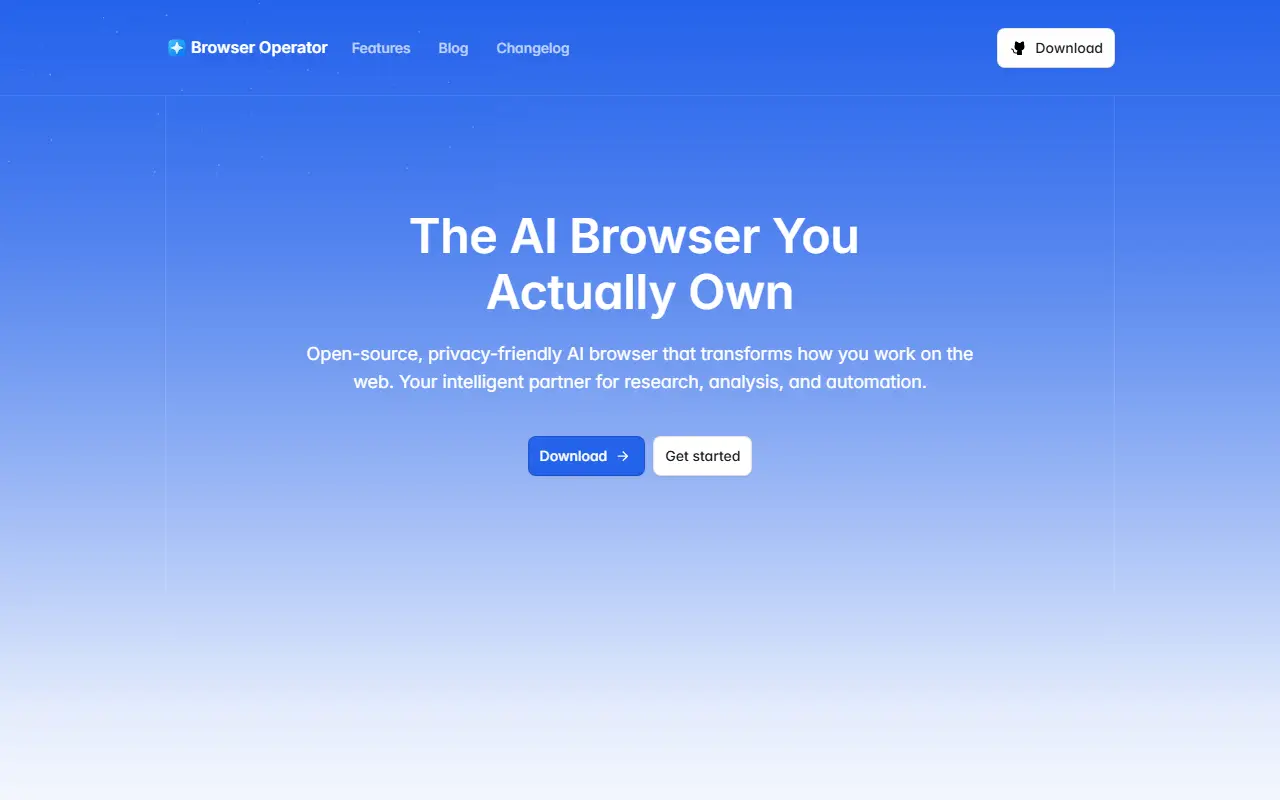
Browser Operator is an open-source, privacy-focused AI browser with a multi-agent platform that automates web research and tasks using cloud or local models.

GitHub stars
508
Last commit
6 mo ago
Latest release
v0.6.0
Licence
BSD-3-Clause
browseroperator.ioBrowser Operator homepage screenshot

Browser Operator is an open-source AI browser that runs agents on the web on your behalf. It is a desktop application for macOS and Windows built to support research, analysis and automation, with processing done locally on your machine. The project describes itself as an open alternative to AI browsers such as ChatGPT Atlas, Perplexity Comet, Dia and the Microsoft Copilot Edge browser.

Its multi-agent platform uses specialized agents that work together on complex web tasks. You choose an AI provider in the settings, including OpenRouter, OpenAI, Groq or LiteLLM, and local models through Ollama allow fully offline operation. Through LiteLLM it is compatible with more than 100 models from OpenAI, Claude, Gemini, Llama and others. The repository topics also mention MCP client support and LangGraph.

Listed use cases include literature reviews and market research, shopping comparison and price monitoring, and business automation such as talent sourcing, lead generation and compliance audits. The system requirements list macOS 10.15 or Windows 10 (64-bit), 8 GB of RAM and 2 GB of free disk space. It is released under the BSD-3-Clause license.

Key features

  • Multi-agent automation for web tasks
  • Privacy-first local processing
  • Works with OpenRouter, OpenAI, Groq and LiteLLM
  • Offline operation with local Ollama models
  • Desktop builds for macOS and Windows
  • MCP client support

Pricing: Free and open source under the BSD-3-Clause license; cloud AI providers bill separately, while local models need no provider account.

labml

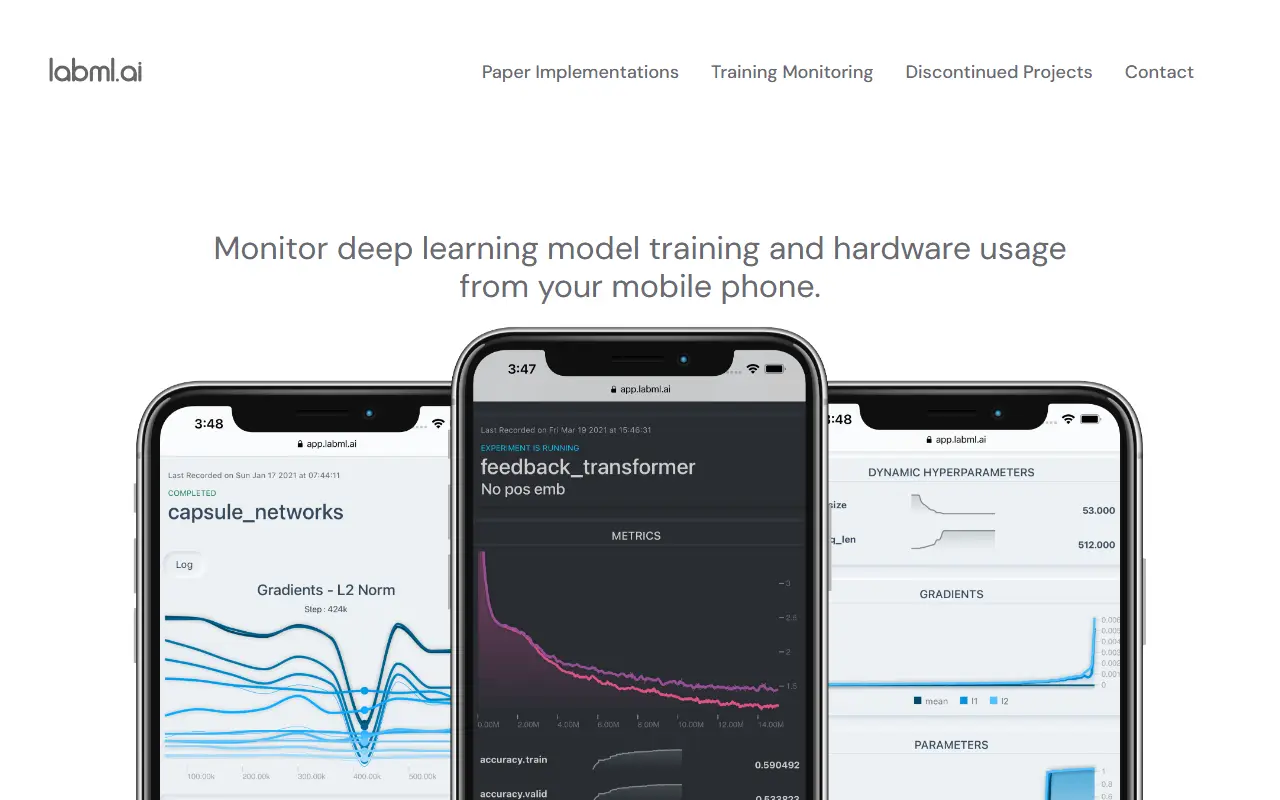
labml is a free, MIT-licensed open-source toolkit for monitoring deep learning training progress and hardware usage remotely, including from a mobile phone.

GitHub stars
2.3k
Last commit
1 yr ago
Latest release
v0.4.132
Licence
MIT
Self-hosted
Yes
labml.ailabml homepage screenshot

labml is an experiment-tracking and monitoring toolkit aimed at machine learning practitioners who want to check on long-running training jobs, including from their phone, without staying tied to a terminal or a single workstation. It integrates with common deep learning frameworks and tracks experiment metadata alongside training metrics.

With as little as two lines of code, it can track git commit information, configuration values and hyperparameters for an experiment, alongside the usual loss and metric curves, and it works with PyTorch, PyTorch Lightning, Keras, TensorFlow and fastai based on its listed topics. A single command also monitors hardware usage on any machine. An optional self-hosted experiments server, backed by MongoDB and optionally fronted by Nginx, provides the web interface for viewing experiments remotely, including from a mobile browser.

labml is written in Python and released under the MIT license. It is installed via pip, both for the monitoring client embedded in training scripts and for the self-hosted server component, and its documentation covers the Python API, custom visualizations and configuration management in more depth.

Key features

  • Remote experiment and hardware monitoring
  • Two-line integration into training scripts
  • Tracks git commit, config and hyperparameters
  • Works with PyTorch, Keras, TensorFlow and fastai
  • Mobile-friendly web dashboard
  • Self-hosted MongoDB-backed server

Pricing: Free and open source under the MIT license.

Comet alternatives: questions

What is the best open-source alternative to Comet?
MLflow is the top-ranked open-source alternative to Comet on Enlisted: MLflow is an open-source platform for debugging, evaluating and monitoring AI agents, LLM applications and machine learning models. Other strong options are Opik, BrowserOS, Browser Operator and labml.
Are these Comet alternatives free?
All 5 are open source, so the code is free to use under its licence, and all of them can be self-hosted on your own server or computer. 2 also offer a paid or managed cloud version if you'd rather not host it yourself.
How is this list of Comet alternatives ranked?
By a score built from GitHub stars, star growth over the last 30 days and how recently the code changed. 3 of these projects shipped code in the last 30 days. Data is refreshed daily, and nobody can pay to move up.

People also look for alternatives to…

View all