
About Galileo
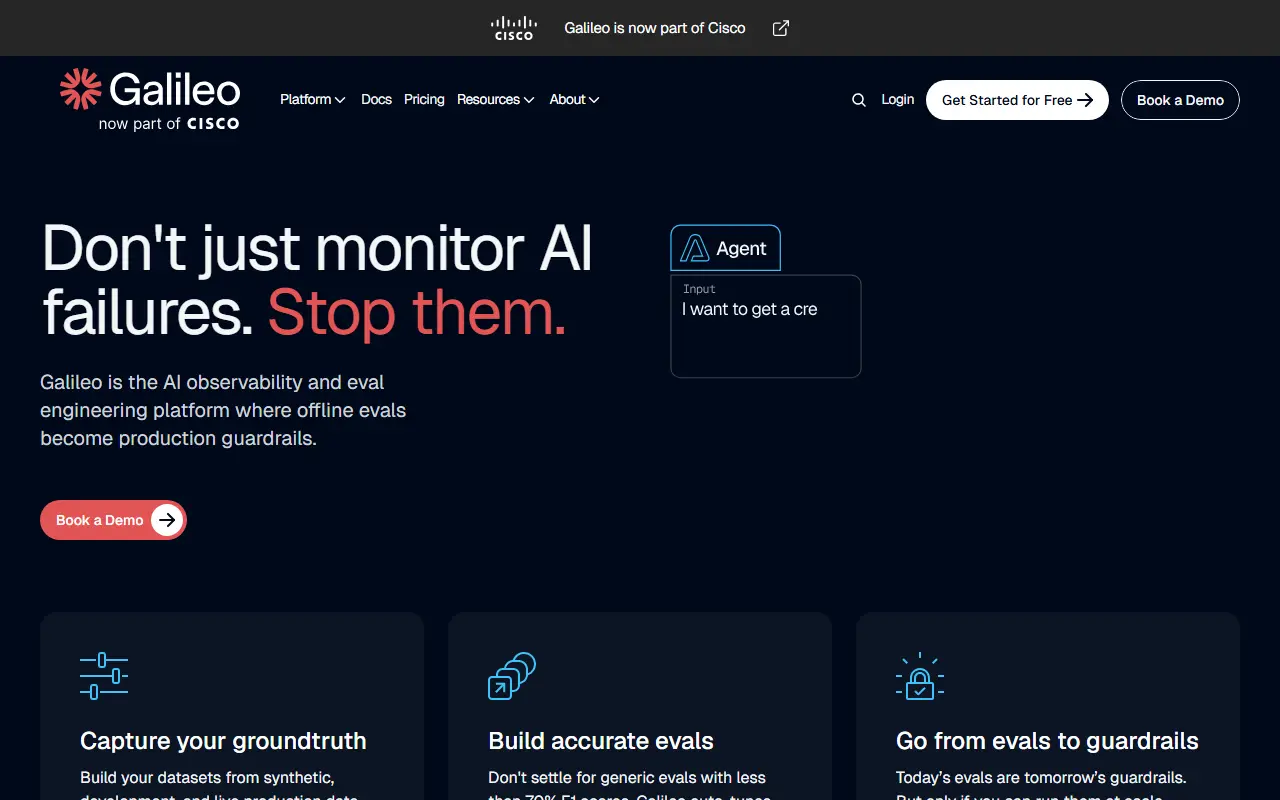
Galileo is an AI observability and eval engineering platform. Its pitch is not only to monitor AI failures but to stop them, by turning the evaluations teams run during development into guardrails that operate on live traffic.
The workflow starts with building datasets from synthetic, development and production data and capturing expert annotations. Metrics are tuned automatically from live feedback, and the platform includes a set of prebuilt evaluators for RAG, agents, safety and security alongside custom ones. Expensive LLM-as-judge evaluators can be distilled into compact Luna models for faster, cheaper monitoring, and an insights engine analyzes agent behavior to identify failure modes and suggest fixes.
Galileo is a proprietary commercial service with a free start option, a demo and a published pricing page. It suits enterprise and developer teams who need systematic quality control for AI applications.
Key features
- Datasets from synthetic and production data
- Prebuilt evals for RAG, agents and safety
- Custom evaluators with auto-tuned metrics
- Luna models for low-cost monitoring
- Insights engine for failure analysis
- Production guardrails from offline evals
Good fit for
- →Evaluating RAG pipelines before launch
- →Monitoring agent failures in production
- →Applying safety guardrails to live traffic
- Tags
- llm-evaluation
- llm-observability
- guardrails
- rag
- agents
- evals
- llmops
- ai-infrastructure
Galileo: questions and answers
- What is Galileo used for?
- Galileo is an AI observability and evaluation platform that turns offline evals into production guardrails for RAG pipelines, agents and generative AI applications. It is a good fit for evaluating RAG pipelines before launch, monitoring agent failures in production and applying safety guardrails to live traffic.
- Is Galileo free?
- Yes. Galileo has a free plan, and paid plans start at $100 per month.
- Is Galileo open source?
- No. Galileo is proprietary (closed-source) software. Open-source alternatives to Galileo include Opik, Arize Phoenix and LangWatch.
- What are some alternatives to Galileo?
- Galileo competes with Arize AI, Braintrust and LangSmith. For open-source options, see Enlisted's ranked list of open-source Galileo alternatives.
Open-source alternatives to Galileo
See all
Opik
AI Infrastructure
Debug, evaluate, and monitor your LLM applications, RAG systems, and agentic workflows wit
Apache-2.0vs Weights & Biases★ 22k
Arize Phoenix
AI Infrastructure
AI Observability & Evaluation
OSSvs Weights & Biases★ 12k
LangWatch
AI Infrastructure
The platform for LLM evaluations and AI agent testing
Apache-2.0vs LangSmith★ 4.9k
Laminar
AI Infrastructure
Laminar - open-source observability platform purpose-built for AI agents. YC S24.
Apache-2.0vs Weights & Biases★ 3.3k
Langfuse
AI Infrastructure
Trace, evaluate, and improve AI agents with one open platform. Use production data to unde
OSSvs Weights & Biases★ 35k
UpTrain
AI Infrastructure
UpTrain is an open-source unified platform to evaluate and improve Generative AI applicati
Apache-2.0vs Weights & Biases★ 2.4k
SaaS alternatives to Galileo
See all
Arize AI
AI Infrastructure
Observability and evaluation platform for machine learning models and LLM applications
SaaS
Braintrust
AI Infrastructure
Evaluation and observability platform for building and testing AI applications
SaaS
LangSmith
AI Infrastructure
Observability, tracing and evaluation platform for LLM applications
SaaS
Fiddler AI
AI Infrastructure
AI observability and model monitoring platform with explainability
SaaS
Weights & Biases
AI Infrastructure
Experiment tracking, model registry and LLM evaluation for machine learning teams
SaaS
Comet
AI Infrastructure
Experiment tracking, model registry and LLM evaluation platform
SaaS