
 Google Artifact Registry
 Quay
Quay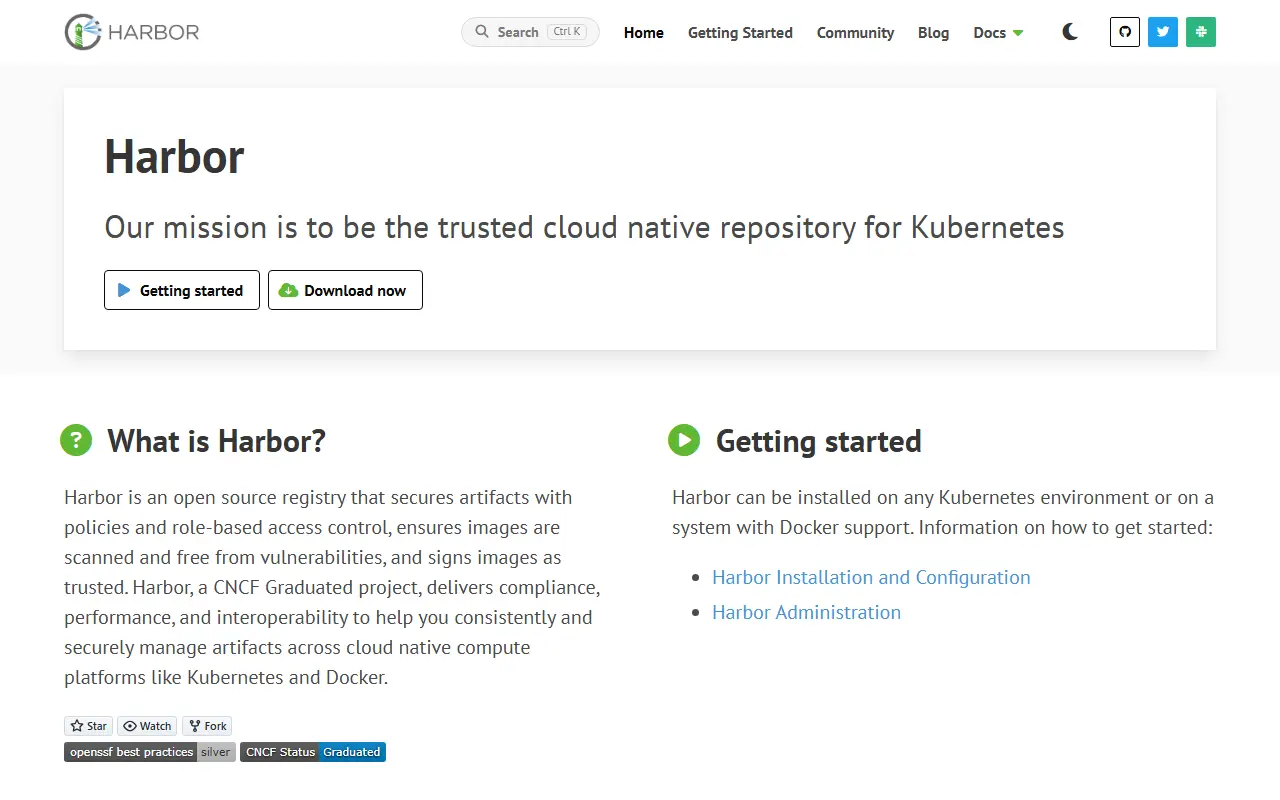
About Harbor
Harbor is an open-source, trusted cloud native registry for storing, signing and scanning content. It extends the open-source Docker Distribution with the security, identity and management features organizations usually need, and a registry close to the build and run environment can speed up image transfers. Harbor is a Cloud Native Computing Foundation project, is written in Go, and is released under the Apache-2.0 license.
It stores both container images and Helm charts for container runtimes and orchestration platforms. Role-based access control works through projects, where users have different permissions for images or charts. Policy-based replication synchronizes content between registry instances using filters on repository, tag and label, with automatic retries. Other capabilities include user management, access control and activity auditing. The project warns that the main branch may be unstable during development, so use tagged releases.
Key features
- Registry for container images and Helm charts
- Role-based access control through projects
- Policy-based replication between registries
- Image signing and vulnerability scanning
- User management and activity auditing
- CNCF-hosted open-source project
Good fit for
- →Private registry for an organization's images
- →Mirroring images across data centers
- Tags
- container-registry
- docker
- kubernetes
- helm
- cncf
- security
- registry
- image-scanning
Harbor: questions and answers
- What is Harbor used for?
- Harbor is an open-source cloud native registry that stores, signs and scans container images and Helm charts with access control. It is a good fit for private registry for an organization's images and mirroring images across data centers.
- Is Harbor open source?
- Yes. Harbor is open source under the Apache-2.0 licence. Its source code is on GitHub at goharbor/harbor and is written mainly in Go.
- Is Harbor free?
- Yes. Harbor is open source, so the software itself is free to use.
- Can I self-host Harbor?
- Yes. Harbor can be self-hosted on your own server or infrastructure.
- What is Harbor an alternative to?
- Harbor is an open-source alternative to JFrog, Cloudsmith, Sonatype Nexus Repository and Docker Hub. Other open-source alternatives to JFrog include Gitea, Harness and GitLab.
- Is Harbor actively maintained?
- Yes. The most recent commit to Harbor was on 2 October 2026, and the latest release is v2.15.2, published on 2 July 2026. The project has 29k stars on GitHub.
Open-source alternatives to Harbor
See all
Gitea
CI/CD & DevOps
Gitea - Git with a cup of tea! Painless self-hosted all-in-one software development servic
MITvs Bitbucket★ 58k
Harness
CI/CD & DevOps
Harness Open Source is an end-to-end developer platform with Source Control Management, CI
Apache-2.0vs GitHub Actions★ 38k
GitLab
CI/CD & DevOps
GitLab CE Mirror | Please open new issues in our issue tracker on GitLab.com
OSSvs GitHub★ 25k
OneDev
CI/CD & DevOps
Git, issues, pull requests, CI/CD, packages, wiki, and workspaces in one place. Assign wor
MITvs Bitbucket★ 15k
Flux
CI/CD & DevOps
Open and extensible continuous delivery solution for Kubernetes. Powered by GitOps Toolkit
Apache-2.0vs Octopus Deploy★ 8.4k
Argo CD
CI/CD & DevOps
Declarative Continuous Deployment for Kubernetes
Apache-2.0vs Octopus Deploy★ 24k
SaaS alternatives to Harbor
See allJFrog
CI/CD & DevOps
Artifact repository and software supply chain platform built around Artifactory
SaaSCloudsmith
CI/CD & DevOps
Cloud package and artifact management supporting many package formats
SaaS
Sonatype Nexus Repository
CI/CD & DevOps
Artifact repository manager for storing and distributing software packages
SaaS
Docker Hub
Infrastructure & Containers
Container image registry and library from Docker
SaaS
Amazon ECR
Infrastructure & Containers
Managed container image registry on AWS
SaaS
Azure Container Registry
Infrastructure & Containers
Managed registry for storing container images and artifacts on Azure
SaaS