
About GoatDB
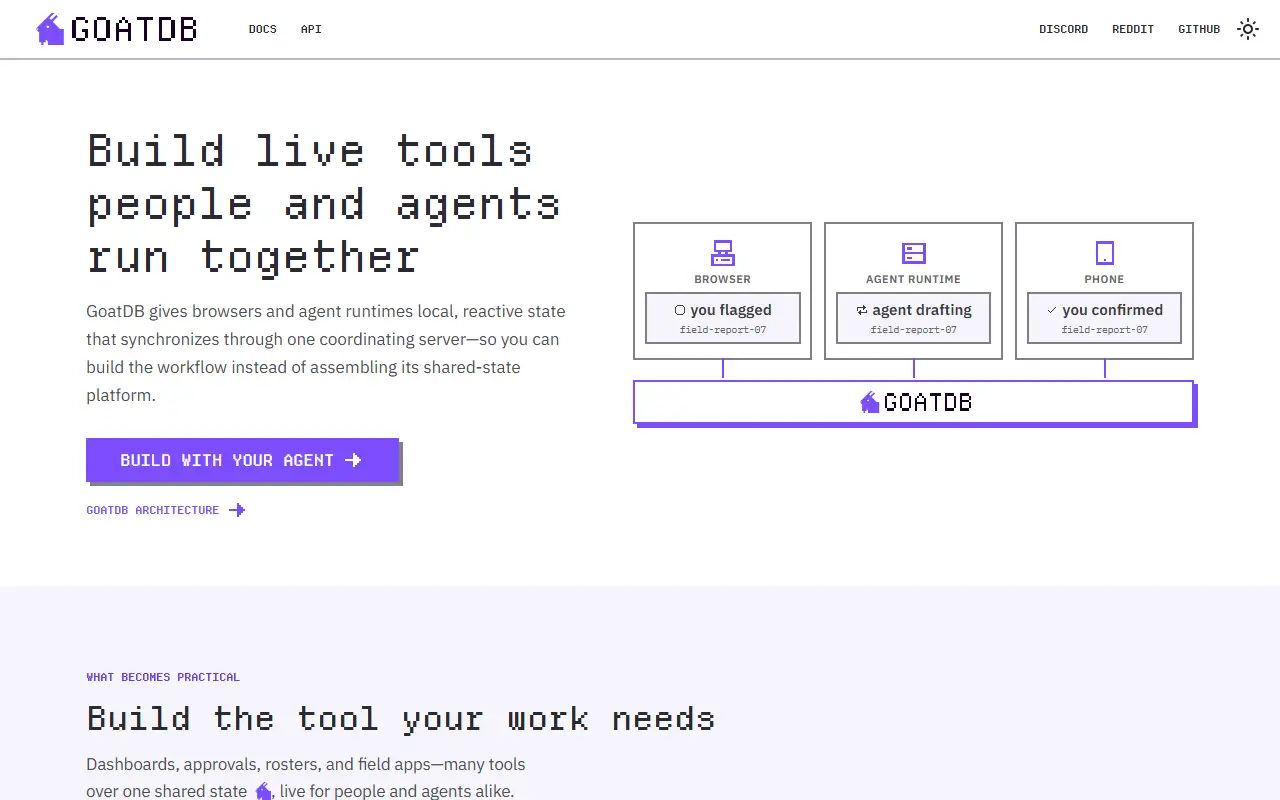
GoatDB describes itself as a realtime state layer for human-agent collaboration, where people, AI agents, tools and devices share the same live, durable state. Under the hood it is an embedded, distributed document database with verifiable state continuity, written TypeScript-first and including React hooks.
It borrows ideas from distributed version control: in its default secure mode every write produces an Ed25519-signed commit in a durable commit graph, and concurrent edits are reconciled by a Git-style three-way structural merge at the field level. Each opened repository has a full local replica, so apps work offline and sync automatically when reconnected, and queries run in memory and update incrementally as data changes. An available authorized replica that retains the relevant history can restore a crashed server. Signed provenance proves which session wrote what, though not the identity of the actor.
GoatDB runs on Deno, recommended, or Node.js 24 and newer, is licensed under MIT, and is under active development, so full backward compatibility is not guaranteed before v1.0. Documentation, benchmarks and an architecture page are available.
Key features
- Embedded distributed document database
- Offline-capable local replicas
- Signed commits with Ed25519
- Field-level three-way merge
- Reactive in-memory queries
- React hooks included
Good fit for
- →Local-first apps that sync across devices
- →Shared live state for humans and AI agents
- Tags
- database
- local-first
- typescript
- deno
- distributed
- sync
- react
- document-database
GoatDB: questions and answers
- What is GoatDB used for?
- GoatDB is an embedded, distributed document database with Git-like signed commits and offline replicas, designed for apps and agents sharing live state. It is a good fit for local-first apps that sync across devices, and shared live state for humans and AI agents.
- Is GoatDB open source?
- Yes. GoatDB is open source under the MIT licence. Its source code is on GitHub at goatplatform/goatdb and is written mainly in TypeScript.
- Is GoatDB free?
- Yes. GoatDB is open source, so the software itself is free to use.
- Can I self-host GoatDB?
- Yes. GoatDB can be self-hosted on your own server or infrastructure.
- What are some alternatives to GoatDB?
- Similar open-source tools in the Databases category include ArangoDB, OrientDB and SurrealDB. SaaS products in the same category include MarkLogic, Aerospike and Amazon DocumentDB.
- Is GoatDB actively maintained?
- Yes. The most recent commit to GoatDB was on 1 October 2026, and the latest release is v0.6.1, published on 1 September 2026. The project has 579 stars on GitHub.
Open-source alternatives to GoatDB
See all
ArangoDB
Databases
🥑 ArangoDB is a native multi-model database with flexible data models for documents, grap
OSSvs Azure Cosmos DB★ 14k
OrientDB
Databases
OrientDB is the most versatile DBMS supporting Graph, Document, Reactive, Full-Text and Ge
Apache-2.0vs Amazon Neptune★ 5k
SurrealDB
Databases
A scalable, distributed, collaborative, document-graph database, for the realtime web
OSSvs MongoDB Atlas★ 33k
MongoDB
Databases
The MongoDB Database
OSSvs Amazon DynamoDB★ 29k
Dgraph
Databases
high-performance graph database for real-time use cases
Apache-2.0vs Amazon Neptune★ 22k
rqlite
Databases
The lightweight, fault-tolerant database built on SQLite. Designed to keep your data highl
MITvs Cloudflare D1★ 18k
SaaS alternatives to GoatDB
See all
MarkLogic
Databases
Multi-model database and data hub platform for integrating and searching enterprise data
SaaS
Aerospike
Databases
Real-time NoSQL database for low-latency, high-throughput applications
SaaS
Amazon DocumentDB
Databases
Managed document database on AWS with a MongoDB-compatible API
SaaS
Amazon DynamoDB
Databases
Serverless key-value and document database from AWS
SaaS
Amazon MemoryDB
Databases
Durable in-memory database service on AWS compatible with Valkey and Redis OSS
SaaS
Azure Data Explorer
Databases
Analytics service on Azure for exploring log, telemetry and time-series data with Kusto queries
SaaS