
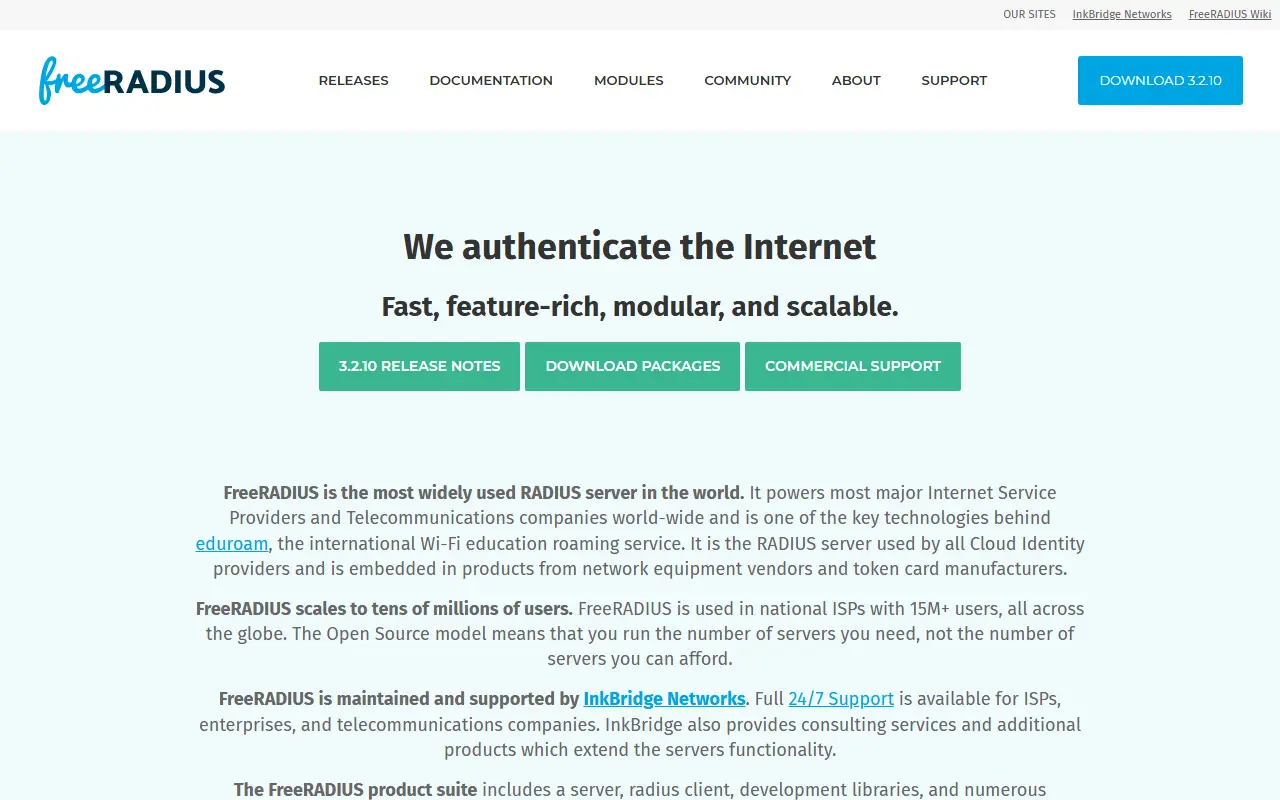
About FreeRADIUS
FreeRADIUS is a highly configurable, high-performance policy server written in C. It supports RADIUS, DHCPv4, DHCPv6, DNS, TACACS+, and VMPS, and is released under the GNU GPLv2. It is widely used to centralize authentication and authorization for networks, which reduces the number of changes needed when users are added or removed.
It can authenticate users for 802.1x Wi-Fi, dial-up, PPPoE, VPNs, VoIP, and many other systems. The topics point to support for EAP, one-time passwords, and AAA functions. Back-end data stores include MySQL, MariaDB, PostgreSQL, Oracle, Microsoft Active Directory, Apache Cassandra, and Redis, among others, so it can fit into existing identity infrastructure.
The project is continuously tested, with build status, Coverity analysis, and OSS-Fuzz in its CI badges. FreeRADIUS runs as a daemon on POSIX systems, and suits network engineers, ISPs, universities, and enterprises that operate wireless networks, VPNs, or other access systems and want a mature open-source AAA server.
Key features
- RADIUS, DHCP, DNS, TACACS+, and VMPS support
- 802.1x Wi-Fi, VPN, and PPPoE authentication
- EAP and one-time password methods
- SQL, LDAP-style, Active Directory, and Redis back ends
- Highly configurable policy language
- Runs as a daemon on POSIX systems
Good fit for
- →Enterprise Wi-Fi authentication with 802.1x
- →Centralized AAA for VPNs and ISPs
- Built with
- C
- Tags
- radius
- aaa
- authentication
- 802.1x
- network
- dhcp
- tacacs
- eap
FreeRADIUS: questions and answers
- What is FreeRADIUS used for?
- FreeRADIUS is a high-performance multi-protocol policy server supporting RADIUS, DHCP, DNS, TACACS+, and VMPS for centralized network authentication and authorization. It is a good fit for enterprise Wi-Fi authentication with 802.1x, and centralized AAA for VPNs and ISPs.
- Is FreeRADIUS open source?
- Yes. FreeRADIUS is open source under the GPL-2.0 licence. Its source code is on GitHub at FreeRADIUS/freeradius-server and is written mainly in C.
- Is FreeRADIUS free?
- Yes. FreeRADIUS is open source, so the software itself is free to use.
- Can I self-host FreeRADIUS?
- Yes. FreeRADIUS can be self-hosted on your own server or infrastructure; there is no official hosted version.
- What are some alternatives to FreeRADIUS?
- Similar open-source tools in the Networking & VPN category include Pi-hole, Technitium DNS Server and AdGuard Home. SaaS products in the same category include Akamai, Amazon CloudFront and Amazon Route 53.
- Is FreeRADIUS actively maintained?
- Yes. The most recent commit to FreeRADIUS was on 2 October 2026. The project has 2.6k stars on GitHub.
Open-source alternatives to FreeRADIUS
See all
Pi-hole
Networking & VPN
A black hole for Internet advertisements
OSSvs Cisco Umbrella★ 61k
Technitium DNS Server
Networking & VPN
Technitium DNS Server
GPL-3.0vs Cloudflare★ 10k
AdGuard Home
Networking & VPN
Network-wide ads & trackers blocking DNS server
GPL-3.0vs Cisco Umbrella★ 37kOxidized
Networking & VPN
Oxidized is a network device configuration backup tool. It's a RANCID replacement!
Apache-2.0vs Auvik★ 3.6k
LibreSpeed
Networking & VPN
Self-hosted Speed Test for HTML5 and more. Easy setup, examples, configurable, mobile frie
LGPL-3.0vs Speedtest by Ookla★ 15k
Wireshark
Networking & VPN
Read-only mirror of Wireshark's Git repository at https://gitlab.com/wireshark/wireshark.
GPL-2.0★ 9.9k
SaaS alternatives to FreeRADIUS
See all
Akamai
Networking & VPN
CDN, security and edge compute platform for enterprise web delivery
SaaS
Amazon CloudFront
Networking & VPN
AWS content delivery network for caching and accelerating web content and APIs
SaaS
Amazon Route 53
Networking & VPN
Scalable DNS, domain registration and health-check routing service on AWS
SaaS
AnyDesk
Networking & VPN
Remote desktop software for support, administration and file transfer
SaaS
Aruba Central
Networking & VPN
Cloud-based network management platform from HPE Aruba
SaaS
Azure Front Door
Networking & VPN
Global CDN and application delivery network on Azure
SaaS