
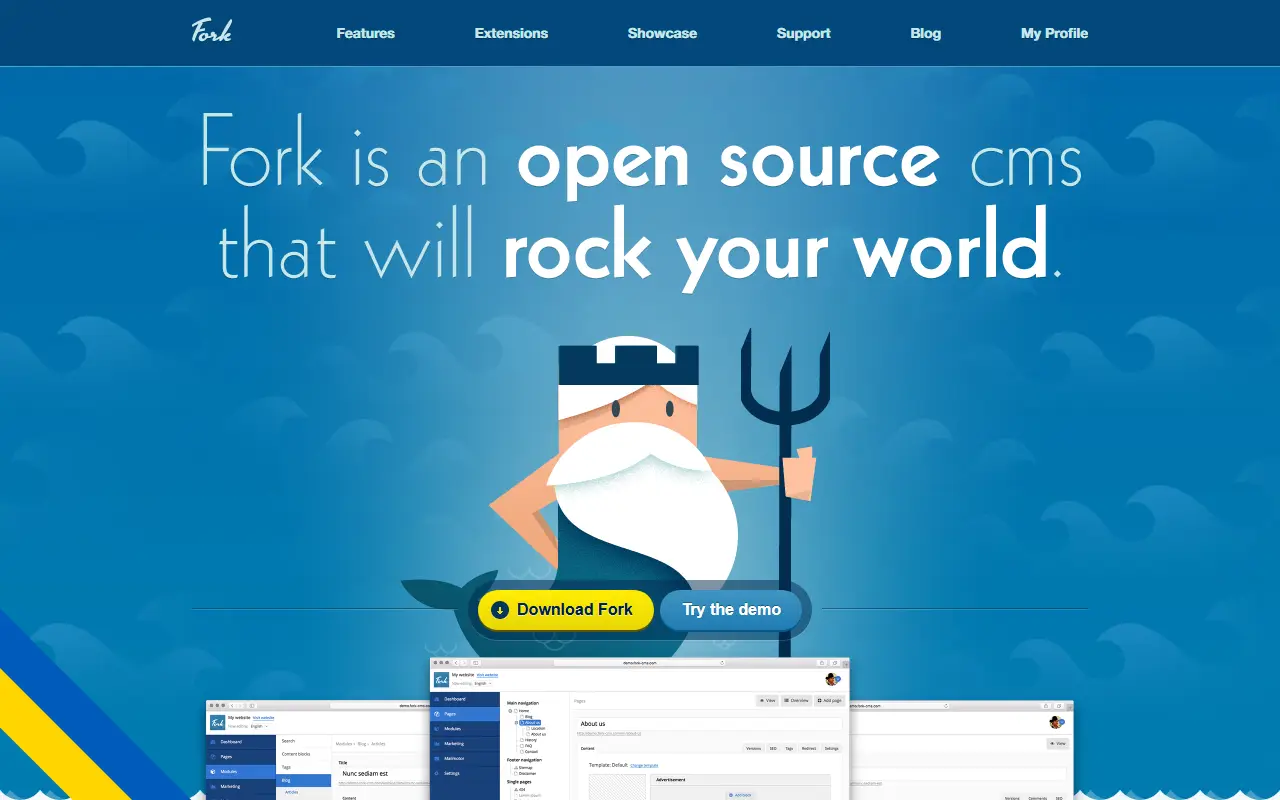
About Fork CMS
Fork CMS is an open-source content management system aimed at being straightforward to install and use for building and maintaining websites. It is built on Symfony Components for its underlying PHP architecture and Doctrine for its data layer, giving it a modern foundation without requiring the full Symfony framework's complexity for site editors.
Installation is handled through Composer with a single create-project command, after which an on-screen setup wizard walks through the remaining configuration. The backend interface is styled with Bootstrap and Sass, and the project explicitly allows HTML within translations because some content genuinely requires it, with site owners able to narrow down who can edit translation strings through group permissions.
Fork CMS includes a PHPUnit-based test suite covering unit, functional and installer test groups, runnable through Composer scripts, and the project maintains a support Slack channel alongside its GitHub issue tracker. It is written in PHP and released under the MIT license, with its codebase spanning back over a decade of continuous development.
Key features
- Composer-based one-command installation
- Symfony Components and Doctrine architecture
- Bootstrap and Sass-styled backend
- Group-based translation editing permissions
- Full PHPUnit test suite
Good fit for
- →Easy-to-use CMS for small to medium websites
- →Symfony-based content management for PHP teams
- Built with
- PHP
- Tags
- cms
- php
- symfony
- doctrine
- self-hosted
- open-source
Fork CMS: questions and answers
- What is Fork CMS used for?
- Fork CMS is a free, MIT-licensed, open-source content management system for PHP built on Symfony Components and Doctrine, aimed at being easy for non-technical editors to use. It is a good fit for easy-to-use CMS for small to medium websites and symfony-based content management for PHP teams.
- Is Fork CMS open source?
- Yes. Fork CMS is open source under the MIT licence. Its source code is on GitHub at forkcms/forkcms and is written mainly in PHP.
- Is Fork CMS free?
- Yes. Fork CMS is open source, so the software itself is free to use.
- Can I self-host Fork CMS?
- Yes. Fork CMS can be self-hosted on your own server or infrastructure; there is no official hosted version.
- What are some alternatives to Fork CMS?
- Similar open-source tools in the CMS category include Sulu, Textpattern and WordPress. SaaS products in the same category include 1FoodMenu, ABHUB and Adobe Experience Manager.
- Is Fork CMS actively maintained?
- The most recent commit to Fork CMS was on 29 July 2025, and the latest release is 5.12.0, published on 31 July 2023. The project has 1.2k stars on GitHub.
Open-source alternatives to Fork CMS
See all
Sulu
CMS
Core framework that implements the functionality of the Sulu content management system
MITvs Sitecore★ 1.4k
Textpattern
CMS
A flexible, elegant, fast and easy-to-use content management system written in PHP.
GPL-2.0★ 881
WordPress
CMS
WordPress, Git-ified. This repository is just a mirror of the WordPress subversion reposit
OSSvs Wix★ 21k
Vvveb
CMS
Powerful and easy to use cms to build websites, blogs or ecommerce stores.
AGPL-3.0vs Squarespace★ 1.2k
WonderCMS
CMS
Fast and small flat file CMS (5 files). Built with PHP, JSON database.
MIT★ 740
HTMLy
CMS
Simple and fast databaseless PHP blogging platform, and Flat-File CMS
GPL-2.0vs Medium★ 1.4k
SaaS alternatives to Fork CMS
See all
1FoodMenu
CMS
One-page website builder for restaurants and food trucks with menu, hours and contact info
SaaSABHUB
CMS
No-code website builder and content management system for small and mid-size wineries
SaaS
Adobe Experience Manager
CMS
Enterprise content management and digital asset management for websites and brand content
SaaS
Authorly
CMS
Author page builder where writers showcase books, share samples and connect with readers
SaaS
Awla
CMS
Link-in-bio profile for teachers to show classes, schedules and free materials and capture student leads
SaaS
BlogBowl
CMS
Open-source blog and newsletter management platform
SaaS