About Flower
Flower is a web application, released as open source, that monitors and administers Celery clusters. It shows live information on the state of Celery workers and tasks, so teams running background job queues can see what is executing, queued or failing.
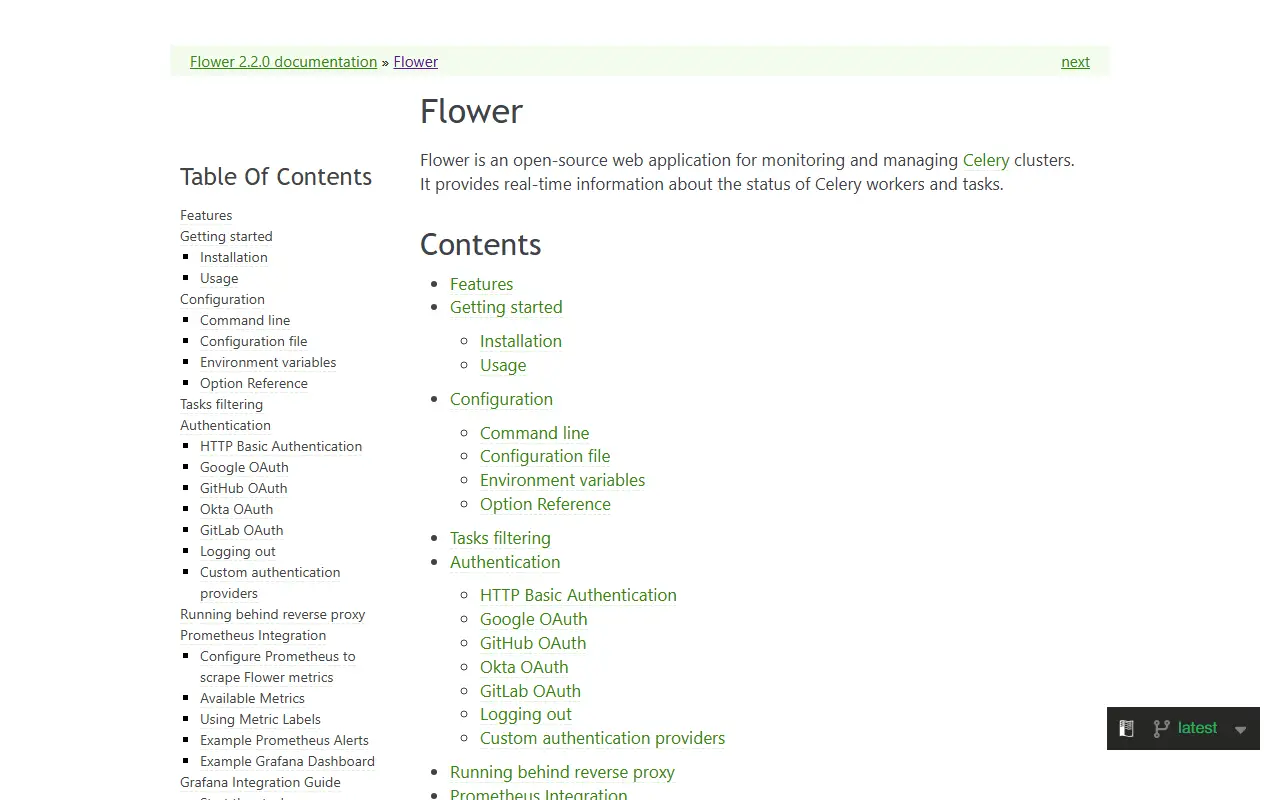
Its documentation covers installation, configuration through command line, config file or environment variables, task filtering and several authentication methods: HTTP Basic, Google OAuth, GitHub OAuth, Okta OAuth, GitLab OAuth and custom providers. It can run behind a reverse proxy, and an integration exposes Prometheus metrics with example alerts and a Grafana dashboard. Brokers such as RabbitMQ and Redis are supported, as the project topics show.
Flower is written in Python and is licensed under the BSD 3-Clause licence according to its documentation, while the repository lists the license as Other. It is run as an additional process alongside your Celery workers. It suits Python teams that use Celery and want visibility and basic control over their distributed task queue.
Key features
- Real-time Celery worker and task status
- Task filtering and inspection
- HTTP Basic and OAuth authentication
- Prometheus metrics endpoint
- Example Grafana dashboard
- Works behind a reverse proxy
Good fit for
- →Monitoring Celery background jobs
- →Debugging failed or slow tasks
- →Exporting queue metrics to Prometheus
- Tags
- celery
- task-queue
- monitoring
- python
- prometheus
- grafana
- workers
- admin-ui
Flower: questions and answers
- What is Flower used for?
- Flower is a real-time web dashboard for monitoring and administering Celery clusters, showing workers and tasks with authentication options and Prometheus metrics. It is a good fit for monitoring Celery background jobs, debugging failed or slow tasks and exporting queue metrics to Prometheus.
- Is Flower open source?
- Yes. Flower is open source under a custom licence. Its source code is on GitHub at mher/flower and is written mainly in Python.
- Is Flower free?
- Yes. Flower is open source, so the software itself is free to use under the terms of its own licence.
- What are some alternatives to Flower?
- Similar open-source tools in the Monitoring & Observability category include Nvitop, Grafana Loki and Glances. SaaS products in the same category include AppSignal, Amazon CloudWatch and AppDynamics.
- Is Flower actively maintained?
- Yes. The most recent commit to Flower was on 22 September 2026, and the latest release is v2.2.0, published on 22 September 2026. The project has 7.2k stars on GitHub.
Open-source alternatives to Flower
See allNvitop
Monitoring & Observability
An interactive NVIDIA-GPU process viewer and beyond, the one-stop solution for GPU process
Apache-2.0★ 7.2k
Grafana Loki
Monitoring & Observability
Like Prometheus, but for logs.
AGPL-3.0vs Datadog★ 29kGlances
Monitoring & Observability
Glances an Eye on your system. A top/htop alternative for GNU/Linux, BSD, macOS and Window
OSS★ 34ks-tui
Monitoring & Observability
Terminal-based CPU stress and monitoring utility
GPL-2.0★ 5.1kgpustat
Monitoring & Observability
📊 A simple command-line utility for querying and monitoring GPU status
MIT★ 4.4k
Sloth
Monitoring & Observability
🦥 Easy and simple Prometheus SLO (service level objectives) generator
Apache-2.0★ 2.6k
SaaS alternatives to Flower
See all
AppSignal
Monitoring & Observability
Application monitoring for Ruby, Elixir, Node.js and Python with errors and metrics
SaaS
Amazon CloudWatch
Monitoring & Observability
AWS service for metrics, logs, alarms and dashboards
SaaS
AppDynamics
Monitoring & Observability
Cisco application performance monitoring that maps technical metrics to business impact
SaaS
Atlassian Statuspage
Monitoring & Observability
Hosted status page and incident communication tool from Atlassian
SaaS
Axiom
Monitoring & Observability
Cloud service for ingesting, storing and querying logs, traces and event data
SaaS
Azure Monitor
Monitoring & Observability
Azure service for collecting and analyzing metrics, logs and traces
SaaS