About gpustat
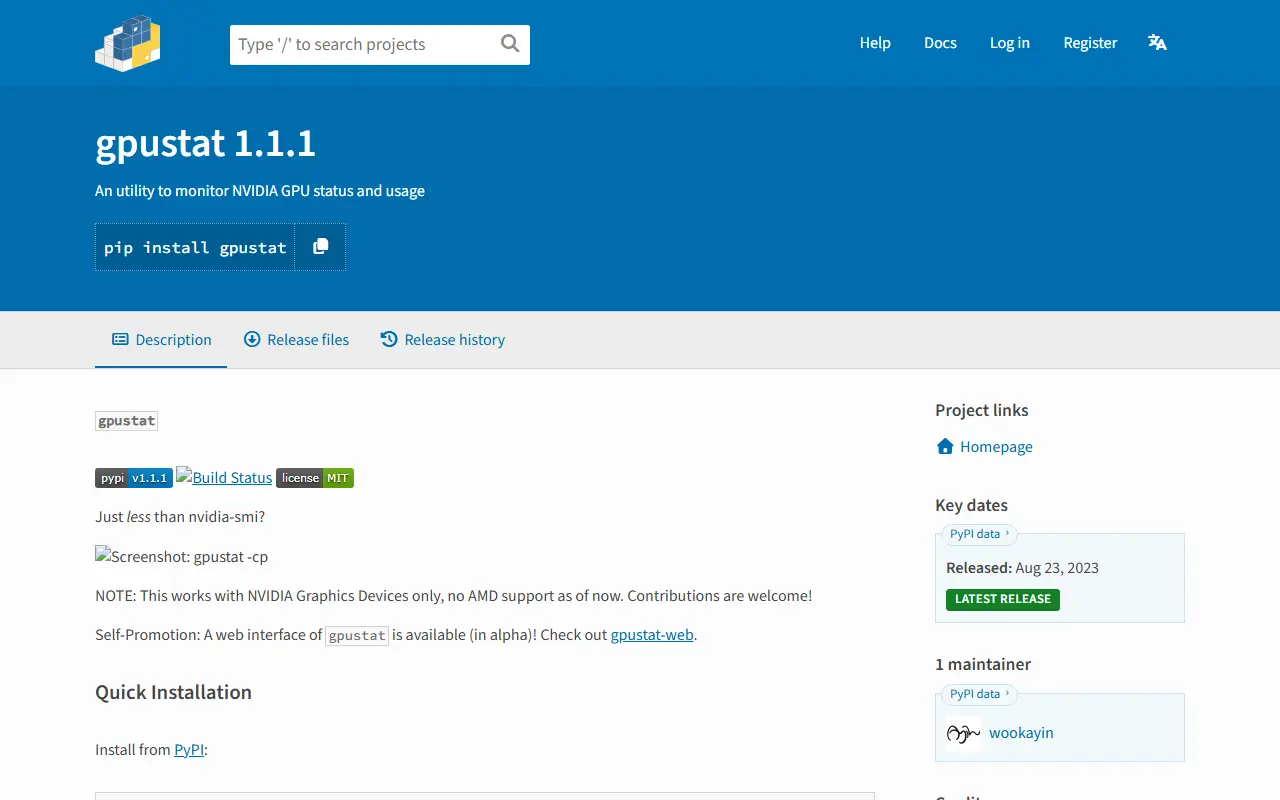
gpustat is a compact terminal utility for checking and watching the state of your GPUs. It condenses the output you would otherwise read from nvidia-smi into a compact view, making it quick to see which cards are in use, how much memory is consumed and by which processes. The README notes that it works only with NVIDIA devices, with no AMD support.
It is installed from PyPI with pip, or with a user-level install if you lack root privileges, and requires an NVIDIA driver together with the pynvml library, with a warning about not installing the wrong package variant. A separate project provides an early-stage web interface called gpustat-web. The utility is written in Python.
gpustat is MIT-licensed and runs locally or over SSH on any GPU server. It suits machine learning engineers, researchers and sysadmins sharing GPU machines who want a fast glance at utilization without parsing long nvidia-smi output.
Key features
- Compact NVIDIA GPU status display
- Shows memory use and running processes
- Install from PyPI with pip
- User-level installation without root
- Optional gpustat-web interface
- Python command-line utility
Good fit for
- →Checking GPU usage on shared servers
- →Quick GPU monitoring over SSH
- Built with
- Python
- Tags
- gpu
- nvidia
- monitoring
- cli
- python
- nvidia-smi
- machine-learning
gpustat: questions and answers
- What is gpustat used for?
- gpustat is a simple Python command-line tool that shows the status of NVIDIA GPUs in a compact, readable form, as a lighter alternative to nvidia-smi. It is a good fit for checking GPU usage on shared servers and quick GPU monitoring over SSH.
- Is gpustat open source?
- Yes. gpustat is open source under the MIT licence. Its source code is on GitHub at wookayin/gpustat and is written mainly in Python.
- Is gpustat free?
- Yes. gpustat is open source, so the software itself is free to use.
- What are some alternatives to gpustat?
- Similar open-source tools in the Monitoring & Observability category include Nvitop, Glances and s-tui. SaaS products in the same category include AppSignal, Amazon CloudWatch and AppDynamics.
- Is gpustat actively maintained?
- Yes. The most recent commit to gpustat was on 15 September 2026, and the latest release is v1.1.1, published on 22 August 2023. The project has 4.4k stars on GitHub.
Open-source alternatives to gpustat
See allNvitop
Monitoring & Observability
An interactive NVIDIA-GPU process viewer and beyond, the one-stop solution for GPU process
Apache-2.0★ 7.2kGlances
Monitoring & Observability
Glances an Eye on your system. A top/htop alternative for GNU/Linux, BSD, macOS and Window
OSS★ 34ks-tui
Monitoring & Observability
Terminal-based CPU stress and monitoring utility
GPL-2.0★ 5.1kBottom
Monitoring & Observability
Yet another cross-platform graphical process/system monitor.
MIT★ 14kFlower
Monitoring & Observability
Real-time monitor and web admin for Celery distributed task queue
OSS★ 7.2kSysstat
Monitoring & Observability
Performance monitoring tools for Linux
GPL-2.0★ 3.4k
SaaS alternatives to gpustat
See all
AppSignal
Monitoring & Observability
Application monitoring for Ruby, Elixir, Node.js and Python with errors and metrics
SaaS
Amazon CloudWatch
Monitoring & Observability
AWS service for metrics, logs, alarms and dashboards
SaaS
AppDynamics
Monitoring & Observability
Cisco application performance monitoring that maps technical metrics to business impact
SaaS
Atlassian Statuspage
Monitoring & Observability
Hosted status page and incident communication tool from Atlassian
SaaS
Axiom
Monitoring & Observability
Cloud service for ingesting, storing and querying logs, traces and event data
SaaS
Azure Monitor
Monitoring & Observability
Azure service for collecting and analyzing metrics, logs and traces
SaaS