
About Deepnote
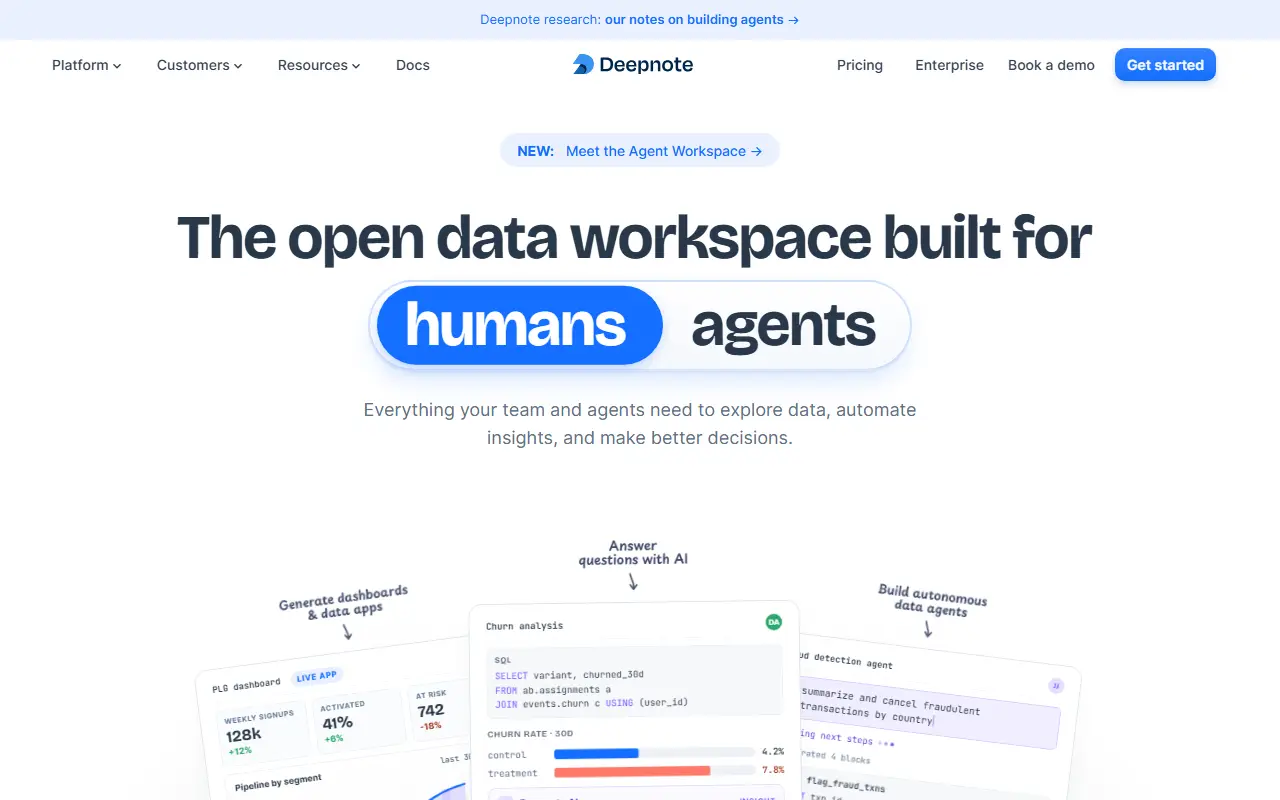
Deepnote is a collaborative data notebook platform. Teams explore data with Python and SQL in a shared workspace, then turn the results into data apps and dashboards that colleagues can use, so analysis does not stay locked inside one person's local environment.
The platform lists a wide range of capabilities: an AI assistant, alerts for monitoring metrics, a semantic layer that works with modules, LookML and dbt, many data source integrations, data engineering for ETL and ELT pipelines, a data catalog, code reviews, history and versioning, and security features such as SOC 2 and HIPAA support. For machine learning it supports model training, serving and monitoring, with access to GPUs and Spark. Its newest framing is an open data workspace for both people and AI agents.
Deepnote is a proprietary hosted commercial product. The vendor publishes pricing, offers demos and an enterprise plan, and compares itself with Jupyter, Google Colab, Databricks and other notebook tools.
Key features
- Shared Python and SQL notebooks
- Data apps and dashboards from notebooks
- AI assistant for analysis
- Semantic layer with dbt and LookML
- History, versioning and code reviews
- Model training and serving from notebooks
Good fit for
- →Team data science collaboration
- →Sharing analysis as interactive data apps
- →Moving off local Jupyter notebooks
- Tags
- notebooks
- data-science
- python
- sql
- collaboration
- dashboards
- data-apps
- machine-learning
Deepnote: questions and answers
- What is Deepnote used for?
- Deepnote is a collaborative notebook platform where analytics and data science teams work in Python and SQL, build data apps and dashboards, and share results. It is a good fit for team data science collaboration, sharing analysis as interactive data apps and moving off local Jupyter notebooks.
- Is Deepnote free?
- Yes. Deepnote has a free plan, and paid plans start at $39 per seat per month. A free trial is also available.
- Is Deepnote open source?
- No. Deepnote is proprietary (closed-source) software. Open-source alternatives to Deepnote include Briefer and Apache Zeppelin.
- What are some alternatives to Deepnote?
- Deepnote competes with Hex, Observable and Julius AI. For open-source options, see Enlisted's ranked list of open-source Deepnote alternatives.
Open-source alternatives to Deepnote
See all
Briefer
BI & Dashboards
Dashboards and notebooks in a single place. Create powerful and flexible dashboards using
AGPL-3.0vs Hex★ 4.3k
Apache Zeppelin
BI & Dashboards
Web-based notebook that enables data-driven, interactive data analytics and collaborative
Apache-2.0vs Hex★ 6.7k
Redash
BI & Dashboards
Make Your Company Data Driven. Connect to any data source, easily visualize, dashboard and
BSD-2-Clausevs Data Studio★ 29k
Superset
BI & Dashboards
Apache Superset is a Data Visualization and Data Exploration Platform
Apache-2.0vs Tableau★ 75k
Preswald
BI & Dashboards
Preswald is a WASM packager for Python-based interactive data apps: bundle full complex da
Apache-2.0vs Hex★ 4.3k
Datasette
BI & Dashboards
An open source multi-tool for exploring and publishing data
Apache-2.0★ 11k
SaaS alternatives to Deepnote
See all
Hex
BI & Dashboards
Collaborative notebooks combining SQL, Python and dashboards for data teams
SaaS
Observable
BI & Dashboards
Collaborative data notebooks and dashboards for visualization and analysis
SaaS
Julius AI
AI Tools
Ask questions of spreadsheets and data files and get charts and analysis back
SaaS
Mode
BI & Dashboards
Collaborative analytics platform combining SQL, Python and dashboards, part of ThoughtSpot
SaaS
Databricks
Data Pipelines & ETL
Lakehouse platform for data engineering, analytics and machine learning
SaaS
AI Dashboard Gen
BI & Dashboards
Generates interactive dashboards from your data with AI
SaaS