 TrackMedia
 TrackRev
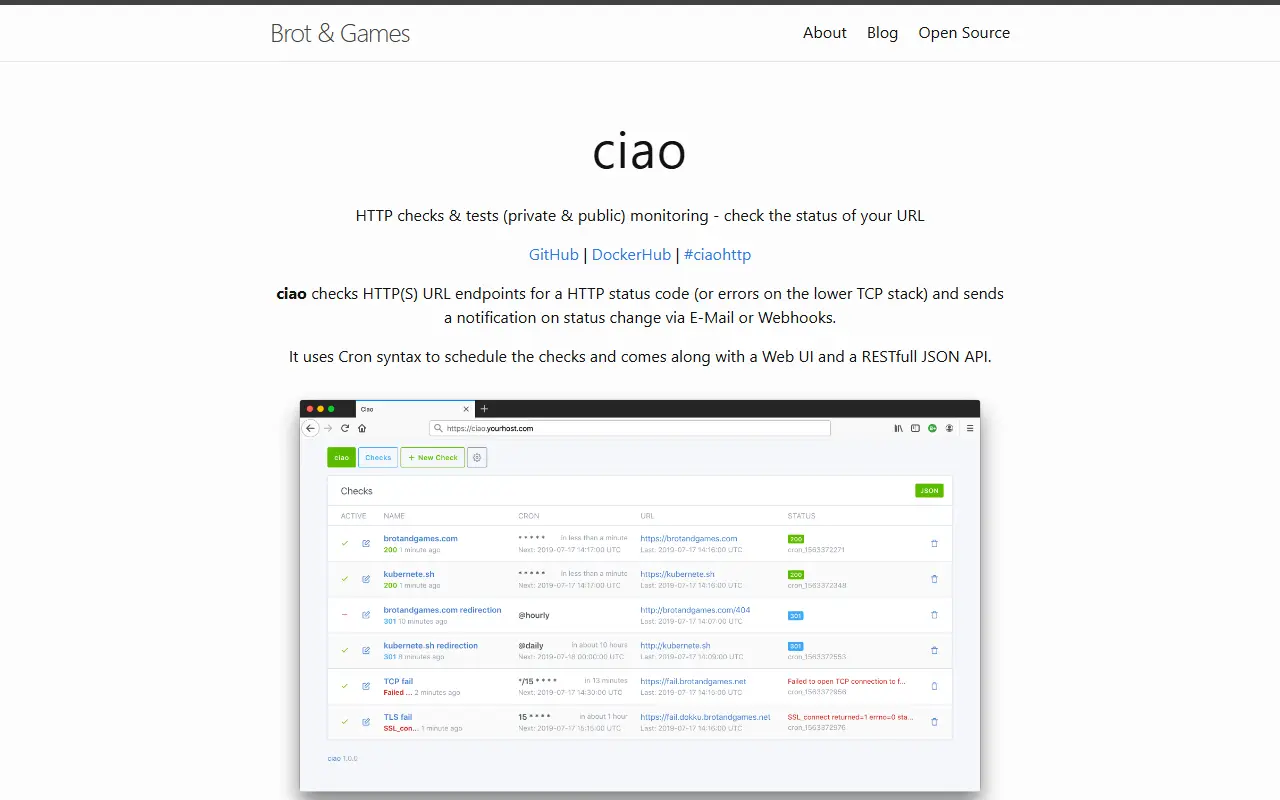
About ciao
ciao checks HTTP and HTTPS URL endpoints for a status code, or for errors lower in the TCP stack, and sends a notification when the status changes. Checks are scheduled with Cron syntax, so an interval can be every minute, every 15 minutes, hourly or daily.
It comes with a web UI and a RESTful JSON API. Notifications go out by e-mail, with SMTP examples for Gmail and Sendgrid, or through webhooks aimed at tools such as Rocket.Chat and Slack. A daily check of TLS certificate expiry warns when a certificate has less than 30 days left.
The stated aim is an easy-to-install, easy-to-maintain application with no external dependencies such as databases or caches. It is configured through environment variables, can expose a Prometheus /metrics endpoint including last response time per check, and can be protected with HTTP Basic auth.
The quick start is a single docker run command. The image is published for linux/amd64 and linux/arm64, and a Helm chart and a community-maintained Terraform provider are listed. The README stresses enabling authentication and TLS if ciao is served publicly.
Key features
- Checks HTTP/S endpoints on a Cron schedule
- Web UI and REST JSON API
- Notifications by e-mail
- Notifications by webhook
- Daily TLS certificate expiry check
- Optional Prometheus metrics endpoint
- Optional HTTP Basic authentication
Good fit for
- Monitoring website uptime
- Watching private internal URLs
- TLS expiry warnings
- Feeding status metrics to Grafana
ciao: questions and answers
- What is ciao used for?
- ciao is a self-hosted HTTP(S) endpoint checker that runs scheduled status checks and sends notifications by e-mail or webhook. It is a good fit for monitoring website uptime, watching private internal URLs and TLS expiry warnings.
- Is ciao open source?
- Yes. ciao is open source under the MIT licence. Its source code is on GitHub at brotandgames/ciao and is written mainly in Ruby.
- Is ciao free?
- Yes. ciao is open source, so the software itself is free to use.
- Can I self-host ciao?
- Yes. ciao can be self-hosted on your own server or infrastructure.
- What is ciao an alternative to?
- ciao is an open-source alternative to UptimeRobot, Pingdom and StatusCake. Other open-source alternatives to UptimeRobot include Gatus, CheckCle and Uptime Kuma.
- Is ciao actively maintained?
- Yes. The most recent commit to ciao was on 9 November 2026, and the latest release is 1.12.0, published on 25 October 2026. The project has 2k stars on GitHub.
Open-source alternatives to ciao
See all
Gatus
Monitoring & Observability
Create beautiful, automated status pages with advanced monitoring. Track HTTP, DNS, TCP en
Apache-2.0vs UptimeRobot★ 13k
CheckCle
Monitoring & Observability
CheckCle is a self-hosted, open-source monitoring platform for seamless, real-time full-st
MITvs UptimeRobot★ 3.3k
Uptime Kuma
Monitoring & Observability
A self-hosted monitoring tool
MITvs UptimeRobot★ 94k
Peekaping
Monitoring & Observability
Open Source Uptime Kuma Alternative
MITvs UptimeRobot★ 1.2k
Upptime
Monitoring & Observability
⬆️ GitHub Actions uptime monitor & status page by @AnandChowdhary
MITvs UptimeRobot★ 17k
Lunalytics
Monitoring & Observability
🚀 Open source monitoring tool built with Node.js
OSSvs UptimeRobot★ 734
SaaS alternatives to ciao
See all
UptimeRobot
Monitoring & Observability
Website, port and keyword uptime checks with alerting and status pages
SaaS
Pingdom
Monitoring & Observability
Pingdom is a website monitoring service that checks uptime and page performance from outside locations and alerts teams when a site has problems.
SaaS
StatusCake
Monitoring & Observability
Uptime, page speed and SSL monitoring with alerts
SaaS
Atlassian Statuspage
Monitoring & Observability
Hosted status page and incident communication tool from Atlassian
SaaS
SSLMonit
Monitoring & Observability
Monitors SSL certificates and sends Slack, Discord, email or webhook alerts before they expire
SaaS
SteadyStack
Monitoring & Observability
Synthetic uptime monitoring that confirms failures across multiple regions before alerting
SaaS