
About SteadyStack
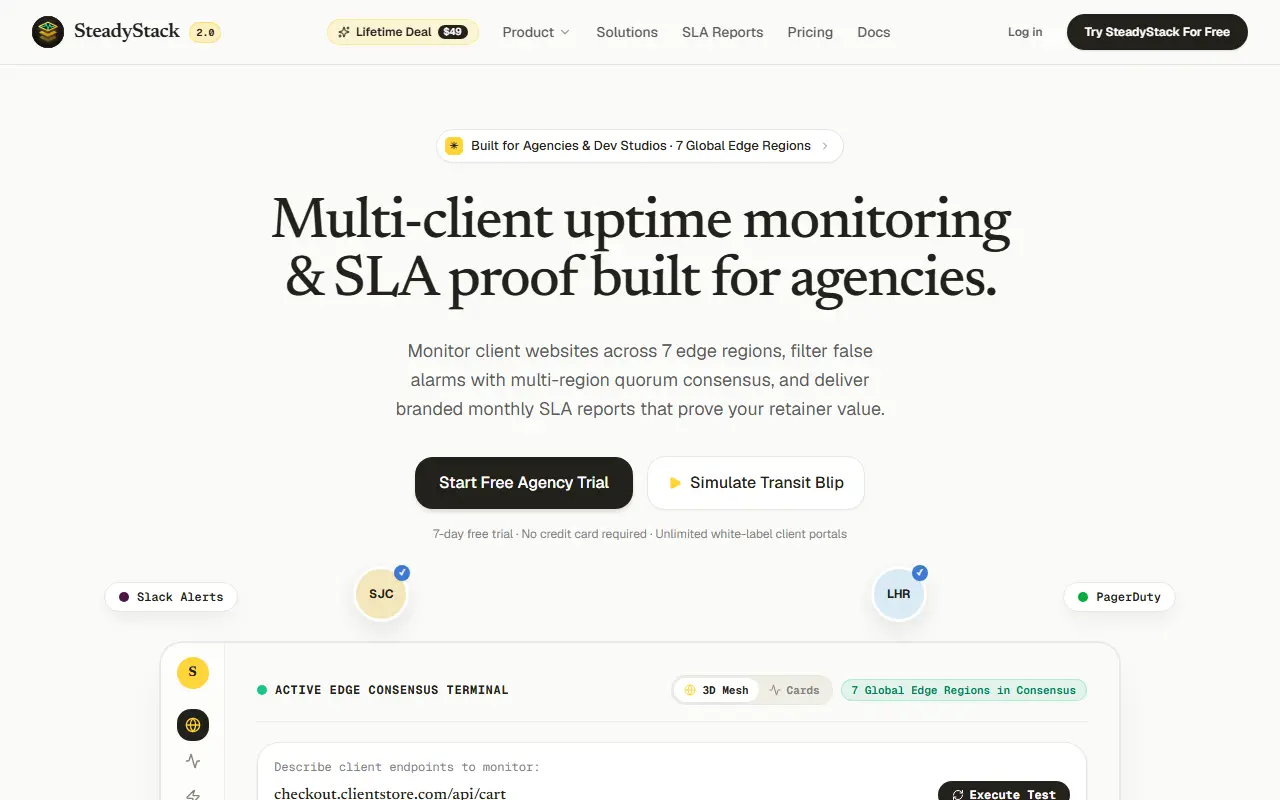
SteadyStack is uptime monitoring designed for agencies and dev studios that look after many client sites. Checks run every 30 seconds from seven edge regions, and an alert fires only when at least four of the seven regions agree that something is wrong, which the vendor says avoids waking engineers for local network blips. Adding a client URL triggers discovery of health routes, SSL certificates and DNS settings, and monitors cover HTTP and HTTPS, TCP, DNS and WebSocket endpoints with payload and JSON validation.
Alerts go to Slack, PagerDuty, OpsGenie, Discord or custom webhooks with signed HMAC payloads, and SSL expiry warnings arrive at 30, 14 and 7 days. For the client-facing side, each client gets a status portal on a custom CNAME domain without vendor branding, and automated monthly PDF reports document uptime for renewals. The site offers a 7-day free trial with no credit card and promotes a lifetime deal.
Key features
- Checks from seven global edge regions
- Quorum voting before an alert fires
- White-label status portals on custom domains
- Automated monthly PDF SLA reports
- HTTP, TCP, DNS and WebSocket monitors
- Slack, PagerDuty, OpsGenie and webhook alerts
Good fit for
- Monitoring many client websites from one account
- Proving uptime to clients at contract renewal
- Cutting false alarms from single-location failures
SteadyStack: questions and answers
- What is SteadyStack used for?
- SteadyStack is a multi-client uptime monitor for agencies that checks sites from seven regions, confirms failures by quorum and produces white-label status pages and SLA reports. It is a good fit for monitoring many client websites from one account, proving uptime to clients at contract renewal and cutting false alarms from single-location failures.
- Is SteadyStack free?
- Yes. SteadyStack has a free plan, and paid plans start at $29 per month. A free trial is also available.
- Is SteadyStack open source?
- No. SteadyStack is proprietary (closed-source) software and can't be self-hosted. In the Monitoring & Observability category, open-source options include CheckCle, Uptime Kuma and OpenStatus.
- What are some alternatives to SteadyStack?
- SteadyStack competes with UptimeRobot, Better Stack and Pingdom.
Open-source alternatives to SteadyStack
See all
CheckCle
Monitoring & Observability
CheckCle is a self-hosted, open-source monitoring platform for seamless, real-time full-st
MITvs UptimeRobot★ 3.3k
Uptime Kuma
Monitoring & Observability
A self-hosted monitoring tool
MITvs UptimeRobot★ 92k
OpenStatus
Monitoring & Observability
🫖 Status page with uptime monitoring & API monitoring as code 🫖
AGPL-3.0vs Pingdom★ 9.2kVigil
Monitoring & Observability
🚦 Microservices Status Page. Monitors a distributed infrastructure and sends alerts (Slac
MPL-2.0vs UptimeRobot★ 2k
Peekaping
Monitoring & Observability
Open Source Uptime Kuma Alternative
MITvs UptimeRobot★ 1.2k
Statping
Monitoring & Observability
Status Page for monitoring your websites and applications with beautiful graphs, analytics
GPL-3.0vs Statuspal★ 7.3k
SaaS alternatives to SteadyStack
See all
UptimeRobot
Monitoring & Observability
Website, port and keyword uptime checks with alerting and status pages
SaaS
Better Stack
Monitoring & Observability
Uptime monitoring, on-call alerts, status pages and log management in one product
SaaS
Pingdom
Monitoring & Observability
Pingdom is a website monitoring service that checks uptime and page performance from outside locations and alerts teams when a site has problems.
SaaS
StatusCake
Monitoring & Observability
Uptime, page speed and SSL monitoring with alerts
SaaS
Hyperping
Monitoring & Observability
Uptime monitoring with status pages and on-call alerting
SaaS
Checkly
Monitoring & Observability
Synthetic monitoring using Playwright scripts, managed as code
SaaS