 TrackMedia
 TrackRev

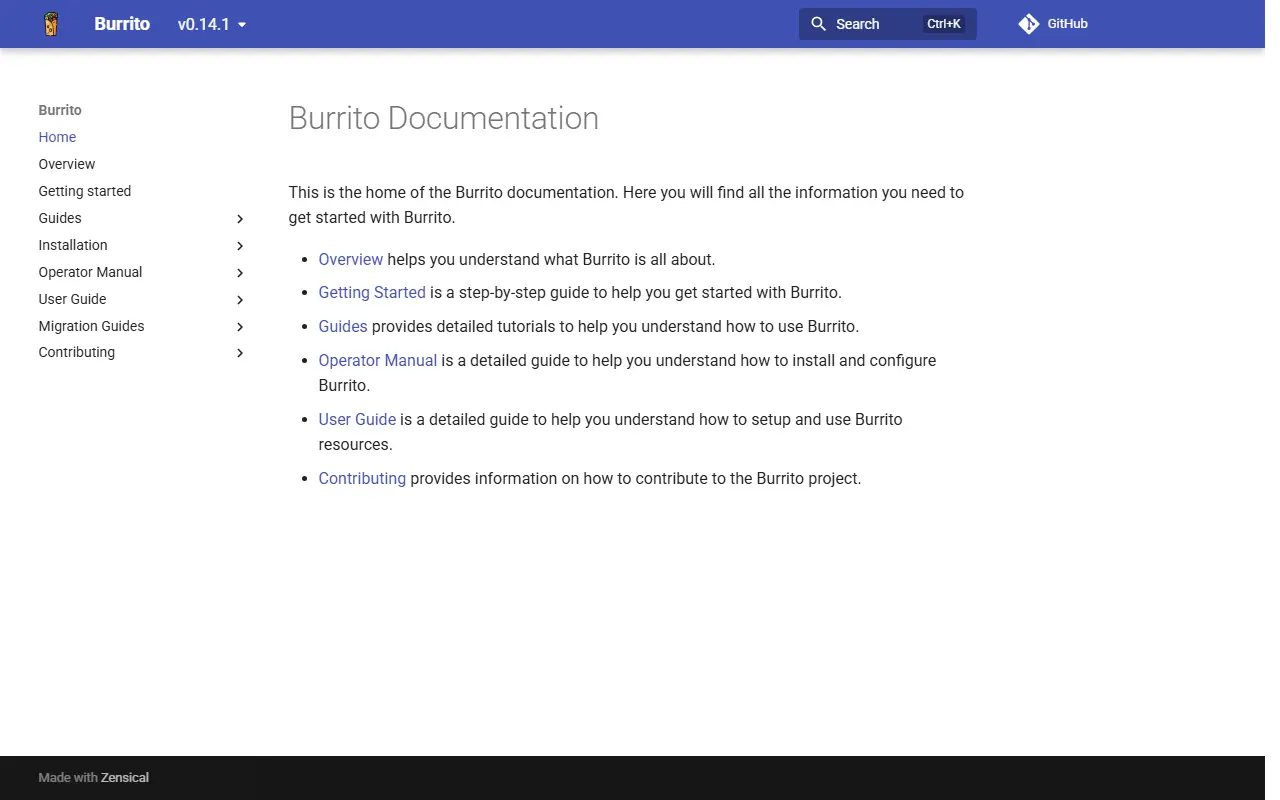
About Burrito
Burrito is a TACoS (Terraform Automation and Collaboration Software) Kubernetes operator, summed up by its authors as Argo CD for Terraform. It targets the lack of built-in tools for managing state drift in Terraform, the difficulty of building CI/CD pipelines for it, and the lack of an easy way to see how state changes.
It plans your Terraform code continuously and runs applies when needed, offers a pull request or merge request integration so teams do not have to write Terraform pipelines, and presents state modifications in a simple web UI. The topics also list OpenTofu and Terragrunt support. Documentation is published at docs.burrito.tf, and conference talks and blog posts describe the design and the challenges it solved.
The project is still pre-release, so minor versions can introduce breaking changes before 1.0, and users should install tagged releases rather than the main branch. Burrito is written in Go, licensed under Apache-2.0, runs inside your own Kubernetes cluster and is maintained by Theodo Cloud.
Key features
- Continuous Terraform plans and applies
- Drift detection for infrastructure state
- Pull and merge request integration
- Web UI for state changes
- OpenTofu and Terragrunt support
- Kubernetes operator deployment
Good fit for
- Terraform automation without custom CI pipelines
- Detecting configuration drift in Kubernetes-based setups
Burrito: questions and answers
- What is Burrito used for?
- Burrito is a Kubernetes operator for Terraform that continuously plans and applies infrastructure code and shows state changes in a web UI. It is a good fit for Terraform automation without custom CI pipelines and detecting configuration drift in Kubernetes-based setups.
- Is Burrito open source?
- Yes. Burrito is open source under the Apache-2.0 licence. Its source code is on GitHub at padok-team/burrito and is written mainly in Go.
- Is Burrito free?
- Yes. Burrito is open source, so the software itself is free to use.
- Can I self-host Burrito?
- Yes. Burrito can be self-hosted on your own server or infrastructure.
- What is Burrito an alternative to?
- Burrito is an open-source alternative to HCP Terraform, Spacelift, env0 and Scalr. Other open-source alternatives to HCP Terraform include Atlantis, Semaphore UI and Terragrunt.
- Is Burrito actively maintained?
- Yes. The most recent commit to Burrito was on 11 November 2026, and the latest release is v0.15.0, published on 23 October 2026. The project has 768 stars on GitHub, with 11 added in the last 30 days.
Open-source alternatives to Burrito
See all
Atlantis
CI/CD & DevOps
Terraform Pull Request Automation
Apache-2.0vs HCP Terraform★ 9.4k
Semaphore UI
CI/CD & DevOps
Modern UI and powerful API for Ansible, Terraform/OpenTofu/Terragrunt, PowerShell and othe
MITvs HCP Terraform★ 14k
Terragrunt
Developer Tools
Terragrunt is a flexible orchestration tool that allows Infrastructure as Code written in
MITvs HCP Terraform★ 9.9k
Terramate
Infrastructure & Containers
Open-source Infrastructure as Code (IaC) orchestration platform: GitOps workflows, orchest
MPL-2.0vs HCP Terraform★ 3.6k
Infracost
Infrastructure & Containers
Cloud cost intelligence for engineers, AI coding agents, and CI/CD 💰📉 Shift FinOps Left!
Apache-2.0vs HCP Terraform★ 13k
Crossplane
Infrastructure & Containers
The Cloud Native Control Plane
Apache-2.0vs Humanitec★ 12k
SaaS alternatives to Burrito
See all
HCP Terraform
CI/CD & DevOps
HashiCorp managed service for running Terraform with remote state and policy checks
SaaS
Spacelift
CI/CD & DevOps
Infrastructure-as-code management for Terraform, OpenTofu, Pulumi and Ansible
SaaS
env0
CI/CD & DevOps
Infrastructure-as-code automation with policy controls and cost tracking
SaaS
Scalr
CI/CD & DevOps
Terraform and OpenTofu automation and collaboration platform
SaaSStackGen
CI/CD & DevOps
AI infrastructure automation that analyses an app and generates its cloud setup instead of hand-written Terraform
SaaS
Red Hat Ansible Automation Platform
Infrastructure & Containers
Enterprise automation platform for infrastructure, network and cloud provisioning
SaaS