7,363 open-source and SaaS tools, with GitHub stats refreshed every day.

4 alternatives ranked by real activity

Open-source HCP Terraform alternatives

A curated, ranked list of the 4 best open-source alternatives to HCP Terraform.

The best open-source alternative to HCP Terraform is OpenTofu. If that doesn't suit you, other good options are Semaphore UI, Atlantis and Burrito.

HCP Terraform alternatives are mainly CI/CD & DevOps tools. 4 of them shipped code in the last 30 days, 4 can be self-hosted, and 4 use a permissive licence.

Last updated October 2, 2026 · ranked by GitHub stars, growth and recent commits

OpenTofu

OpenTofu is an open-source infrastructure as code tool that declaratively builds, changes and versions cloud infrastructure.

GitHub stars
30k
Last commit
today
Latest release
v1.13.1
Licence
MPL-2.0
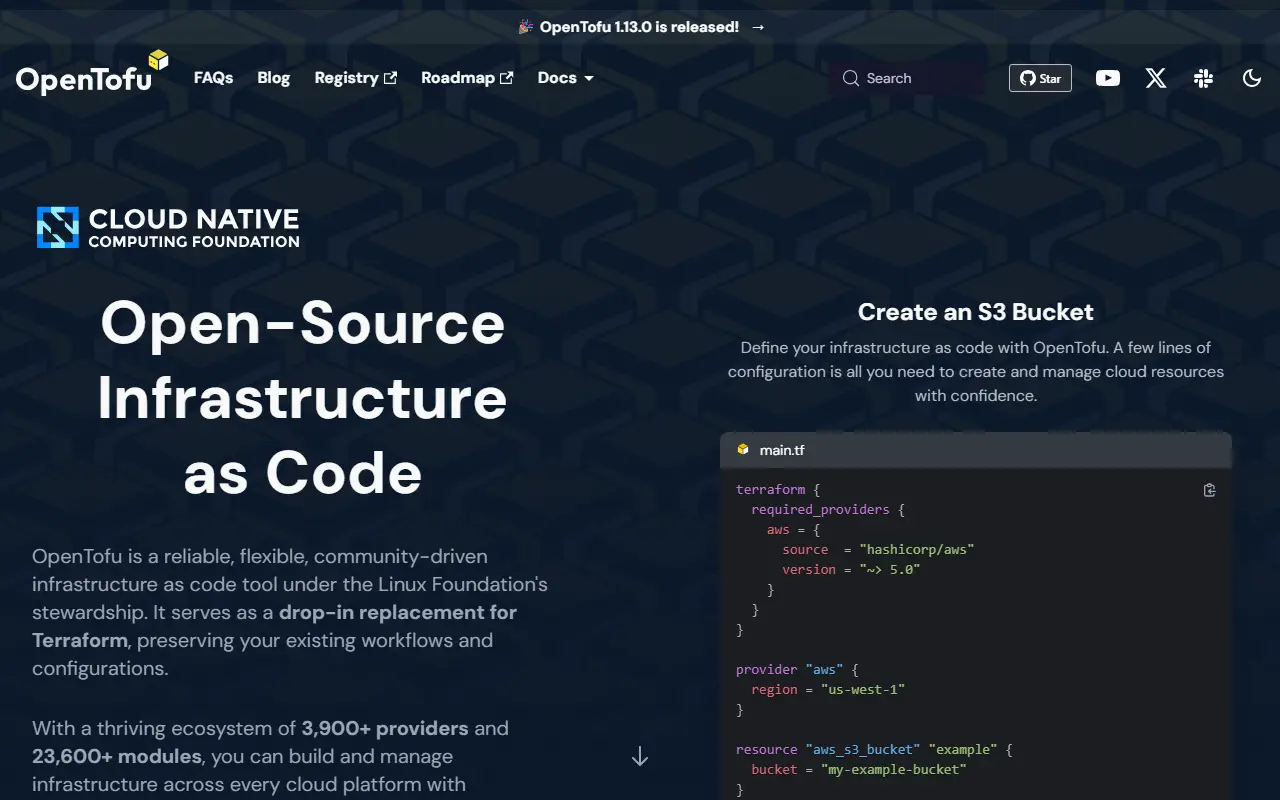
opentofu.orgOpenTofu homepage screenshot

OpenTofu is an open-source infrastructure tool for creating, modifying and versioning resources with safety and efficiency in mind. You describe infrastructure in a high-level configuration language, so a blueprint of your environment can be versioned and shared like other code. It can work with established cloud and service providers and with custom in-house platforms. It is written in Go and released under the MPL-2.0 license. It is widely understood as a community continuation of Terraform's open-source code.

Its key features are infrastructure as code, execution plans that preview what an apply will do, a resource graph that parallelizes work on independent resources, and change automation that applies complex changesets with little manual effort. Nightly builds are available. The community uses GitHub Discussions, the opentofu channel on the CNCF Slack, regular community meetings and a Technical Steering Committee.

Key features

  • Declarative infrastructure as code
  • Execution plans preview changes before apply
  • Resource graph parallelizes independent work
  • Works with many service providers
  • Change automation for large changesets
  • Nightly builds for early testing

Pricing: Free and open source under the MPL-2.0 license.

Read more about OpenTofuWebsite GitHub

Semaphore UI

A web UI and API for running Ansible, Terraform, OpenTofu, Terragrunt, PowerShell and Bash from a shared, access-controlled place, with scheduling and notifications.

GitHub stars
14k
Last commit
yesterday
Latest release
v2.19.12
Licence
MIT
Self-hosted
Yes
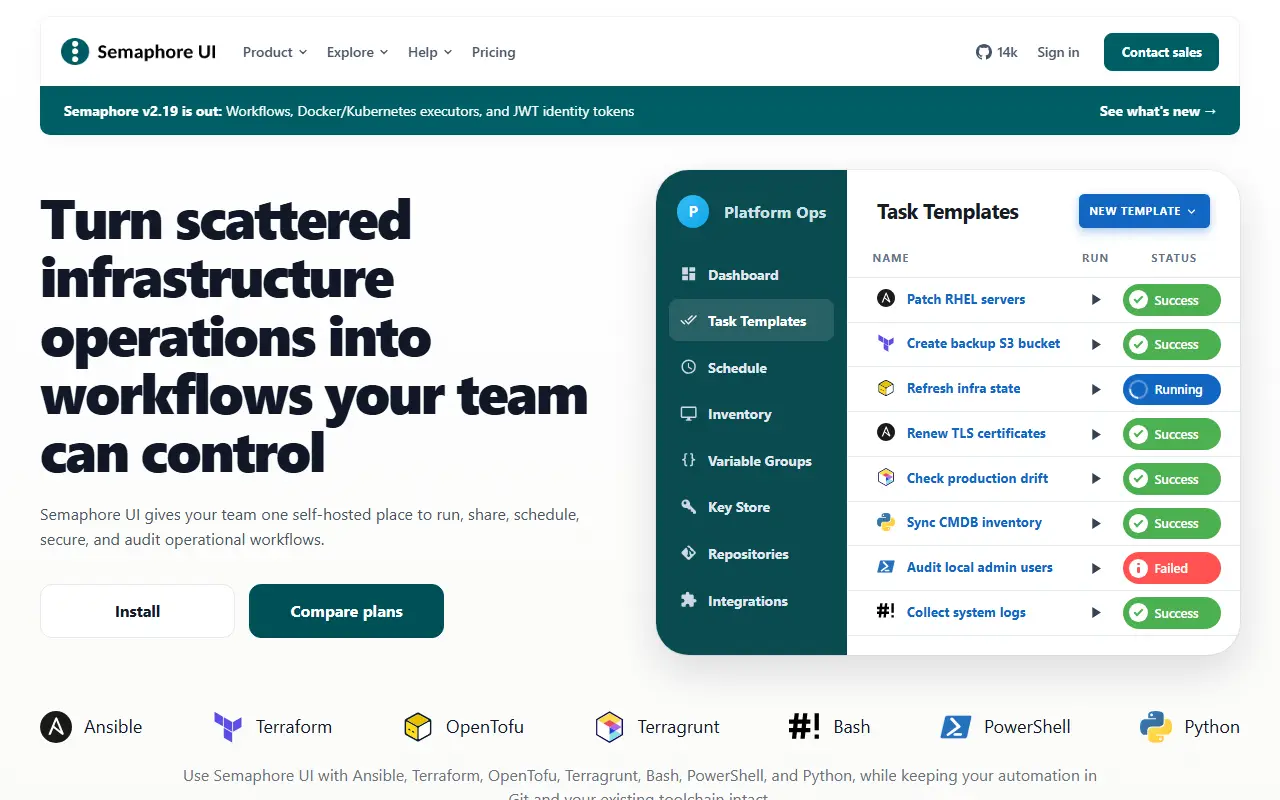
semaphoreui.comSemaphore UI homepage screenshot

Semaphore UI is a web interface for managing DevOps tooling when running commands from a terminal no longer scales. It lets teams run Ansible playbooks, Terraform and OpenTofu code, and Bash and PowerShell scripts from a shared place with controlled access and notifications about failed tasks.

Work is organized into projects, with reusable task templates that can be run on demand or on a schedule. Inventories describe the target hosts, and variable groups hold environment variables and secrets for tasks to use. An API allows automation, and a Postman collection plus documentation are provided. Its repository topics place it in the same space as AWX and Jenkins.

Semaphore is written in Go and licensed under MIT. The most common installation method is Docker, but it is also available as a Snap, as Debian or RPM packages, as a plain binary, or as a pre-built virtual machine from marketplaces such as AWS, DigitalOcean and Vultr. An online demo is available for trying it out.

Key features

  • Run Ansible playbooks from a web UI
  • Terraform, OpenTofu and Terragrunt support
  • Bash and PowerShell script execution
  • Reusable task templates and schedules
  • Inventories and secret variable groups
  • Failure notifications and access control
  • API for automation

Pricing: Community is free and self-hosted. Pro is $490 per year for a 4-user, 4-runner package (1 and 10 user packages also exist), with a 30-day trial; Enterprise is custom.

Atlantis

A self-hosted Go application that automates Terraform through pull requests, running plan and apply remotely and commenting the results back on the PR.

GitHub stars
9.3k
Last commit
yesterday
Latest release
v0.48.0
Licence
Apache-2.0
Self-hosted
Yes
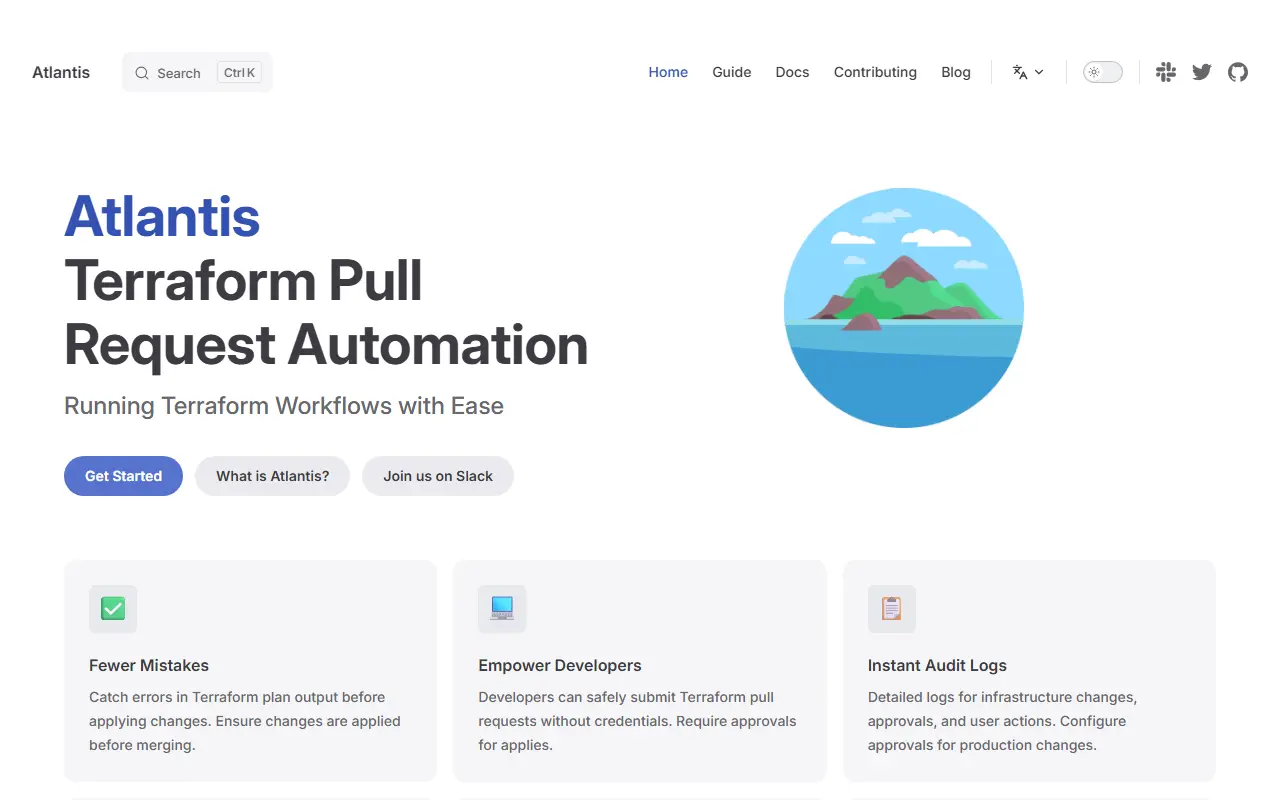
runatlantis.ioAtlantis homepage screenshot

Atlantis is a self-hosted application written in Go that automates Terraform through pull requests. It listens for pull request events delivered by webhooks, runs terraform plan, import and apply on a server, and then comments the output back on the pull request.

Moving these steps into the review flow makes Terraform changes visible to the whole team and lets engineers who are not operations specialists collaborate on infrastructure. It also helps standardize how Terraform is run, since everyone's changes go through the same remote workflow rather than from individual laptops. The project documents a getting-started guide, full documentation and release downloads, and community help comes through Slack.

Atlantis is licensed under Apache-2.0 and you run it yourself, which is why it is often grouped with Terraform automation and collaboration tools. It suits platform and SRE teams managing infrastructure as code with a Git-based review workflow.

Key features

  • Runs Terraform plan from pull requests
  • Remote apply and import commands
  • Posts command output as PR comments
  • Webhook-driven Git integration
  • Single self-hosted Go binary
  • Shared Terraform workflow for teams

Pricing: Free and open source under the Apache-2.0 licence.

Read more about AtlantisWebsite GitHub

Burrito

Burrito is a Kubernetes operator for Terraform that continuously plans and applies infrastructure code and shows state changes in a web UI.

GitHub stars
756
Last commit
today
Latest release
v0.14.1
Licence
Apache-2.0
Self-hosted
Yes
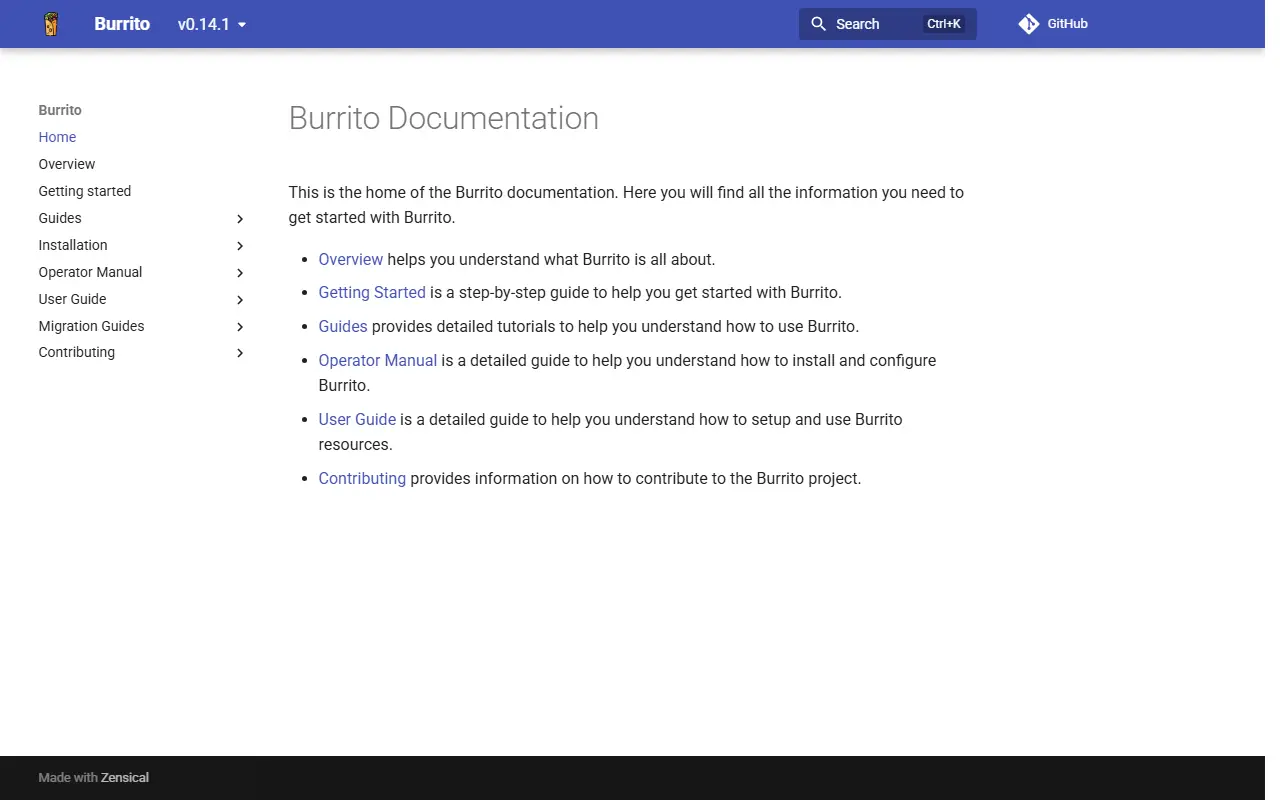
docs.burrito.tfBurrito homepage screenshot

Burrito is a TACoS (Terraform Automation and Collaboration Software) Kubernetes operator, summed up by its authors as Argo CD for Terraform. It targets the lack of built-in tools for managing state drift in Terraform, the difficulty of building CI/CD pipelines for it, and the lack of an easy way to see how state changes.

It plans your Terraform code continuously and runs applies when needed, offers a pull request or merge request integration so teams do not have to write Terraform pipelines, and presents state modifications in a simple web UI. The topics also list OpenTofu and Terragrunt support. Documentation is published at docs.burrito.tf, and conference talks and blog posts describe the design and the challenges it solved.

The project is still pre-release, so minor versions can introduce breaking changes before 1.0, and users should install tagged releases rather than the main branch. Burrito is written in Go, licensed under Apache-2.0, runs inside your own Kubernetes cluster and is maintained by Theodo Cloud.

Key features

  • Continuous Terraform plans and applies
  • Drift detection for infrastructure state
  • Pull and merge request integration
  • Web UI for state changes
  • OpenTofu and Terragrunt support
  • Kubernetes operator deployment

Pricing: Free and open source under the Apache-2.0 license.

Read more about BurritoWebsite GitHub

HCP Terraform alternatives: questions

What is the best open-source alternative to HCP Terraform?
OpenTofu is the top-ranked open-source alternative to HCP Terraform on Enlisted: OpenTofu is an open-source infrastructure as code tool that declaratively builds, changes and versions cloud infrastructure. Other strong options are Semaphore UI, Atlantis and Burrito.
Are these HCP Terraform alternatives free?
All 4 are open source, so the code is free to use under its licence, and all of them can be self-hosted on your own server or computer.
How is this list of HCP Terraform alternatives ranked?
By a score built from GitHub stars, star growth over the last 30 days and how recently the code changed. 4 of these projects shipped code in the last 30 days. Data is refreshed daily, and nobody can pay to move up.

People also look for alternatives to…

View all