#1
Pulumi is an infrastructure as code platform that lets teams define cloud infrastructure in Node.js, Python, Go, .NET, Java or YAML.
- GitHub stars
- 26k
- Last commit
- yesterday
- Latest release
- v3.275.0
- Licence
- Apache-2.0
- Self-hosted
- Yes
- Hosted version
- Available
pulumi.com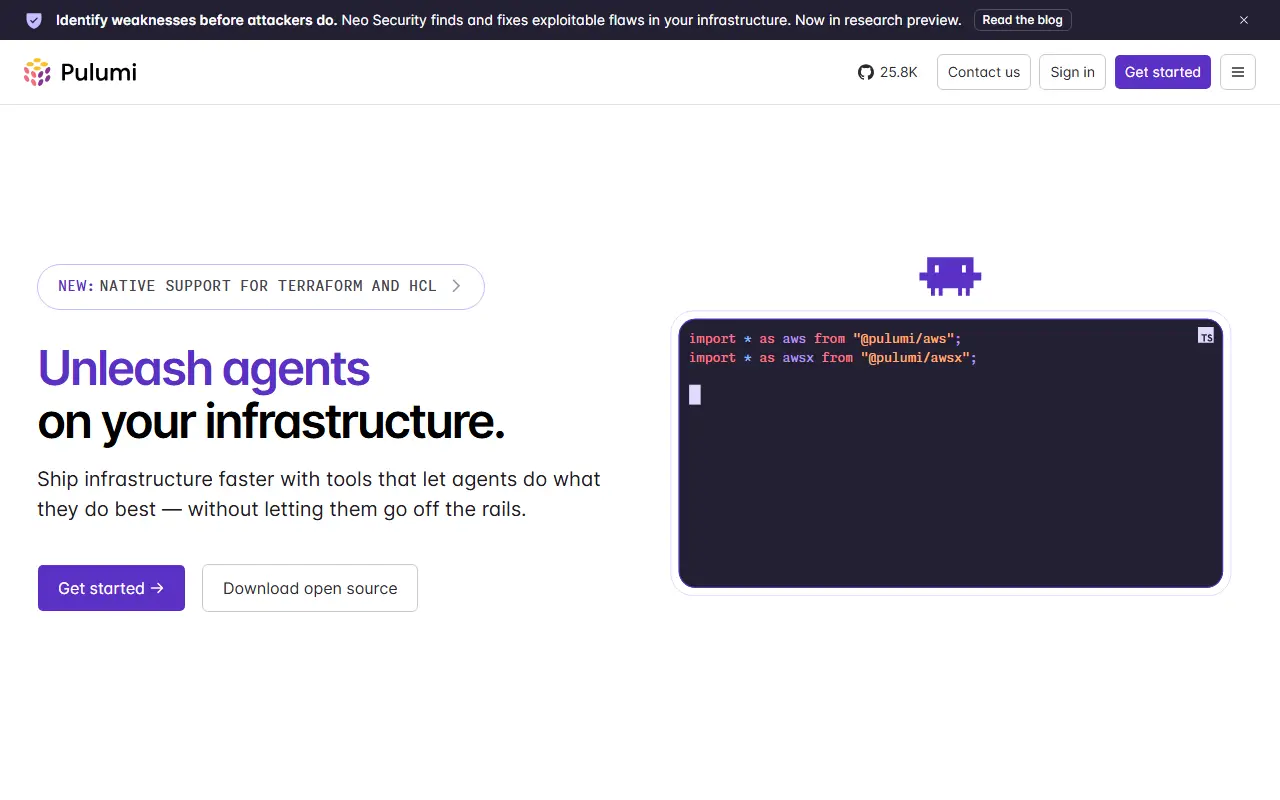
Pulumi is an infrastructure as code platform. Teams describe infrastructure for any cloud in a general-purpose language: Node.js, Python, Go, .NET, Java, or YAML. A registry lists hundreds of cloud providers and packages.
Around the core tool sit services for secrets and configuration, discovery and governance, an internal developer platform, and an AI agent named Neo. The Free plan covers one user with state management and Pulumi Deployments; Essentials, Pro and Enterprise add users, policy, SSO, audit logs and more.
The licence listed for the project is Apache-2.0. The pricing page says Pulumi stays free for open source and individuals, and the Enterprise plan lists self-hosting as available.
Key features
- Infrastructure as code in several languages
- AI infrastructure agent called Neo
- Environments, secrets and configuration management
- Asset management and compliance remediation
- Registry of cloud providers and packages
- Unlimited projects, stacks and environments on Free
- SSO, RBAC and policy enforcement on Pro
Pricing: Free is $0 for 1 user. Essentials is $40/month (up to 500 managed resources), Pro $400/month (up to 2,000), Enterprise $2,000/month (up to 4,750). Credits: 40, 400 and 2,000.
#2
A web UI and API for running Ansible, Terraform, OpenTofu, Terragrunt, PowerShell and Bash from a shared, access-controlled place, with scheduling and notifications.
- GitHub stars
- 14k
- Last commit
- today
- Latest release
- v2.20.23
- Licence
- MIT
- Self-hosted
- Yes
semaphoreui.com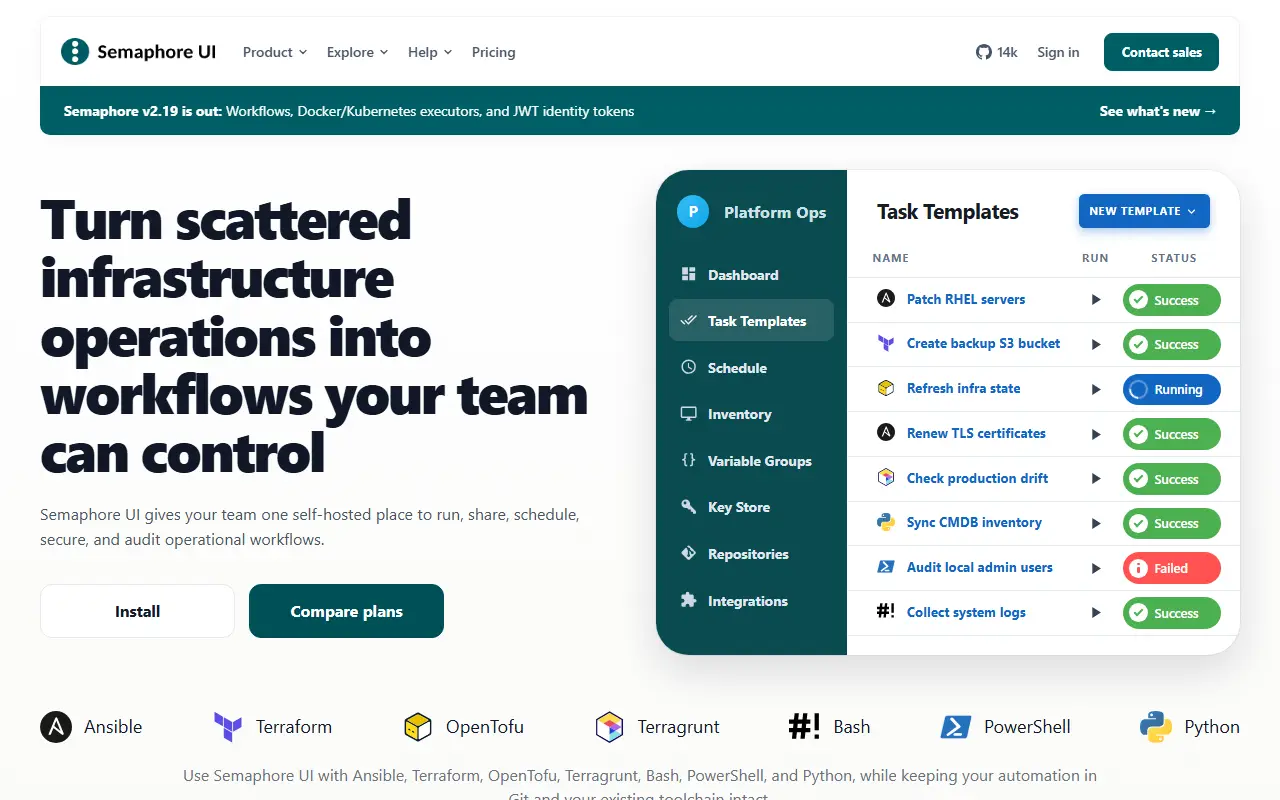
Semaphore UI is a web interface for managing DevOps tooling when running commands from a terminal no longer scales. It lets teams run Ansible playbooks, Terraform and OpenTofu code, and Bash and PowerShell scripts from a shared place with controlled access and notifications about failed tasks.
Work is organized into projects, with reusable task templates that can be run on demand or on a schedule. Inventories describe the target hosts, and variable groups hold environment variables and secrets for tasks to use. An API allows automation, and a Postman collection plus documentation are provided. Its repository topics place it in the same space as AWX and Jenkins.
Semaphore is written in Go and licensed under MIT. The most common installation method is Docker, but it is also available as a Snap, as Debian or RPM packages, as a plain binary, or as a pre-built virtual machine from marketplaces such as AWS, DigitalOcean and Vultr. An online demo is available for trying it out.
Key features
- Run Ansible playbooks from a web UI
- Terraform, OpenTofu and Terragrunt support
- Bash and PowerShell script execution
- Reusable task templates and schedules
- Inventories and secret variable groups
- Failure notifications and access control
- API for automation
Pricing: Community is free and self-hosted. Pro is $490 per year for a 4-user, 4-runner package (1 and 10 user packages also exist), with a 30-day trial; Enterprise is custom.
#3
Crossplane is an open source CNCF project built on Kubernetes to orchestrate applications and infrastructure through custom declarative APIs.
- GitHub stars
- 12k
- Last commit
- yesterday
- Latest release
- v2.4.3
- Licence
- Apache-2.0
- Self-hosted
- Yes
crossplane.io
Crossplane is a cloud-native framework for platform engineering that enables organizations to build control planes similar to those used by cloud providers. It extends Kubernetes to manage any resource anywhere and provides a library of components for assembling platforms. The framework allows users to expose declarative APIs that humans, automation, and AI systems can safely act on.
Built on the Kubernetes control plane, Crossplane is designed for extensibility through Providers that orchestrate new kinds of applications and infrastructure, and Configurations that expose new APIs. It puts users in control by allowing them to build platforms around their own opinions using declarative APIs that are explicit, auditable, and machine-readable. The project is maintained by Upbound and is part of the CNCF.
Key features
- Build custom APIs and services with control planes
- Extend Kubernetes to manage any resource anywhere
- Use a library of components to assemble platforms faster
- Expose declarative APIs for humans, automation, and AI systems
- Encapsulate policies, permissions, and guardrails behind a custom API layer
- Extensible through Providers and Configurations

Infracost produces cost estimates for Terraform, CloudFormation and CDK code and brings FinOps policies into engineering workflows.
- GitHub stars
- 13k
- Last commit
- 3 days ago
- Latest release
- v0.10.49
- Licence
- Apache-2.0
infracost.io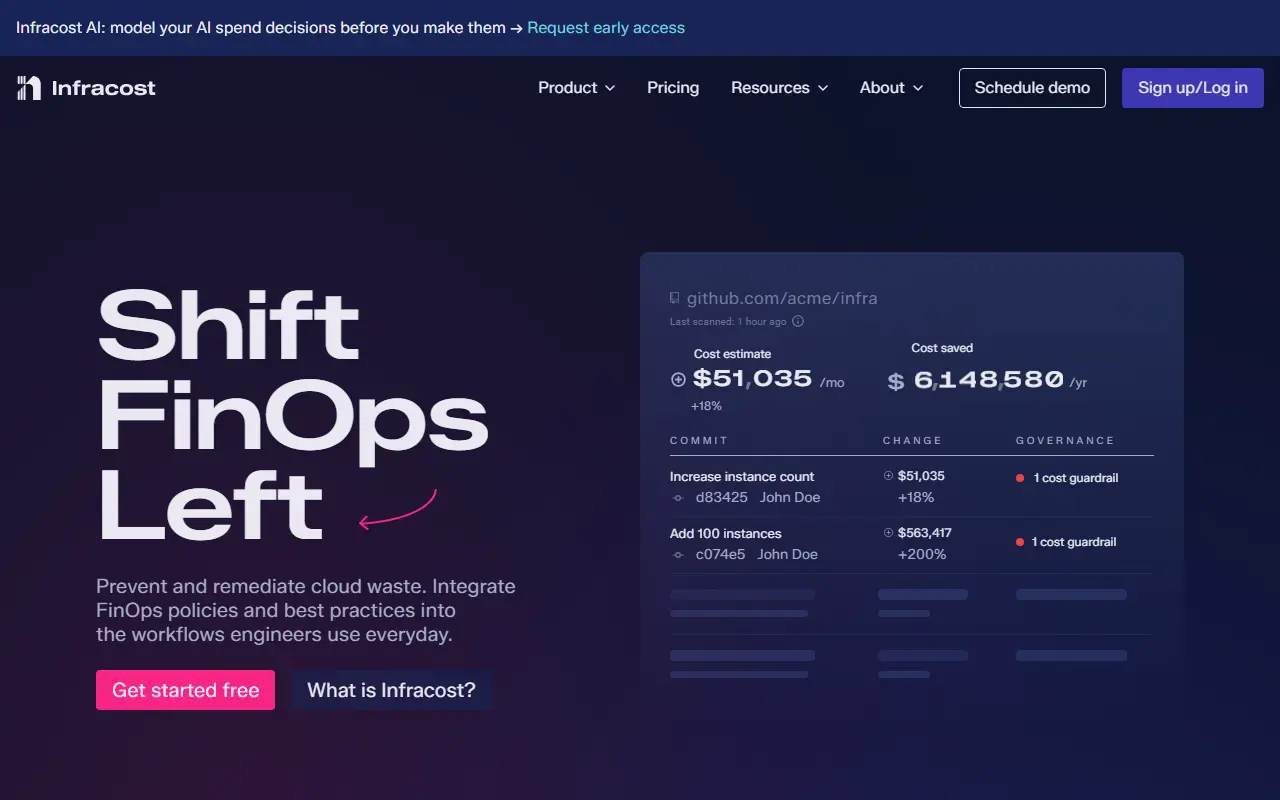
Infracost is aimed at stopping cloud overspend before it ships. Its pitch is to integrate FinOps policies and best practices into the workflows engineers use every day, so cost is considered while infrastructure code is written and reviewed instead of after the bill arrives.
It connects to AWS, Azure and GCP and works with infrastructure-as-code tools including Terraform, CloudFormation, CDK, Azure ARM and Kubernetes. Listed integrations cover IDEs such as VS Code, Cursor and JetBrains, and CI/CD systems including GitHub, GitLab and Azure DevOps.
Paid tiers add team-level controls on top of the CI/CD plan: cost guardrails, an issue explorer, autofix workflows, visibility dashboards, audit trails and custom price book support. The top tier adds SSO and SAML, SKU-level price overrides and reporting across business units.
Key features
- Cost estimates for Terraform, CloudFormation and CDK
- Cost guardrails, issue explorer, autofix workflows
- Custom price book support
- Dashboards, team management and audit trails
- SKU-level price overrides and cross-unit reporting
- Works across AWS, Azure, GCP and Kubernetes
Pricing: The CI/CD plan is free with 1000 free runs per month. Starter is $250/mo with 10,000 runs per month, and Cloud is $1,000/mo. Enterprise is priced by contacting the vendor.
#5
Terragrunt is an open-source IaC orchestration tool that helps manage Terraform and OpenTofu at scale.
- GitHub stars
- 9.9k
- Last commit
- yesterday
- Latest release
- v1.2.2
- Licence
- MIT
- Self-hosted
- Yes
- Hosted version
- Available
terragrunt.com
Terragrunt is a flexible orchestration tool for Infrastructure as Code written in OpenTofu or Terraform. It helps platform teams organize and speed up their IaC by breaking down monolithic infrastructure into manageable units with independent state. The tool provides control over what infrastructure is updated, how it gets updated, and in what order using a Run Queue.
Key features
- Segment infrastructure into manageable units with independent state
- Control updates with a Run Queue to reject all-or-nothing updates
- Authentication tooling for managing infrastructure across environments and cloud providers with least privilege access
- Automate tasks before and after IaC updates using hooks
- Handle expected errors from flaky networks and cloud providers with built-in error handling
- Catalog standard infrastructure patterns for reuse using a Terminal User Interface (TUI)

A self-hosted Go application that automates Terraform through pull requests, running plan and apply remotely and commenting the results back on the PR.
- GitHub stars
- 9.4k
- Last commit
- today
- Latest release
- v0.49.0
- Licence
- Apache-2.0
- Self-hosted
- Yes
runatlantis.io
Atlantis is a self-hosted application written in Go that automates Terraform through pull requests. It listens for pull request events delivered by webhooks, runs terraform plan, import and apply on a server, and then comments the output back on the pull request.
Moving these steps into the review flow makes Terraform changes visible to the whole team and lets engineers who are not operations specialists collaborate on infrastructure. It also helps standardize how Terraform is run, since everyone's changes go through the same remote workflow rather than from individual laptops. The project documents a getting-started guide, full documentation and release downloads, and community help comes through Slack.
Atlantis is licensed under Apache-2.0 and you run it yourself, which is why it is often grouped with Terraform automation and collaboration tools. It suits platform and SRE teams managing infrastructure as code with a Git-based review workflow.
Key features
- Runs Terraform plan from pull requests
- Remote apply and import commands
- Posts command output as PR comments
- Webhook-driven Git integration
- Single self-hosted Go binary
- Shared Terraform workflow for teams
Pricing: Free and open source under the Apache-2.0 licence.
#7
CloudQuery is an open-source, self-hosted tool that syncs 80+ cloud and SaaS sources into your own database for SQL-based inspection and automation.
- GitHub stars
- 6.6k
- Last commit
- 2 days ago
- Latest release
- plugins-destination-clickhouse-v8.4.0
- Licence
- MPL-2.0
- Self-hosted
- Yes
cloudquery.io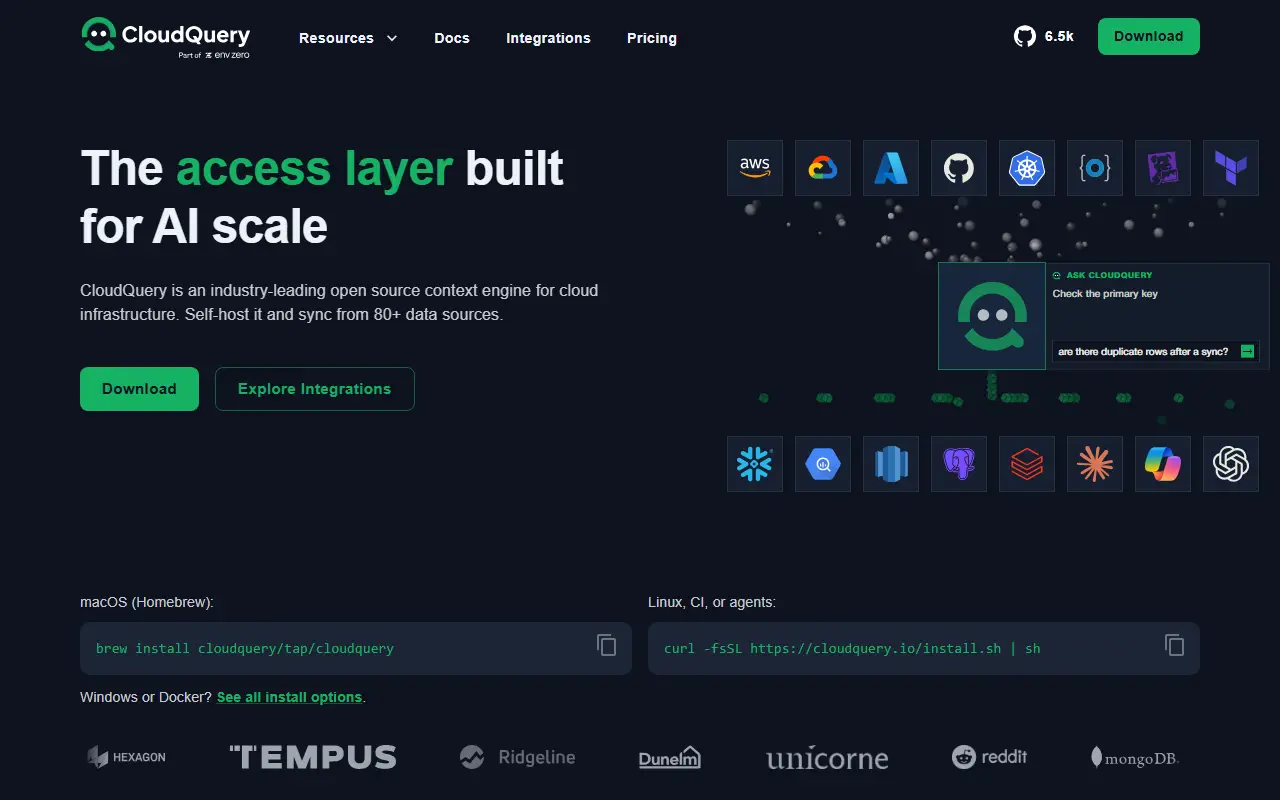
CloudQuery is an open-source context engine for cloud infrastructure. It syncs data from 80+ cloud and SaaS sources into a database of the user's choice, such as Postgres, BigQuery, Snowflake, or S3. The tool is self-hosted and runs as a single binary on Linux, macOS, or Windows.
Users define sources in YAML configuration files and run syncs once or on a schedule. CloudQuery standardizes data across providers, allowing users to query everything with standard SQL. It is suited for teams that need to build cloud asset inventory, CSPM, FinOps, or vulnerability management solutions.
Key features
- Syncs from 80+ cloud and SaaS sources including AWS, Azure, and GCP
- Self-hosted, data stays within the user's network
- Configuration defined in version-controlled YAML
- Supports destinations such as Postgres, BigQuery, Snowflake, and S3
- Provides an SDK to build new source integrations

Gardener is a managed Kubernetes service that provisions homogeneous clusters with identical configuration on any infrastructure using hosted control planes.
- GitHub stars
- 3.5k
- Last commit
- yesterday
- Latest release
- v1.154.4
- Licence
- Apache-2.0
gardener.cloud
Gardener is a managed Kubernetes service that delivers fully-managed clusters at scale on any infrastructure. It provisions clusters with identical configuration and options across different infrastructures, with 100% CNCF Kubernetes and AI conformance.
The platform supports running thousands of clusters without sacrificing performance, resilience, or cost efficiency. It includes security and compliance checks, fleet management capabilities, and self-healing and auto-scaling features across the stack. Gardener is built in the open and governed under the NeoNephos Foundation.
Key features
- Provision clusters with identical configuration on any infrastructure
- Run thousands of clusters with day-1 and day-2 operations remaining consistent
- Check clusters against enterprise-grade security standards
- Apply guardrails to all clusters and control Kubernetes and OS versions and lifecycle
- Self-healing and auto-scaling capabilities across the stack
- Manage cluster lifecycle via click of a button or kubectl apply

Terramate is an open-source IaC orchestration platform that helps platform teams and developers manage Terraform, OpenTofu, and Terragrunt with GitOps workflows, code generation, and observability.
- GitHub stars
- 3.6k
- Last commit
- 4 days ago
- Latest release
- v0.17.4
- Licence
- MPL-2.0
terramate.io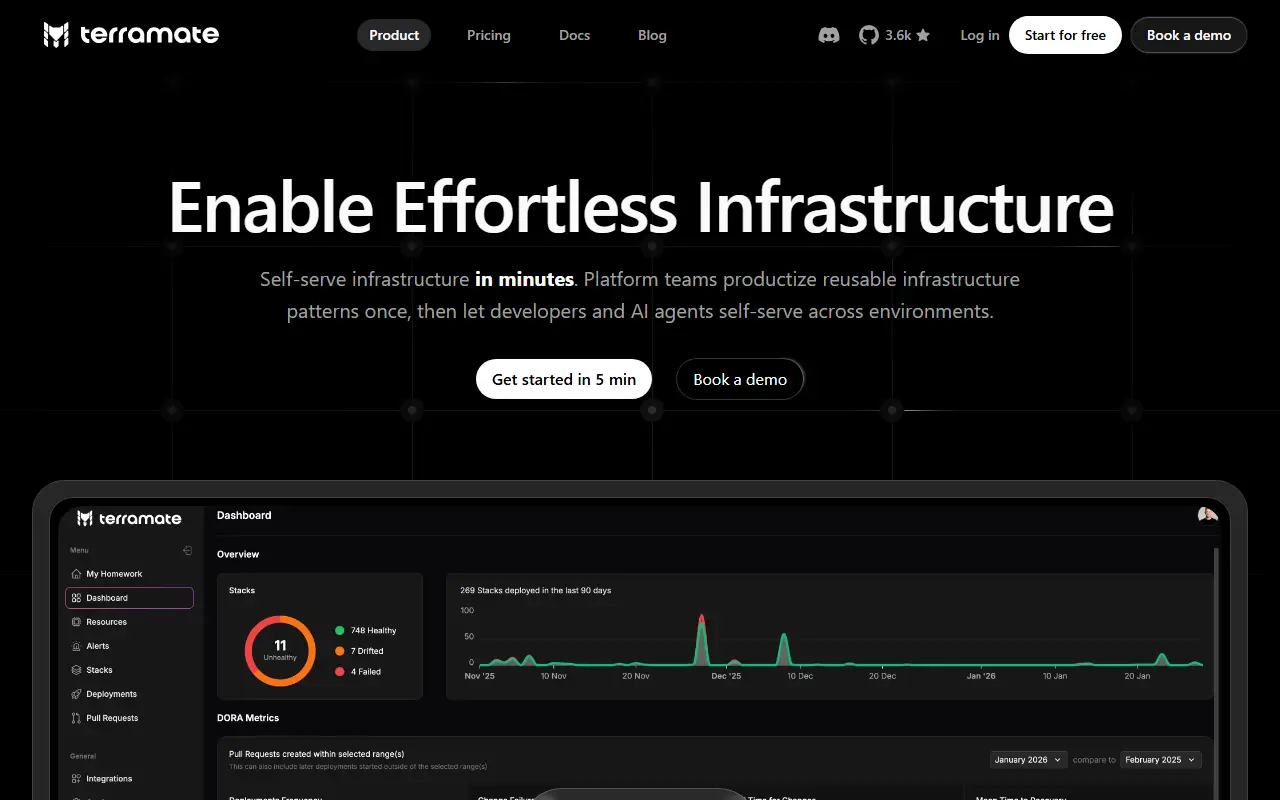
Terramate is an open-source Infrastructure as Code (IaC) orchestration platform. It provides GitOps workflows, orchestration, code generation, observability, drift detection, asset management, policies, and Slack notifications. It integrates with Terraform, OpenTofu, Terragrunt, Kubernetes, GitHub Actions, GitLab CI/CD, BitBucket Pipelines, and other CI/CD platforms.
The platform is designed for two audiences: platform teams and developers. Platform teams can productize reusable infrastructure patterns, while developers can self-serve infrastructure without requiring cloud or Terraform expertise. It includes features like Stacks, Code Generation, Orchestration, CI/CD Integration, Observability, Drift Detection, Incident Management, and Asset Inventory.
Key features
- Stacks: Split Terraform, OpenTofu, and Terragrunt state files into smaller stacks that can be deployed, managed, and governed as a unit.
- Code Generation: Generate infrastructure code to standardize golden paths.
- Orchestration: Automate workflows across environments.
- CI/CD Integration: Works with GitHub Actions, GitLab CI/CD, BitBucket Pipelines, and any other CI/CD platform.
- Observability: Provides full visibility, analytics, and real-time insights across infrastructure, repositories, and teams.
- Drift Detection: Detects drift and misconfiguration early.

Terrakube is an open source platform for remote infrastructure as code operations using Terraform or OpenTofu, installable in Kubernetes.
- GitHub stars
- 998
- Last commit
- yesterday
- Latest release
- 2.34.1
- Licence
- Apache-2.0
- Self-hosted
- Yes
docs.terrakube.io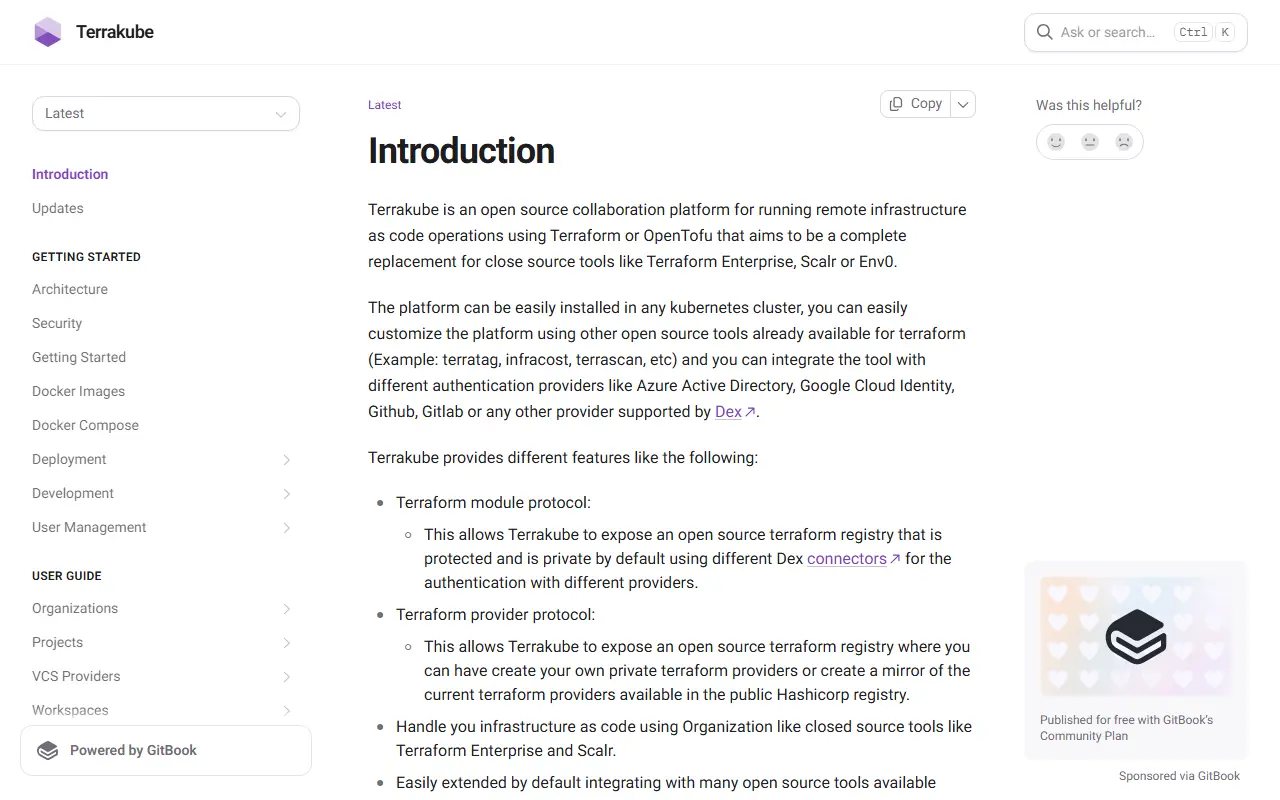
Terrakube is an open source collaboration platform for running remote infrastructure as code operations using Terraform or OpenTofu. It aims to be a complete replacement for closed source tools like Terraform Enterprise, Scalr or Env0. The platform can be installed in any Kubernetes cluster and customized with other open source tools.
Key features
- Exposes an open source Terraform registry that is private by default using Dex connectors for authentication
- Allows creation of private Terraform providers or mirroring of public Hashicorp registry providers
- Handles infrastructure as code using organizations similar to Terraform Enterprise and Scalr
- Integrates with many open source tools available for Terraform CLI
- Supports any RDBMS supported by Liquibase (MySQL, PostgreSQL, Oracle, SQL Server)
- Plugin support to extend functionality using different cloud providers and open source tools via Terrakube Configuration Language (TCL)
Commercial env0 alternatives
Hosted, closed-source products that compete with env0.
env0 alternatives: questions
- What is the best open-source alternative to env0?
- Pulumi is the top-ranked open-source alternative to env0 on Enlisted: Pulumi is an infrastructure as code platform that lets teams define cloud infrastructure in Node.js, Python, Go, .NET, Java or YAML. Other strong options are Semaphore UI, Crossplane, Infracost and Terragrunt.
- What are the best commercial alternatives to env0?
- HCP Terraform, Spacelift, Scalr, Red Hat Ansible Automation Platform and StackGen are among the hosted, closed-source alternatives to env0 listed on Enlisted, which lists 9 in total. Compare their pricing and features on each tool page.
- Are these env0 alternatives free?
- All 12 are open source, so the code is free to use under its licence, and all of them can be self-hosted on your own server or computer. 2 also offer a paid or managed cloud version if you'd rather not host it yourself.
- How is this list of env0 alternatives ranked?
- By a score built from GitHub stars, star growth over the last 30 days and how recently the code changed. 12 of these projects shipped code in the last 30 days. Data is refreshed daily, and nobody can pay to move up.
 TrackMedia
 TrackRev