 TrackMedia
 TrackRev

About Browserless
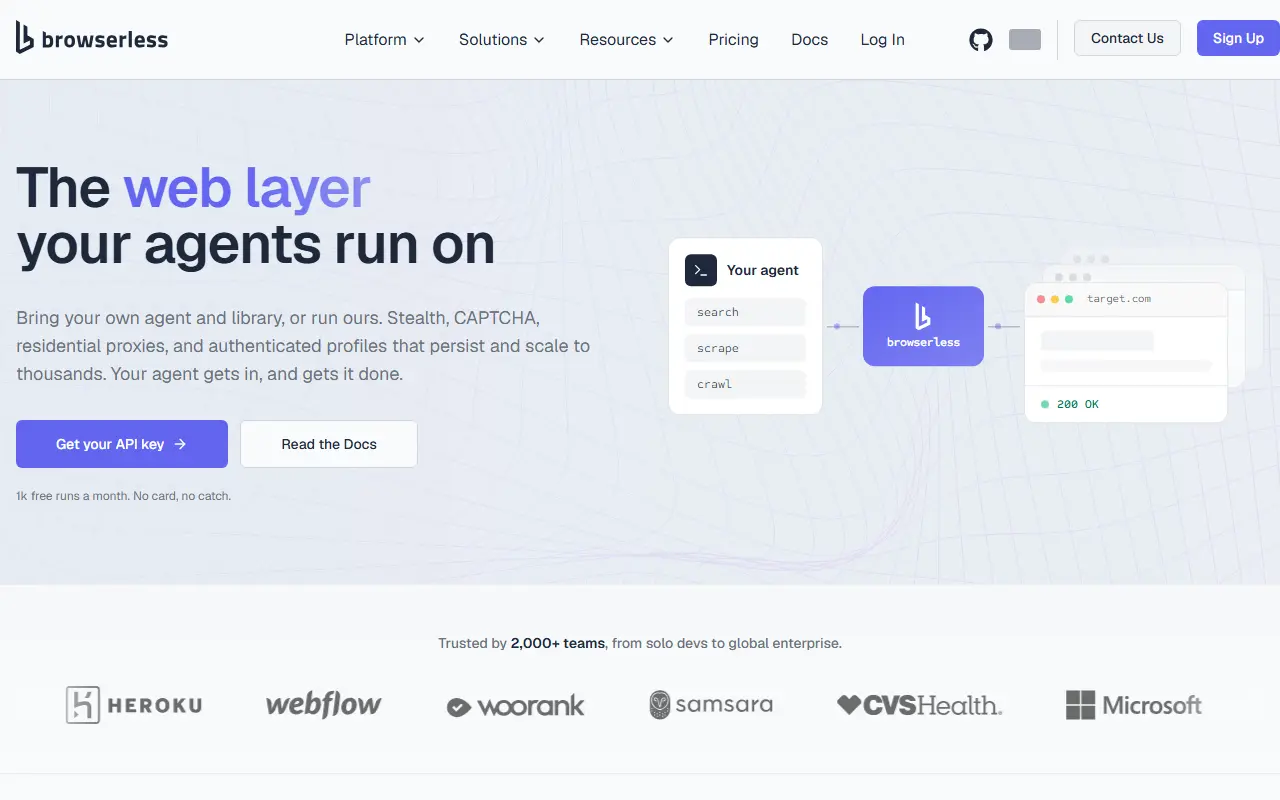
Browserless runs managed headless browsers that scripts and AI agents connect to instead of running Chrome themselves. Existing Puppeteer or Playwright code connects by pointing at a Browserless WebSocket endpoint with an API token, which the homepage describes as a three-line change.
The platform lists browsers as a service, browser tasks over simple HTTP APIs, an MCP server and a self-hosted option that runs on your own infrastructure. For agents it offers stealth, CAPTCHA handling, residential proxies and authenticated profiles that persist across runs, plus a browser agent that carries out multi-step tasks.
Solution pages target web scraping, automation, testing and Lighthouse audits, screenshots and PDFs, AI agents and enterprise needs with SLAs and compliance. The homepage says more than 2,000 teams use it and offers 1k free runs a month with no card required.
Key features
- Connect Puppeteer or Playwright scripts with a small change
- MCP tools for search, scrape and crawl
- Authenticated profiles reused across runs
- Browser agent for multi-step tasks
- Stealth, CAPTCHA and residential proxies
- Managed, API-based and self-hosted deployment options
Good fit for
- Web scraping without getting blocked
- Browser automation for AI agents
- Screenshots and PDFs
- Headless testing and Lighthouse audits
Browserless: questions and answers
- What is Browserless used for?
- Browserless is a headless browser service for scraping, automation, testing and AI agents, reachable through Puppeteer, Playwright, HTTP APIs or an MCP server, with a self-hosted option. It is a good fit for web scraping without getting blocked, browser automation for AI agents, and screenshots and PDFs.
- Is Browserless open source?
- Yes. Browserless is open source under a custom licence. Its source code is on GitHub at browserless/browserless and is written mainly in TypeScript.
- Is Browserless free?
- Yes. Browserless is open source, so the software itself is free to use under the terms of its own licence. A managed cloud version is also available.
- Can I self-host Browserless?
- Yes. Browserless can be self-hosted on your own server or infrastructure.
- What is Browserless an alternative to?
- Browserless is an open-source alternative to Apify, PhantomBuster, Bardeen and Axiom.ai. Other open-source alternatives to Apify include Playwright, Maxun and Skyvern.
- Is Browserless actively maintained?
- Yes. The most recent commit to Browserless was on 12 November 2026, and the latest release is v2.62.0, published on 10 November 2026. The project has 14k stars on GitHub, with 114 added in the last 30 days.
Open-source alternatives to Browserless
See all
Playwright
Testing & QA
Playwright is a framework for Web Testing and Automation. It allows testing Chromium, Fire
Apache-2.0vs BrowserStack★ 100k
Maxun
Workflow Automation
Turn any website into clean, structured data. Scrape, crawl, extract, search and monitor v
AGPL-3.0vs Octoparse★ 18k
Skyvern
Workflow Automation
Automate browser based workflows with AI
AGPL-3.0vs Browse AI★ 23k
Automa
Workflow Automation
A browser extension for automating your browser by connecting blocks
OSSvs Bardeen★ 22k
BrowserAct
Workflow Automation
Browser automation CLI built for AI agents. Break through anti-bot walls, hand off to huma
MITvs Browse AI★ 6.3k
n8n
Workflow Automation
n8n is a workflow automation platform that uniquely combines AI capabilities with business
OSSvs Zapier★ 210k
SaaS alternatives to Browserless
See all
Apify
Workflow Automation
Cloud platform and marketplace for web scraping and browser automation actors
SaaS
PhantomBuster
Workflow Automation
Cloud automations for lead generation and data extraction from social platforms
SaaS
Bardeen
Workflow Automation
Browser-based AI automation that scrapes web data and fills in sales and ops workflows
SaaS
Axiom.ai
Workflow Automation
No-code browser bots that click, type and scrape websites to automate repetitive tasks
SaaS
Browserbase
Workflow Automation
Cloud headless browser infrastructure for web automation and AI agents
SaaS