7,363 open-source and SaaS tools, with GitHub stats refreshed every day.

3 alternatives ranked by real activity

Open-source Browserbase alternatives

A curated, ranked list of the 3 best open-source alternatives to Browserbase.

The best open-source alternative to Browserbase is Skyvern. If that doesn't suit you, other good options are BrowserAct and Magnitude.

Browserbase alternatives are mainly workflow automation tools, but some are also testing & QA tools. 1 of them shipped code in the last 30 days, 3 can be self-hosted, and 2 use a permissive licence.

Last updated October 3, 2026 · ranked by GitHub stars, growth and recent commits

Skyvern

A browser automation tool that uses LLMs and computer vision to perform workflows on websites, with a Playwright-compatible SDK and a no-code workflow builder.

GitHub stars
23k
Last commit
yesterday
Latest release
v1.0.55
Licence
AGPL-3.0
Self-hosted
Yes
Hosted version
Available
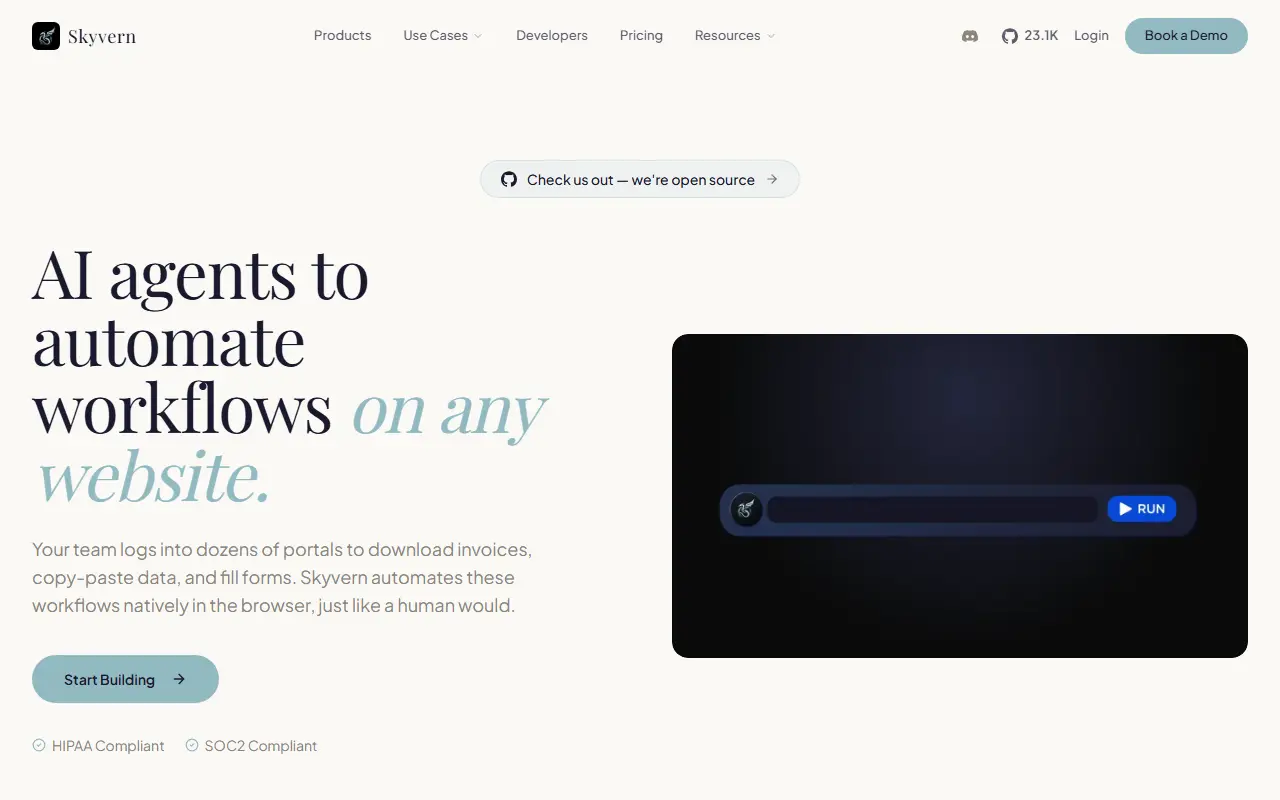
skyvern.comSkyvern homepage screenshot

Skyvern automates browser-based workflows using large language models and computer vision. It offers a Playwright-compatible SDK that adds AI capabilities on top of Playwright, and a no-code workflow builder so that both technical and non-technical users can automate manual tasks on any website, replacing brittle automation scripts.

Traditional browser automation depends on custom scripts for each site, often relying on DOM parsing and XPath selectors that break whenever the layout changes. Skyvern instead relies on vision-capable LLMs to understand and interact with pages. Its design was inspired by task-driven autonomous agents such as BabyAGI and AutoGPT, with the added ability to act on sites using browser automation libraries. A swarm of agents comprehends a website, plans actions and executes them.

Skyvern is written in Python and licensed under AGPL-3.0, and topics note RPA and workflow use. You can self-host it or use the hosted service at skyvern.com. It targets teams that automate tasks across many different websites, such as form filling or data retrieval, where writing and maintaining per-site scripts is costly.

Key features

  • LLM and vision-based website understanding
  • SDK compatible with Playwright
  • No-code workflow builder
  • Works on sites without custom scripts
  • Multi-agent planning and execution
  • Self-hosted or hosted service

Pricing: A free plan includes 5,000 credits. Hobby is $29 per month for 30,000 credits and Pro $149 per month for 150,000 credits; Enterprise is custom through sales.

Read more about SkyvernWebsite GitHub

BrowserAct

Browser automation CLI and skills for AI agents that run web tasks in real browsers, with parallel sessions, isolated accounts, and human hand-off.

GitHub stars
6.1k
Last commit
1 mo ago
Licence
MIT
Hosted version
Available
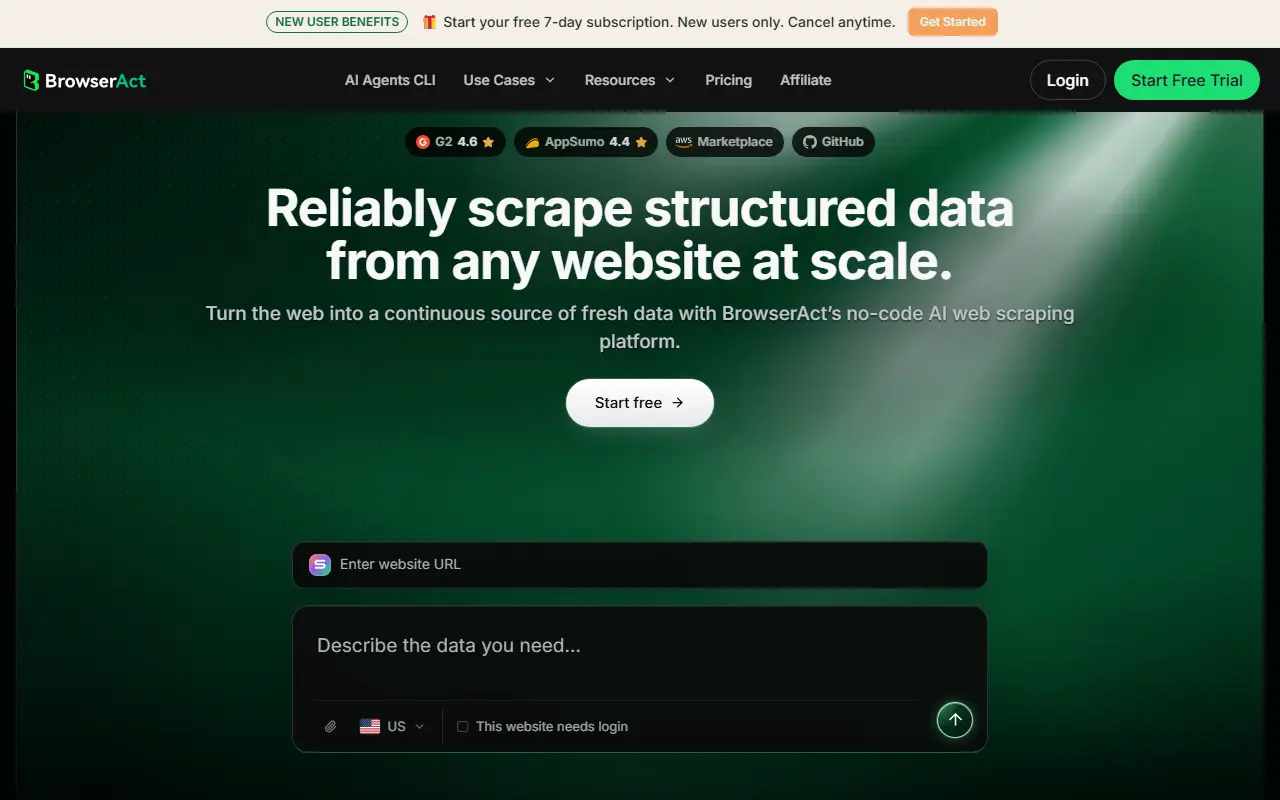
browseract.comBrowserAct homepage screenshot

BrowserAct gives AI agents and teams a way to automate real browsers for web data extraction and account-based workflows. The repository contains skills for agents such as Claude Code, Cursor, and Codex, along with a CLI. The project describes features for handling anti-bot protections, handing control to a human when an agent gets stuck, and running tasks in parallel without cross-contamination. It is released under the MIT license.

There are two ways to use it. In the cloud mode, you describe the website and the fields you need and BrowserAct builds and tests a reusable scraping bot in a cloud browser, then runs it for you. In the local mode, agents load the BrowserAct skill and drive a local browser, including reuse of local Chrome login state, from their own environment. Independent sessions and isolated multi-account browsing keep identities separate.

It suits developers building AI agents that need dependable browser access, and teams that want repeatable data collection. The cloud service is run by the vendor, so check browseract.com for plans and usage limits.

Key features

  • Browser automation CLI for AI agents
  • Skills for Claude Code, Cursor, and Codex
  • Cloud-managed or local browser control
  • Parallel tasks and independent sessions
  • Isolated multi-account browsing
  • Human hand-off when an agent is stuck

Pricing: A free plan includes 200 signup credits. Paid plans cost $16 (Basic), $70 (Essential) and $120 (Advanced) per month with a 7-day trial, cheaper billed yearly; the local CLI has no runtime fee.

Magnitude

Magnitude is an open-source, vision-first browser agent that controls web pages from natural language and includes a test runner with visual assertions.

GitHub stars
4.1k
Last commit
7 mo ago
Latest release
magnitude-core@0.3.1
Licence
Apache-2.0
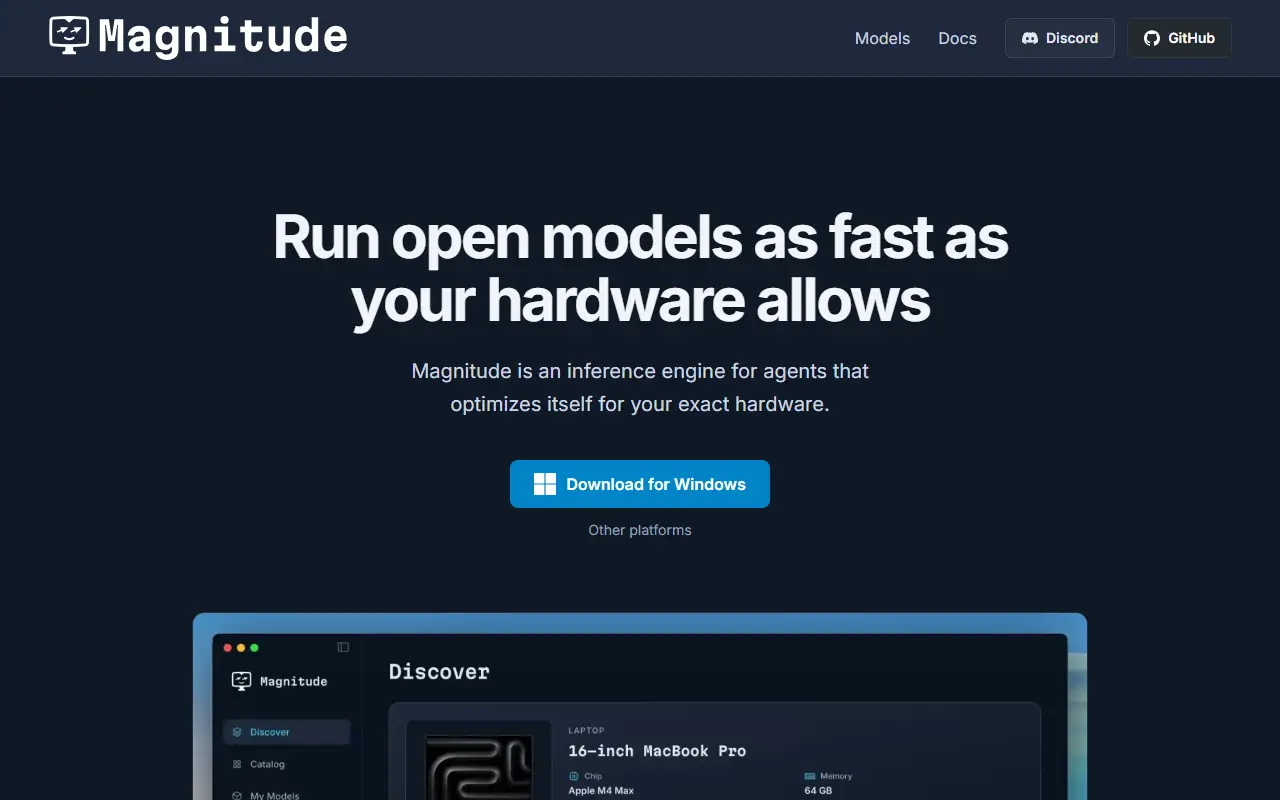
magnitude.runMagnitude homepage screenshot

Magnitude is a browser agent that uses vision AI so you can control a browser with natural language. It navigates by looking at the interface and planning actions, interacts with precise mouse and keyboard actions, extracts structured data, and verifies results with a built-in test runner that supports visual assertions.

Rather than drawing numbered boxes around page elements, which the authors say generalizes poorly on complex modern sites, it has a visually grounded model give pixel coordinates, making it independent of the page's DOM structure and extendable to desktop apps or virtual machines. It can be used to automate web tasks, integrate apps that have no APIs, extract data, test web apps or build other browser agents. The README reports a 94% score on the WebVoyager benchmark.

Magnitude needs a large visually grounded model; Claude Sonnet 4 is recommended and Qwen-2.5VL 72B is also compatible. A setup command creates a project with an example script, and the test runner adds a tests directory with a configuration file and example test. It is written in TypeScript and licensed under Apache-2.0.

Key features

  • Natural-language browser control
  • Vision-first element targeting by coordinates
  • Structured data extraction
  • Test runner with visual assertions
  • Setup command with example script
  • Works with Claude and Qwen vision models

Pricing: Free and open source under the Apache-2.0 license; requires access to a vision-capable model.

Browserbase alternatives: questions

What is the best open-source alternative to Browserbase?
Skyvern is the top-ranked open-source alternative to Browserbase on Enlisted: A browser automation tool that uses LLMs and computer vision to perform workflows on websites, with a Playwright-compatible SDK and a no-code workflow builder. Other strong options are BrowserAct and Magnitude.
Are these Browserbase alternatives free?
All 3 are open source, so the code is free to use under its licence, and all of them can be self-hosted on your own server or computer. 2 also offer a paid or managed cloud version if you'd rather not host it yourself.
How is this list of Browserbase alternatives ranked?
By a score built from GitHub stars, star growth over the last 30 days and how recently the code changed. 1 of these projects shipped code in the last 30 days. Data is refreshed daily, and nobody can pay to move up.

People also look for alternatives to…

View all