#1
A fair-code workflow automation platform that mixes a visual canvas with custom code and AI agent features, for teams connecting apps and automating processes.
- GitHub stars
- 210k
- Last commit
- today
- Latest release
- n8n@2.47.5
- Self-hosted
- Yes
- Hosted version
- Available
n8n.io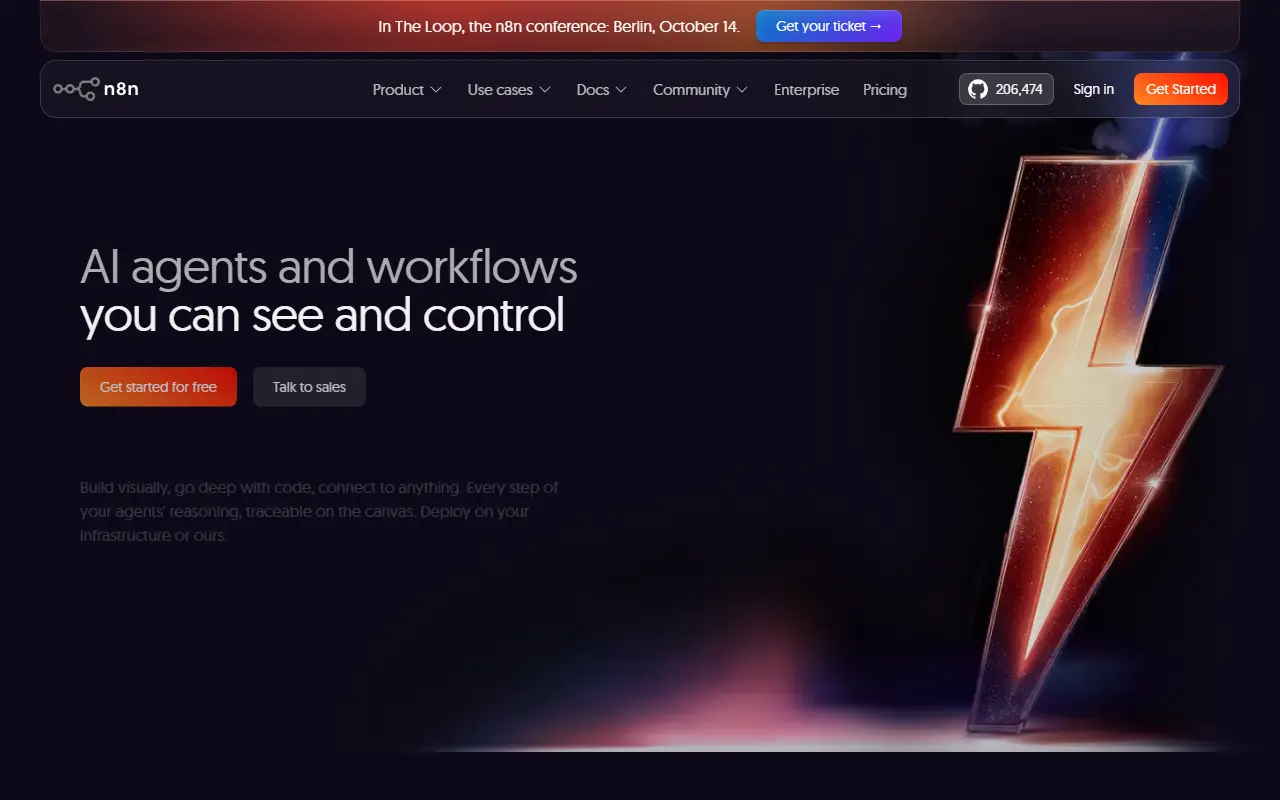
n8n is a workflow automation platform for connecting apps, moving data between them and triggering actions without writing a full integration from scratch. Workflows are built on a visual canvas, and when a step needs more logic you can drop in JavaScript or Python and use npm packages. It is often compared with Zapier and Make, but the source is public and it can run on your own infrastructure.
Recent versions put a lot of weight on AI. You can build multi-step agents and LLM workflows that call OpenAI, Anthropic, Google or open-source models, add human approval steps, and inspect what happened afterward. The project advertises over a thousand integrations and a large library of ready-made workflow templates, and you can extend it with your own nodes.
n8n is distributed under a fair-code model: the Sustainable Use License, plus a separate enterprise license for additional features. The code is always visible and can be self-hosted, for example with Docker, but it is not an OSI-approved open-source license, so commercial redistribution is restricted. A managed cloud edition is available if you would rather not run it yourself.
Key features
- Visual workflow canvas with branching logic
- JavaScript and Python code steps with npm packages
- Multi-step AI agents with human approval
- Over 1,500 integrations plus reusable templates
- Connects to OpenAI, Anthropic, Google or local models
- Role-based access and audit trails
- Self-hosting with Docker or managed cloud
Pricing: Free self-hosted Community Edition. Hosted plans cost 20€ (Starter), 50€ (Pro) and 667€ (Business) per month billed annually, scaled by workflow executions; Enterprise is custom. Free trial available.
#2
A framework from Microsoft for end-to-end web testing and browser automation across Chromium, Firefox and WebKit using one API.
- GitHub stars
- 100k
- Last commit
- today
- Latest release
- v1.65.0
- Licence
- Apache-2.0
- Self-hosted
- Yes
playwright.dev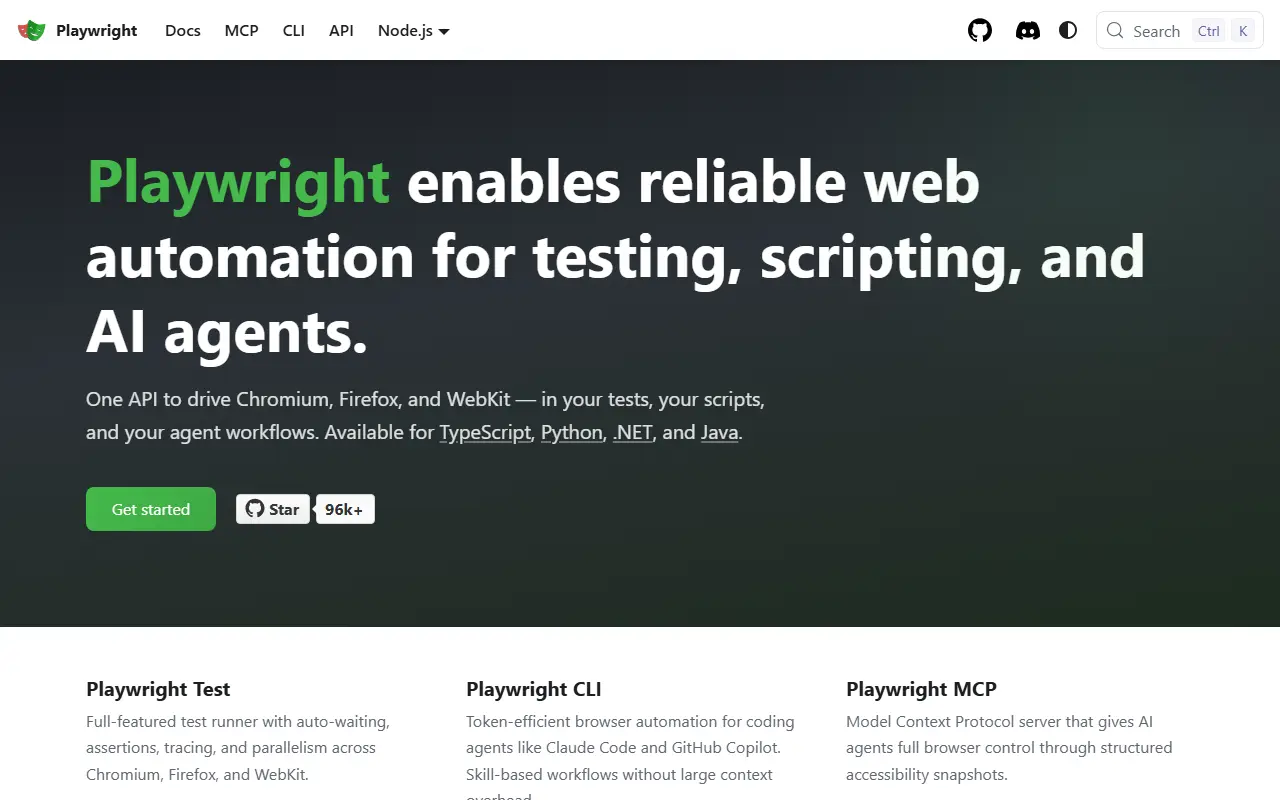
Playwright is an open-source framework for testing and automating web applications. A single API drives Chromium, Firefox and WebKit, so the same script or test can cover all three engines. It is used for end-to-end testing, for scripted browser tasks and, increasingly, as a tool that AI agents call to operate a browser.
The bundled Playwright Test runner executes tests in parallel with a fresh browser context per test, which gives isolation without the cost of launching a new browser. Locators mirror how users see the page, actions wait automatically until elements are ready, and assertions retry until they pass. Failures can be investigated with traces that capture screenshots, DOM snapshots, network requests and console output in a Trace Viewer.
Beyond the test runner there is a standalone library for scripts, a CLI aimed at coding agents, an MCP server for LLM-driven automation and a VS Code extension. The code is Apache-2.0 licensed and runs on your own machines and CI servers, with no hosted service required.
Key features
- One API for Chromium, Firefox and WebKit
- Auto-waiting actions and retrying assertions
- Parallel tests with isolated browser contexts
- Trace Viewer with DOM snapshots and network logs
- Locators that mirror how users see pages
- MCP server and CLI for AI agents
- VS Code extension for authoring tests
Pricing: Free and open source under the Apache-2.0 license.
#3
An open-source web data platform for scraping, crawling, searching and monitoring websites, turning pages into structured APIs with a no-code approach and AI extraction.
- GitHub stars
- 18k
- Last commit
- 4 days ago
- Latest release
- v0.1.0
- Licence
- AGPL-3.0
- Self-hosted
- Yes
- Hosted version
- Available
maxun.dev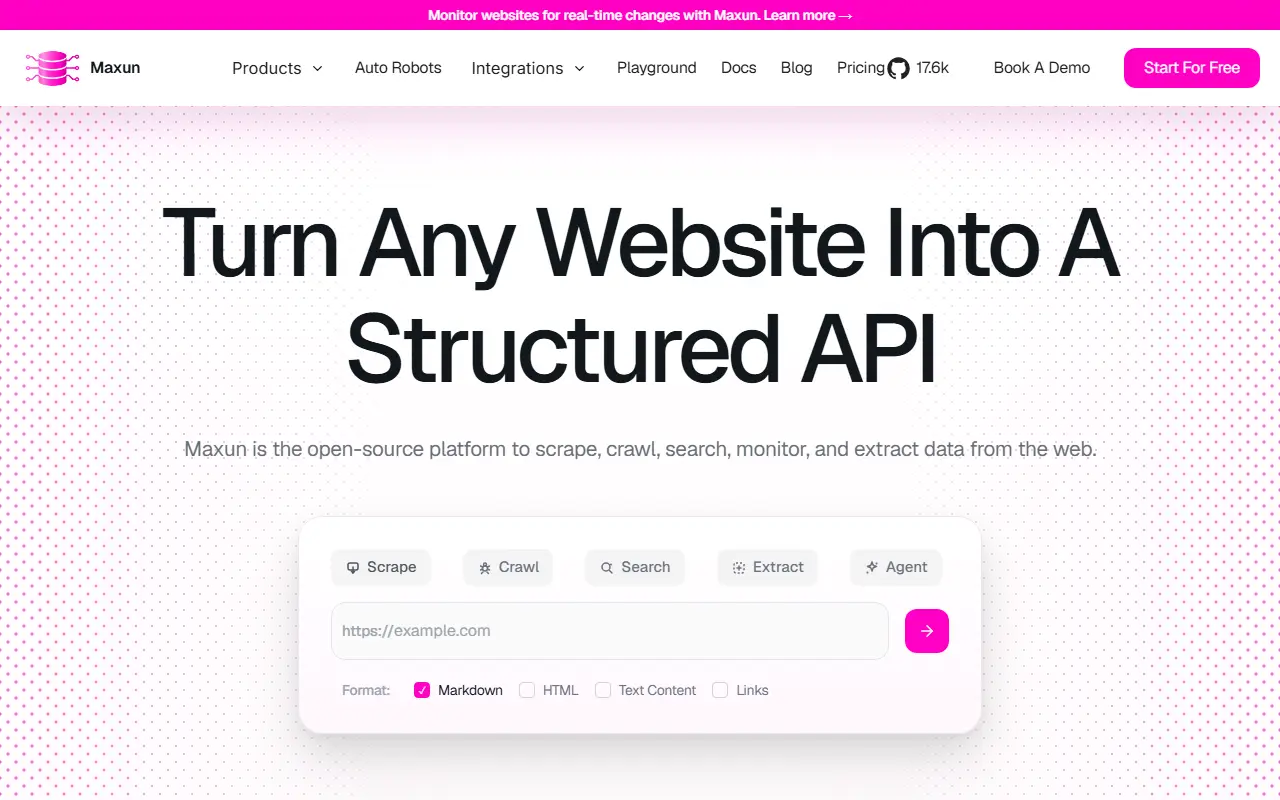
Maxun is an open-source platform for getting structured data out of websites. Its pitch is to turn any site into an API: you can scrape pages, crawl links, search, monitor for changes and use AI-powered extraction, without having to hand-code a scraper for every site. Topics tag it as a no-code, RPA and browser-automation tool.
It is built on Playwright-style browser automation, written in TypeScript, and is meant to be used through a visual interface so that people who do not code can create data-extraction robots. The project offers a hosted app and documentation, tutorials and a Discord community, and it can be self-hosted. The README is heavily sponsored by proxy providers, which reflects how scraping at scale usually needs rotating proxies, though those are third-party services that are not part of Maxun itself.
Maxun is licensed under AGPL-3.0, which requires sharing source changes if you offer a modified version as a network service. It suits analysts, marketers and developers who regularly pull data from websites without official APIs, and who want a managed or self-run alternative to custom scraping scripts.
Key features
- Turns websites into structured APIs
- Scraping, crawling and search
- Change monitoring of web pages
- AI-assisted data extraction
- No-code robot creation
- Self-hosted or hosted app
Pricing: Self-hosting the open-source edition is free. Maxun Cloud costs $19 (Starter), $99 (Growth) or $399 (Pro) per month by credit allowance, with a 7-day free trial; Premium is custom.
#4
A browser automation tool that uses LLMs and computer vision to perform workflows on websites, with a Playwright-compatible SDK and a no-code workflow builder.
- GitHub stars
- 23k
- Last commit
- today
- Latest release
- v1.0.57
- Licence
- AGPL-3.0
- Self-hosted
- Yes
- Hosted version
- Available
skyvern.com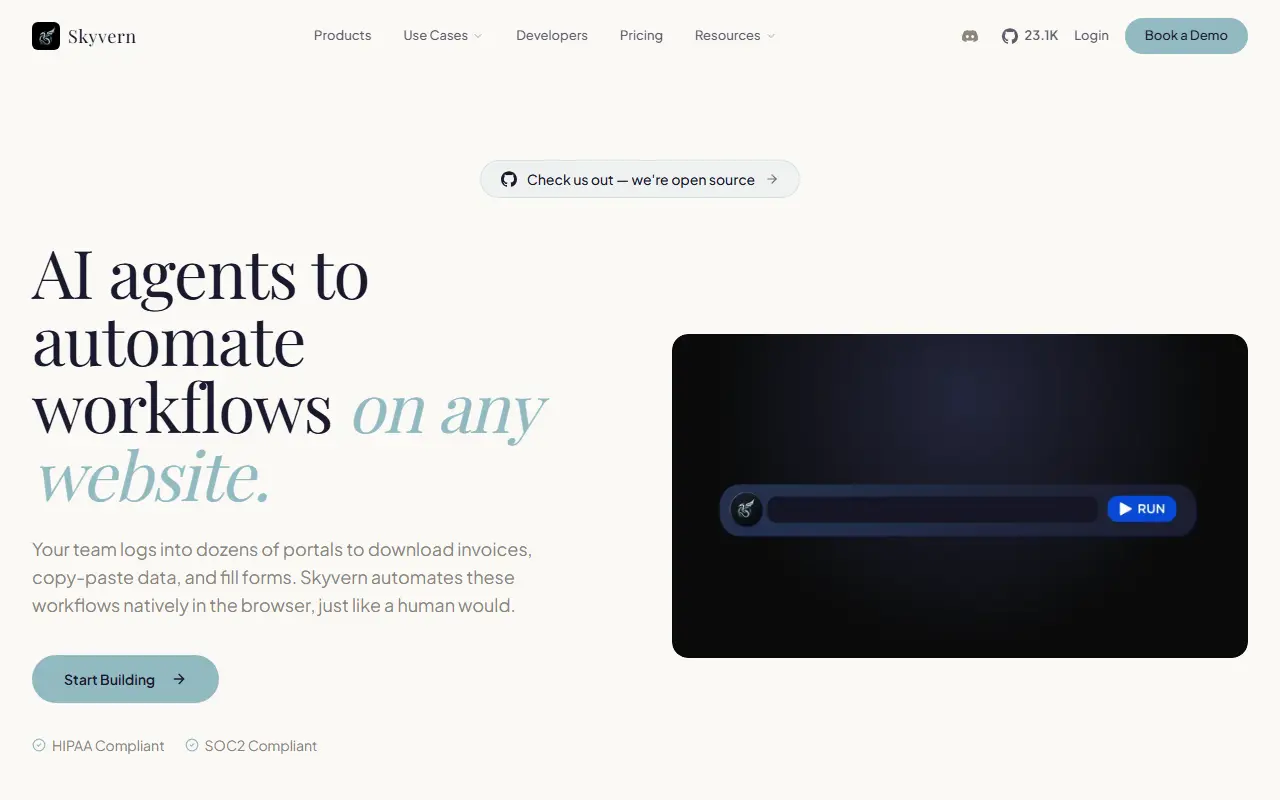
Skyvern automates browser-based workflows using large language models and computer vision. It offers a Playwright-compatible SDK that adds AI capabilities on top of Playwright, and a no-code workflow builder so that both technical and non-technical users can automate manual tasks on any website, replacing brittle automation scripts.
Traditional browser automation depends on custom scripts for each site, often relying on DOM parsing and XPath selectors that break whenever the layout changes. Skyvern instead relies on vision-capable LLMs to understand and interact with pages. Its design was inspired by task-driven autonomous agents such as BabyAGI and AutoGPT, with the added ability to act on sites using browser automation libraries. A swarm of agents comprehends a website, plans actions and executes them.
Skyvern is written in Python and licensed under AGPL-3.0, and topics note RPA and workflow use. You can self-host it or use the hosted service at skyvern.com. It targets teams that automate tasks across many different websites, such as form filling or data retrieval, where writing and maintaining per-site scripts is costly.
Key features
- LLM and vision-based website understanding
- SDK compatible with Playwright
- No-code workflow builder
- Works on sites without custom scripts
- Multi-agent planning and execution
- Self-hosted or hosted service
Pricing: A free plan includes 5,000 credits. Hobby is $29 per month for 30,000 credits and Pro $149 per month for 150,000 credits; Enterprise is custom through sales.
#5
Browser automation CLI and skills for AI agents that run web tasks in real browsers, with parallel sessions, isolated accounts, and human hand-off.
- GitHub stars
- 6.3k
- Last commit
- 9 days ago
- Licence
- MIT
- Hosted version
- Available
browseract.com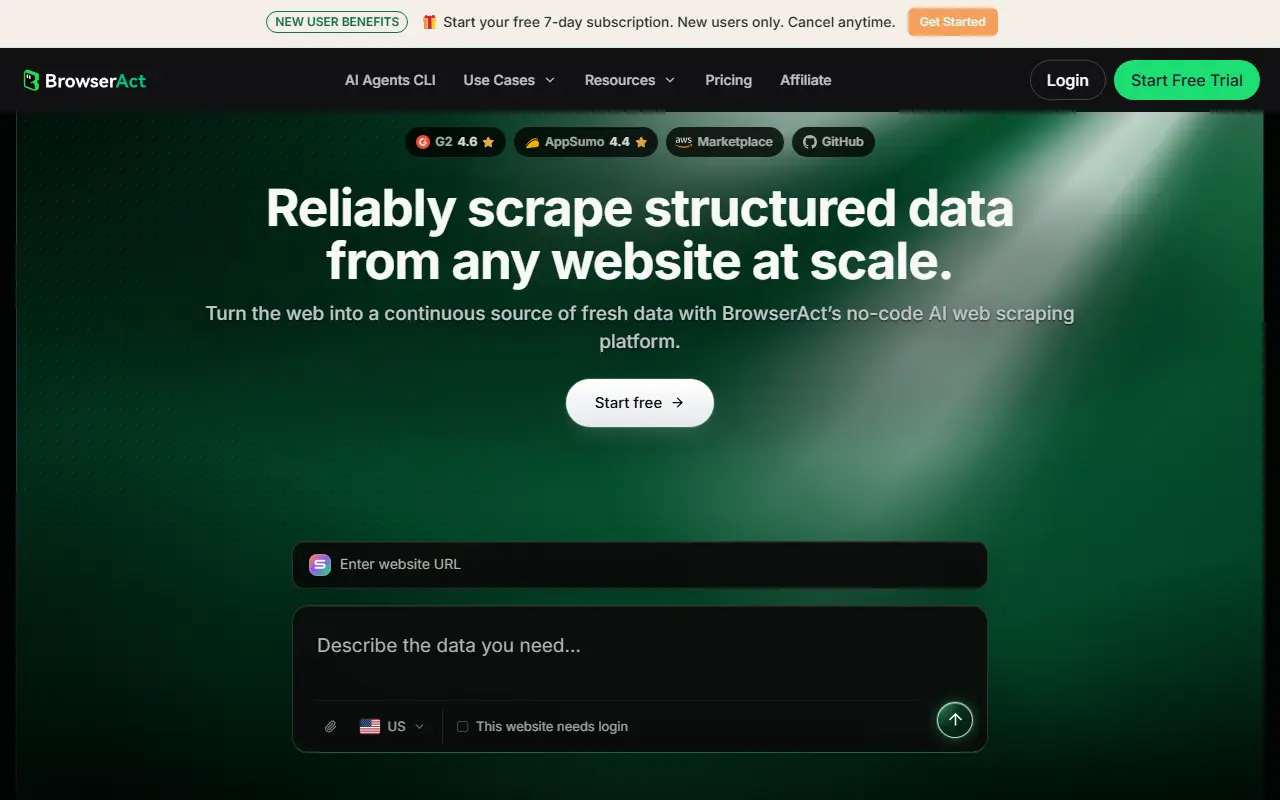
BrowserAct gives AI agents and teams a way to automate real browsers for web data extraction and account-based workflows. The repository contains skills for agents such as Claude Code, Cursor, and Codex, along with a CLI. The project describes features for handling anti-bot protections, handing control to a human when an agent gets stuck, and running tasks in parallel without cross-contamination. It is released under the MIT license.
There are two ways to use it. In the cloud mode, you describe the website and the fields you need and BrowserAct builds and tests a reusable scraping bot in a cloud browser, then runs it for you. In the local mode, agents load the BrowserAct skill and drive a local browser, including reuse of local Chrome login state, from their own environment. Independent sessions and isolated multi-account browsing keep identities separate.
It suits developers building AI agents that need dependable browser access, and teams that want repeatable data collection. The cloud service is run by the vendor, so check browseract.com for plans and usage limits.
Key features
- Browser automation CLI for AI agents
- Skills for Claude Code, Cursor, and Codex
- Cloud-managed or local browser control
- Parallel tasks and independent sessions
- Isolated multi-account browsing
- Human hand-off when an agent is stuck
Pricing: A free plan includes 200 signup credits. Paid plans cost $16 (Basic), $70 (Essential) and $120 (Advanced) per month with a 7-day trial, cheaper billed yearly; the local CLI has no runtime fee.
#6
Nanobrowser is an open-source Chrome extension that runs multi-agent AI web automation in your browser using your own LLM API key.
- GitHub stars
- 14k
- Last commit
- 3 days ago
- Latest release
- v0.3.0
- Licence
- Apache-2.0
- Self-hosted
- Yes
nanobrowser.ai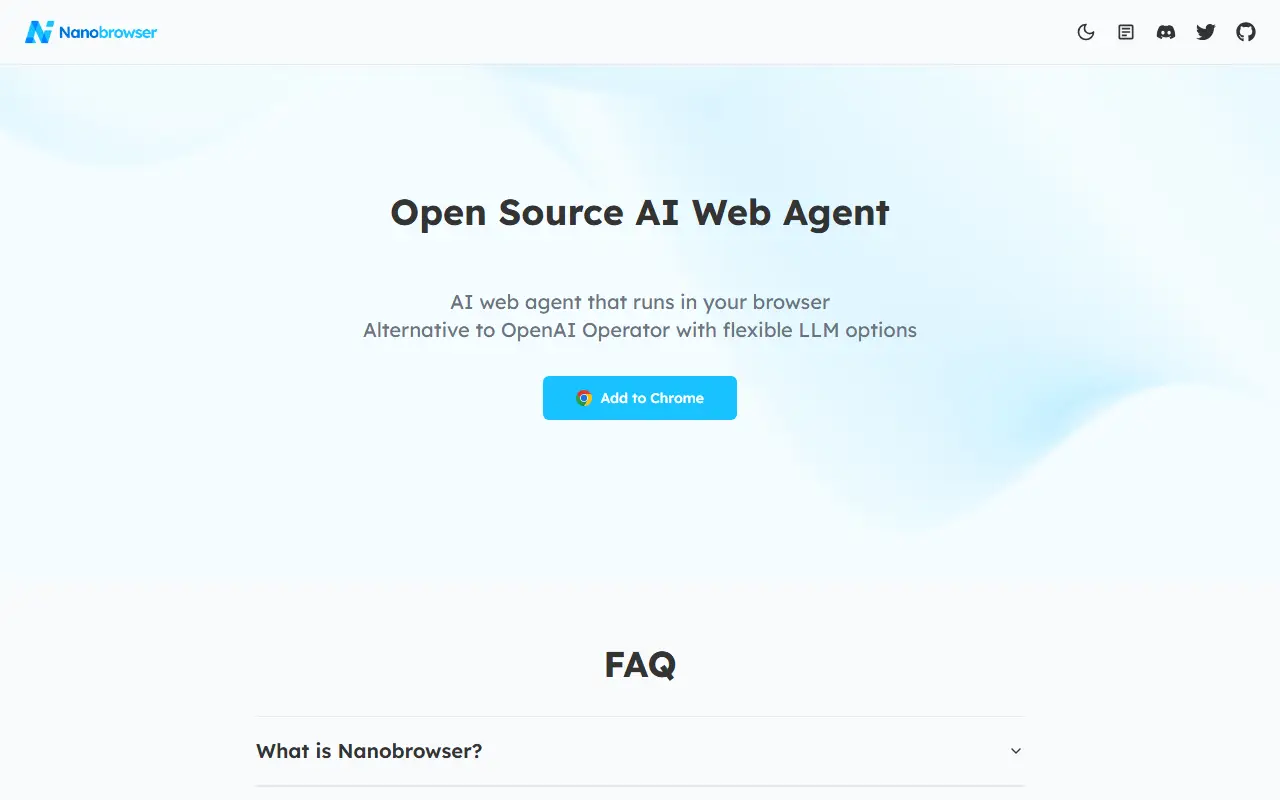
Nanobrowser is an AI web automation tool delivered as a Chrome extension. You describe a task, and a team of AI agents carries it out in your browser. The project presents itself as a free, open-source alternative to OpenAI Operator, with the flexibility of choosing which language model provider you use.
Its multi-agent design splits the work: a Planner analyzes the task and corrects course when it runs into obstacles, while a Navigator carries out the steps on web pages. Everything runs locally in the browser, and you supply your own LLM API key, so there is no required vendor account. Topics mention browser automation, Playwright and n8n. It is available from the Chrome Web Store and is written in TypeScript.
Nanobrowser is licensed under Apache-2.0. It suits people who want agentic browsing and web task automation with their own model keys, without handing control to a hosted browser agent. Support comes from community sponsorship and a Discord server.
Key features
- Chrome extension for AI web automation
- Multi-agent Planner and Navigator system
- Bring your own LLM API key
- Runs locally in your browser
- Self-correcting task execution
- Available from Chrome Web Store
Pricing: Free and open source under Apache-2.0; you pay your own LLM provider for API usage.
#7
Headless browser service for scraping, automation, testing and AI agents, reachable through Puppeteer, Playwright, HTTP APIs or an MCP server, with a self-hosted option.
- GitHub stars
- 14k
- Last commit
- yesterday
- Latest release
- v2.62.0
- Self-hosted
- Yes
- Hosted version
- Available
browserless.io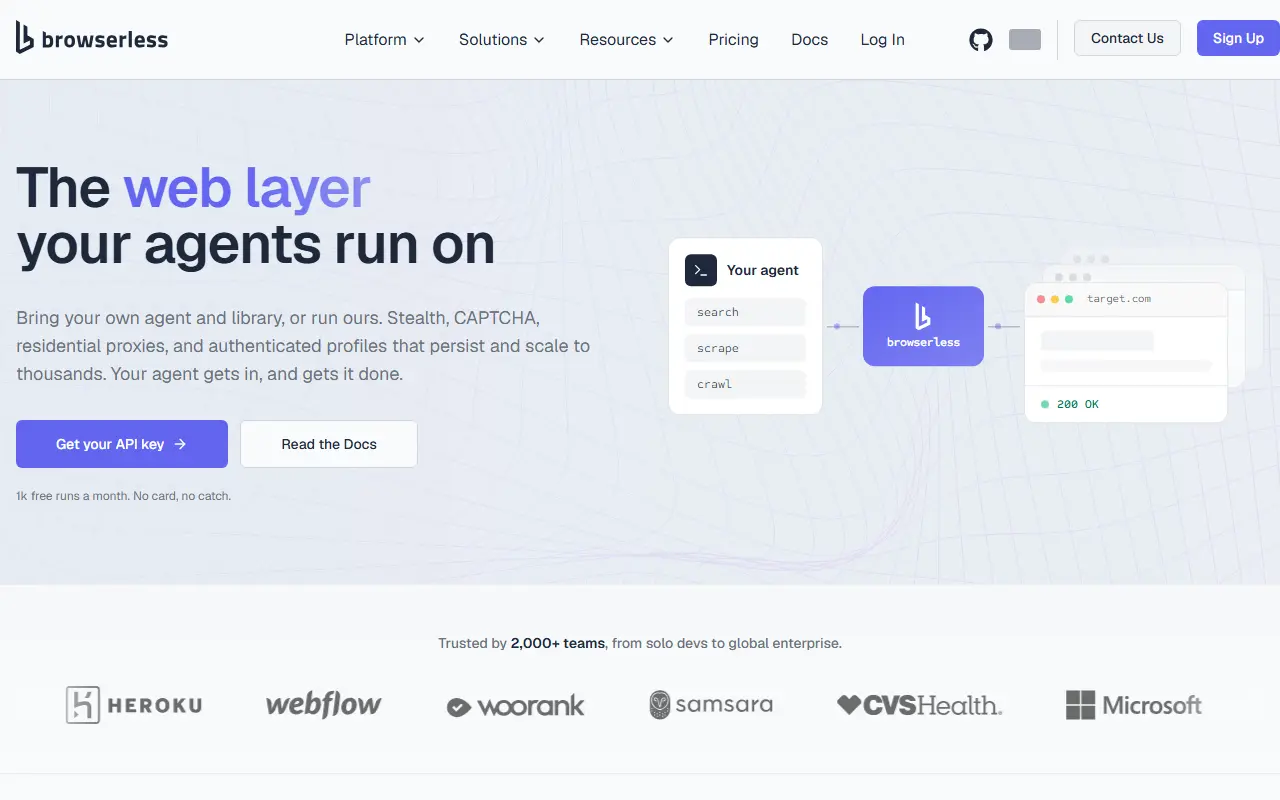
Browserless runs managed headless browsers that scripts and AI agents connect to instead of running Chrome themselves. Existing Puppeteer or Playwright code connects by pointing at a Browserless WebSocket endpoint with an API token, which the homepage describes as a three-line change.
The platform lists browsers as a service, browser tasks over simple HTTP APIs, an MCP server and a self-hosted option that runs on your own infrastructure. For agents it offers stealth, CAPTCHA handling, residential proxies and authenticated profiles that persist across runs, plus a browser agent that carries out multi-step tasks.
Solution pages target web scraping, automation, testing and Lighthouse audits, screenshots and PDFs, AI agents and enterprise needs with SLAs and compliance. The homepage says more than 2,000 teams use it and offers 1k free runs a month with no card required.
Key features
- Connect Puppeteer or Playwright scripts with a small change
- MCP tools for search, scrape and crawl
- Authenticated profiles reused across runs
- Browser agent for multi-step tasks
- Stealth, CAPTCHA and residential proxies
- Managed, API-based and self-hosted deployment options
Pricing: Free is $ 0 /month billed annually with 1k units a month. Prototyping is $ 25 /month billed annually with 20k units per month and $0.0020 per unit overages.
#8
Automa is a browser extension for Chrome and Firefox that automates tasks by connecting blocks, including form filling, scraping and scheduled runs.
- GitHub stars
- 22k
- Last commit
- 8 mo ago
- Latest release
- v1.29.12
- Self-hosted
- Yes
goautoma.com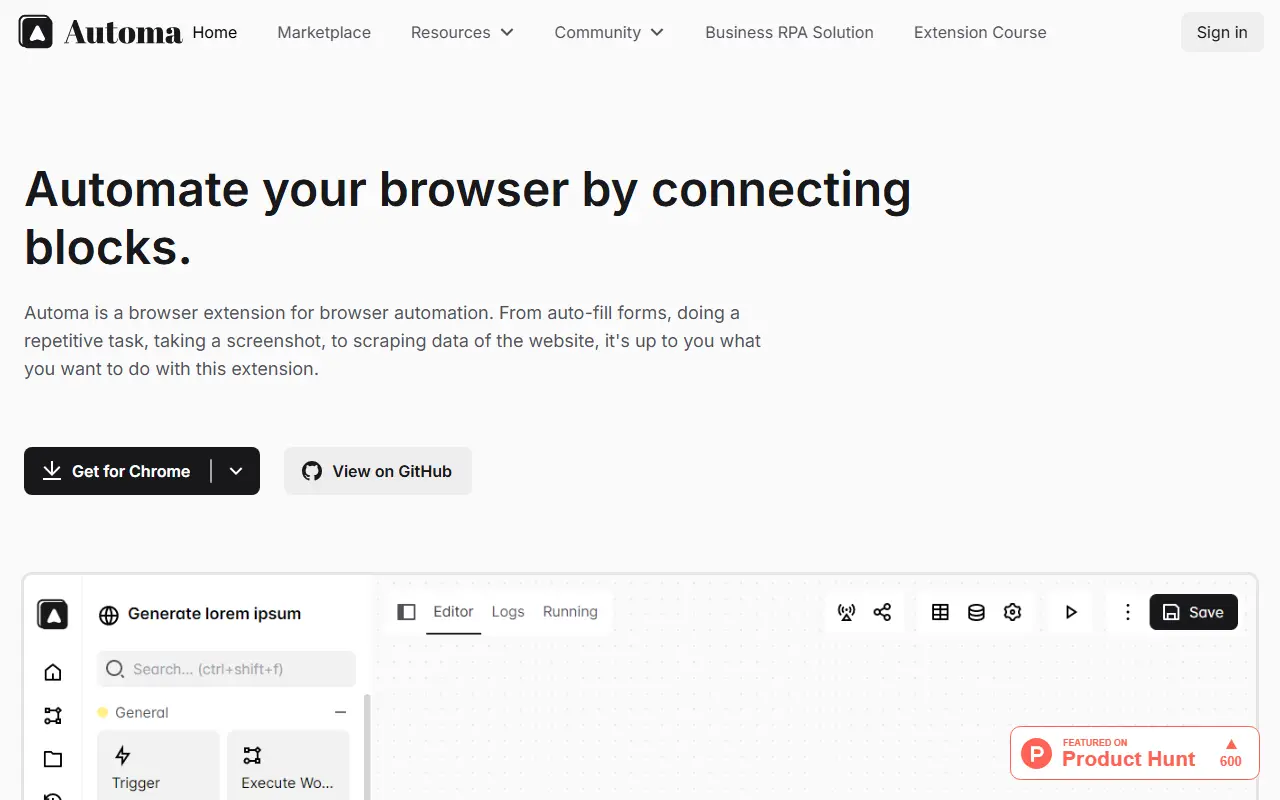
Automa is a browser extension for automating your browser through a visual workflow of connected blocks. You can auto-fill forms, perform repetitive tasks, take screenshots or scrape data from websites, and schedule when a workflow runs, all without writing code. It is built with Vue.
A marketplace lets users share and download workflows, and an Automa Chrome Extension Builder can turn a workflow into a standalone Chrome extension. The extension is available from the Chrome Web Store and Firefox Add-ons, and the repository includes setup instructions for contributors. Topics include workflow, browser automation and web scraping.
The repository license is listed as 'Other' on GitHub, so check the terms. Automa runs inside your own browser, so there is no server to manage. It suits non-programmers and developers who want quick browser automation similar to a lightweight RPA tool.
Key features
- Block-based visual workflow builder
- Form autofill and repetitive task automation
- Web scraping and screenshots
- Scheduled workflow execution
- Marketplace for sharing workflows
- Standalone extension builder
Axiom.ai alternatives: questions
- What is the best open-source alternative to Axiom.ai?
- n8n is the top-ranked open-source alternative to Axiom.ai on Enlisted: A fair-code workflow automation platform that mixes a visual canvas with custom code and AI agent features, for teams connecting apps and automating processes. Other strong options are Playwright, Maxun, Skyvern and BrowserAct.
- What are the best commercial alternatives to Axiom.ai?
- Bardeen, ParseHub, Browse AI, Octoparse and Browserbase are among the hosted, closed-source alternatives to Axiom.ai listed on Enlisted, which lists 17 in total. Compare their pricing and features on each tool page.
- Are these Axiom.ai alternatives free?
- All 8 are open source, so the code is free to use under its licence, and all of them can be self-hosted on your own server or computer. 5 also offer a paid or managed cloud version if you'd rather not host it yourself.
- How is this list of Axiom.ai alternatives ranked?
- By a score built from GitHub stars, star growth over the last 30 days and how recently the code changed. 7 of these projects shipped code in the last 30 days. Data is refreshed daily, and nobody can pay to move up.
 TrackMedia
 TrackRev