About Blocky
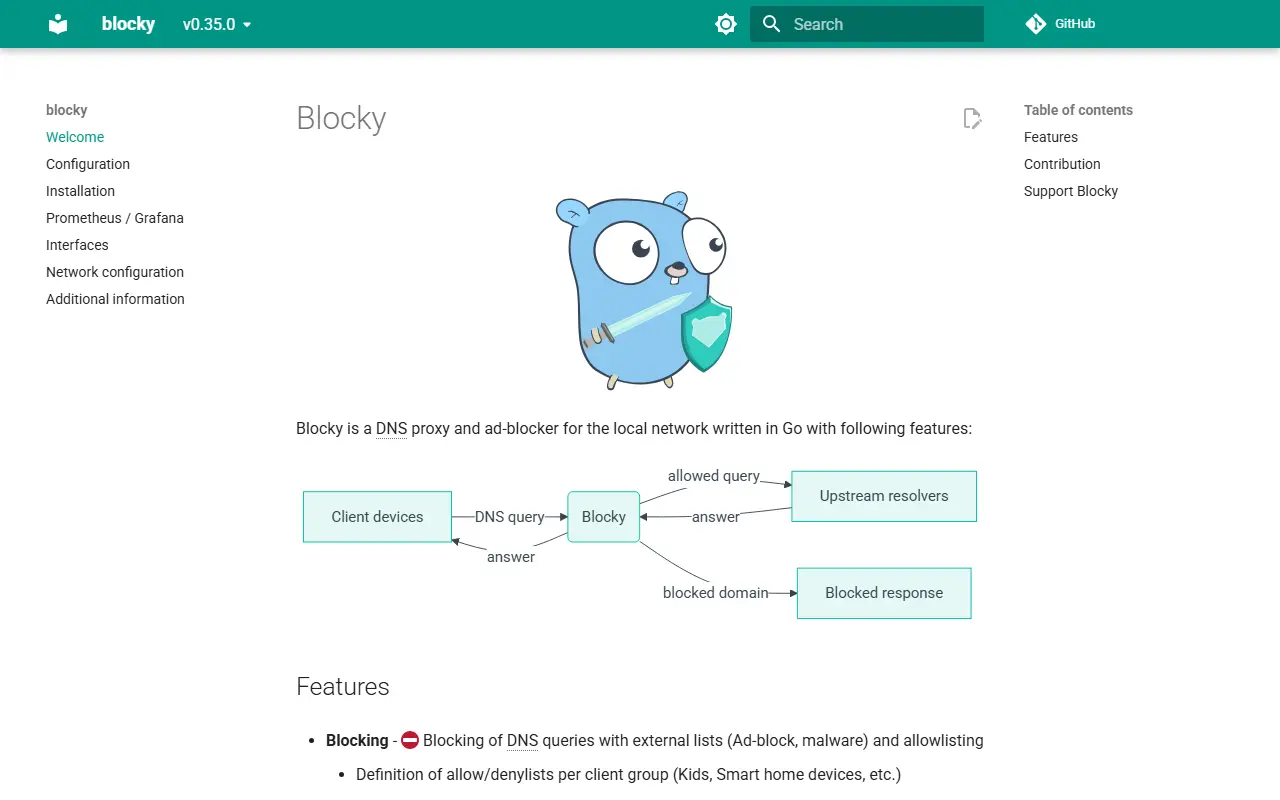
Blocky is a Go program that acts as a DNS proxy and ad blocker for local networks. It answers DNS queries for devices on the network and blocks unwanted domains using external lists for ads and malware, along with allowlists. It is a self-hosted alternative in the same space as Pi-hole.
Blocking rules can differ per client group, such as kids or smart home devices, and lists reload periodically. Blocky can inspect CNAME responses and IP addresses as well as request domains, and supports regular expressions. Beyond blocking it offers custom DNS resolution for chosen names, conditional forwarding, per-group upstream resolvers, caching with prefetching of frequent queries, DNS over HTTPS, TLS, QUIC and HTTP/3, DNSSEC validation, Prometheus metrics and Grafana dashboards.
Blocky is licensed under Apache-2.0. According to its README it collects no user data, telemetry or statistics, and it uses a low memory footprint, which makes it practical to run on small home servers.
Key features
- DNS blocking with external lists
- Allow and deny lists per client group
- Custom DNS and conditional forwarding
- Caching with prefetching
- DNS over HTTPS, TLS and QUIC
- DNSSEC validation
- Prometheus metrics and Grafana dashboards
Good fit for
- →Blocking ads across a home network
- →Applying different filtering rules to kids and IoT devices
- Built with
- Go
- Tags
- dns
- ad-blocker
- dns-proxy
- pihole-alternative
- self-hosted
- go
- privacy
- parental-control
Blocky: questions and answers
- What is Blocky used for?
- Blocky is a Go-based DNS proxy and ad blocker for local networks, with per-client rules, caching and modern DNS protocol support. It is a good fit for blocking ads across a home network, and applying different filtering rules to kids and IoT devices.
- Is Blocky open source?
- Yes. Blocky is open source under the Apache-2.0 licence. Its source code is on GitHub at 0xERR0R/blocky and is written mainly in Go.
- Is Blocky free?
- Yes. Blocky is open source, so the software itself is free to use.
- Can I self-host Blocky?
- Yes. Blocky can be self-hosted on your own server or infrastructure; there is no official hosted version.
- What is Blocky an alternative to?
- Blocky is an open-source alternative to Cisco Umbrella, NextDNS and Control D. Other open-source alternatives to Cisco Umbrella include Pi-hole, AdGuard Home and Technitium DNS Server.
- Is Blocky actively maintained?
- Yes. The most recent commit to Blocky was on 29 September 2026, and the latest release is v0.35.0, published on 5 September 2026. The project has 7k stars on GitHub.
Open-source alternatives to Blocky
See all
Pi-hole
Networking & VPN
A black hole for Internet advertisements
OSSvs Cisco Umbrella★ 61k
AdGuard Home
Networking & VPN
Network-wide ads & trackers blocking DNS server
GPL-3.0vs Cisco Umbrella★ 37k
Technitium DNS Server
Networking & VPN
Technitium DNS Server
GPL-3.0vs Cloudflare★ 10k
OPNsense
Security
OPNsense GUI, API and systems backend
BSD-2-Clausevs Fortinet★ 4.7k
pfSense
Security
Main repository for pfSense
Apache-2.0vs Fortinet★ 5.7k
IPsec VPN Server
Networking & VPN
Docker image to run an IPsec VPN server, with IPsec/L2TP, Cisco IPsec and IKEv2. Auto-gene
OSSvs ExpressVPN★ 7.1k
SaaS alternatives to Blocky
See all
Cisco Umbrella
Security
Cloud security service providing DNS-layer protection and secure web gateway
SaaS
NextDNS
Networking & VPN
Cloud DNS resolver with ad, tracker and malware blocking
SaaS
Control D
Networking & VPN
Customizable DNS filtering and traffic routing service
SaaS
Cato Networks
Security
Cloud-native SASE platform combining SD-WAN and network security
SaaS
Prisma Access
Security
Palo Alto Networks cloud-delivered secure access service edge
SaaS
Amazon Route 53
Networking & VPN
Scalable DNS, domain registration and health-check routing service on AWS
SaaS