7,363 open-source and SaaS tools, with GitHub stats refreshed every day.

6 alternatives ranked by real activity

Open-source Vellum alternatives

A curated, ranked list of the 6 best open-source alternatives to Vellum.

The best open-source alternative to Vellum is Dify. If that doesn't suit you, other good options are Langflow, Langfuse, Sim and Promptfoo.

Vellum alternatives are mainly AI infrastructure tools. 5 of them shipped code in the last 30 days, 6 can be self-hosted, and 4 use a permissive licence.

Last updated October 3, 2026 · ranked by GitHub stars, growth and recent commits

Dify

An LLM application platform for building AI workflows, RAG pipelines and agents on one canvas, deployable in the cloud, a private VPC or self-hosted.

GitHub stars
158k
Last commit
yesterday
Latest release
1.17.1
Self-hosted
Yes
Hosted version
Available
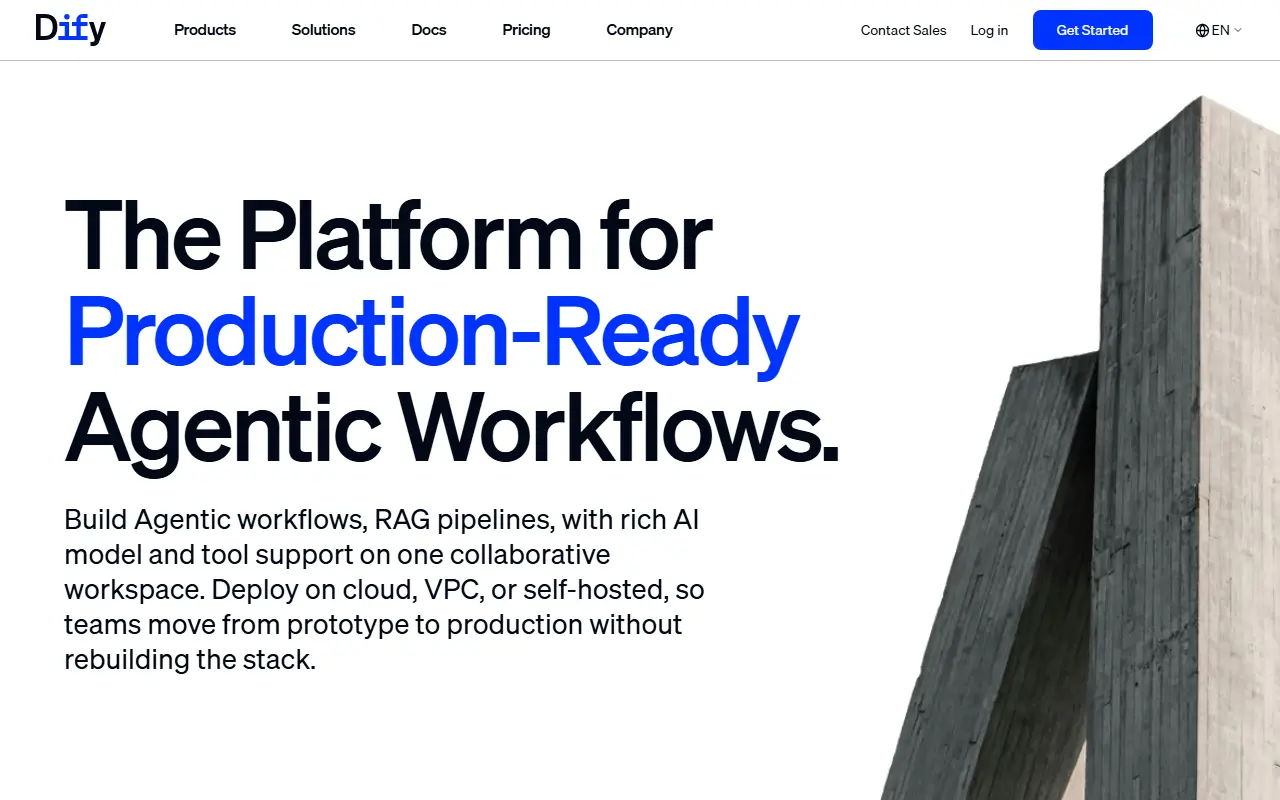
dify.aiDify homepage screenshot

Dify is a platform for building applications on top of large language models. Instead of wiring together prompts, retrieval code and model APIs by hand, teams assemble AI workflows, knowledge pipelines and agents in a shared visual workspace, then move them from prototype to production without changing stacks.

The product covers a workflow studio for agentic flows, a knowledge pipeline that prepares searchable knowledge bases for retrieval-augmented generation, model management across many providers, and a marketplace of tools, models and integrations. Observability integrations such as Opik, Langfuse and Arize Phoenix help trace and debug runs once an app is live.

Dify comes in a few editions: a community edition you deploy yourself with Docker, a hosted cloud service, and an enterprise edition for private deployments. The repository carries a custom license rather than a standard one, so check its terms before offering Dify as a service to others.

Key features

  • Visual workflow studio for agentic apps
  • Knowledge pipelines for retrieval-augmented generation
  • Model management across many LLM providers
  • Marketplace of tools, models and integrations
  • Observability integrations such as Langfuse
  • Deploy on cloud, VPC or Docker

Pricing: Free Sandbox on Dify Cloud and a free self-hosted Community edition. Cloud Professional costs $590 and Team $1590 per workspace per year; Enterprise is custom.

Langflow

A visual platform for building and deploying AI agents and workflows, with Python-customizable components and built-in API and MCP server support.

GitHub stars
155k
Last commit
today
Latest release
v1.12.4
Licence
MIT
Self-hosted
Yes
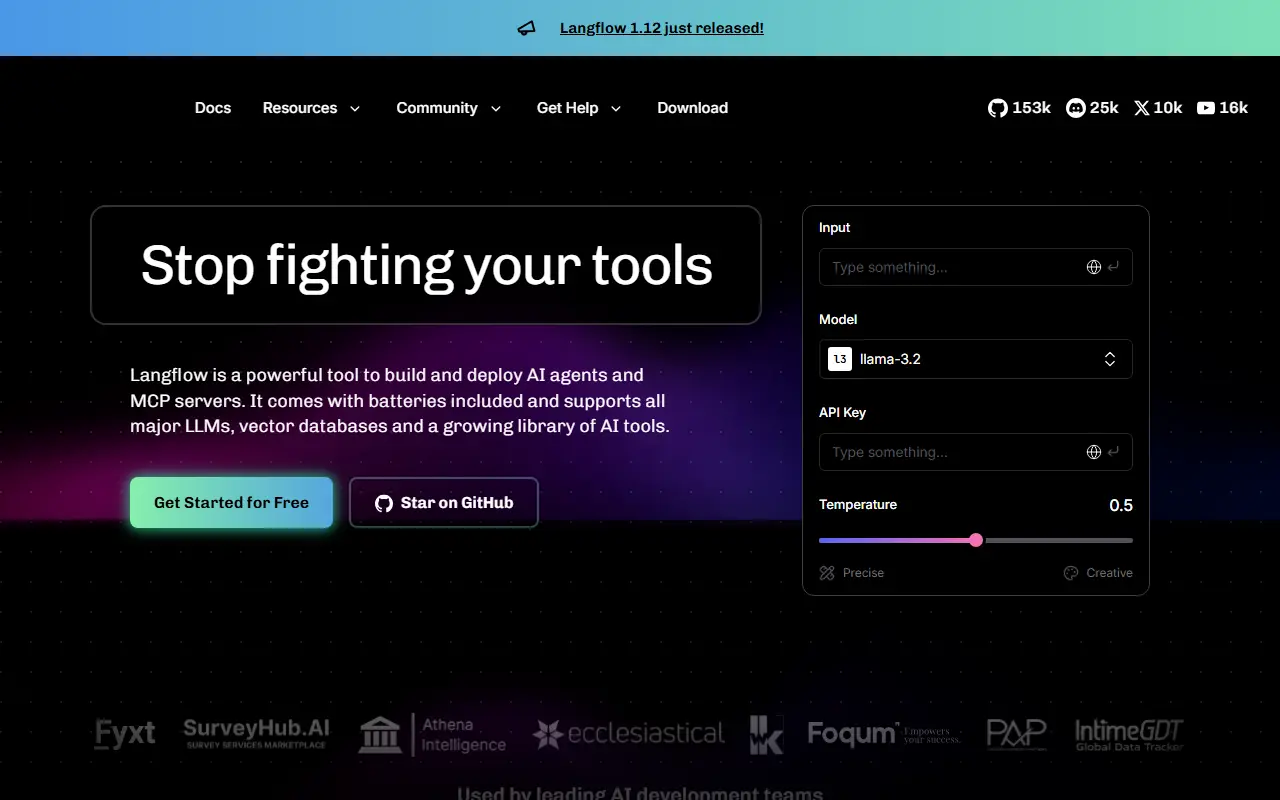
langflow.orgLangflow homepage screenshot

Langflow is an open-source platform for building AI-powered agents and workflows. Developers assemble flows in a visual authoring interface and can then deploy each flow as an API or export it as JSON for use in Python applications. It is written in Python and released under the MIT license.

The visual builder is paired with source-code access, so any component can be customized in Python, and an interactive playground lets you test and refine flows step by step. Langflow can orchestrate several agents with conversation handling and retrieval, works with the major LLMs and vector databases, and can expose flows as an MCP server so they become tools for MCP clients. Observability integrations include LangSmith and LangFuse.

You can install the Python package locally with uv, after which it serves the app at a local address, or use Langflow Desktop for Windows and macOS, which bundles its dependencies. It suits developers and AI teams prototyping retrieval and agent workflows who want both a drag-and-drop canvas and the freedom to write code.

Key features

  • Visual builder for agents and workflows
  • Python source access to customize components
  • Interactive playground for testing flows
  • Multi-agent orchestration with retrieval
  • Deploy flows as APIs or export as JSON
  • MCP server mode exposing flows as tools
  • Observability integrations such as LangFuse

Pricing: Free and open source under the MIT license.

Langfuse

An open-source LLM engineering platform for tracing, evaluating and improving AI applications, with prompt management, datasets and a playground, self-hosted or cloud.

GitHub stars
35k
Last commit
yesterday
Latest release
v4.50.0
Self-hosted
Yes
Hosted version
Available
langfuse.comLangfuse homepage screenshot

Langfuse is an open-source LLM engineering platform that helps teams develop, monitor, evaluate and debug AI applications together. You instrument your app, and Langfuse records traces of LLM calls and surrounding logic such as retrieval, embeddings and agent actions, so complex runs and user sessions can be inspected and debugged.

Prompt management lets you centrally version and iterate on prompts, with caching on server and client so that changes do not add latency to your app. Evaluation features cover LLM-as-a-judge, code evaluators, user feedback, manual labeling and custom pipelines through the API and SDKs. Datasets provide test sets and benchmarks, there is an LLM playground for trying prompts, and integrations exist for OpenAI, LangChain and LlamaIndex. It is built on the ClickHouse database, and the Langfuse team has been part of ClickHouse since January 2026.

You can use Langfuse Cloud or self-host it, which the maintainers say takes minutes. The repository license is listed as 'Other' because it combines open-source and enterprise components, so check the terms. It suits teams shipping production LLM features who need visibility into quality, latency and cost.

Key features

  • Tracing of LLM calls, retrieval and agent actions
  • Prompt versioning with caching
  • LLM-as-a-judge and custom evaluations
  • Datasets for tests and benchmarks
  • Interactive LLM playground
  • Integrations with OpenAI, LangChain and LlamaIndex

Pricing: Core has a $29 monthly base that includes 100k units, then $8 per 100k units with volume discounts. Hobby and Pro tiers exist but their prices are not shown in the text; Enterprise is by sales.

Sim

A collaborative workspace for building, deploying and monitoring AI agents and workflows, with 1,000+ integrations, built-in tables and knowledge, in cloud or self-hosted form.

GitHub stars
30k
Last commit
yesterday
Latest release
v0.9.10
Licence
Apache-2.0
Self-hosted
Yes
Hosted version
Available

Sim is a workspace for building, deploying and managing AI agents and workflows. You can build visually, conversationally or with code, connect more than a thousand integrations such as Slack, Notion, HubSpot, Salesforce and databases, and use any major LLM provider. The platform includes monitoring of runs, logs, schedules and workflow activity.

Beyond workflows, the same workspace also holds tables, files and knowledge. Tables act as a built-in database, files give the team and every agent one shared store, and knowledge bases serve as the agents' memory, ingesting files and structured data. The workspace is available in the browser and also as a desktop app for macOS 12 and later, for both Apple Silicon and Intel, which can be pointed at a self-hosted deployment.

Sim can be used as a cloud-hosted service at sim.ai or self-hosted, which requires Node.js 20 or newer and Docker. An interactive npx sim-setup wizard creates a deployment directory, provisions the database, generates secrets, writes the environment file and starts the services. The code is Apache-2.0 licensed and written in TypeScript with Next.js.

Key features

  • Visual, conversational and code-based agent building
  • 1,000+ integrations and major LLM support
  • Built-in tables, files and knowledge bases
  • Run, log and schedule monitoring
  • macOS desktop app
  • Interactive self-hosting setup wizard

Pricing: A free plan is available. Pro is $25 and Max $100 per user per month on monthly billing, with about 15% off annually; Enterprise is custom and sold through sales.

Promptfoo

Open-source CLI and library for evaluating prompts, agents, and RAG apps, and for red-teaming LLM applications to find security weaknesses.

GitHub stars
26k
Last commit
yesterday
Latest release
0.123.1
Licence
MIT
Self-hosted
Yes
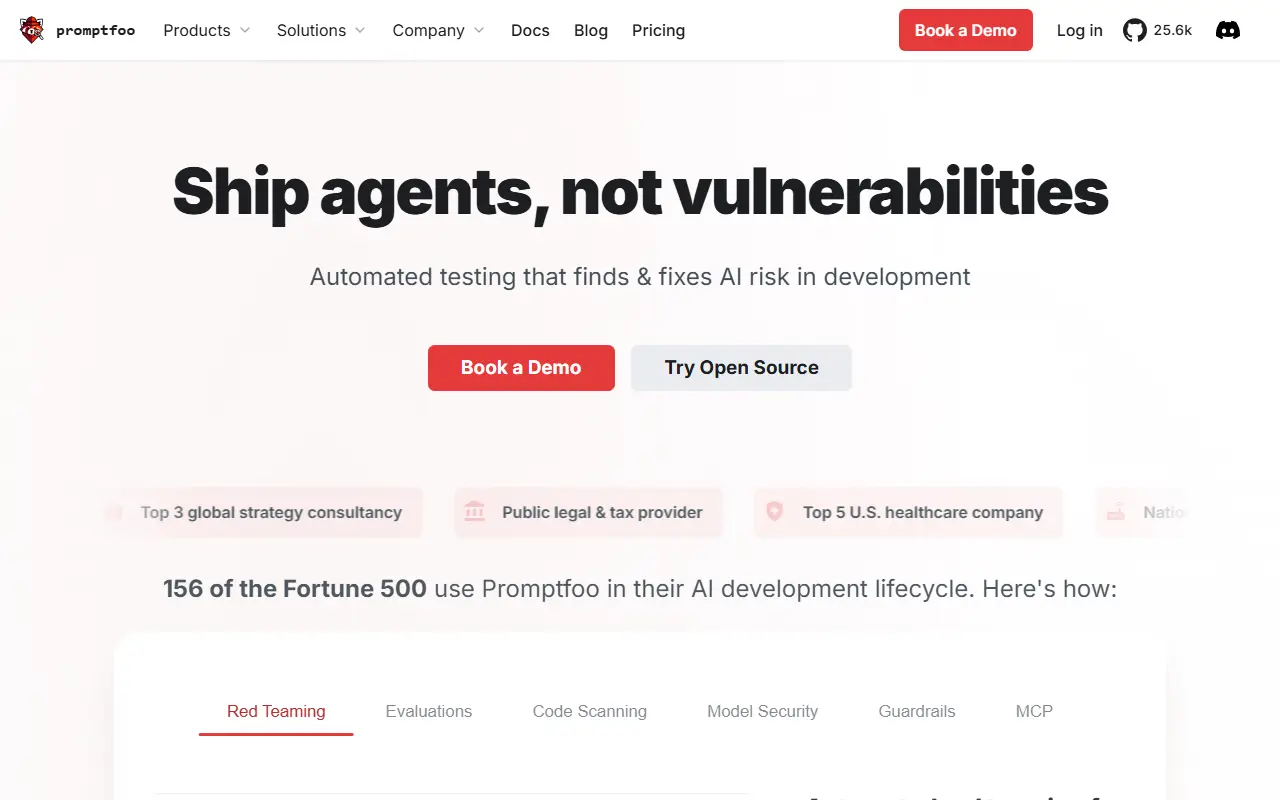
promptfoo.devPromptfoo homepage screenshot

Promptfoo is an open-source command-line tool and library for testing applications built on large language models. Developers describe test cases and checks in declarative configuration files, run them against one or more models, and review the results, which replaces manual trial and error with repeatable evaluations. It is written in TypeScript and released under the MIT license.

Beyond quality testing, Promptfoo includes red teaming and vulnerability scanning for AI systems, probing prompts, agents, and retrieval-augmented generation (RAG) pipelines for security and safety weaknesses. It can compare models from providers such as OpenAI, Anthropic, Azure, Bedrock, and Ollama side by side, and it works with any LLM API or programming language. Its documentation also covers a code-scanning feature that reviews pull requests for LLM-related security and compliance issues.

The project is designed to run locally: the maintainers state that evaluations execute on the developer's own machine, so prompts only leave it when a chosen model provider receives them. It can be installed with Homebrew or pip, or run without installing via npx, and it plugs into CI/CD so checks run automatically on each change. The README notes that Promptfoo is now part of OpenAI while remaining open source and MIT licensed.

Key features

  • Declarative test configs for prompts and models
  • Side-by-side comparison of multiple LLM providers
  • Red teaming and vulnerability scanning for AI apps
  • Evaluations run locally on your own machine
  • CI/CD integration for automated checks
  • Pull request code scanning for LLM risks
  • Live reload and result caching
  • Shareable results and security reports

Pricing: The Community edition is free forever. Enterprise and On-Premise plans have custom pricing arranged through a demo or by contacting the vendor.

Pezzo

An open-source, cloud-native LLMOps platform for managing prompts, tracking versions, observing AI calls, caching responses and collaborating on LLM features.

GitHub stars
3.3k
Last commit
1 mo ago
Latest release
v0.9.2
Licence
Apache-2.0
Self-hosted
Yes

Pezzo is an open-source LLMOps platform aimed at developers who build features on top of large language models. It gives teams one place to design and manage prompts, track versions, monitor and troubleshoot AI operations, and deliver prompt changes to applications without redeploying code.

The platform provides prompt management, observability and caching, with client libraries for Node.js, Python and LangChain. Teams can publish a new prompt version and have applications pick it up instantly, inspect requests and responses to find problems, and reduce cost and latency through caching. Topics on the repository also reference OpenAI, prompt engineering and monitoring.

Pezzo is built with TypeScript, Node.js and NestJS and depends on open-source infrastructure including PostgreSQL, ClickHouse, Redis and Supertokens, which can be started with Docker Compose. It is licensed under Apache-2.0 and designed to be run on your own infrastructure, with documentation covering architecture, tutorials and provider recipes. It suits product and engineering teams that want a self-managed prompt and observability layer.

Key features

  • Prompt management with versioning
  • Instant delivery of prompt changes
  • Observability of LLM requests
  • Response caching to cut cost and latency
  • Clients for Node.js, Python, and LangChain
  • Docker Compose deployment

Pricing: Free and open source under the Apache-2.0 licence.

Vellum alternatives: questions

What is the best open-source alternative to Vellum?
Dify is the top-ranked open-source alternative to Vellum on Enlisted: An LLM application platform for building AI workflows, RAG pipelines and agents on one canvas, deployable in the cloud, a private VPC or self-hosted. Other strong options are Langflow, Langfuse, Sim and Promptfoo.
Are these Vellum alternatives free?
All 6 are open source, so the code is free to use under its licence, and all of them can be self-hosted on your own server or computer. 3 also offer a paid or managed cloud version if you'd rather not host it yourself.
How is this list of Vellum alternatives ranked?
By a score built from GitHub stars, star growth over the last 30 days and how recently the code changed. 5 of these projects shipped code in the last 30 days. Data is refreshed daily, and nobody can pay to move up.

People also look for alternatives to…

View all