7,363 open-source and SaaS tools, with GitHub stats refreshed every day.

17 alternatives ranked by real activity

Open-source TablePlus alternatives

A curated, ranked list of the 17 best open-source alternatives to TablePlus.

The best open-source alternative to TablePlus is DBeaver. If that doesn't suit you, other good options are Chat2DB, DB Browser for SQLite, Dbx and Beekeeper Studio.

TablePlus alternatives are mainly database tools. 14 of them shipped code in the last 30 days, 17 can be self-hosted, and 5 use a permissive licence.

Last updated October 2, 2026 · ranked by GitHub stars, growth and recent commits

DBeaver

A free multi-platform desktop database tool and SQL client for developers, DBAs and analysts, supporting over 100 databases through JDBC and ODBC drivers.

GitHub stars
52k
Last commit
today
Latest release
26.2.1
Licence
Apache-2.0
Self-hosted
Yes
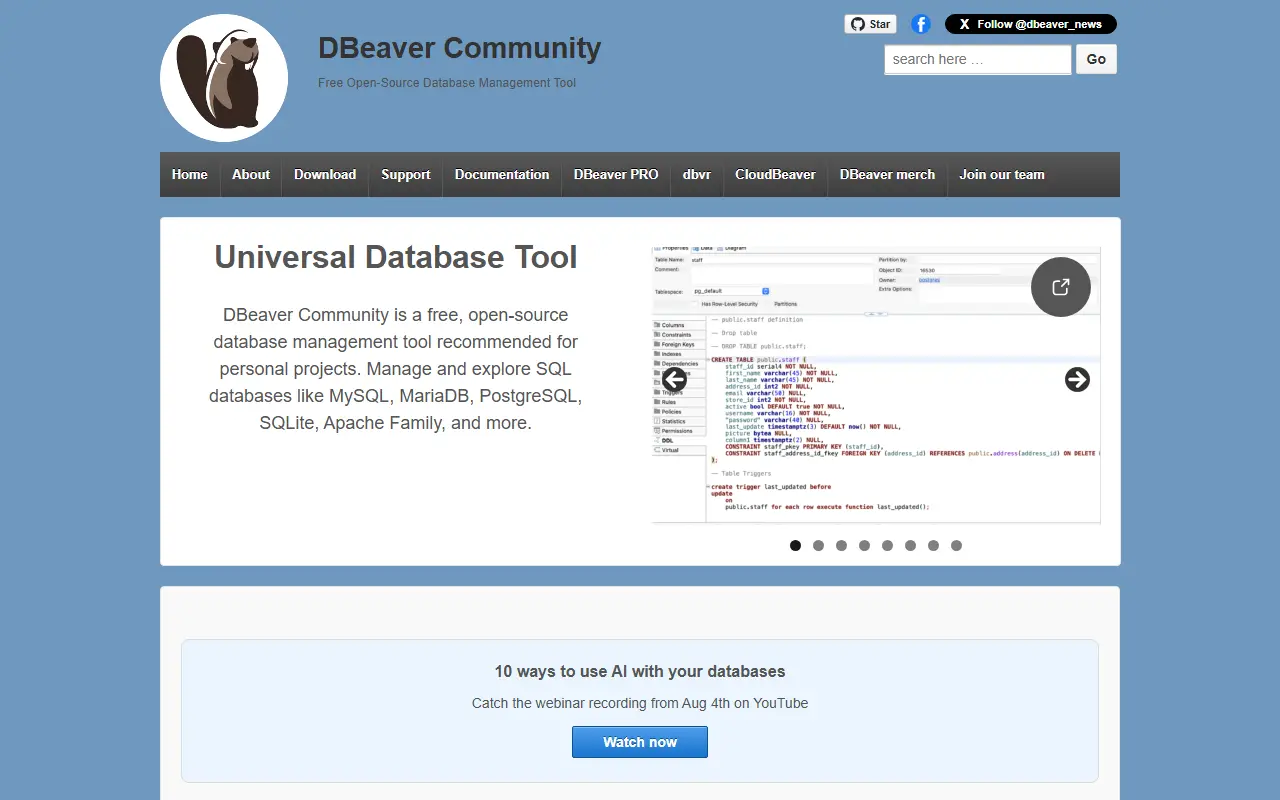
dbeaver.ioDBeaver homepage screenshot

DBeaver is a free, multi-platform database tool aimed at developers, SQL programmers, database administrators and analysts. A single desktop application lets you browse schemas, write and run SQL, edit data and administer many different database systems, instead of switching between vendor-specific clients.

Its feature set covers a schema editor, an SQL editor, a data editor, ER diagrams, data export, import and migration, SQL execution plans, administration tools, database dashboards, a spatial data viewer, proxy and SSH tunneling, and an editor for custom database drivers. An AI chat integrates AI tools for working with data, SQL and database structure. More than 100 drivers are supported out of the box, and anything with a JDBC or ODBC driver can be connected.

DBeaver is a Java application, with OpenJDK included in all distributions so no separate Java install is needed. It is Apache-2.0 licensed and can be downloaded as prebuilt binaries from the website or GitHub releases, with an Early Access build published daily. The vendor also sells paid editions with additional capabilities.

Key features

  • SQL editor with execution plans
  • Schema editor and ER diagrams
  • Data editor with export, import and migration
  • 100+ database drivers plus any JDBC or ODBC source
  • SSH tunneling and proxy support
  • Built-in AI chat for SQL and data
  • Database dashboards and spatial data viewer

Pricing: The Community Edition is free and open source under Apache-2.0; the vendor also sells paid editions.

Chat2DB

A free, local-first desktop database client and SQL workspace that supports 40+ databases and lets you connect your own AI model to write, explain and optimize SQL.

GitHub stars
28k
Last commit
2 days ago
Latest release
v5.3.7
Self-hosted
Yes
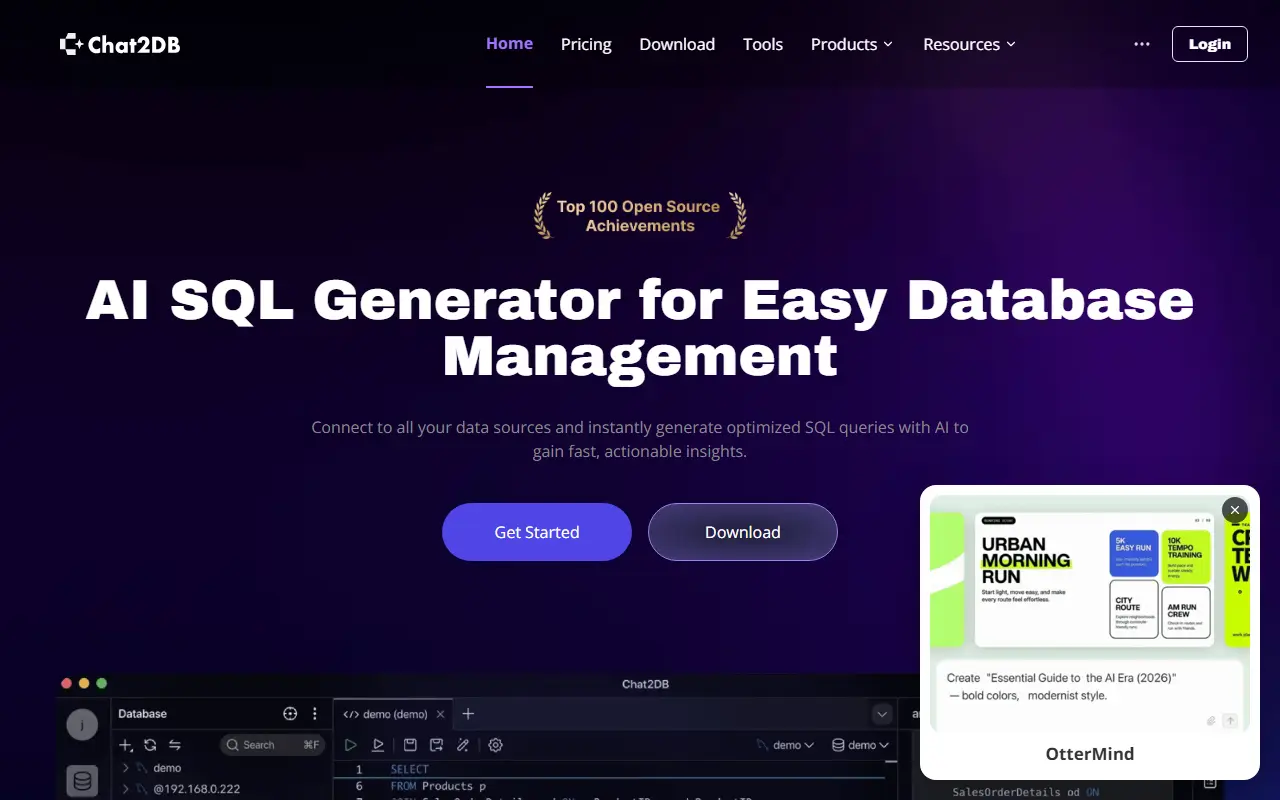
chat2db.aiChat2DB homepage screenshot

Chat2DB is a free desktop database client and SQL workspace aimed at developers, DBAs, analysts and data teams on any platform. The Community edition runs entirely on your own machine on Windows, macOS and Linux, and pairs a full SQL editor with an AI assistant that you connect to the model of your choice rather than one bundled with the app.

It connects to more than 40 databases, including MySQL, Oracle, PostgreSQL, SQL Server, MongoDB, Redis, ClickHouse, SQLite, MariaDB, TiDB, Snowflake and BigQuery, and new JDBC databases can be added through configuration alone. The SQL workspace covers editing, completion, formatting, execution, saved queries and history. Database management features let you browse metadata, manage tables and other objects and edit data in place, and there are tools for data import and export, dashboards and charts, plus a command line interface.

The AI assistant generates, explains and optimizes SQL from natural-language requests, and topics mention MCP support. Chat2DB is written in Java and powered by OtterMind, and its license is listed as 'Other' on GitHub, so check the terms before redistribution. It suits people who want one tool for many databases and would like to keep queries and credentials local.

Key features

  • Connects to 40+ databases via JDBC
  • SQL editor with completion and history
  • Bring-your-own-model AI for SQL generation
  • Table and object management with in-place editing
  • Data import, export, dashboards and charts
  • Runs locally on Windows, macOS and Linux

Pricing: A free Community edition is available and the Pro plan has a 30-day free trial. Local and Pro prices are not shown in the page text; Enterprise is by contact.

DB Browser for SQLite

DB Browser for SQLite is a visual open-source tool for creating, designing and editing SQLite database files through a familiar spreadsheet-like interface.

GitHub stars
25k
Last commit
2 days ago
Latest release
v3.13.1
Self-hosted
Yes
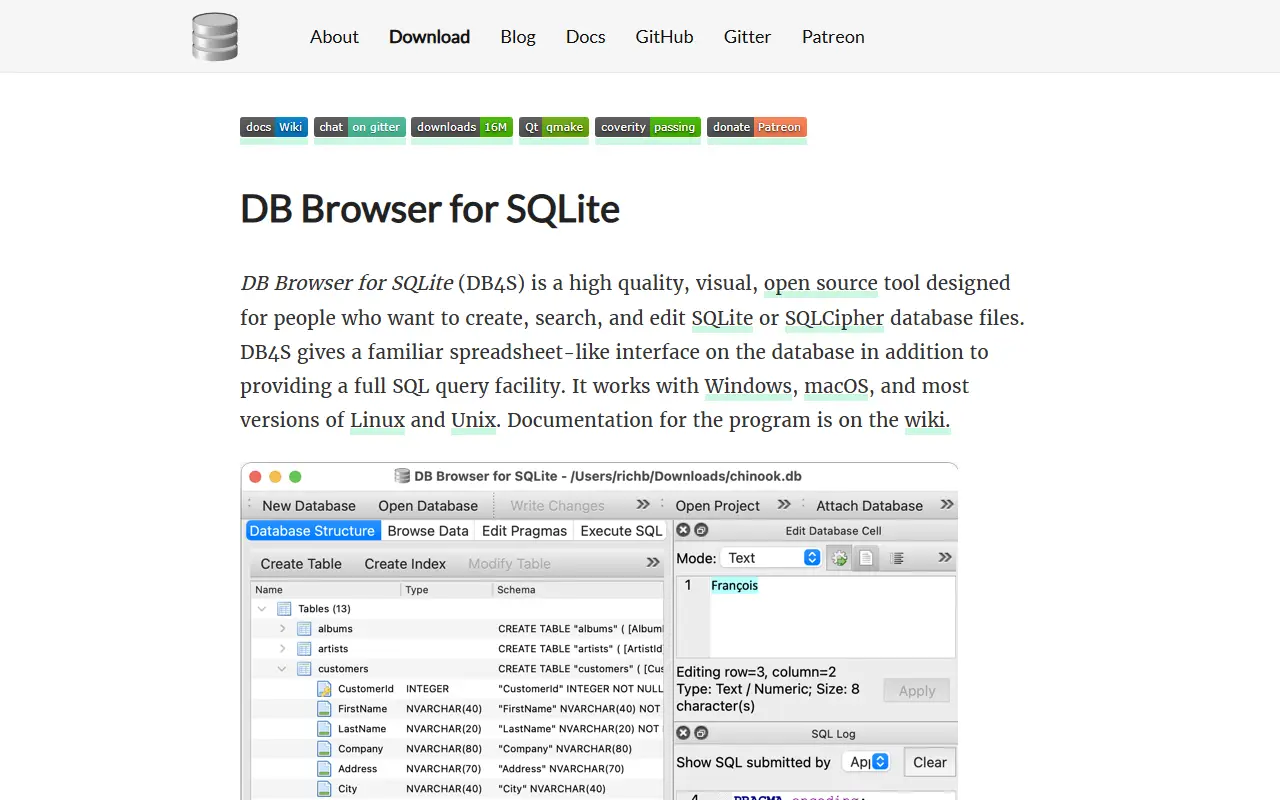
sqlitebrowser.orgDB Browser for SQLite homepage screenshot

DB Browser for SQLite, often abbreviated DB4S, is a visual, open-source tool for creating, designing and editing database files compatible with SQLite. It is aimed at people who build, query and modify databases and would rather not work purely in the command line, and it uses a familiar spreadsheet-like interface. The project was previously known as SQLite Database Browser.

It is a cross-platform desktop application written in C++ with the Qt toolkit, with builds and nightly versions for Windows, macOS and Linux, including packages for Arch Linux, Debian, Fedora, openSUSE, Ubuntu, FreeBSD, Snap, Nix and Flox. The README also has sections on what the tool is and is not, links to a wiki, build instructions and release history. Chat and donation channels support the community.

The repository's license is listed as 'Other' on GitHub, so check the terms for your use. As a local desktop program there is nothing to host; you open a SQLite file and work with it directly, which makes it popular with developers, students and analysts who handle SQLite databases.

Key features

  • Visual editor for SQLite databases
  • Spreadsheet-like data browsing
  • Create and modify tables and indexes
  • Cross-platform Qt application
  • Nightly builds and distro packages
  • Search and edit records

Dbx

A lightweight Rust and Tauri database client for 100+ databases with a built-in AI assistant, MCP server, CLI and Docker option, in roughly 25 MB.

GitHub stars
24k
Last commit
today
Latest release
v0.6.30
Licence
Apache-2.0
Self-hosted
Yes
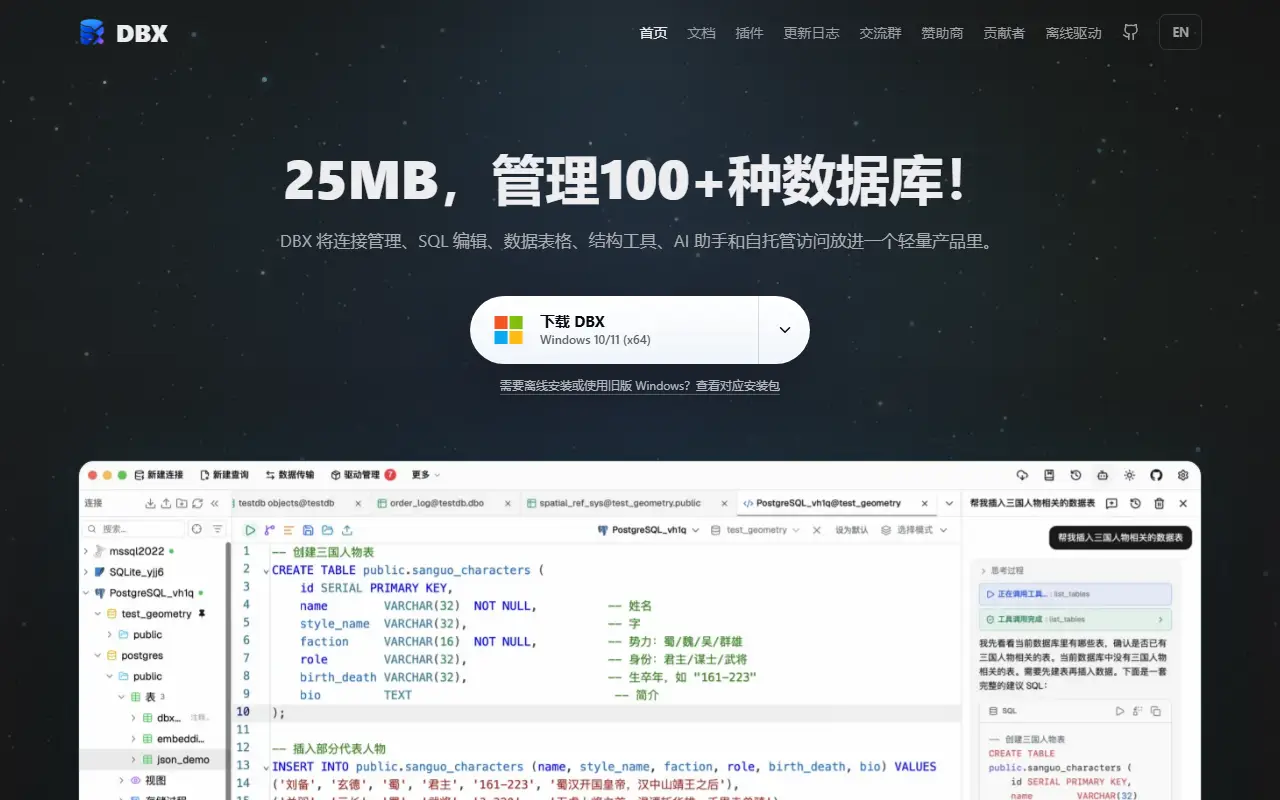
dbxio.comDbx homepage screenshot

DBX is a cross-platform database client built with Rust and Tauri, billed as lightweight at around 25 MB. It connects to more than a hundred databases, among them SQLite, MySQL, PostgreSQL, MongoDB, Redis, DuckDB, SQL Server and Dameng, and aims to cover many systems with one small application instead of several heavier tools.

Beyond the desktop app, it can be run through Docker and a command line interface, and it includes a built-in AI assistant and an MCP server, so AI tools can query and work with your databases through a standard protocol. The interface is built with Vue, and topics highlight support for ClickHouse, MySQL, MongoDB, PostgreSQL, Redis, SQL Server and SQLite along with general database management features. The project was created in 2026 and its documentation includes Chinese-language material.

DBX is Apache-2.0 licensed. It is meant for developers and administrators who want a fast, small client that works across relational and NoSQL systems, and who like the idea of connecting AI assistants to databases through MCP.

Key features

  • Supports 100+ databases
  • Lightweight Rust and Tauri desktop app
  • Built-in AI assistant
  • MCP server for AI tools
  • Command line interface
  • Docker deployment option

Pricing: Free and open source under the Apache-2.0 license.

Read more about DbxWebsite GitHub

Beekeeper Studio

A cross-platform SQL editor and database manager for Linux, macOS and Windows that supports PostgreSQL, MySQL, SQLite, SQL Server and many more databases.

GitHub stars
24k
Last commit
yesterday
Latest release
v6.1.4
Self-hosted
Yes
beekeeperstudio.ioBeekeeper Studio homepage screenshot

Beekeeper Studio is a modern, easy-to-use SQL editor and database manager for Linux, macOS and Windows. It supports a long list of databases, including PostgreSQL, MySQL, SQLite, SQL Server, Amazon Redshift, CockroachDB, BigQuery, Cassandra and Firebird, and is built with TypeScript and Electron.

It is free to download and offers many features at no cost, with no sign-up, registration or credit card required. Some premium features are sold under a paid license. The repository explains the arrangement: most of the code is open source under the GPLv3, while the paid features live in the same repository under a commercial source-available license. A table in the README shows which databases have full support in the community and paid editions.

The project welcomes community contributions and has translated READMEs in a dozen languages. Because its license is listed as 'Other' on GitHub, it is worth reading the terms to see which parts are free. It suits developers and analysts who want a clean, approachable client for everyday querying and schema browsing.

Key features

  • SQL editor and database manager
  • Supports PostgreSQL, MySQL, SQLite and SQL Server
  • Also supports Redshift, CockroachDB and BigQuery
  • Apps for Linux, macOS and Windows
  • No sign-up required for free use
  • Optional paid premium features

Pricing: The Community edition is free. Indie is $18, Professional $28 and Business $35 per user per month, or $9, $14 and $18 on yearly billing; paid features stay usable after 12 months of payments. Free trial available.

Another Redis Desktop Manager

Desktop GUI client for browsing and editing Redis data on Linux, Windows and Mac, including clusters and very large key sets.

GitHub stars
35k
Last commit
1 mo ago
Latest release
v1.7.4
Licence
MIT

Another Redis Desktop Manager is a graphical client for working with Redis servers from a desktop computer. It is positioned as a faster and more stable alternative to other Redis desktop tools and is designed to keep running when a database holds a very large number of keys, a case where some clients freeze or crash.

The project covers Redis cluster setups as well as single instances, and it is available for Linux, Windows and macOS. On Windows it can be installed with Chocolatey or winget, on Linux through an AppImage or Snap, and on macOS with Homebrew or a downloadable disk image. Paid listings in the Windows and Mac app stores exist as a way to support the author.

The code is written in JavaScript and released under the MIT license. Releases are published on GitHub, with a mirror on Gitee for users in China, and the README is also provided in Simplified Chinese. It is a local client, so it connects to Redis servers you already run rather than hosting data itself.

Key features

  • GUI browser for Redis keys and values
  • Redis cluster support
  • Handles very large key counts without crashing
  • Runs on Linux, Windows and macOS
  • Installable via Chocolatey, winget, Snap or Homebrew

Pricing: Free and open source under the MIT license; paid app store versions exist to support the author.

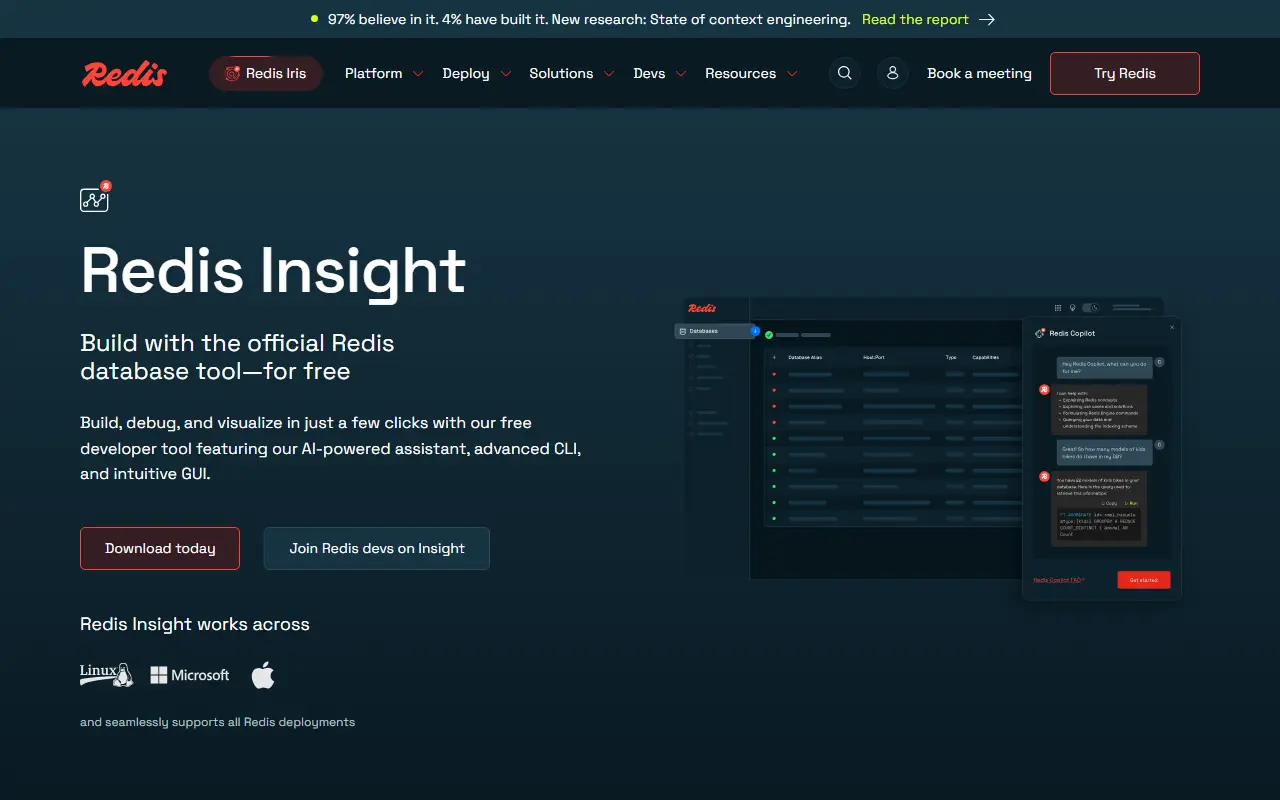
RedisInsight

Redis Insight is a visual developer tool from Redis for browsing, querying and optimizing Redis data, with a workbench, profiler and slow log analysis.

GitHub stars
8.9k
Last commit
3 days ago
Latest release
3.8.0
redis.ioRedisInsight homepage screenshot

Redis Insight is a graphical client for Redis, published by Redis. It helps developers design, build and tune applications by letting them browse, filter and visualize key-value data and view values in formats such as JSON, Hex and ASCII.

It offers create, read, update and delete support for lists, hashes, strings, sets, sorted sets, streams and JSON, plus management of vector sets, including similarity search. A Workbench provides a command-line interface with command auto-complete, while Profiler shows commands sent to Redis in real time and SlowLog highlights slow operations. Pub/Sub support, bulk deletion by filter and in-context recommendations for performance and memory use round out the tool, along with interactive tutorials.

The application is built with Electron, the Monaco editor and Node.js, and it works with Redis modules. The repository licence is listed as non-standard rather than a common open-source licence, so check the repository for the exact terms before redistributing.

Key features

  • Browse and filter Redis keys visually
  • CRUD for core data types and JSON
  • Vector set creation and similarity search
  • Workbench with command auto-complete
  • Real-time command profiler
  • SlowLog analysis and Pub/Sub support

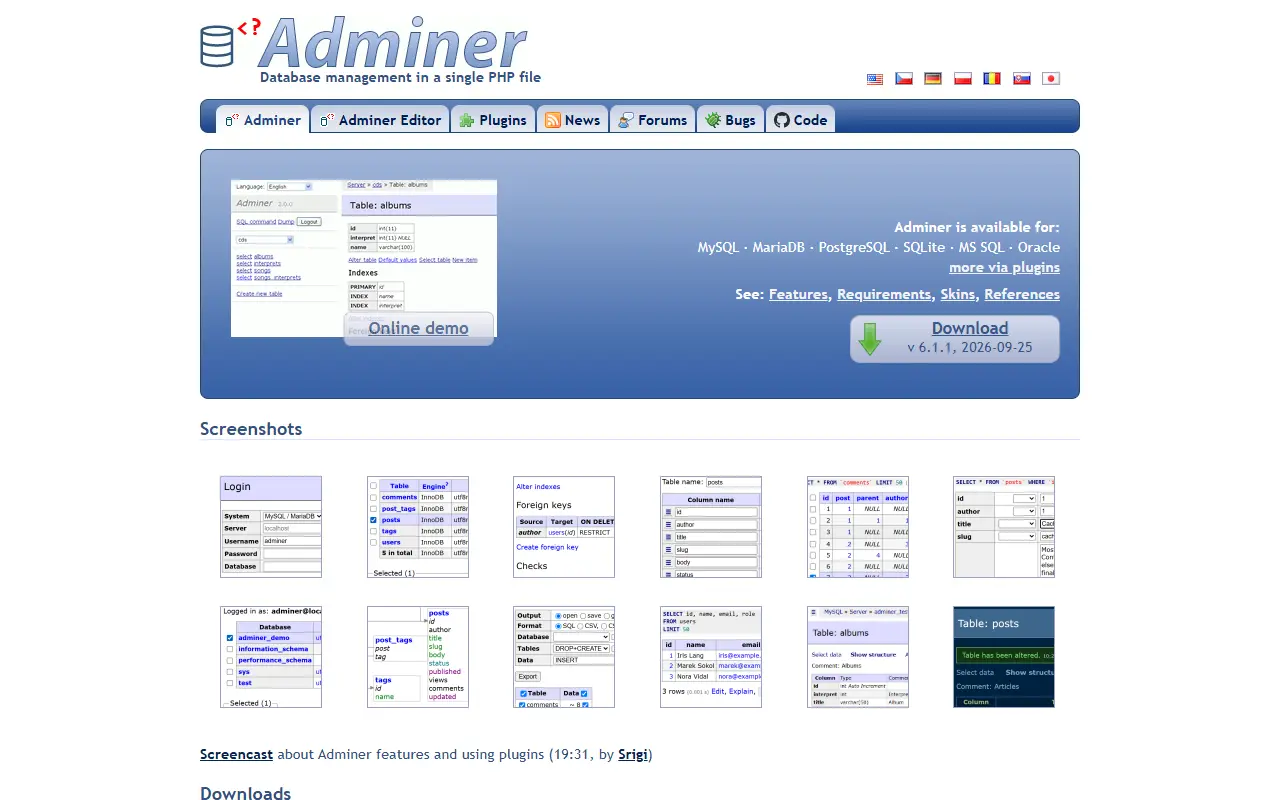
Adminer

A database management tool delivered as a single PHP file that works with MySQL, MariaDB, PostgreSQL, SQLite, MS SQL, Oracle and more through plugins.

GitHub stars
7.9k
Last commit
3 days ago
Latest release
v6.1.1
Self-hosted
Yes
adminer.orgAdminer homepage screenshot

Adminer is a database management tool written in PHP and distributed as a single file that you drop onto a server. It offers a web interface for browsing, querying and editing databases, and serves as a lighter alternative to heavier admin suites.

Supported systems are MySQL, MariaDB, PostgreSQL, CockroachDB, SQLite, MS SQL and Oracle, with plugins adding Elasticsearch, OpenSearch, SimpleDB, MongoDB, Redis, Firebird, ClickHouse, IGDB and IMAP. A related tool, Adminer Editor, provides data manipulation for end users rather than administrators. The compiled single file needs PHP 5.3 or later, while the source code needs PHP 7.4 or later, and many user-contributed plugins are listed on the plugins page.

The development version can be run from the adminer and editor directories, a compile script produces the single-file build, translations are updated with a language script, and end-to-end tests use Playwright. The repository lists the license as Other. Adminer suits developers and administrators who need quick access to a database from the browser.

Key features

  • Single-file PHP deployment
  • Works with MySQL, PostgreSQL and SQLite
  • Support for MS SQL, Oracle and CockroachDB
  • Plugins for MongoDB, Redis and Elasticsearch
  • Adminer Editor for end-user data editing
  • Translations and community plugins

Pricing: Free to use; the repository lists the license as Other.

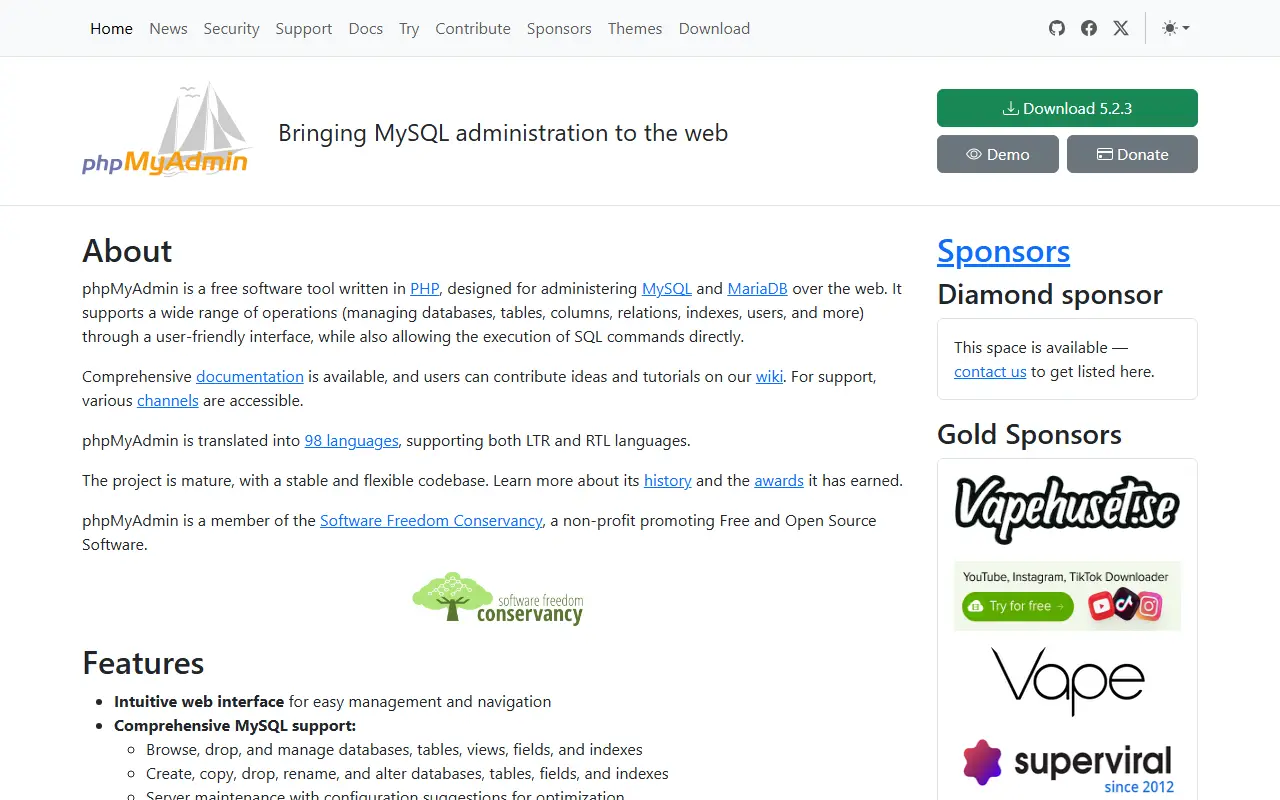
phpMyAdmin

phpMyAdmin is a free PHP web tool for administering MySQL and MariaDB databases, covering tables, users, SQL queries and data import and export.

GitHub stars
7.9k
Last commit
today
Latest release
RELEASE_5_2_3
Licence
GPL-2.0
Self-hosted
Yes
phpmyadmin.netphpMyAdmin homepage screenshot

phpMyAdmin is free software written in PHP that administers MySQL and MariaDB through a web browser. It provides an interface for managing databases, tables, columns, relations, indexes and users, and it also lets you run SQL commands directly.

Operations include browsing, creating, copying, renaming and dropping databases, tables, fields and indexes, plus managing views, stored procedures and triggers, and managing MySQL user accounts and privileges. Statements can be executed, edited and bookmarked, including batch queries. Data can be imported from CSV and SQL and exported to formats such as CSV, SQL, XML and PDF. Multi-server administration allows control of several MySQL servers from one place, and the server maintenance pages offer configuration suggestions.

The interface is translated into 98 languages, including both left-to-right and right-to-left scripts. The project is licensed under GPL-2.0, is a member of the Software Freedom Conservancy, and offers a public demo so you can try it before installing it on your own web server.

Key features

  • Manage databases, tables, columns and indexes
  • Run and bookmark SQL statements
  • Manage MySQL users and privileges
  • Import from CSV and SQL
  • Export to CSV, SQL, XML and PDF
  • Multi-server administration
  • Interface in 98 languages

Pricing: Free software under the GPL-2.0 licence.

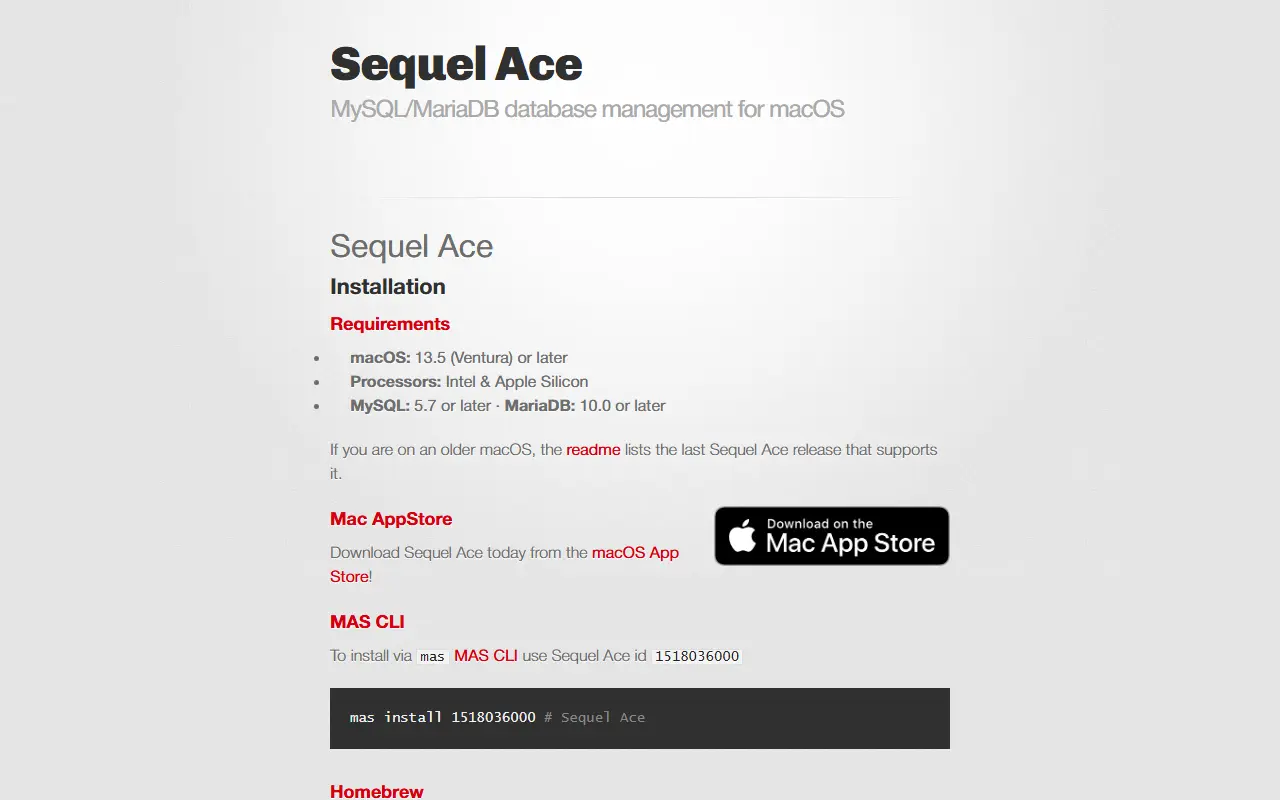
Sequel Ace

Sequel Ace is a native macOS app for managing MySQL and MariaDB databases, serving as the successor to Sequel Pro.

GitHub stars
7.5k
Last commit
5 days ago
Latest release
production/6.0.1-20114
sequel-ace.comSequel Ace homepage screenshot

Sequel Ace is a Mac database management application for working with MySQL and MariaDB databases. It is described as the sequel to the long-standing macOS tool Sequel Pro and is written in Objective-C, with documentation on its own website.

It runs on Intel and Apple Silicon Macs and is available from the Mac App Store, through the mas command-line tool, and via an unofficial community Homebrew cask. Older releases are provided for older versions of macOS and MySQL, but the maintainers state that no support is given for them. The README also describes a built-in Model Context Protocol server that lets AI agents query databases using the connections already saved in Sequel Ace. It is disabled until you enable it, accepts only local connections and is read-only.

Development is supported by sponsorships through Open Collective and GitHub Sponsors. The repository lists its licence as other, so check the project for its exact terms.

Key features

  • Native macOS MySQL and MariaDB client
  • Intel and Apple Silicon support
  • Mac App Store and Homebrew installation
  • Optional read-only MCP server for AI agents
  • Previous releases for older macOS versions

7 more TablePlus alternatives

TablePlus alternatives: questions

What is the best open-source alternative to TablePlus?
DBeaver is the top-ranked open-source alternative to TablePlus on Enlisted: A free multi-platform desktop database tool and SQL client for developers, DBAs and analysts, supporting over 100 databases through JDBC and ODBC drivers. Other strong options are Chat2DB, DB Browser for SQLite, Dbx and Beekeeper Studio.
Are these TablePlus alternatives free?
All 17 are open source, so the code is free to use under its licence, and all of them can be self-hosted on your own server or computer. 1 also offers a paid or managed cloud version if you'd rather not host it yourself.
How is this list of TablePlus alternatives ranked?
By a score built from GitHub stars, star growth over the last 30 days and how recently the code changed. 14 of these projects shipped code in the last 30 days. Data is refreshed daily, and nobody can pay to move up.

People also look for alternatives to…

View all