
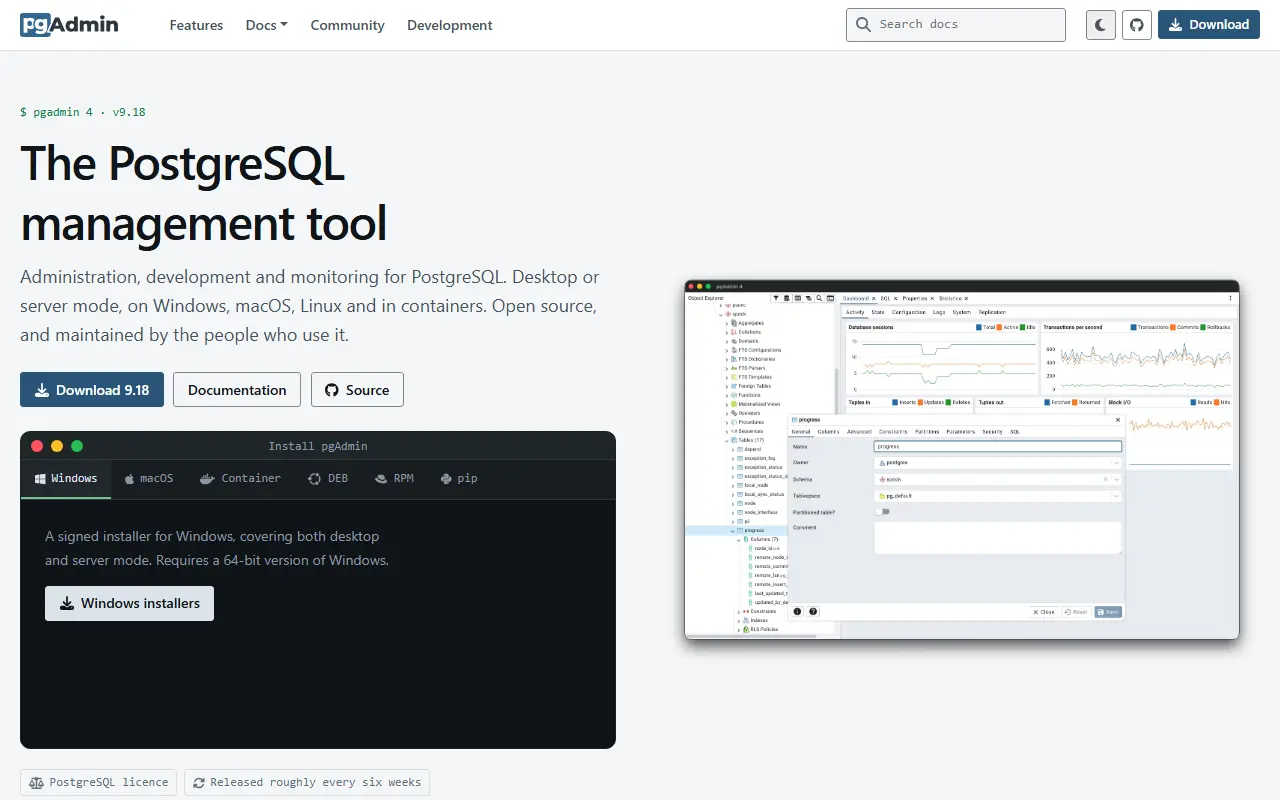
About pgAdmin
pgAdmin 4 is an administration and development tool for the PostgreSQL database, written as a rewrite of the earlier pgAdmin 3. It is built as a web application, with Python and Flask on the server side and ReactJS, HTML5 and CSS on the client.
Although it uses web technologies, pgAdmin 4 can either be deployed on a web server and accessed from a browser or run standalone on a workstation. For the standalone mode, an Electron-based runtime starts a Python server process and displays the interface. Building from source needs Node.js 20 or later, yarn, Python 3.9 or later and a PostgreSQL server.
The README explains how to compile the JavaScript, CSS and image assets into a bundle that is sent to the browser, and how to set up the Python environment on Unix-like systems and on Windows. Documentation, downloads and release information are on pgadmin.org.
Key features
- Web-based PostgreSQL administration
- Server or standalone desktop deployment
- Flask backend with React frontend
- Electron runtime for standalone mode
- Development tools for PostgreSQL
Good fit for
- →Administering PostgreSQL databases from a browser
- →Shared database admin console for a team
- →Local PostgreSQL management on a workstation
- Tags
- postgresql
- postgres
- database-administration
- dba
- database-gui
- python
- flask
- react
pgAdmin: questions and answers
- What is pgAdmin used for?
- pgAdmin is a web-based administration and development platform for PostgreSQL, deployable on a server or run standalone on a workstation, built with Flask and React. It is a good fit for administering PostgreSQL databases from a browser, shared database admin console for a team and local PostgreSQL management on a workstation.
- Is pgAdmin open source?
- Yes. pgAdmin is open source under a custom licence. Its source code is on GitHub at pgadmin-org/pgadmin4 and is written mainly in Python.
- Is pgAdmin free?
- Yes. pgAdmin is open source, so the software itself is free to use under the terms of its own licence.
- What is pgAdmin an alternative to?
- pgAdmin is an open-source alternative to Navicat, DataGrip, TablePlus and Postico. Other open-source alternatives to Navicat include Beekeeper Studio, DBeaver and Chat2DB.
- Is pgAdmin actively maintained?
- Yes. The most recent commit to pgAdmin was on 2 October 2026. The project has 3.9k stars on GitHub.
Open-source alternatives to pgAdmin
See all
Beekeeper Studio
Database Tools
Modern and easy to use SQL client for MySQL, Postgres, SQLite, SQL Server, and more. Linux
OSSvs DataGrip★ 24k
DBeaver
Database Tools
Free universal database tool and SQL client
Apache-2.0vs DataGrip★ 52k
Chat2DB
Database Tools
Chat2DB is a free, cross-platform, local-first database client and SQL workspace for devel
OSSvs DataGrip★ 28kAdminer
Database Tools
Database management in a single PHP file
OSSvs DataGrip★ 7.9k
DbGate
Database Tools
Database manager for MySQL, PostgreSQL, SQL Server, MongoDB, SQLite and others. Runs under
GPL-3.0vs DataGrip★ 7.3k
Dbx
Database Tools
25 MB lightweight cross-platform database client for 100+ databases, including MySQL, Post
Apache-2.0vs DataGrip★ 24k
SaaS alternatives to pgAdmin
See all
Navicat
Database Tools
Database administration and development client for many SQL and NoSQL systems
SaaS
DataGrip
Database Tools
JetBrains IDE for SQL with code completion and multi-database support
SaaS
TablePlus
Database Tools
Native database client for PostgreSQL, MySQL, SQLite, Redis and more
SaaS
Postico
Database Tools
PostgreSQL client for macOS with a table-based interface
SaaS
SQLPro Studio
Database Tools
Database client for macOS, iOS and Windows supporting Postgres, MySQL, SQL Server and Oracle
SaaS
DbVisualizer
Database Tools
Universal database client with a free edition and a paid Pro tier
SaaS