8 open-source alternatives ranked by real activity

Open-source ShareFile alternatives

A curated, ranked list of the 8 best open-source alternatives to ShareFile.

The best open-source alternative to ShareFile is Syncthing. If that doesn't suit you, other good options are Nextcloud, SFTPGo, ownCloud and Papermark.

Commercial alternatives to ShareFile include Dropbox, Box, Egnyte and Kiteworks. See all 30.

ShareFile alternatives are mainly file storage & sharing tools. 6 of them shipped code in the last 30 days, 8 can be self-hosted, and 2 use a permissive licence.

Last updated November 12, 2026 · ranked by GitHub stars, growth and recent commits

Syncthing

Open-source continuous file synchronization that keeps folders in step between two or more computers, with a focus on safety, security and ease of use.

GitHub stars
90k
Last commit
3 days ago
Latest release
v2.1.7
Licence
MPL-2.0
Self-hosted
Yes
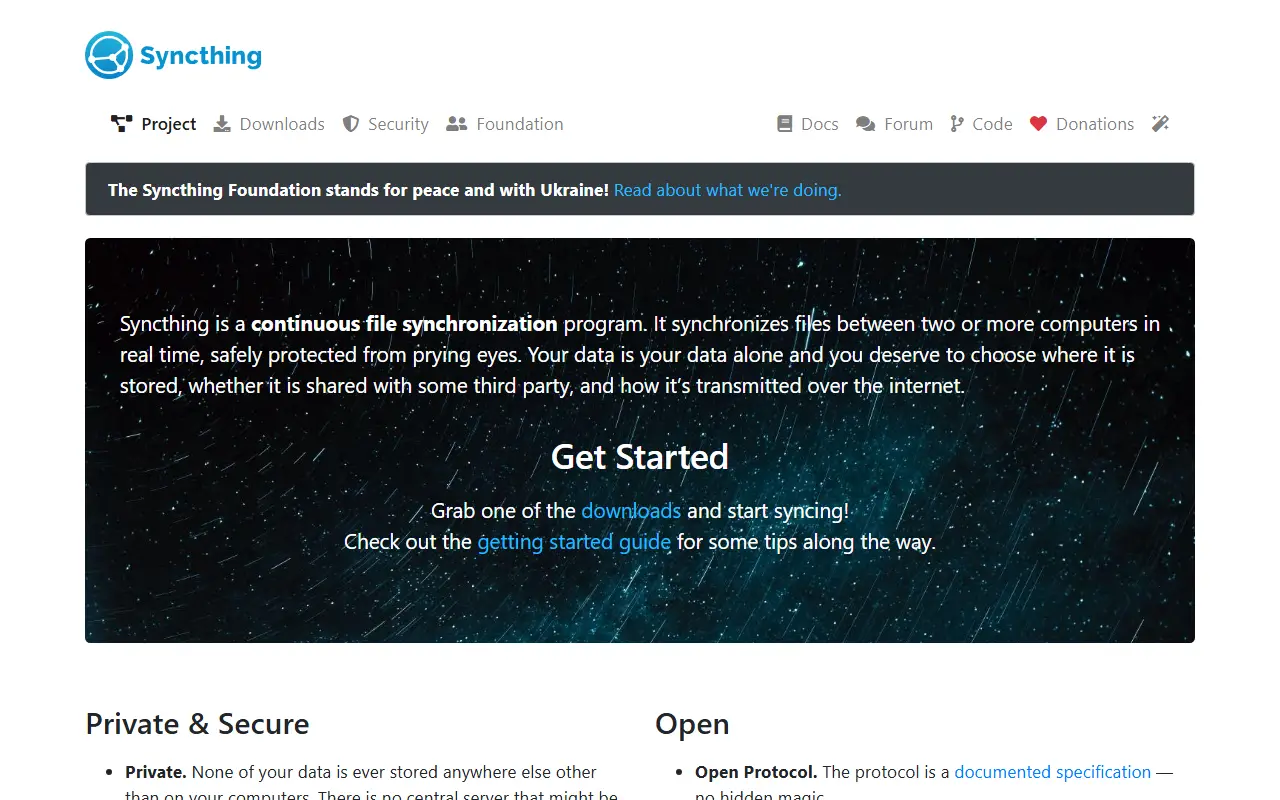
syncthing.netSyncthing homepage screenshot

Syncthing is a continuous file synchronization program that keeps files in sync between two or more computers. It is written in Go and released under the MPL-2.0 license, and its peer-to-peer design means your devices exchange files with each other directly rather than through a central storage service.

The project ranks its goals in order of importance: protect users from data loss, stay secure against eavesdropping and tampering, be easy to use, work automatically with minimal interaction, run on every common computer, and focus on empowering individuals. Several graphical front ends exist for Windows, Mac and Linux, and the repository includes sample files for running it as a background service.

Syncthing can also be run in Docker, and a getting-started guide covers setup. It suits individuals and small groups who want to sync folders between laptops, desktops and servers they control instead of relying on a hosted file-sharing service, and who value open, auditable software.

Key features

  • Continuous file synchronization between computers
  • Peer-to-peer device connections
  • Safety and security as top-ranked goals
  • Graphical interfaces for Windows, Mac and Linux
  • Docker deployment support
  • Automatic operation with minimal user interaction

Pricing: Free and open source under the MPL-2.0 license.

Nextcloud

A self-hosted file sync, sharing and collaboration platform that stores files, contacts and calendars on a server you choose, extensible with hundreds of apps.

GitHub stars
37k
Last commit
yesterday
Latest release
v33.0.11
Licence
AGPL-3.0
Self-hosted
Yes
Hosted version
Available
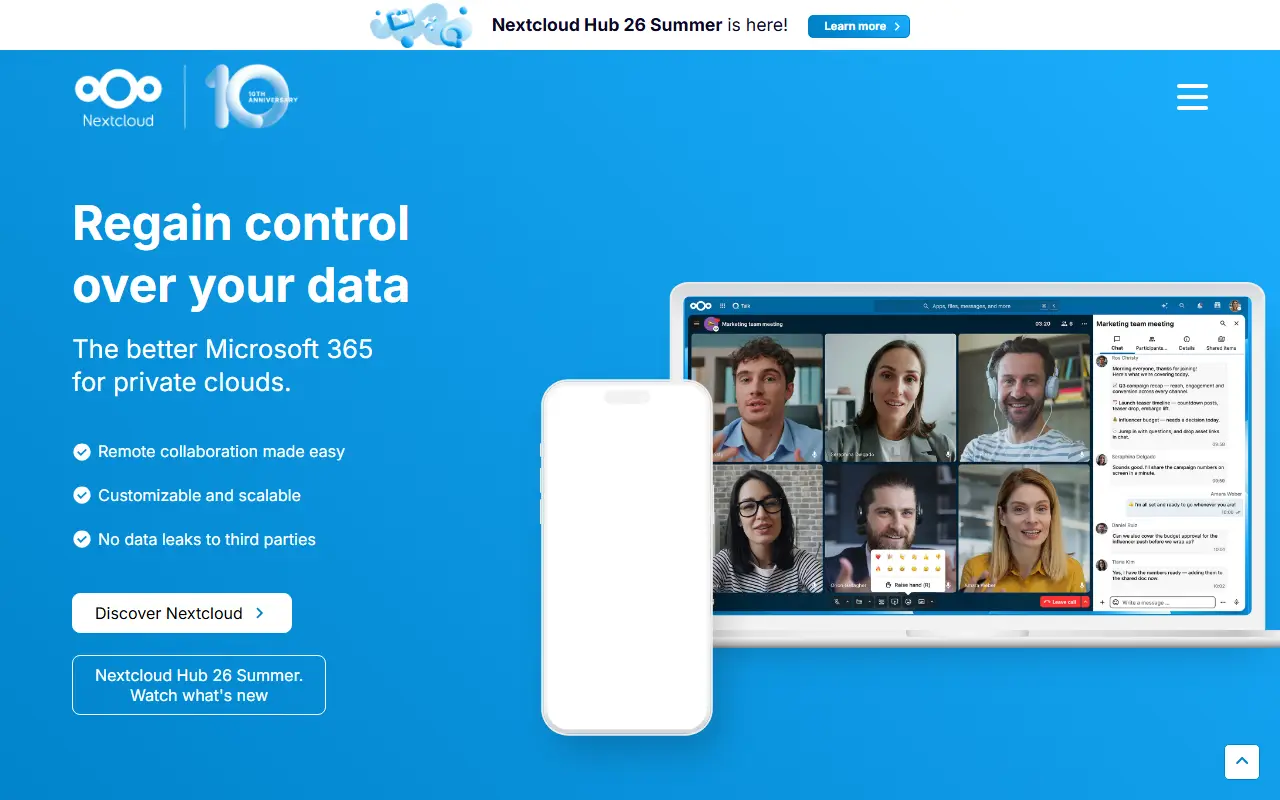
nextcloud.comNextcloud homepage screenshot

Nextcloud Server is a platform for keeping your files, contacts, calendars and other data on a server of your choosing. Content is synchronized across your devices, can be shared with other people for viewing or collaboration, and stays under your control rather than with a large cloud provider. It grew out of the ownCloud lineage.

Functionality can be expanded through hundreds of apps in its App Store, including Calendar, Contacts, Mail and Video Chat. Security measures include encryption mechanisms, a public bug bounty program and two-factor authentication. There are several ways to get a Nextcloud: sign up with a provider, install the server yourself on your own hardware or with a ready-to-use appliance, buy a device that comes with it preinstalled, or find a service provider to host it for you.

The server is written in PHP and JavaScript under the AGPL-3.0 license. Nextcloud GmbH also offers an Enterprise edition aimed at public sector, education and company users. It suits households, schools and organizations that want to replace commercial cloud storage and office suites with something they run themselves.

Key features

  • File storage and sync across devices
  • Contacts and calendar hosting
  • Sharing and collaboration controls
  • App Store with hundreds of apps
  • Two-factor authentication and encryption
  • Self-install, appliance or provider-hosted options

Pricing: Nextcloud Enterprise Standard starts at 42€ per user per year, with subscriptions from 100 users and 31.50€ from 250 users. Nextcloud One managed hosting is offered for smaller teams.

SFTPGo

Event-driven file transfer server speaking SFTP, FTP/S, HTTP/S and WebDAV, with local, S3, Google Cloud and Azure storage backends.

GitHub stars
13k
Last commit
3 days ago
Latest release
v2.7.6
Licence
AGPL-3.0
Self-hosted
Yes
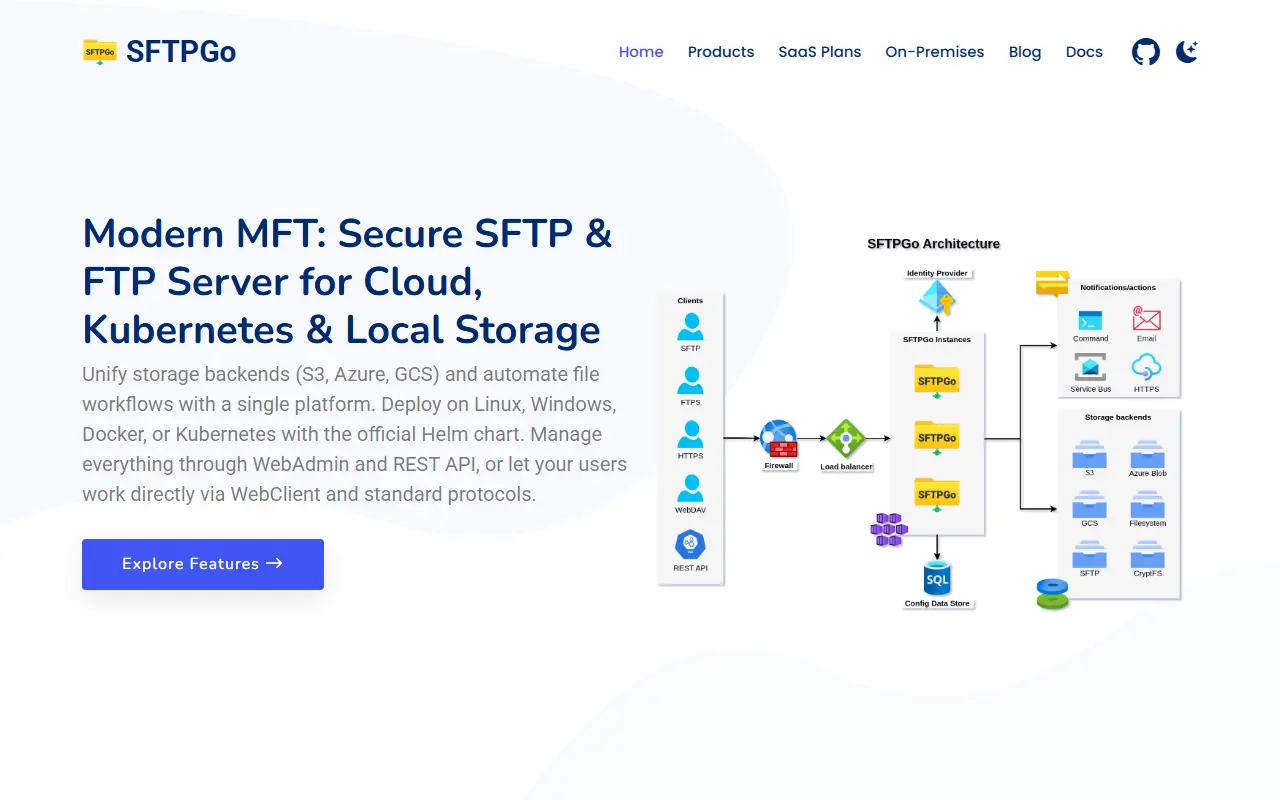
sftpgo.comSFTPGo homepage screenshot

SFTPGo is a configurable file transfer server that exposes SFTP, HTTP/S, FTP/S and WebDAV. Storage can be a local filesystem, an encrypted local filesystem, S3-compatible object storage, Google Cloud Storage, Azure Blob Storage or another SFTP server, so teams can exchange files internally or with business partners using familiar tools and protocols.

The Community edition includes the core protocols, the storage backends and the WebAdmin and WebClient interfaces. The project topics highlight multi-factor authentication, Prometheus metrics, proxy protocol support and data-at-rest encryption. It is also used to place legacy protocols in front of cloud storage, which lets older clients write to S3, Google Cloud Storage or Azure Blob.

SFTPGo is written in Go and released under the AGPL-3.0 license, with community support through GitHub. A separate Enterprise edition is sold under a commercial license with direct support from the authors, ISO 27001 vendor status and extra features for compliance-heavy environments. It is described as a drop-in upgrade from the Community edition.

Key features

  • SFTP, FTP/S, HTTP/S and WebDAV protocols
  • Local, S3, Google Cloud and Azure Blob storage
  • Web admin and web client interfaces
  • Multi-factor authentication
  • Prometheus metrics and Docker deployment
  • Encrypted local filesystem option

Pricing: Managed SFTPGo SaaS runs from 50 euros (Tiny) to 850 euros (Premium) per month by storage and bandwidth, with a 10-day free trial and two months free on annual billing; Custom is quoted.

Read more about SFTPGoWebsiteGitHub#3 ShareFile alternative

ownCloud

The server core of ownCloud Classic, a self-hosted platform for file storage, sync and sharing with WebDAV, CalDAV and CardDAV support.

GitHub stars
8.8k
Last commit
4 days ago
Latest release
v11.1.0
Licence
AGPL-3.0
Self-hosted
Yes
owncloud.comownCloud homepage screenshot

ownCloud Core is the server component of ownCloud Classic, a self-hosted platform for file storage, synchronization and sharing. It is the foundation on which apps such as Activity, Calendar and Contacts are built, and is written in PHP and JavaScript.

It ships with servers for WebDAV, CalDAV and CardDAV, an app plugin architecture, backends for external storage, support for encryption, user and group management, and a REST API. The server runs on PHP with MySQL, MariaDB, PostgreSQL or SQLite, and is also available as a Docker image on Docker Hub. Its topics point to federated sharing and enterprise use.

ownCloud Classic is licensed under AGPL-3.0, and installation is covered by the official manual. For the next-generation platform, the project points to ownCloud Infinite Scale. Contributors follow a rebase workflow with signed commits and DCO sign-off, and enterprise support is available from the vendor. It suits organizations and individuals who want to keep files on their own servers instead of a public cloud.

Key features

  • File storage, sync and sharing
  • WebDAV, CalDAV and CardDAV servers
  • Plugin architecture for apps
  • User and group management
  • Encryption and external storage support
  • REST API for integrations
  • Docker image available

Pricing: Free and open source under AGPL-3.0; enterprise support is available from the vendor.

Papermark

An open-source DocSend alternative for sharing documents through trackable links, with analytics, custom domains, secure data rooms and self-hosting.

GitHub stars
9.3k
Last commit
2 mo ago
Latest release
v0.22.0
Self-hosted
Yes
Hosted version
Available
papermark.comPapermark homepage screenshot

Papermark is an open-source alternative to DocSend for sharing documents through links, with built-in analytics and custom domains. It also offers secure data rooms for sharing groups of documents, and it can be self-hosted and customized as needed.

Documents are shared by sending a custom link, and a custom domain and branding can be applied so the link looks like your own. Document tracking provides insights into how recipients engage, with page-by-page analytics listed as coming soon. The project is built with Next.js, TypeScript, Tailwind, shadcn/ui, Prisma and PostgreSQL, with NextAuth.js for authentication and Tinybird for analytics.

Running it yourself requires Node.js 18.17 or later, a PostgreSQL database, blob storage on AWS S3 or Vercel Blob, and Resend for sending email, plus Tinybird setup for analytics. The documentation covers cloning the repository, configuring environment variables and initializing the database. A hosted version is available at papermark.com.

Key features

  • Shareable document links
  • Custom domains and branding
  • Document view analytics
  • Secure data rooms
  • Self-hosting with PostgreSQL
  • Next.js and TypeScript codebase

Pricing: A free plan covers 1 team member. Pro is €24, Business €59 and Data Rooms €99 per month billed yearly; Data Rooms Plus is €249. Enterprise and self-hosting are quoted; the data rooms plan has a 7-day trial.

ProjectSend

Self-hosted PHP application for sharing files with clients, each of whom signs in to a private page, with groups, expiry dates, quotas, and notifications.

GitHub stars
2.1k
Last commit
2 days ago
Latest release
v2.8.1
Licence
GPL-2.0
Self-hosted
Yes
Hosted version
Available
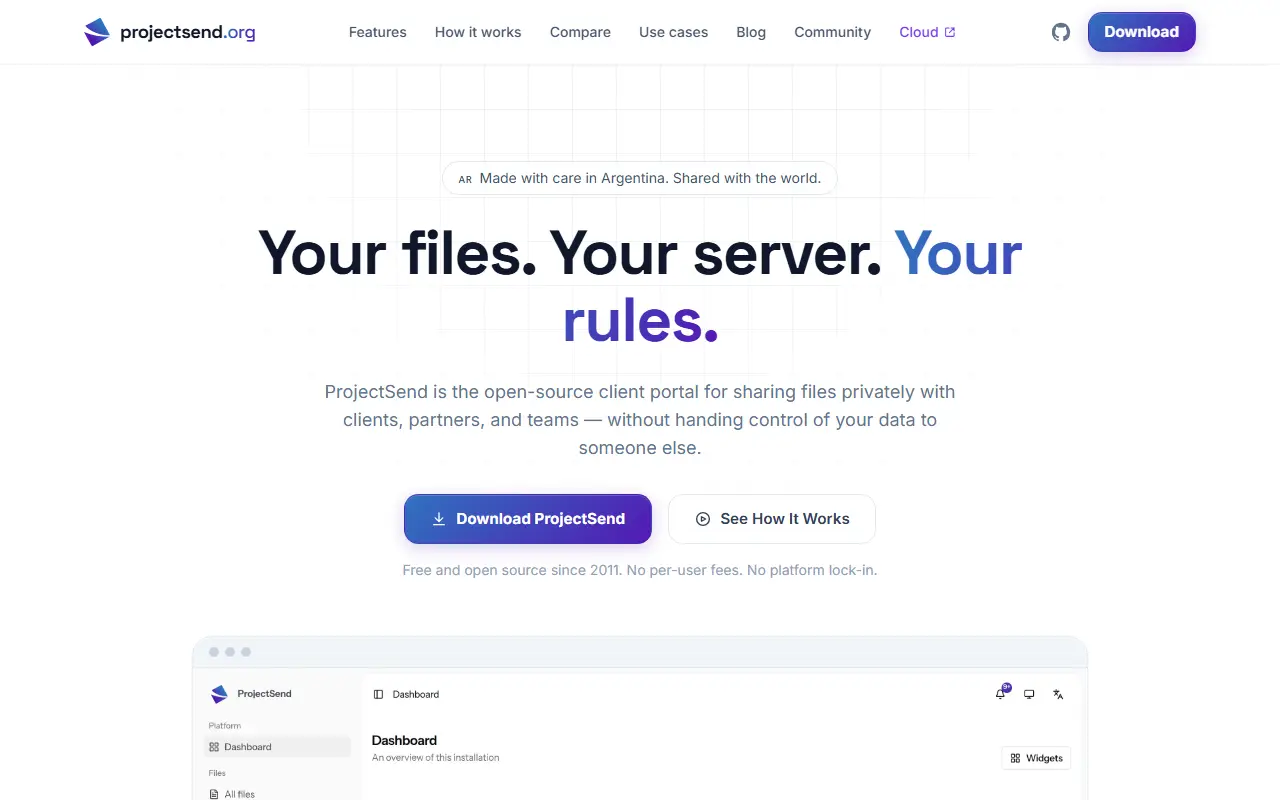
projectsend.orgProjectSend homepage screenshot

ProjectSend is a self-hosted application for getting files to the people you work with. You upload files, choose exactly who can see them, and each client signs in to a private page to download them. There are no public links passed around by email, no third-party service holding documents, and no per-seat pricing. It is written in PHP with MySQL and released under the GPL-2.0 license.

Clients get a private area showing only what was shared with them, optional two-factor authentication, search, filtering and sorting, and downloads of single files, zip bundles, or whole folders, with email notifications in their language. For you, it provides resumable uploads that survive dropped connections, folders, categories, and client groups, sharing with one client, a group, or publicly with an expiry date or download limit, previews, and storage quotas.

People who prefer not to run the server can use ProjectSend Cloud, the official hosted version run by the same team, whose subscriptions fund the free software. S3 storage is among the topics. It suits agencies, consultants, and accountants who regularly deliver files to clients.

Key features

  • Private client portal per customer
  • Resumable uploads for large files
  • Client groups, folders, and categories
  • Expiry dates and download limits
  • Optional two-factor authentication
  • Email notifications
  • Storage quotas and S3 support

Pricing: Self-hosting is free forever. A hosted ProjectSend Cloud exists, but the page text does not show its price.

Safebucket

Safebucket is an open-source, self-hosted file sharing platform where uploads and downloads go directly to storage via presigned URLs.

GitHub stars
995
Last commit
2 days ago
Latest release
v0.8.1
Licence
Apache-2.0
Self-hosted
Yes
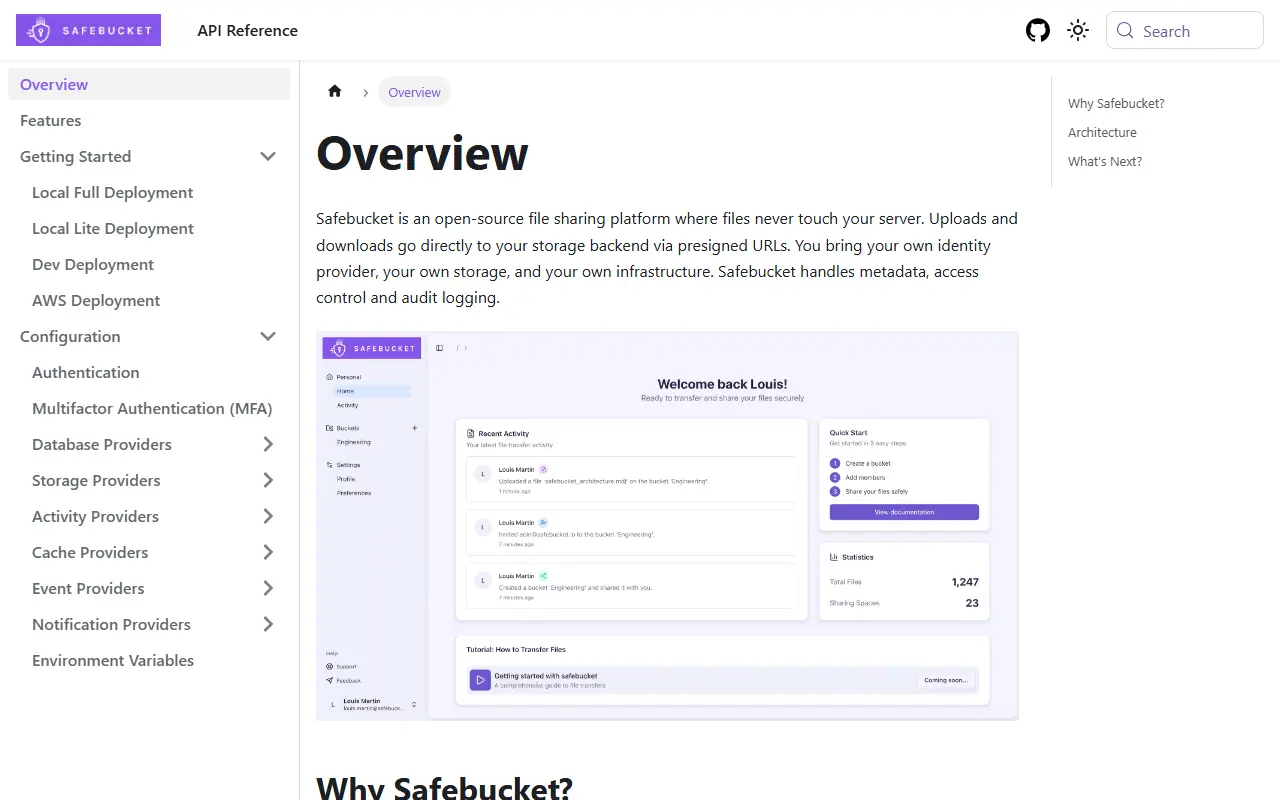
docs.safebucket.ioSafebucket homepage screenshot

Safebucket is an open-source platform for sharing files on infrastructure you control. Its distinguishing design choice is that uploads and downloads use presigned URLs, so file data goes straight between the user and the storage backend and bypasses the application server. That keeps the server light and avoids it becoming a bottleneck for large transfers.

The platform covers the sharing workflow with quick and reverse share links that can be protected by a password or limited by download or view count, role-based access control at platform and bucket level, and file expiration with a configurable trash retention period. Sign-in works through any OIDC provider, local accounts exist for external users, and TOTP multifactor authentication is supported. Administrators get an activity feed, audit logs and a dashboard with platform-wide statistics.

Each component, including storage, database, events, cache and notifier, can be swapped for another implementation. The backend is written in Go, is licensed under Apache-2.0 and ships as container images that are signed with cosign. A Docker-based quick start brings it up locally on port 8080.

Key features

  • Direct uploads via presigned URLs
  • Password-protected public share links
  • Reverse share for receiving files
  • OIDC single sign-on and TOTP
  • Role-based access at bucket level
  • Audit logs and admin dashboard
  • File expiration and configurable trash

Pricing: Free and open source under the Apache-2.0 license.

LinShare

LinShare is an open-source, self-hosted file sharing platform from Linagora for organizations that need traceable, private exchange of documents.

GitHub stars
581
Last commit
1 mo ago
Licence
AGPL-3.0
Self-hosted
Yes
linshare.appLinShare homepage screenshot

LinShare is an open-source file sharing platform built for organizations that need to exchange documents with internal and external collaborators while keeping full control over privacy and traceability. It is meant to replace email attachments, USB sticks and consumer cloud drives with a service you run on your own infrastructure.

Key features include a personal space where you upload, version and organize files and share them by link or email, shared spaces as workgroups with roles and nested folders, upload requests that let outsiders send files through a secure expiring drop box, guest accounts with restricted time-limited access, reusable contact lists, and activity logs and audit trails for every download, share and change. Enterprise integration covers LDAP directories, LemonLDAP::NG, Microsoft Azure SSO through OpenID Connect, JWT, antivirus scanning and file previews, plus a REST API and an MCP server that lets compatible AI assistants manage files, shares, guests and workgroups.

LinShare is licensed under AGPL-3.0, is documented with install and upgrade guides, and a recent release added guest sharing through contact lists. A demo can be tried before installing.

Key features

  • Personal and shared workspaces
  • Upload requests via expiring drop boxes
  • Guest accounts with time limits
  • Audit logs for downloads and shares
  • LDAP and Azure SSO integration
  • REST API and MCP server

Pricing: Free and open source under the AGPL-3.0 license.

Commercial ShareFile alternatives

Hosted, closed-source products that compete with ShareFile. Showing 12 of 30.

See every ShareFile alternative on its tool page

ShareFile alternatives: questions

What is the best open-source alternative to ShareFile?
Syncthing is the top-ranked open-source alternative to ShareFile on Enlisted: Open-source continuous file synchronization that keeps folders in step between two or more computers, with a focus on safety, security and ease of use. Other strong options are Nextcloud, SFTPGo, ownCloud and Papermark.
What are the best commercial alternatives to ShareFile?
Dropbox, Box, Egnyte, Kiteworks and FileCloud are among the hosted, closed-source alternatives to ShareFile listed on Enlisted, which lists 30 in total. Compare their pricing and features on each tool page.
Are these ShareFile alternatives free?
All 8 are open source, so the code is free to use under its licence, and all of them can be self-hosted on your own server or computer. 3 also offer a paid or managed cloud version if you'd rather not host it yourself.
How is this list of ShareFile alternatives ranked?
By a score built from GitHub stars, star growth over the last 30 days and how recently the code changed. 6 of these projects shipped code in the last 30 days. Data is refreshed daily, and nobody can pay to move up.

People also look for alternatives to…

View all