#1
Open-source marketing automation platform for email campaigns, segmentation and multi-channel marketing that you can host yourself.
- GitHub stars
- 11k
- Last commit
- 2 days ago
- Latest release
- 7.2.2
- Self-hosted
- Yes
- Hosted version
- Available
mautic.org
Mautic is open-source marketing automation software. It lets businesses and organizations build integrated marketing campaigns, including email marketing, while keeping control of their own data. The project is supported by a worldwide community of contributors and presents privacy and extensibility as core goals.
The README highlights several advantages over conventional hosted tools: it is free to use, you can run it on your own infrastructure with your own database, there is no vendor lock-in, integrations can be built as needed, and both the frontend and backend are customizable. It also describes multi-channel marketing without extra cost and unlimited segmentation and automation.
Mautic is written in PHP. It can be downloaded and self-hosted, or you can request a trial of a hosted option, and community channels and a blog share news, releases and strategy. Its license is stated in the repository. It suits marketing teams that want automation without relying entirely on a third-party SaaS provider.
Key features
- Email marketing and campaign automation
- Contact segmentation
- Multi-channel marketing
- Customizable frontend and backend
- Custom integrations
- Own your data in your own database
Pricing: Managed Mautic hosting through a partner starts from 275 euros a month billed quarterly (247.50 on annual billing) for Essential and from 1,237 euros a month for Professional; Enterprise is custom.
#2
Postal is an open-source mail delivery platform for sending and receiving email, comparable to Sendgrid, Mailgun or Postmark but run on your own servers.
- GitHub stars
- 17k
- Last commit
- 2 days ago
- Latest release
- 3.3.7
- Licence
- MIT
- Self-hosted
- Yes
postalserver.io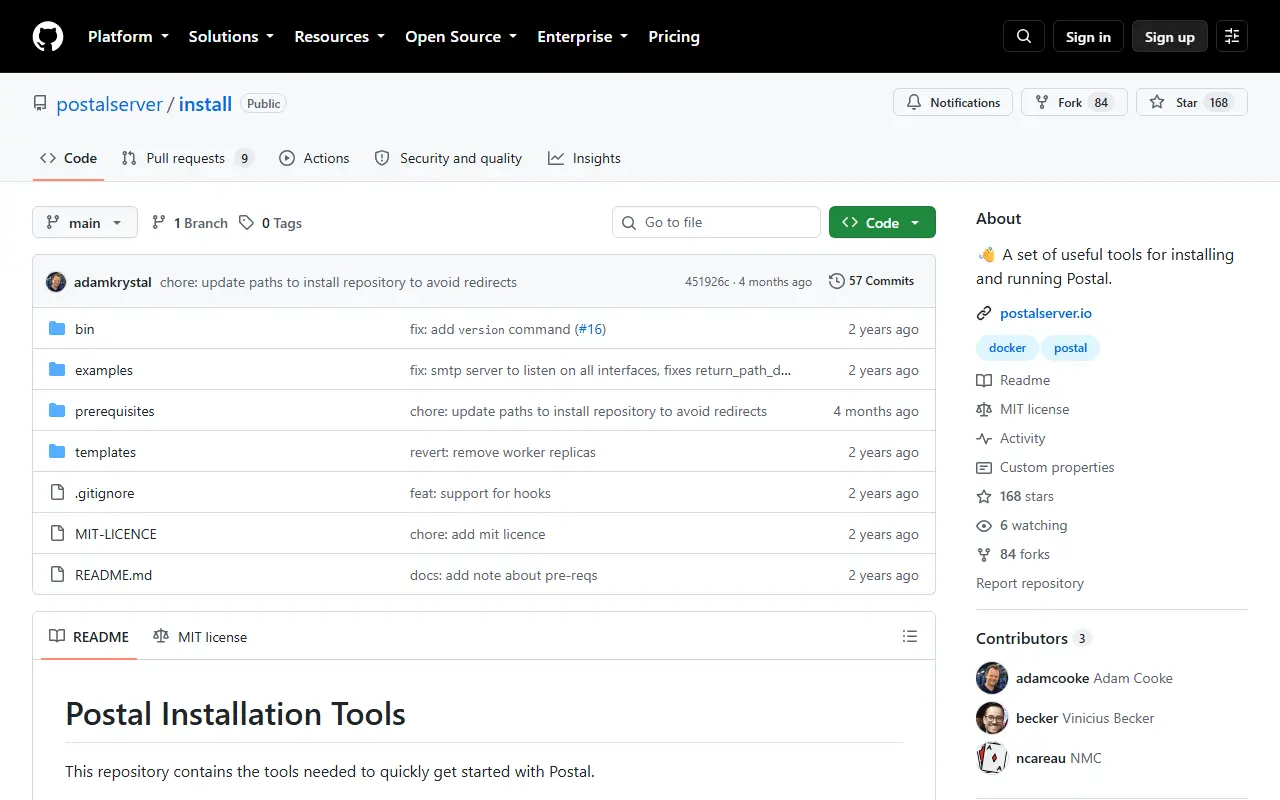
Postal is a complete mail server for websites and web servers that handles both outgoing and incoming email. The project describes it as an open-source take on services such as Sendgrid, Mailgun and Postmark, ready to run on your own servers rather than rented as a hosted API.
It is written in Ruby and released under the MIT license. The project provides documentation with installation instructions, an FAQ and features list, a separate repository of installation tools, and community support through GitHub Discussions and Discord. Repository topics list Ruby, mail, SMTP and mail server.
Because it is self-hosted, Postal suits teams that want control over their own email delivery infrastructure instead of relying on a hosted provider, such as websites that send transactional messages.
Key features
- Outgoing and incoming email handling
- Self-hosted alternative to Sendgrid and Mailgun
- SMTP mail server written in Ruby
- Installation tools and documentation
- Community support on Discord
Pricing: Free and open source under the MIT license.
#3
SimpleLogin is an open-source email alias service that hides your real address behind aliases, with a back end and web app you can self-host.
- GitHub stars
- 7.1k
- Last commit
- 3 days ago
- Latest release
- v4.83.5
- Licence
- AGPL-3.0
- Self-hosted
- Yes
- Hosted version
- Available
simplelogin.io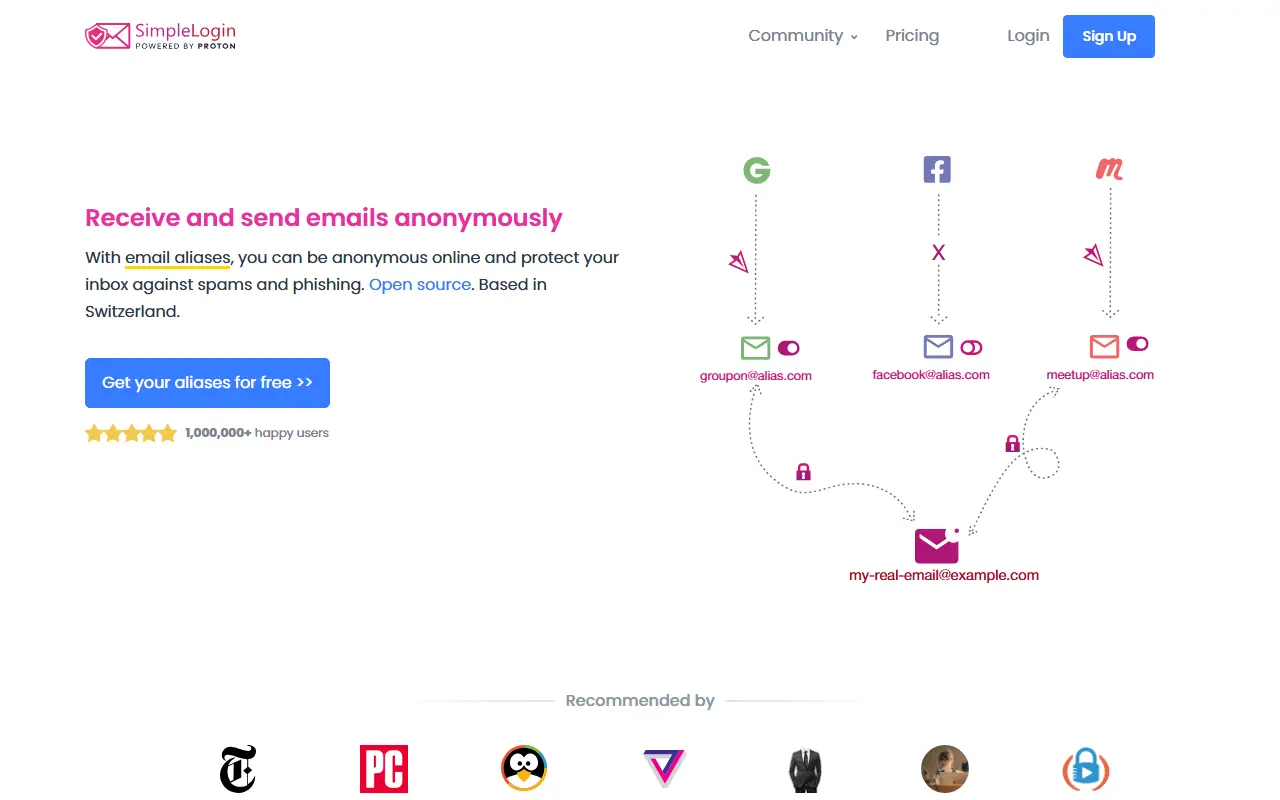
SimpleLogin is an email alias service that protects your online identity. The idea is that your email address works as an identity, and using the same one everywhere makes it easy to track you, so you create a separate alias for each site and forward mail to your real inbox.
This repository contains the back end and web app, and its README is mainly a guide to self-hosting. You need a Linux server, with at least 2 GB of RAM recommended because most components run as Docker containers, open ports for email, web and SSH, and a domain whose DNS you can configure. Once your instance is running, you can point the SimpleLogin Chrome and Firefox extensions and the Android and iOS apps at your own server by changing the API URL.
SimpleLogin is written in Python with Flask and licensed under AGPL-3.0. The roadmap and forum are kept on GitHub, where users can submit ideas and vote on features. The vendor also operates a hosted service at simplelogin.io.
Key features
- Email aliases that forward to your inbox
- Self-hosting guide for Linux servers
- Browser extensions for Chrome and Firefox
- Android and iOS apps
- Custom API URL for self-hosted instances
Pricing: Free plan with 10 aliases. Premium costs $4 billed monthly or $36 per year and adds unlimited aliases and custom domains. The software is open source and can be self-hosted.
#4
An open-source email platform for transactional email, campaigns and workflow automation, offered as a self-hostable alternative to SendGrid and Mailgun.
- GitHub stars
- 5.6k
- Last commit
- 2 days ago
- Latest release
- v0.18.0
- Licence
- AGPL-3.0
- Self-hosted
- Yes
- Hosted version
- Available
useplunk.com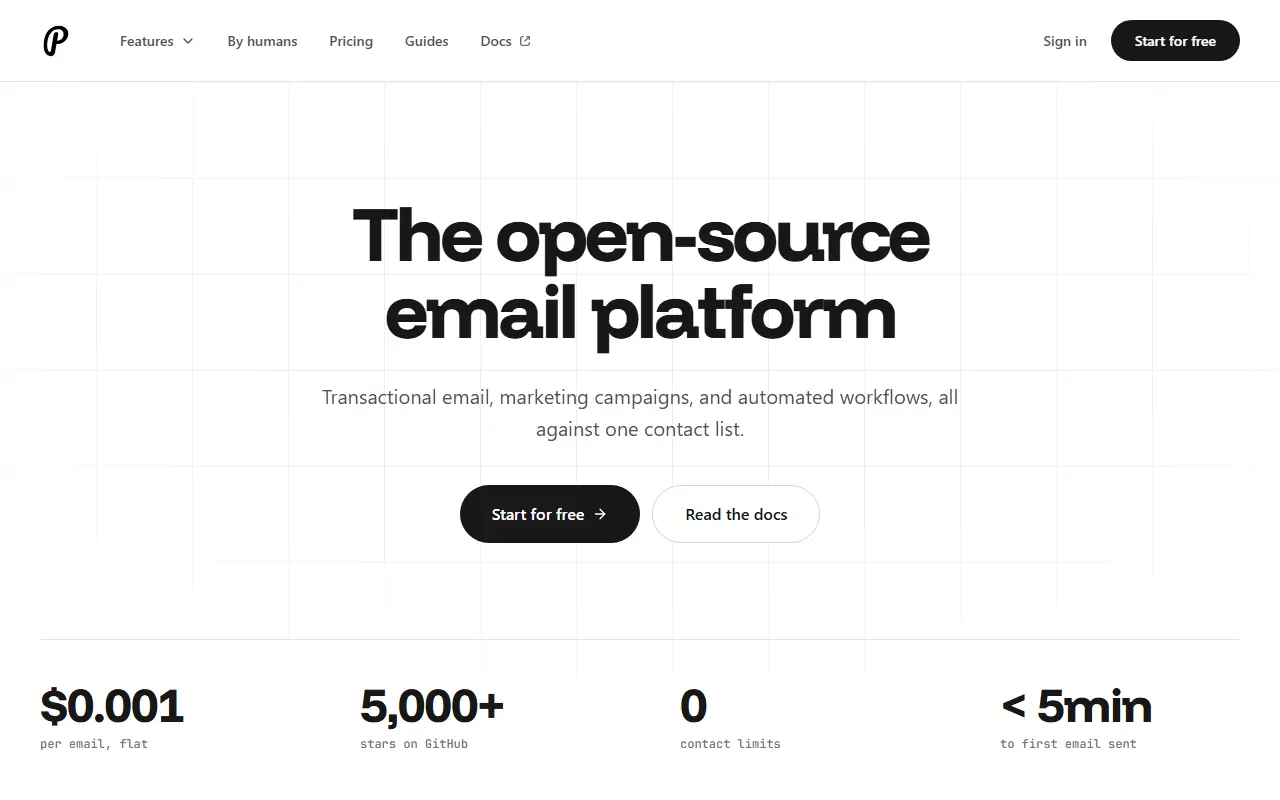
Plunk is an open-source email platform that combines transactional email, marketing campaigns and workflow automation in a single product. Developers can send messages from an API with templates and variable substitution, or use Plunk as an SMTP relay so that existing tools and frameworks can send through it.
Marketing features include campaigns for newsletters and product updates, dynamic segments, and contact management with custom fields and activity history. Workflows add triggers, delays and conditional logic, analytics track opens, clicks and bounces, custom domains are verified with DKIM and SPF, and inbound emails can be received and routed with custom rules.
Plunk is positioned as an open-source, self-hosted alternative to services such as SendGrid, Resend and Mailgun. It is licensed under AGPL-3.0, written in TypeScript, and can be deployed from an official Docker image following the project's documentation. The README cites a rate of $0.001 per email with no contact limits.
Key features
- Transactional email API with templates
- SMTP relay for existing tools
- Campaigns for newsletters and updates
- Workflow automation with delays and conditions
- Dynamic contact segments
- Open, click and bounce analytics
- Inbound email routing
- Custom sending domains with DKIM and SPF
Pricing: Free plan sends 1,000 emails a month. The paid plan charges $0.001 per email with unlimited contacts, and the software can be self-hosted for free.
#5
An open source email platform for sending transactional, product and marketing emails with analytics and contact management.
- GitHub stars
- 4.8k
- Last commit
- today
- Latest release
- v1.10.3
- Licence
- AGPL-3.0
- Self-hosted
- Yes
usesend.com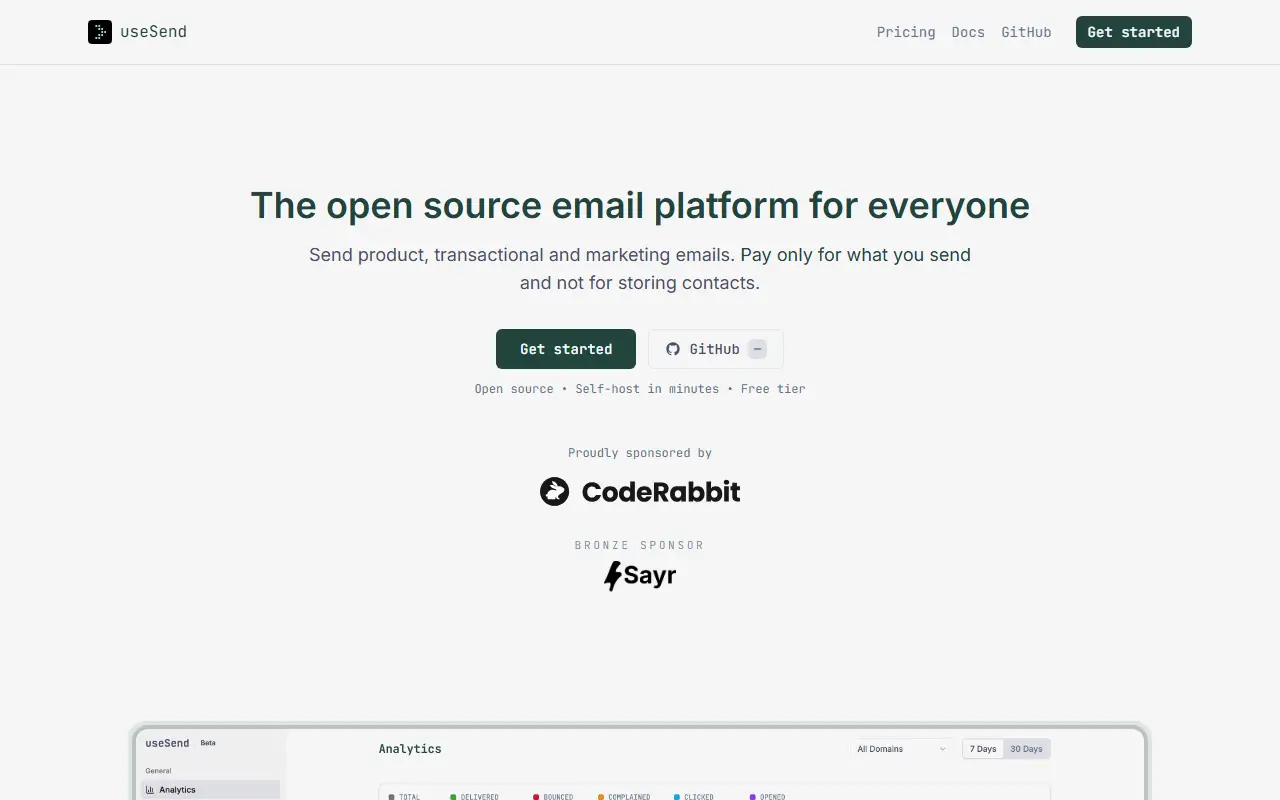
useSend is an open source email platform that allows users to send transactional, product and marketing emails. It offers features such as analytics, a marketing email editor, contact management, suppression lists, and an SMTP relay. The platform is designed for developers and teams who want to send emails without vendor lock-in.
Key features
- Analytics: Track deliveries, opens, clicks, bounces and unsubscribes in real time with a searchable log
- Marketing Email Editor: Design campaigns with a visual WYSIWYG editor that supports templates, brand styles, and variables
- Contact Management: Manage contacts, lists, and consent with import/export and automatic updates from bounces
- Suppression List: Automatically populated from bounces and complaints to prevent accidental sends
- SMTP Relay: Drop-in SMTP relay that works with any app or framework
- Developers: Typed SDKs and simple APIs for TypeScript, Python, Go, and PHP

Self-hosted newsletter, email marketing, and transactional email platform with a visual MJML editor, Liquid templating, automations, and seven sending providers.
- GitHub stars
- 2.3k
- Last commit
- today
- Latest release
- v43.0
- Self-hosted
- Yes
- Hosted version
- Available
notifuse.com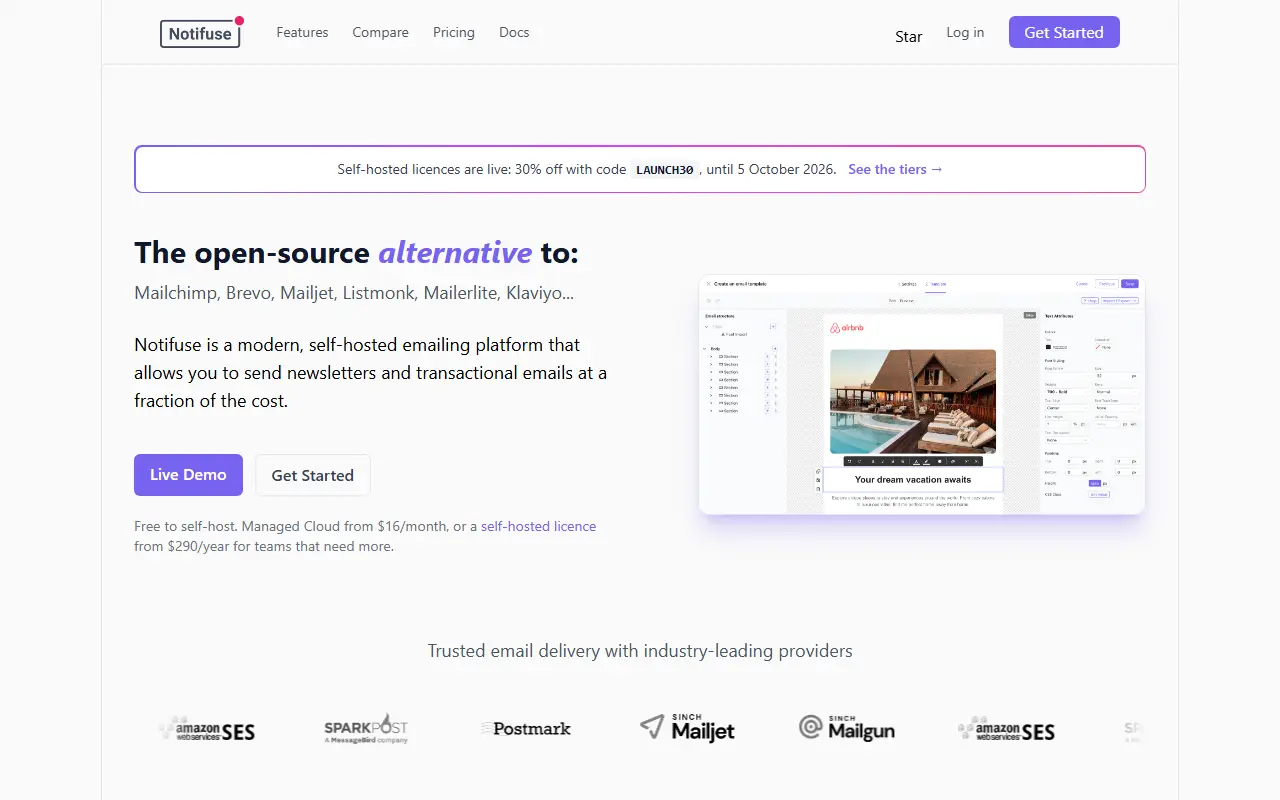
Notifuse is a modern, self-hosted emailing platform for sending newsletters and transactional email at a fraction of the cost of hosted services. It is built with Go and React and presented as an open-source alternative to Mailchimp, Brevo, Mailjet, Listmonk, MailerLite, and Klaviyo. The input lists its license only as other.
Email marketing features include a drag-and-drop visual builder with MJML components and live preview, campaign scheduling, A/B testing of subject lines, content, and send times, list segmentation, and contact profiles with custom fields. Automations use a visual canvas with nodes for delays, emails, branches, filters, list changes, A/B tests, and webhooks, and Liquid templating personalizes messages. Messages are sent through seven providers, with topics naming Amazon SES, Mailgun, Postmark, and SendGrid.
For people who prefer not to run it themselves, Notifuse Cloud offers managed hosting, which the README says starts at 16 dollars per month, and a live demo is available. It suits marketers and developers who want lower costs and control over subscriber data.
Key features
- Visual MJML email builder
- Campaign scheduling and A/B testing
- Visual automation flow builder
- Liquid templating
- Seven sending providers including Amazon SES
- Transactional email API
Pricing: Self-hosting is free, with yearly licences from $290 for extra capabilities. Managed Notifuse Cloud starts at $16 per month with no per-email or per-seat charges.
#7
Reaction Commerce, later Mailchimp Open Commerce, an API-first headless commerce platform on Node.js, MongoDB, and GraphQL that has been discontinued.
- GitHub stars
- 12k
- Last commit
- 8 mo ago
- Latest release
- v5.0.0
- Licence
- GPL-3.0
- Self-hosted
- Yes
mailchimp.com
Reaction, formerly Reaction Commerce and later Mailchimp Open Commerce, is an API-first, headless commerce platform built with Node.js, React, MongoDB, and GraphQL. It runs with npm, Docker, and Kubernetes. The repository tagline states that the project has been discontinued, so it should be treated as archived code, not a maintained product. It is released under the GPL-3.0 license.
While it was active it offered a plugin system for choosing integrations, multi-tenant hosting of several shops in one installation, products with options and variants, and an architecture designed to scale from one server to hundreds. The README claimed fast GraphQL queries and use on sites processing tens of thousands of orders a day.
Today it is mostly useful as a reference for headless commerce architecture or as a starting point for teams willing to maintain a fork. Anyone planning a new store should look at actively maintained alternatives.
Key features
- API-first headless commerce architecture
- GraphQL API on Node.js and MongoDB
- Plugin system for integrations
- Multi-tenant shops in one installation
- Products with options and variants
- Docker and Kubernetes deployment
Pricing: Free and open source under the GPL-3.0 license; the project has been discontinued.
Resend alternatives: questions
- What is the best open-source alternative to Resend?
- Mautic is the top-ranked open-source alternative to Resend on Enlisted: Open-source marketing automation platform for email campaigns, segmentation and multi-channel marketing that you can host yourself. Other strong options are Postal, SimpleLogin, Plunk and Send.
- What are the best commercial alternatives to Resend?
- Mailtrap, MailerSend, SMTP2GO, Amazon SES and Postmark are among the hosted, closed-source alternatives to Resend listed on Enlisted, which lists 27 in total. Compare their pricing and features on each tool page.
- Are these Resend alternatives free?
- All 7 are open source, so the code is free to use under its licence, and all of them can be self-hosted on your own server or computer. 4 also offer a paid or managed cloud version if you'd rather not host it yourself.
- How is this list of Resend alternatives ranked?
- By a score built from GitHub stars, star growth over the last 30 days and how recently the code changed. 6 of these projects shipped code in the last 30 days. Data is refreshed daily, and nobody can pay to move up.
 TrackMedia
 TrackRev