7,363 open-source and SaaS tools, with GitHub stats refreshed every day.

7 alternatives ranked by real activity

Open-source Passwordstate alternatives

A curated, ranked list of the 7 best open-source alternatives to Passwordstate.

The best open-source alternative to Passwordstate is Vaultwarden. If that doesn't suit you, other good options are Bitwarden, Gopass, Passbolt and Padloc.

Passwordstate alternatives are mainly password managers. 5 of them shipped code in the last 30 days, 7 can be self-hosted, and 1 uses a permissive licence.

Last updated October 2, 2026 · ranked by GitHub stars, growth and recent commits

Vaultwarden

A lightweight, unofficial Bitwarden-compatible server written in Rust for self-hosting, working with the official Bitwarden clients.

GitHub stars
68k
Last commit
7 days ago
Latest release
1.37.3
Licence
AGPL-3.0
Self-hosted
Yes

Vaultwarden is a Rust server that reimplements the Bitwarden Client API as an alternative to the official service, and it works with the official Bitwarden clients. It was formerly known as bitwarden_rs and is released under the AGPL-3.0 license. It is aimed at people who self-host and find the official server too heavy to run themselves.

The project implements most of the Bitwarden Client API, including personal vaults, Send, attachments, website icons and personal API keys, as well as organizations, with collections, shared passwords, member roles, groups, event logs and policies. Multi-factor authentication covers authenticator apps, email, FIDO2 WebAuthn, YubiKey and Duo, and emergency access is supported. An admin backend and a modified web vault client are included.

Vaultwarden is distributed as a Docker image and the code is on GitHub. The project is unofficial, and its maintainers ask users to report problems to them rather than to Bitwarden's official support channels. It suits individuals, families and small teams who want to host their own password manager while keeping the familiar Bitwarden apps and browser extensions.

Key features

  • Bitwarden Client API-compatible server
  • Works with official Bitwarden clients
  • Organizations with collections and member roles
  • Multi-factor authentication including FIDO2 and YubiKey
  • Emergency access and Send support
  • Admin backend for server management

Pricing: Free and open source under the AGPL-3.0 license.

Read more about VaultwardenGitHub

Bitwarden

This is the Bitwarden server: the API, database and Docker-based infrastructure behind the Bitwarden password manager's client apps.

GitHub stars
20k
Last commit
today
Latest release
v2026.9.2
Self-hosted
Yes
Hosted version
Available
bitwarden.comBitwarden homepage screenshot

Bitwarden is a password manager, and this repository contains its server side: the APIs, database and other core infrastructure that all Bitwarden client applications connect to. The code is written in C# on .NET Core with ASP.NET Core, and the database layer is written in T-SQL for SQL Server.

The server can be developed, built, run and deployed on Windows, macOS and Linux. For deployment, the project provides Docker containers along with PowerShell and Bash scripts that bootstrap an installation, and the images are published on GitHub Container Registry. The services include Admin, API, Billing, Events, Identity, Notifications, SCIM and SSO components.

Organizations that want to keep their vaults on their own infrastructure can follow the on-premise install guide in the Bitwarden help center, which requires Docker and Docker Compose. Bitwarden also runs managed cloud clusters in the US and EU. The repository lists its license as 'Other', so check the license files for the exact terms.

Key features

  • APIs used by all Bitwarden client apps
  • Identity, SCIM and SSO services
  • SQL Server database layer
  • Docker-based on-premise deployment
  • Install scripts for Windows, macOS and Linux
  • Admin and event processing services

Pricing: A free personal plan exists. Premium is $1.65 a month, Families $3.99 a month for six users, Teams $4 and Enterprise $6 per user per month, all billed annually.

Read more about BitwardenWebsite GitHub

Bitwarden

Source repository for the Bitwarden web vault, browser extension, desktop app and command-line client for the Bitwarden password manager.

GitHub stars
14k
Last commit
today
Latest release
desktop-v2026.9.1
bitwarden.comBitwarden homepage screenshot

This repository holds the client applications of Bitwarden, the password manager, except for the mobile apps. It contains the web app, the browser extension, the desktop application and the command-line tool, which together are the interfaces people use to store and fill in their credentials.

The code is written mostly in TypeScript, with Angular for the web interfaces, Electron for the desktop app and Node.js for the CLI. Browser extensions cover Chrome, Firefox and Safari. The clients talk to the Bitwarden server, which lives in a separate repository and covers the API, database and Docker deployment, while the iOS and Android apps each have their own repositories.

The repository is published under a custom Bitwarden license rather than a standard SPDX identifier. Contribution guidance, build instructions and recommended tooling are kept in Bitwarden's contributing documentation, and the project welcomes security audits and reports through its issue tracker or private email for sensitive findings.

Key features

  • Web vault client for Bitwarden
  • Browser extension for Chrome, Firefox and Safari
  • Electron-based desktop application
  • Command-line client for scripting access
  • TypeScript and Angular codebase

Pricing: A free personal plan exists. Premium is $1.65 a month, Families $3.99 a month for six users, Teams $4 and Enterprise $6 per user per month, all billed annually.

Read more about BitwardenWebsite GitHub

Gopass

A command-line password manager for teams that works as a drop-in replacement for pass, encrypting with GPG and storing credentials in git by default.

GitHub stars
7.2k
Last commit
yesterday
Latest release
v1.17.3
Licence
MIT
Self-hosted
Yes
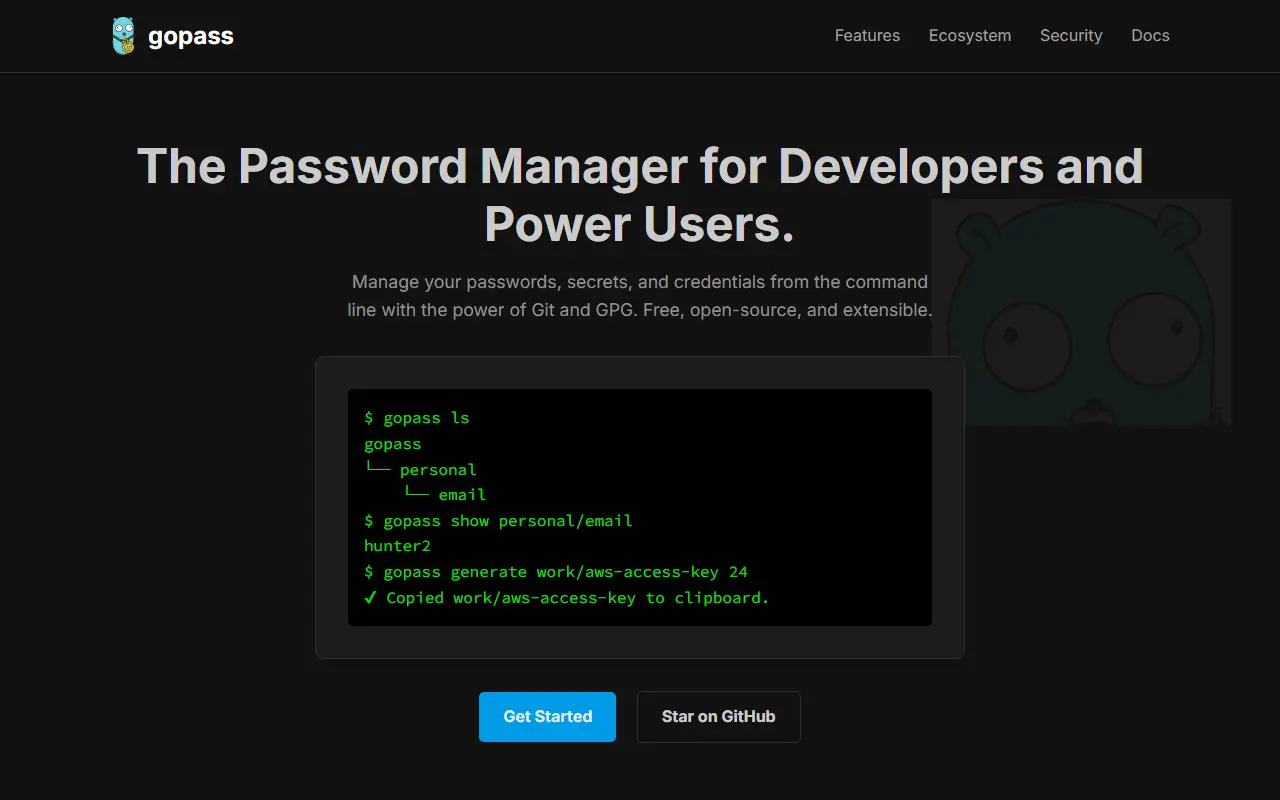
gopass.pwGopass homepage screenshot

Gopass is a UNIX-style password manager aimed at teams. It can replace pass, the standard UNIX password manager, as a drop-in, and works the same across Linux, macOS, BSD and Windows, including across several devices, or entirely offline on an air-gapped computer.

By default, credentials get encrypted using GPG and tracked in git, which provides history and syncing through any git remote. The backends can be changed, with options such as age for encryption and fossil for storage. The primary interface is the command line, which suits CLI users and CI/CD systems, while a browser integration reduces the need to use it. It needs no network connection unless you want one, and most users pair it with gpg and git.

Gopass is written in Go and licensed under MIT. It is available from package managers including Homebrew, MacPorts, Fedora COPR, Arch, Alpine, FreeBSD and Windows, but the README warns not to install the package called gopass from the official Debian repositories, because that is an unrelated project. It suits developers and ops teams sharing secrets through git.

Key features

  • Drop-in replacement for pass
  • GPG encryption with git versioning
  • Alternative backends such as age
  • Team sharing through git remotes
  • Browser integration option
  • Works offline on air-gapped machines

Pricing: Free and open source under the MIT licence.

Read more about GopassWebsite GitHub

Passbolt

Passbolt is an open-source, security-focused password manager for teams, with end-to-end encryption and options to self-host or use vendor cloud.

GitHub stars
6.1k
Last commit
15 days ago
Latest release
v5.16.0
Licence
AGPL-3.0
Self-hosted
Yes
Hosted version
Available
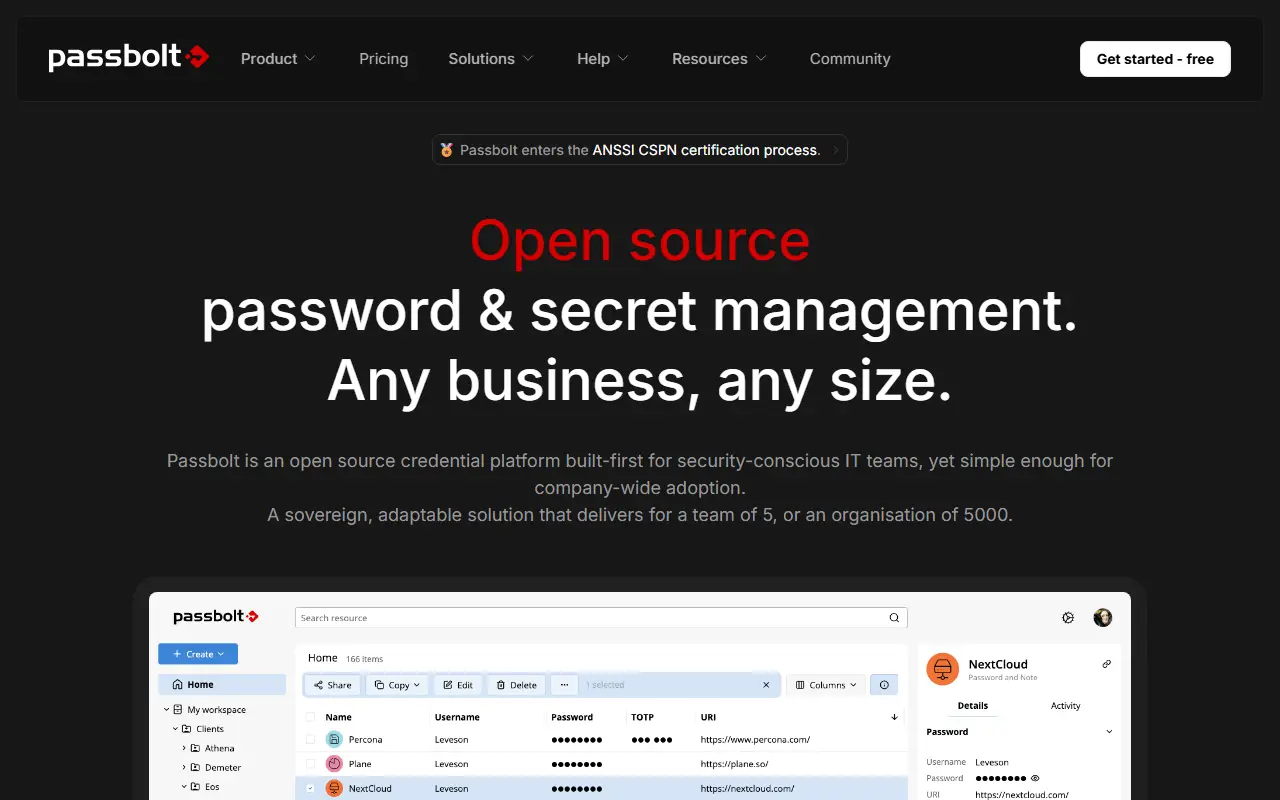
passbolt.comPassbolt homepage screenshot

Passbolt is an open-source password manager built for teams. It lets organizations gather, structure and share passwords and other secrets, and its security model relies on secret keys owned by each user together with end-to-end encryption. The vendor says the product is audited several times a year and that the findings are made public.

The repository holds the JSON API of the Community Edition, written in PHP on CakePHP. Users work through clients: browser extensions, mobile apps, a command-line tool and a desktop app. Teams can share credentials and audit access, with policies aimed at power users. The README includes guidance for running the server natively on your own machine.

Passbolt Community Edition is licensed under AGPL-3.0. The vendor also offers paid Pro and cloud-hosted options, which suit organizations that prefer managed hosting or extra features. It fits teams, from small startups to larger IT departments, that want shared credential management they can host and inspect themselves.

Key features

  • End-to-end encrypted password sharing
  • User-owned secret keys
  • Browser extensions and mobile apps
  • CLI and desktop clients
  • Credential audit and access policies
  • Self-hosted Community Edition API

Pricing: Free Community Edition with unlimited users. Pro costs $4.9 per user per month billed annually with a 10-user minimum; Enterprise is quoted.

Read more about PassboltWebsite GitHub

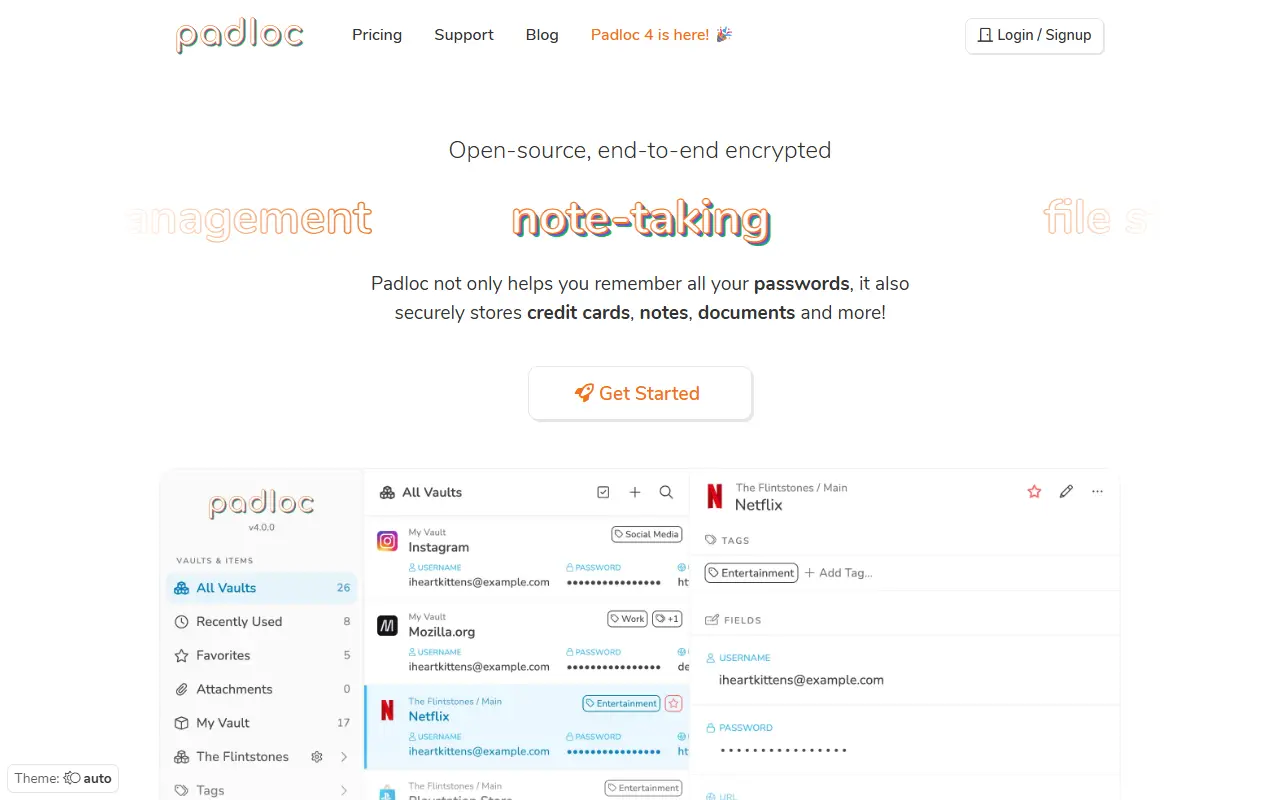
Padloc

Padloc is a free, AGPL-licensed, open-source, end-to-end encrypted password manager for individuals and teams, with web, desktop and mobile clients.

GitHub stars
2.9k
Last commit
1 yr ago
Latest release
v4.3.0
Licence
AGPL-3.0
Self-hosted
Yes
Hosted version
Available
padloc.appPadloc homepage screenshot

Padloc is a password and secure data manager aimed at both individuals and teams who want an open-source alternative to closed commercial password managers. It emphasizes simplicity and security, built around end-to-end encryption so that stored data is protected even from the server operator.

The project is organized as several packages: a core logic library, web-based UI components, a backend server, a progressive web app client, a desktop app built with Electron, mobile apps built with Cordova, a cross-platform native app built with Tauri, and a browser extension, along with a localization package for translations. This split lets different front ends share the same core encryption and data logic.

Setting up a local instance for testing requires installing and configuring at least the server and a web client, which the README describes as quick to do, while guides for running a production deployment and building distributable desktop and mobile apps are still being written. Padloc is written in JavaScript and TypeScript and released under the AGPL-3.0 license, making it self-hostable.

Key features

  • End-to-end encrypted password storage
  • Web, desktop, mobile and browser extension clients
  • Password generator
  • Team and individual vault support
  • Self-hostable backend server
  • Progressive web app client

Pricing: A free plan is available. Personal Premium costs $3.49 and Family $5.95 per month, Team $3.49 and Business $6.99 per month, each with a 30-day trial and cheaper yearly options; Enterprise is by request.

Read more about PadlocWebsite GitHub

sysPass

sysPass is a PHP web-based password manager for businesses and individuals, with AES-256 encryption, multi-user access control and a JSON-RPC API.

GitHub stars
996
Last commit
1 yr ago
Latest release
3.2.11
Licence
GPL-3.0
Self-hosted
Yes

sysPass is a self-hosted, web-based password manager written in PHP and designed for both business and personal use. It stores credentials centrally and lets teams share them according to permissions, which suits system administrators who manage many accounts for servers and services.

Security features include AES-256 encryption in CTR mode, RSA for sending passwords from forms, and two-factor authentication. Administration covers users, groups and profiles with up to 29 access levels, and logins can use MySQL, OpenLDAP or Active Directory authentication. Accounts can carry tags, custom fields, public links, history and favorites, and can be marked private.

Further functions include email and in-app activity notifications, an event log, a multilingual interface and a JSON-RPC API for integrations. sysPass is published under GPL-3.0, with installation documentation at doc.syspass.org and a Docker image on Docker Hub. It runs on your own PHP server and database.

Key features

  • AES-256 encryption in CTR mode
  • Two-factor authentication
  • Users, groups and profiles with fine-grained access
  • MySQL, OpenLDAP and Active Directory login
  • Tags, custom fields and public links
  • Account history and event log
  • JSON-RPC API

Pricing: Free and open source under the GPL-3.0 license.

Read more about sysPassWebsite GitHub

Passwordstate alternatives: questions

What is the best open-source alternative to Passwordstate?
Vaultwarden is the top-ranked open-source alternative to Passwordstate on Enlisted: A lightweight, unofficial Bitwarden-compatible server written in Rust for self-hosting, working with the official Bitwarden clients. Other strong options are Bitwarden, Gopass, Passbolt and Padloc.
Are these Passwordstate alternatives free?
All 7 are open source, so the code is free to use under its licence, and all of them can be self-hosted on your own server or computer. 3 also offer a paid or managed cloud version if you'd rather not host it yourself.
How is this list of Passwordstate alternatives ranked?
By a score built from GitHub stars, star growth over the last 30 days and how recently the code changed. 5 of these projects shipped code in the last 30 days. Data is refreshed daily, and nobody can pay to move up.

People also look for alternatives to…

View all