7,363 open-source and SaaS tools, with GitHub stats refreshed every day.

9 alternatives ranked by real activity

Open-source Mem alternatives

A curated, ranked list of the 9 best open-source alternatives to Mem.

The best open-source alternative to Mem is AppFlowy. If that doesn't suit you, other good options are AFFiNE, Open Notebook, NoteGen and Blinko.

Mem alternatives are mainly note-taking tools, but some are also AI tools. 6 of them shipped code in the last 30 days, 9 can be self-hosted, and 2 use a permissive licence.

Last updated October 2, 2026 · ranked by GitHub stars, growth and recent commits

AppFlowy

An open-source AI collaborative workspace for notes, wikis, tasks and projects, built as a Notion alternative that keeps you in control of your data.

GitHub stars
77k
Last commit
2 days ago
Latest release
0.14.6
Licence
AGPL-3.0
Self-hosted
Yes
Hosted version
Available
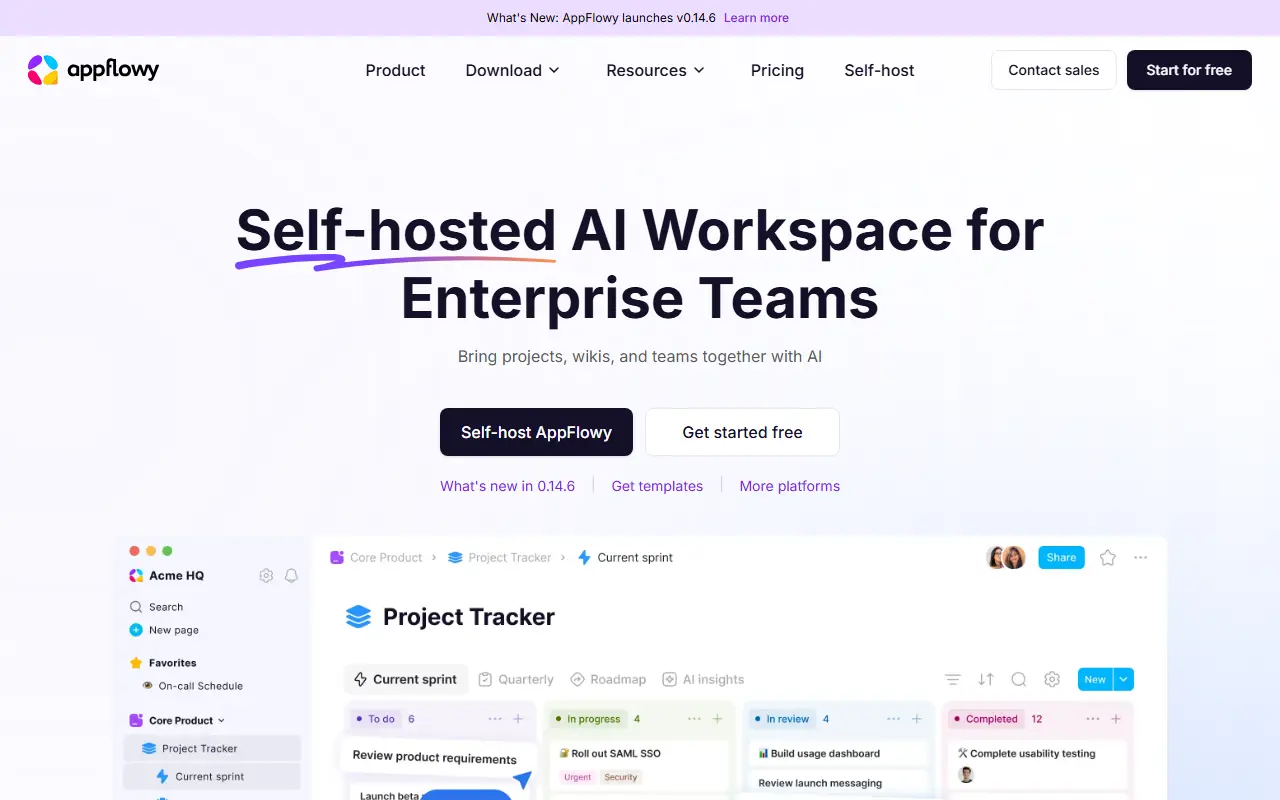
appflowy.comAppFlowy homepage screenshot

AppFlowy is an open-source workspace that brings documents, wikis, project and task management and team collaboration into one app. It is presented as an alternative to Notion, and its topics also tag it as a Confluence alternative, with the emphasis on keeping control of your own data.

The client is built with Flutter and a Rust core, giving apps for macOS, Windows and Linux plus iOS and Android versions. Desktop builds can be downloaded directly or from channels such as Flathub and Snapcraft. AI features are part of the workspace, and a public roadmap and active forum let users propose features. Translations are contributed through JSON files and tools such as inlang.

The project is AGPL-3.0 licensed and has documentation for self-hosting the server side, so organizations can keep content on their own infrastructure. A hosted version is available through appflowy.com for people who do not want to run servers. It suits teams looking for a Notion-style workspace with a privacy-first stance.

Key features

  • Notes, wikis and documentation in one workspace
  • Project and task management
  • AI features built into the workspace
  • Apps for desktop, iOS and Android
  • Self-hosting option for your own data
  • Public roadmap and community translations

Pricing: Free plan for up to 2 members. Pro costs $12.50 per user per month, or $10 billed annually. Self-hosted plans range from Free to Enterprise but their prices are not listed.

AFFiNE

A privacy-focused, local-first workspace that merges docs, whiteboards and tables on one canvas, positioned as an open-source alternative to Notion and Miro.

GitHub stars
73k
Last commit
3 days ago
Latest release
v0.27.4
Self-hosted
Yes
Hosted version
Available
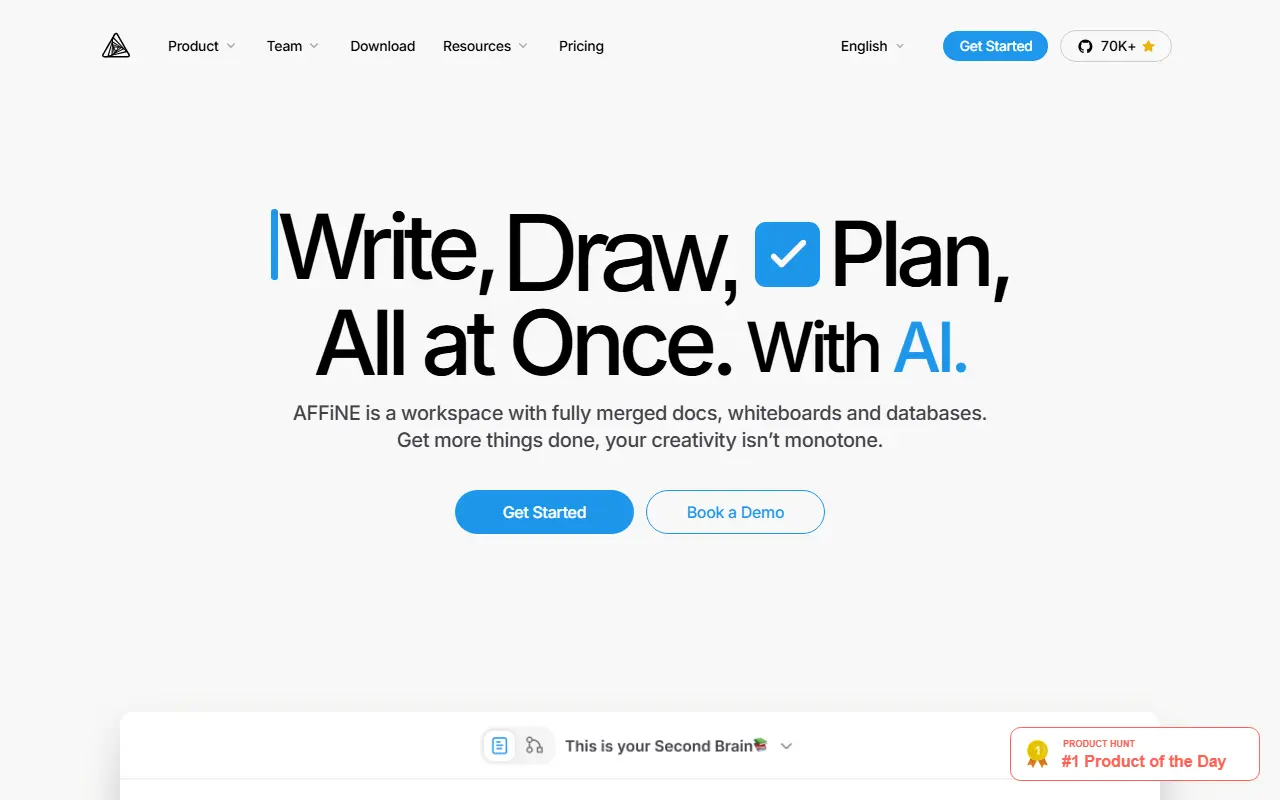
affine.proAFFiNE homepage screenshot

AFFiNE is an open-source workspace that combines writing, drawing and planning in a single app. Documents, an edgeless whiteboard and table views share the same blocks, so you can place rich text, sticky notes, embedded web pages, database views, linked pages, shapes and even slides anywhere on one canvas. It is presented as an alternative to Notion and Miro.

The project stresses local-first storage, meaning your data lives on your own device first, together with real-time collaboration. A multimodal AI assistant helps write reports, turn outlines into slides, summarize articles into mind maps and organize tasks. Under the hood it uses CRDTs for syncing and is built mostly in TypeScript and Rust, with Electron for the desktop app. It also supports Markdown, wiki and knowledge-base use, and presentations.

AFFiNE's license is listed as 'Other' on GitHub, so review it before commercial use. There is a live demo and documentation on the project site, a hosted version is available, and the app can also be self-hosted.

Key features

  • Docs, whiteboard and tables on one canvas
  • Local-first data storage on your device
  • Real-time multi-user collaboration
  • AI assistant for writing, slides and mind maps
  • Markdown editing and linked pages
  • Desktop app built on Electron

Pricing: Free plan with local use and 10 GB of cloud storage. Pro is $6.75 per month and Team $10 per seat per month; a $499.99 one-time Believer plan exists and Enterprise is custom-priced.

Open Notebook

A privacy-focused, self-hosted alternative to Google's NotebookLM that supports many AI providers, multimodal sources, podcast generation and search.

GitHub stars
40k
Last commit
yesterday
Latest release
v1.14.0
Licence
MIT
Self-hosted
Yes
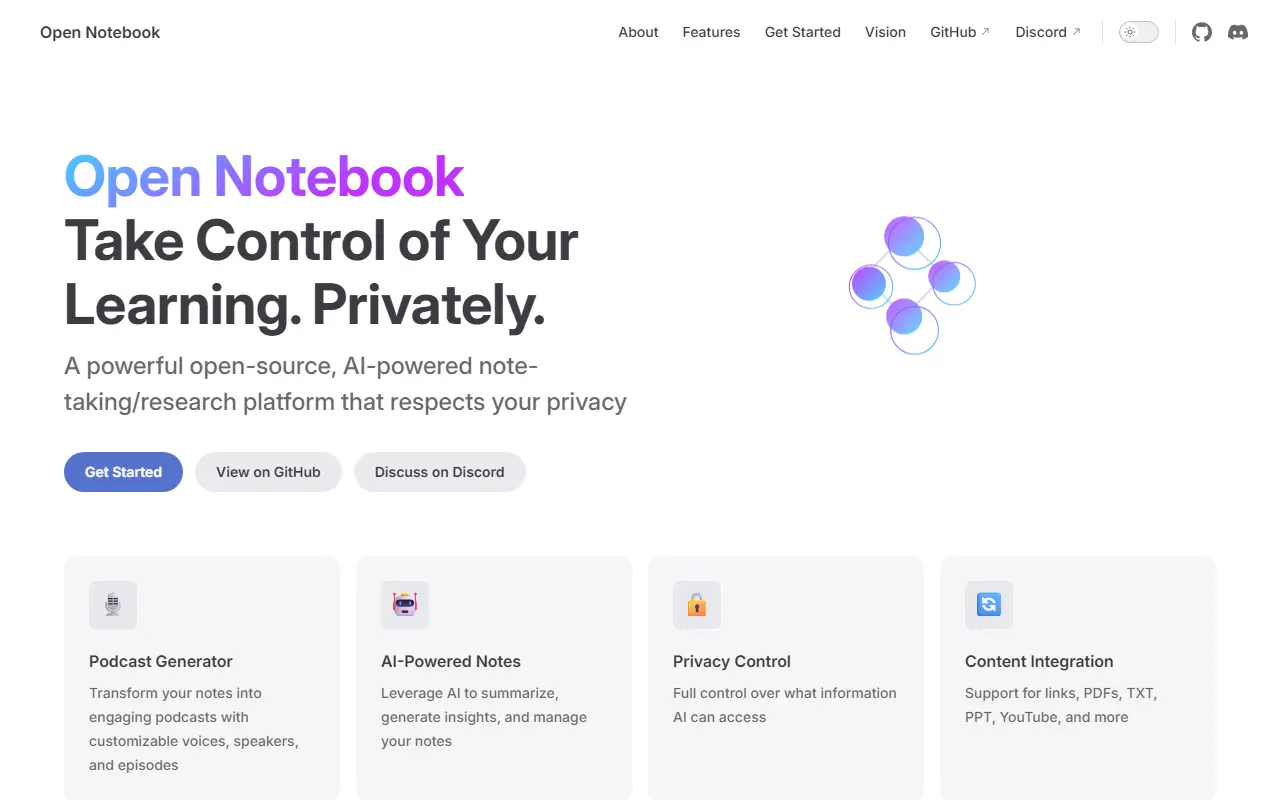
open-notebook.aiOpen Notebook homepage screenshot

Open Notebook is a privacy-oriented, open-source option for people who want something like Google's NotebookLM for researching and learning with AI. It is written in TypeScript and released under the MIT license. The project describes itself as private, multi-model and fully local, so your research material stays on infrastructure you control instead of a single cloud provider.

It supports more than a dozen AI providers, including OpenAI, Anthropic, Ollama and LM Studio, and lets you organize multimodal content such as PDFs, videos, audio and web pages. Features include podcasts with several speakers, keyword and vector search over everything you add, and chat conversations grounded in your own sources. The interface is available in several languages, including Portuguese, Chinese, Japanese, Russian and Bengali.

The README compares Open Notebook with Google NotebookLM across privacy and control, choice of AI provider and more, and links a getting-started guide, user guide, feature list and deployment instructions. A Discord server is open for help and workflow ideas. It suits students, researchers and knowledge workers who want a NotebookLM-style workflow with their own choice of models.

Key features

  • Self-hosted NotebookLM-style research notebooks
  • Support for many AI providers and local models
  • PDFs, video, audio and web page sources
  • Multi-speaker podcast generation
  • Full-text and vector search
  • Chat grounded in your sources
  • Interface in multiple languages

Pricing: Free and open source under the MIT license.

NoteGen

A local-first Markdown note-taking app built with Tauri that collects scattered information and uses AI to turn it into organized notes.

GitHub stars
13k
Last commit
2 days ago
Latest release
note-gen-v0.38.0
Licence
GPL-3.0
Self-hosted
Yes
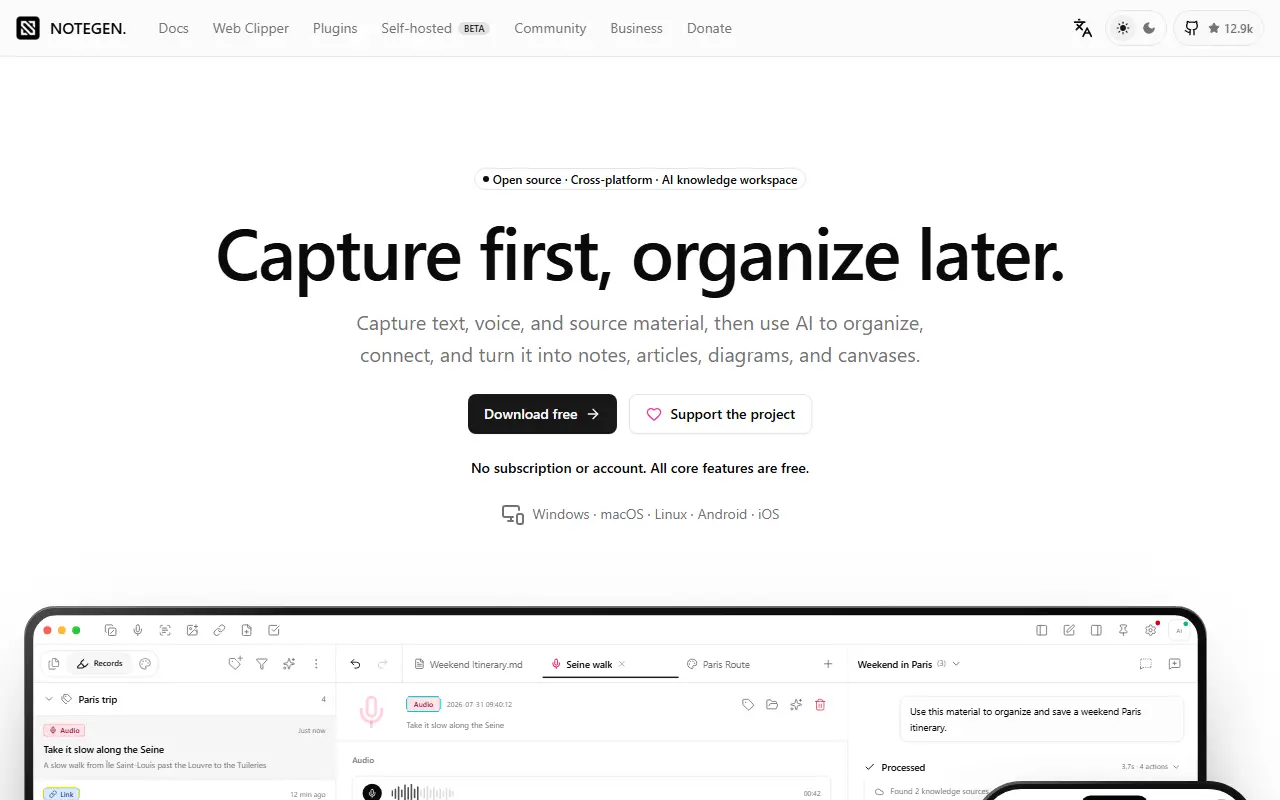
notegen.topNoteGen homepage screenshot

NoteGen is a local-first Markdown note-taking app built around the idea of capturing first and organizing later. It helps collect scattered snippets, records and clippings and then uses AI to arrange them into clear notes, acting as a personal knowledge base.

It is a desktop application built with Tauri and Next.js. The project topics point to Markdown editing, WebDAV sync, retrieval augmented generation, MCP and agent features, and the README describes configurable model settings with an OpenAI-compatible interface for conversations, note organization, writing assistance, translation and summarization. Knowledge base features reference embeddings, reranking, OCR and speech.

NoteGen is licensed under GPL-3.0, and downloads, documentation, a business offering and community discussions are linked from the repository. Since it is a local app, you keep notes on your own machine and choose which model provider to connect, which suits people building a personal knowledge management system.

Key features

  • Local-first Markdown editor
  • AI-assisted note organization
  • OpenAI-compatible model configuration
  • Knowledge base with retrieval support
  • WebDAV sync support
  • Desktop app built with Tauri

Pricing: Free and open source under the GPL-3.0 licence.

Blinko

Blinko is an open-source, self-hosted personal AI note app that lets you capture quick card notes and search them in natural language.

GitHub stars
11k
Last commit
1 mo ago
Latest release
1.8.8
Licence
GPL-3.0
Self-hosted
Yes
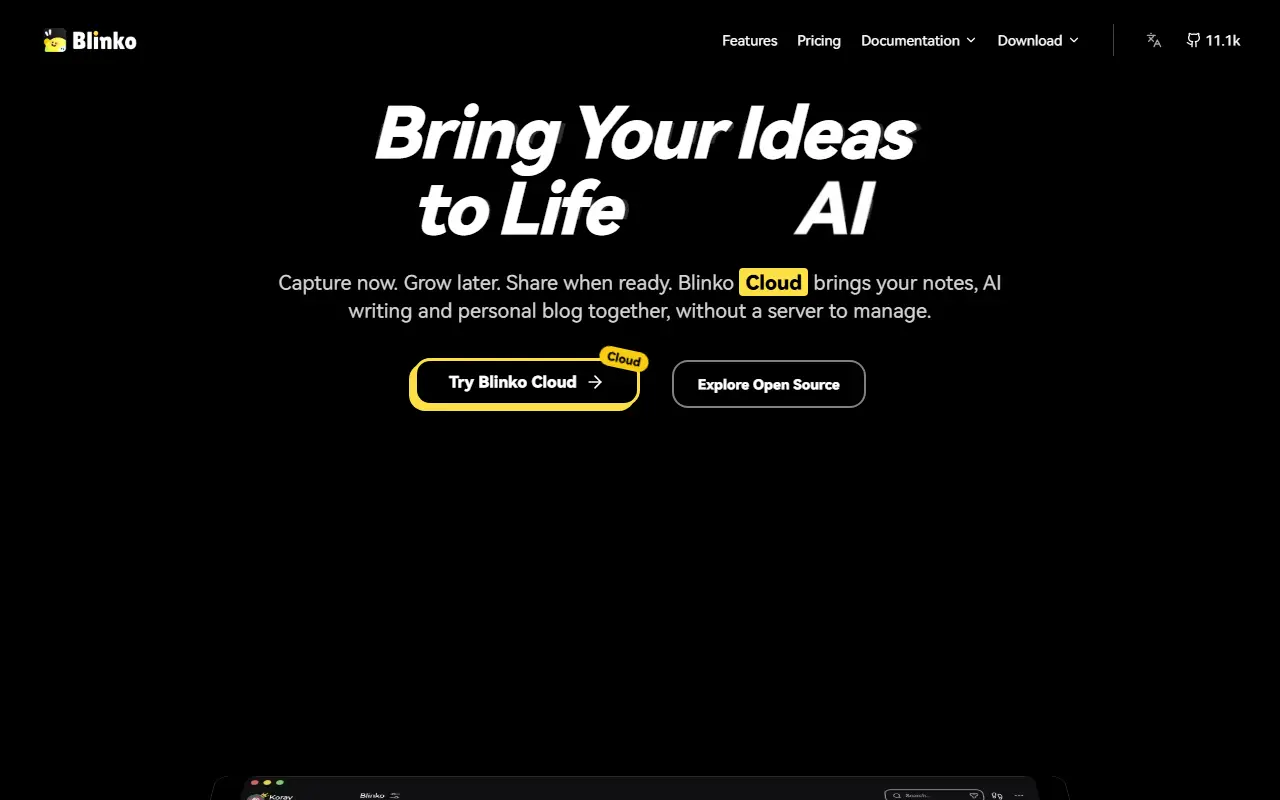
blinko.spaceBlinko homepage screenshot

Blinko is a card-style note-taking app with AI features, designed for people who want to capture fleeting ideas the moment they happen. It is self-hosted and puts privacy first, so your notes stay on a server you control. The interface is built with Next.js and React in TypeScript, backed by PostgreSQL.

Its AI-enhanced retrieval uses retrieval-augmented generation, so you can find notes by asking in natural language rather than remembering keywords. Notes use Markdown and the project is tagged for memos and notebooks. A live demo, official site, documentation and English and Chinese Telegram communities are linked from the README.

Blinko is licensed under GPL-3.0 and installed on your own server, typically with Docker. It suits individuals who want a private alternative to cloud note and memo apps and are comfortable connecting their own AI provider.

Key features

  • Quick card-style note capture
  • AI-powered natural language note search
  • Markdown note support
  • Self-hosted with privacy focus
  • Next.js and PostgreSQL stack
  • Live demo available

Pricing: The open-source edition is free to self-host, and Blinko Cloud has a free plan. Paid cloud plans are Pro at $5.99 and Pro Plus at $10.99 per month.

EdgeEver

AI-native, open-source note-taking and knowledge base with an Evernote-style three-pane layout, MCP support, and deployment on Cloudflare or Docker.

GitHub stars
2k
Last commit
today
Latest release
v1.98.0
Licence
AGPL-3.0
Self-hosted
Yes
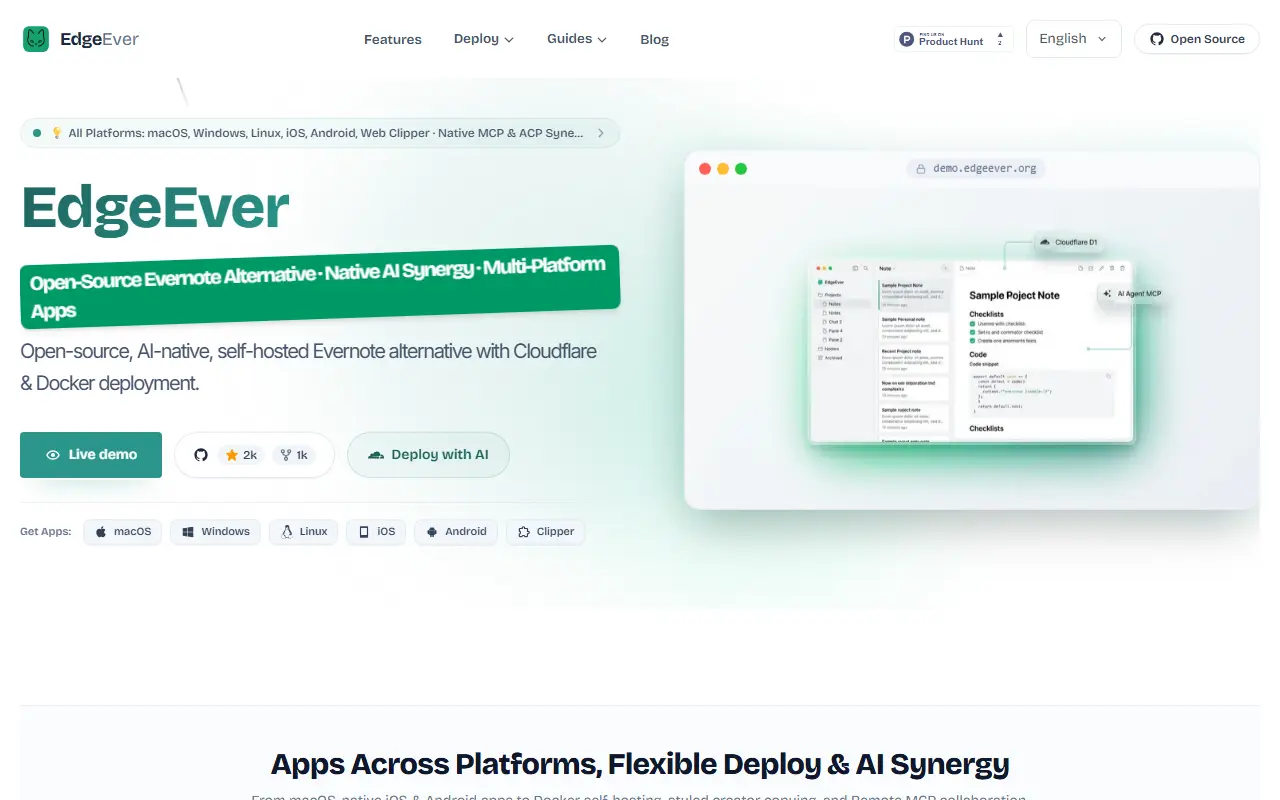
edgeever.orgEdgeEver homepage screenshot

EdgeEver is an open-source notes and knowledge base workspace that revives the three-pane layout familiar from Evernote while adding an open data architecture and integration with AI agents. It is presented as a portable Evernote alternative, is written in TypeScript, and is released under the AGPL-3.0 license.

It can run serverlessly within Cloudflare's free quotas using Workers, D1, and R2, so no server purchase is needed, or you can deploy the same application with Docker on a VPS, NAS, or home server. Native MCP support lets AI agents work with your notes. Other topics include a web clipper, offline-first behavior, PWA and Electron clients, SQLite storage, and the Tiptap editor.

A live demo and client downloads are provided, with the interface available in several languages. EdgeEver was created in 2026, so it is young. It suits people migrating from Evernote and developers who want a knowledge base that agents can read and write.

Key features

  • Evernote-style three-pane notes interface
  • Native MCP support for AI agents
  • Runs on Cloudflare free tier or Docker
  • Web clipper
  • Offline-first PWA and Electron clients
  • Multilingual interface

Pricing: Free and open source under the AGPL-3.0 license; the README says it can run within Cloudflare's free quotas.

Nowen Note

Nowen Note is a self-hosted notes and private knowledge base with Markdown and rich text editing, AI Q&A, mind maps, tasks and Docker or NAS deployment.

GitHub stars
545
Last commit
yesterday
Latest release
v1.4.16
Licence
GPL-3.0
Self-hosted
Yes
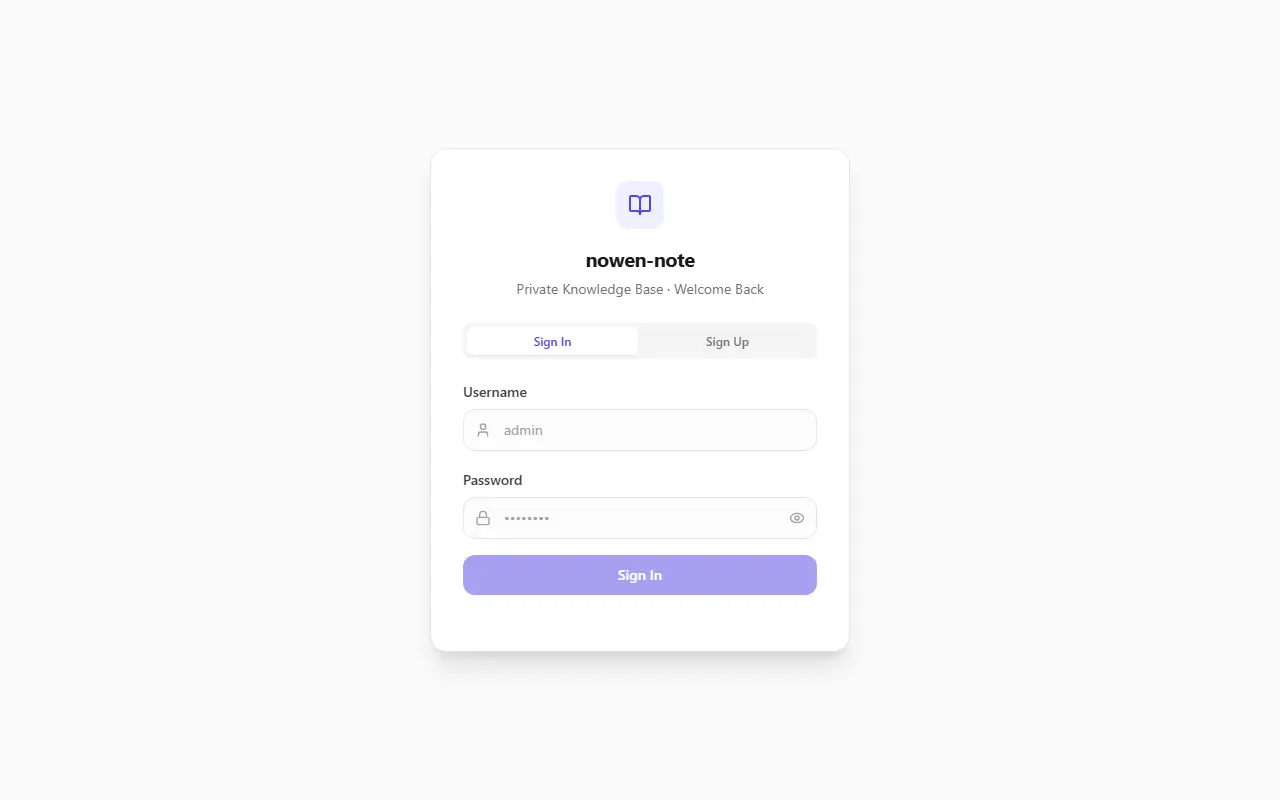
note.nowen.cnNowen Note homepage screenshot

Nowen Note is an open-source, self-hosted knowledge base, daily log and task workspace. It aims to be personal and team knowledge infrastructure that you control, running on a NAS or server and reachable through the web, desktop and mobile clients. Its documentation is mainly in Chinese, with an English version available.

A single knowledge tree organizes folders, rich-text documents and Markdown documents, with unlimited levels, drag and drop, import, permission inheritance, password protection and sharing. Editors are built on Tiptap and CodeMirror with Mermaid, KaTeX, tables, outlines, comments and version history, and an offline workspace can cache content and sync when back online. The product also includes AI-assisted writing and RAG question answering, mind maps, tasks, daily records, full-text search, tags, bidirectional links and an MCP integration. Attachments can use S3, Cloudflare R2 or MinIO, and backups can go to email or WebDAV.

It deploys with Docker and supports NAS platforms such as UGREEN UGOS and fnOS. Nowen Note is written in TypeScript and licensed under GPL-3.0, with an online trial, downloads and tutorials.

Key features

  • Unified tree of folders and documents
  • Markdown and rich text editors
  • AI writing and RAG question answering
  • Mind maps and task management
  • Offline workspace with sync
  • Docker and NAS deployment

Pricing: Free and open source under the GPL-3.0 license.

Eclaire

Local-first, self-hosted AI assistant that organizes and searches your tasks, notes, documents, photos and bookmarks using models you run yourself.

GitHub stars
922
Last commit
4 mo ago
Latest release
v0.6.3
Licence
MIT
Self-hosted
Yes
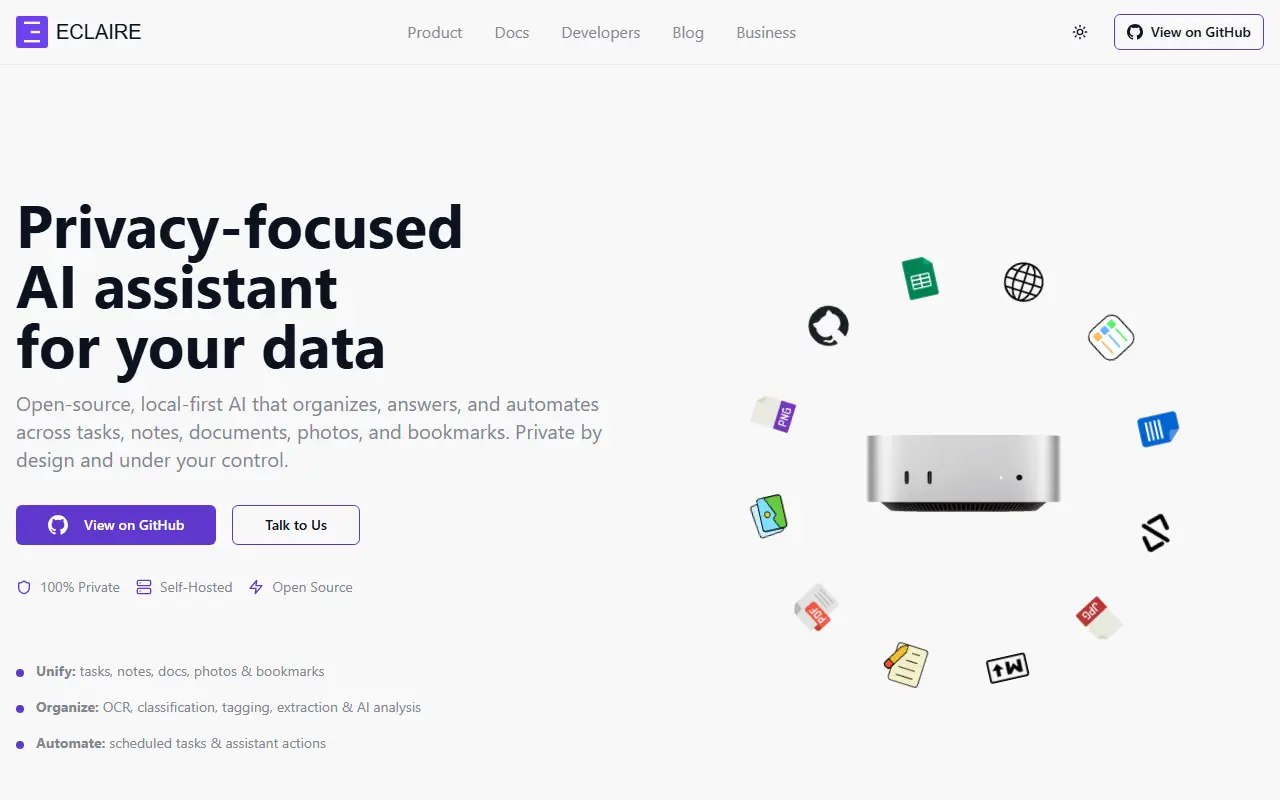
eclaire.coEclaire homepage screenshot

Eclaire is an open-source, privacy-focused AI assistant that works across your personal data: tasks, notes, documents, photos, bookmarks and more. It aims to be a complete product rather than a framework, assembling proven building blocks into something you can run on your own hardware with local models and local data storage. It targets people who want AI help with personal or sensitive information without using hosted services.

The README lists four ideas: self-hosting, unified data so the AI can see and connect everything in one place, AI-powered features such as content understanding, search, classification, OCR and automation, and open-source extensibility through APIs. It also has sections on selecting models, architecture and development.

The project carries two prominent warnings. It is pre-release and under active development, so breaking changes are expected and backups are advised. It must also not be exposed directly to the public internet, and the authors recommend placing it behind Tailscale, Cloudflare Tunnels or an authenticating reverse proxy. Eclaire is written in TypeScript and licensed under MIT.

Key features

  • Unifies tasks, notes, documents, photos and bookmarks
  • Runs with local models on your hardware
  • Content classification and OCR
  • AI-powered search and automation
  • APIs for extension
  • Self-hosted data storage

Pricing: Free and open source under the MIT license.

Liubai

Local-first notes, schedule and to-do app with AI assistants, WeChat integration and collaboration, built with Vue 3 as a progressive web app.

GitHub stars
863
Last commit
3 mo ago
Latest release
v0.34.3
Licence
AGPL-3.0
Hosted version
Available
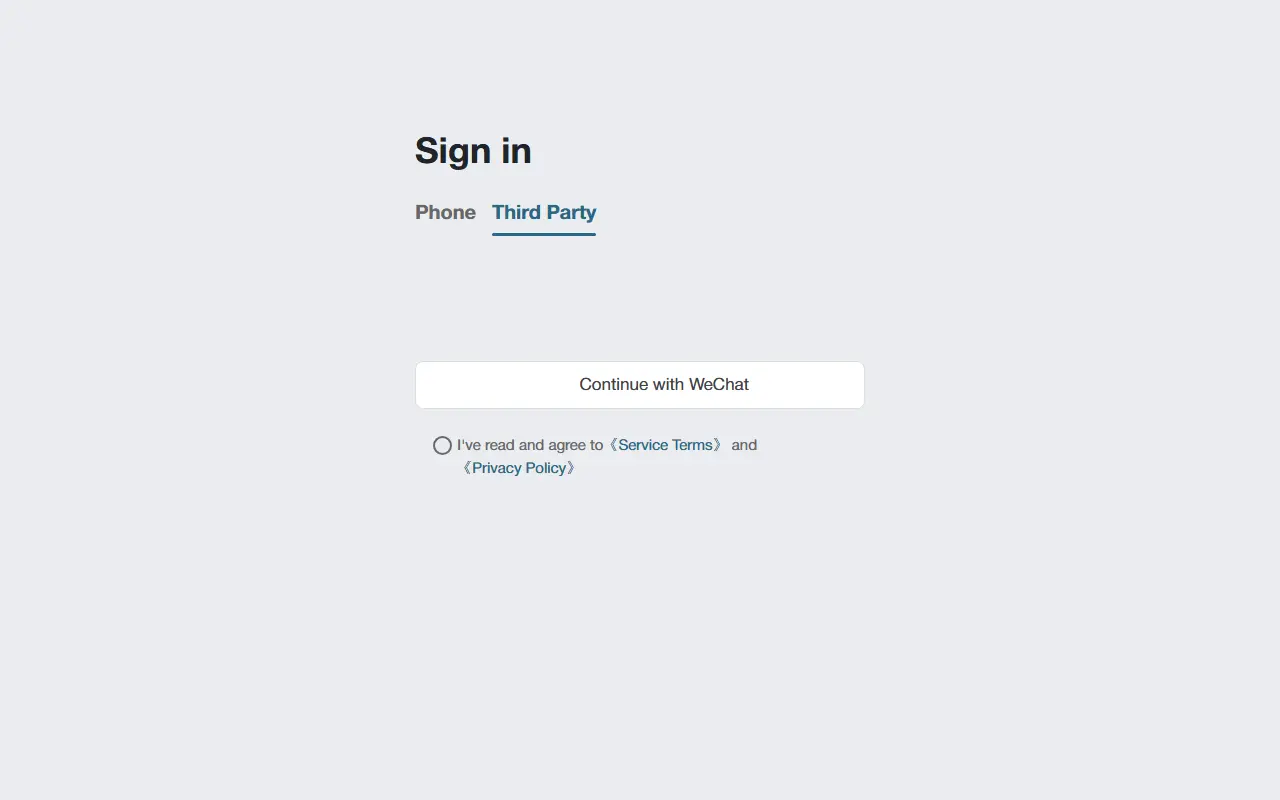
my.liubai.ccLiubai homepage screenshot

Liubai is a combined notes, schedule, to-do and task app with AI features, documented mainly in Chinese. Each item is an atomic card that can hold text, images, multi-level tags, status and files, and cards can be synced to the cloud. It is aimed at individuals and small groups who want personal note-taking and light collaboration in one place, and it works in layouts from phone to desktop widths.

The README lists integration with large language models such as DeepSeek, Kimi, MiniMax, Stepfun and Zhipu, which are made available inside WeChat through the official customer-service message API. For privacy, each card can be set to stay local only or to refuse AI reading. The app is local first, using a PWA service worker so it works offline on the web, and it supports light and dark modes, Chinese and English, a rich text editor with light Markdown, and a VS Code extension for quick notes. WeChat integration covers schedule reminders and picking collaborators from contacts.

The repository is split into a Laf-based back end with cloud functions, VitePress documentation, a Vue 3 front end using Vite, Dexie.js and TipTap, a WeChat mini program and the VS Code extension. A hosted instance is available at my.liubai.cc, and the project is licensed under AGPL-3.0.

Key features

  • Atomic cards with text, images, tags and files
  • Cloud sync with local-first offline use
  • AI assistants inside WeChat
  • Per-card local-only and no-AI settings
  • Schedule reminders through WeChat
  • VS Code extension for quick notes
  • Responsive progressive web app

Mem alternatives: questions

What is the best open-source alternative to Mem?
AppFlowy is the top-ranked open-source alternative to Mem on Enlisted: An open-source AI collaborative workspace for notes, wikis, tasks and projects, built as a Notion alternative that keeps you in control of your data. Other strong options are AFFiNE, Open Notebook, NoteGen and Blinko.
Are these Mem alternatives free?
All 9 are open source, so the code is free to use under its licence, and all of them can be self-hosted on your own server or computer. 3 also offer a paid or managed cloud version if you'd rather not host it yourself.
How is this list of Mem alternatives ranked?
By a score built from GitHub stars, star growth over the last 30 days and how recently the code changed. 6 of these projects shipped code in the last 30 days. Data is refreshed daily, and nobody can pay to move up.

People also look for alternatives to…

View all