7,380 open-source and SaaS tools, with GitHub stats refreshed every day.

10 alternatives ranked by real activity

Open-source GitBook alternatives

A curated, ranked list of the 10 best open-source alternatives to GitBook.

The best open-source alternative to GitBook is Wiki.js. If that doesn't suit you, other good options are BookStack, PandaWiki, MrDoc and Gollum.

GitBook alternatives are mainly documentation & wiki tools, but some are also CMS tools. 7 of them shipped code in the last 30 days, 10 can be self-hosted, and 4 use a permissive licence.

Last updated October 2, 2026 · ranked by GitHub stars, growth and recent commits

Wiki.js

Wiki.js is a Node.js-based open-source wiki; this repository holds the 3.0 beta, which is not intended for production use, while the stable 2.x line lives elsewhere.

GitHub stars
29k
Last commit
yesterday
Latest release
3.0.0-beta.617
Licence
AGPL-3.0
Self-hosted
Yes
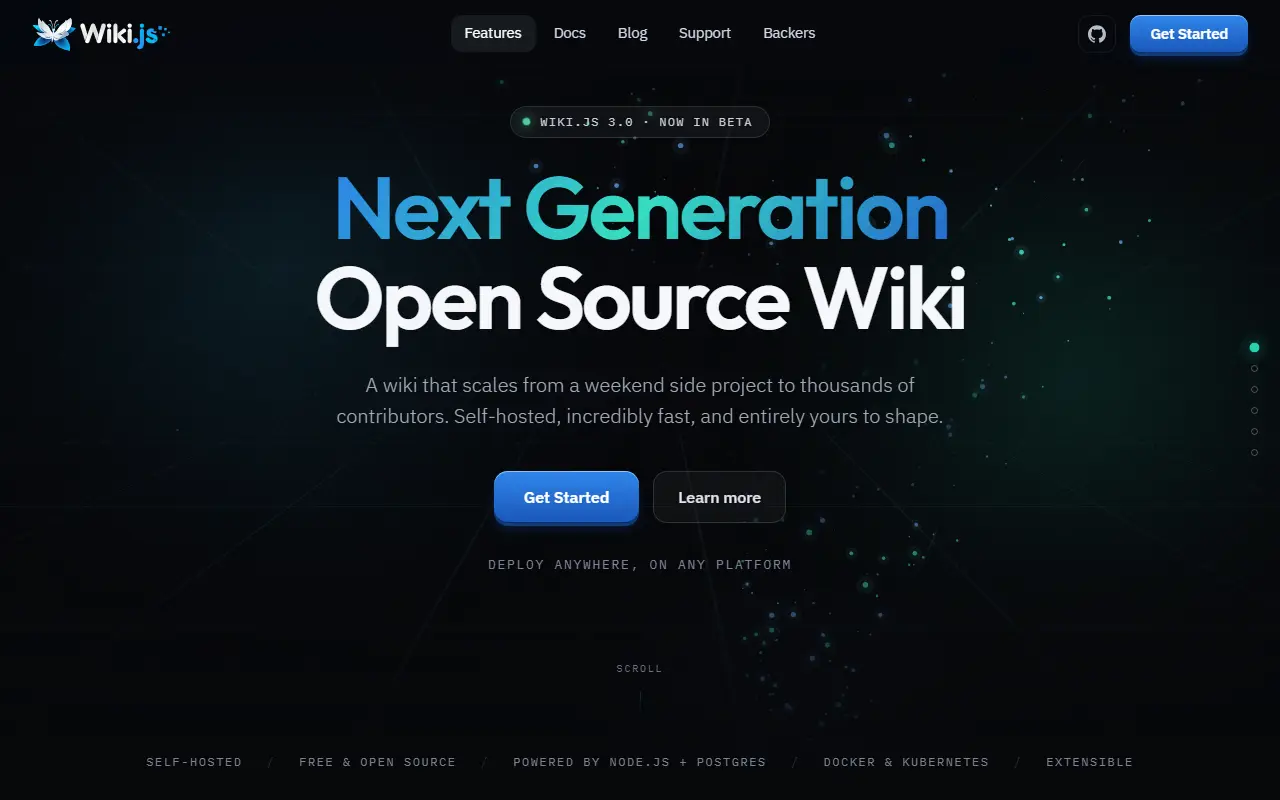
beta.js.wikiWiki.js homepage screenshot

Wiki.js is a next-generation open-source wiki platform built on Node.js with a Vue front end. This repository contains the upcoming 3.0 release in beta, and the README is explicit that it is not for production use. The current stable 2.x release is published at js.wiki and in a separate repository.

The project is aimed at documentation and knowledge sharing for teams. Topics list Markdown editing, Git, cross-platform operation and documentation, and the beta is accompanied by installation requirements, a changelog and a feature request channel. Contributors can help with translations, and the project is supported by sponsors, patrons and donations from the community.

Wiki.js is AGPL-3.0 licensed. It is software you run on your own server, so it suits teams that want a self-hosted wiki they control. Anyone who needs a dependable wiki today should look at the 2.x stable version rather than this beta, and treat the 3.0 code as a preview of what is coming.

Key features

  • Node.js wiki with a Vue front end
  • Markdown content editing
  • Git-friendly documentation workflow
  • Installs on multiple platforms
  • Community-driven translation effort
  • 3.0 beta preview with changelog

Pricing: Free and open source under the AGPL-3.0 license.

BookStack

A simple, self-hosted wiki and documentation platform built with PHP and Laravel that organizes content into books, chapters and pages.

GitHub stars
19k
Last commit
today
Latest release
v26.09.1
Licence
MIT
Self-hosted
Yes
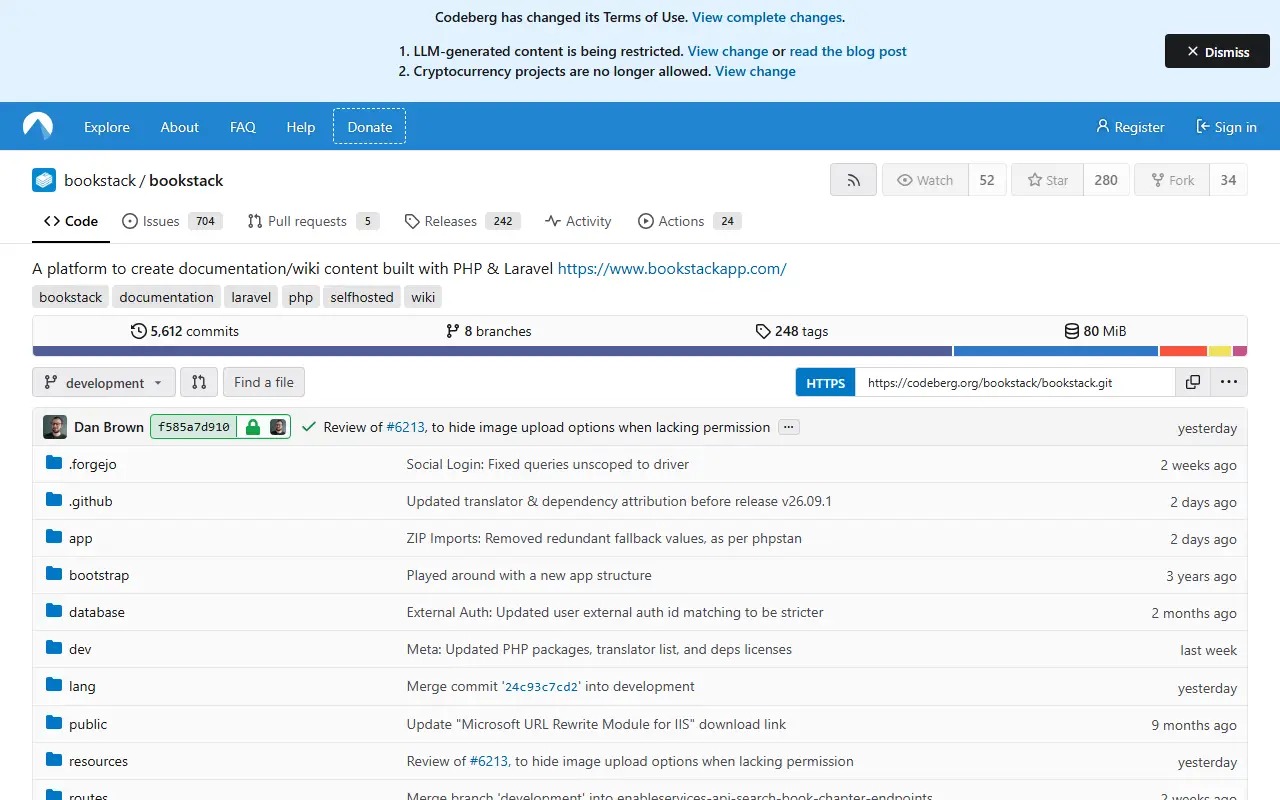
codeberg.orgBookStack homepage screenshot

BookStack is a platform for storing and organizing information and documentation, built with PHP and the Laravel framework. It is deliberately opinionated: the aim is a pleasant, intuitive experience out of the box where only basic word-processing skills are needed to create content, so non-technical colleagues can contribute.

Content is organized in a book metaphor, with shelves, books, chapters and pages. Advanced capabilities are available for those who want them, but the project says they should never get in the way of the simple core experience, and it is not intended as a general extensible platform for unrelated purposes. Development is relaxed and positive, evolving slowly while keeping upgrades stable and easy. There is a demo instance, installation instructions, documentation and a blog.

BookStack is licensed under MIT and is now managed on Codeberg, which is where the primary repository and issue list live. You host it on your own server with PHP and a database. It suits teams, schools and small organizations that want an approachable internal wiki rather than a highly configurable knowledge system.

Key features

  • Shelves, books, chapters and pages structure
  • Simple editor for non-technical users
  • Self-hosted PHP and Laravel application
  • Stable and easy upgrade path
  • Demo instance and documentation
  • Advanced options that stay out of the way

Pricing: Free and open source under the MIT license.

PandaWiki

An AI-powered open-source knowledge base builder for product docs, technical docs, FAQs and blogs, with AI writing, Q&A and search, from the Chaitin team.

GitHub stars
10k
Last commit
2 days ago
Latest release
v3.87.3
Licence
AGPL-3.0
Self-hosted
Yes
Hosted version
Available
pandawiki.docs.baizhi.cloudPandaWiki homepage screenshot

PandaWiki is an open-source system for building knowledge bases, powered by large language models. It helps teams quickly set up product documentation, technical documentation, FAQs and blog sites, and uses AI to assist with writing, answering questions and searching the content.

The editor supports Markdown and HTML and can export to Word, PDF and Markdown. Sites can be embedded in other websites as a widget or turned into chatbots for DingTalk, Feishu and WeCom. Content can be imported from web page URLs, website sitemaps, RSS feeds and offline files. A knowledge base is a collection of documents from which PandaWiki builds a separate wiki website, and AI features need an LLM to be configured at first login.

To self-host it you need a Linux server with Docker 20.x or newer and run the installer as root. A SaaS version also exists for those who prefer not to deploy it. PandaWiki is licensed under AGPL-3.0, so modifications and network services built on it must also be open source, and the project documentation is mainly written in Chinese.

Key features

  • AI-assisted writing, Q&A and search
  • Markdown and HTML rich text editing
  • Export to Word, PDF and Markdown
  • Embeddable web widget
  • Chatbots for DingTalk, Feishu and WeCom
  • Import from URLs, sitemaps, RSS and files
  • Installation with Docker on Linux

Pricing: Free and open source under AGPL-3.0; a SaaS version is also available.

MrDoc

Self-hosted document and knowledge base system built with Python and Django, for individuals and small teams writing notes, wikis, and product docs.

GitHub stars
3.2k
Last commit
3 days ago
Latest release
v1.1.1
Licence
GPL-3.0
Self-hosted
Yes
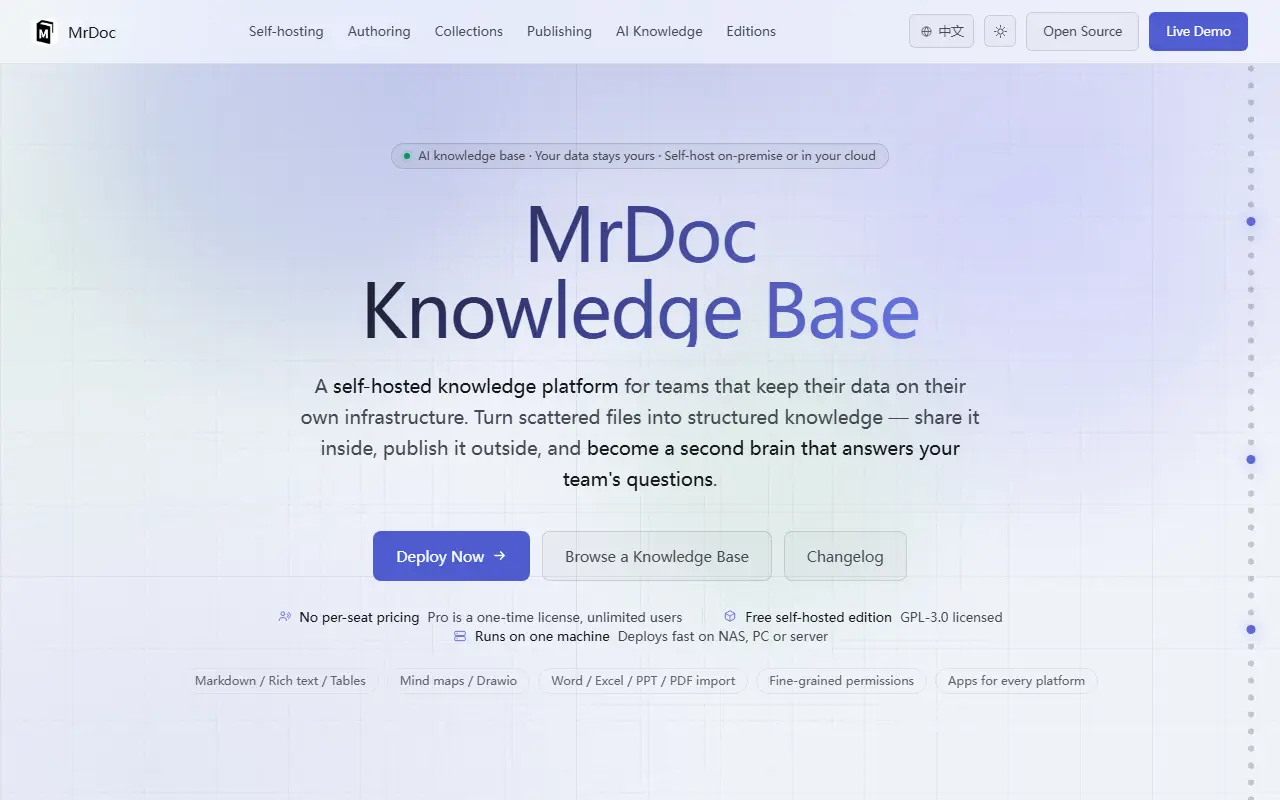
mrdoc.ioMrDoc homepage screenshot

MrDoc is an online document and knowledge management system you host yourself. It covers capturing and storing content, organizing it into collections, AI-assisted question answering, writing, and sharing, so individuals and small teams can keep personal notes, internal wikis, product documentation, and tutorials in one place. Its own description compares it to a self-hosted Yuque or an online-editable GitBook.

Content is written in Markdown, and the project provides several ways in: the web application, browser extensions for web clipping and quick notes, desktop clients for Windows, macOS, and Linux, a mobile client for Android, and an Obsidian plugin for two-way sync. The web app comes in an open-source edition and a professional edition, so some features are reserved for the paid tier.

MrDoc is written in Python with the Django framework and released under the GPL-3.0 license, with documentation in both Chinese and English and a demo site. It suits teams that want full ownership of their knowledge base data and a simple self-hosted alternative to cloud documentation tools.

Key features

  • Markdown document editing and organization
  • Wiki and knowledge base structure
  • AI knowledge base question answering
  • Browser extension for web clipping
  • Desktop and mobile clients
  • Two-way sync with Obsidian

Pricing: The open-source edition is free under the GPL-3.0 license; a separate Professional Edition exists.

Gollum

Gollum is a simple wiki built on Git, storing pages as editable text files and offering a local web editor and many markup formats.

GitHub stars
14k
Last commit
10 mo ago
Latest release
v6.1.0
Licence
MIT
Self-hosted
Yes

Gollum is a wiki system built on top of Git. A Gollum wiki is simply a Git repository of text or markup files that humans can edit, organized into directories however you like, and it can also hold images, PDFs and page headers and footers. Pages can be written in a variety of markups and edited with your own editor or with the built-in web interface.

Because it is Git, every page keeps its history, can be displayed in all versions and can be reverted. Gollum aims to stay compatible with GitHub and GitLab wikis, so you can clone one of those wikis and view or edit it locally. Advanced features include diagrams with Mermaid or PlantUML, BibTeX and citation support, annotations with CriticMarkup, mathematics via KaTeX or MathJax, macros, redirects and an RSS feed of recent changes.

It is written in Ruby and released under the MIT license. It runs on Unix-like systems and Windows using either standard Ruby or JRuby, though on Windows only JRuby is supported. You can install it as a Ruby gem, run it with Docker or deploy it as a Java web application resource. It also supports Rack, authentication servers and running as a service.

Key features

  • Wiki stored as a Git repository
  • Built-in web editor and local file editing
  • Compatible with GitHub and GitLab wikis
  • Mermaid and PlantUML diagrams
  • Math with KaTeX or MathJax
  • Page redirects and macros
  • RSS feed of recent changes

Pricing: Free and open source under the MIT license.

Read more about GollumGitHub

Andesine

Open-source collaborative content workspace for technical blogs, product documentation, and knowledge bases, with a Kanban dashboard, editor, and content API.

GitHub stars
2k
Last commit
6 days ago
Latest release
v0.4.4
Self-hosted
Yes
Hosted version
Available
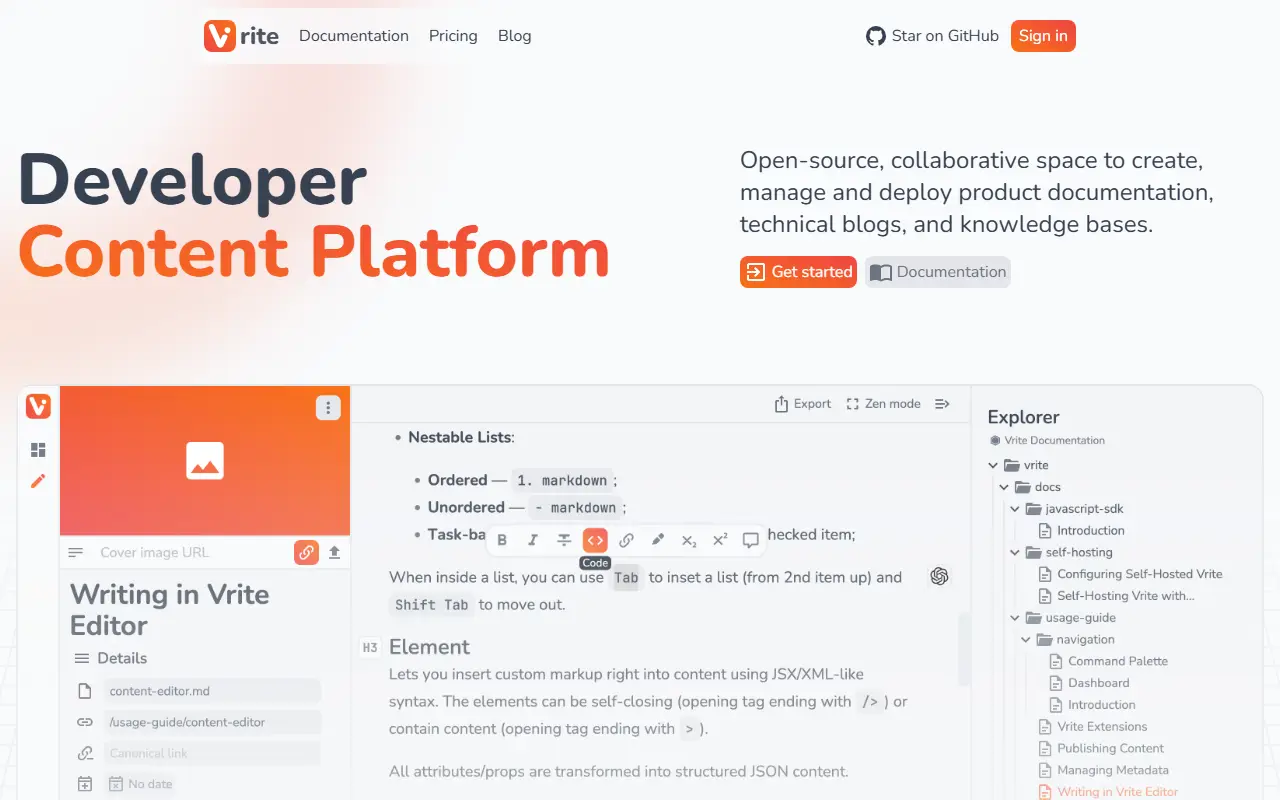
vrite.ioAndesine homepage screenshot

Vrite is an open-source, collaborative space to create, manage, and deploy product documentation, technical blogs, and knowledge bases. It aims to provide a high-quality, integrated experience for both writers and developers. This repository is described as a work-in-progress branch for Andesine, the version 2 rewrite, and the README points to the main branch for the latest stable Vrite. The input lists its license only as other.

Features listed include a built-in dashboard to manage content production and delivery using Kanban or list views, a modern WYSIWYG editor with Markdown support, an integrated code editor with formatting, and real-time collaboration. AI-powered semantic search helps organize and find content, and a versatile API serves content to websites and applications, which is why topics call it a headless CMS.

A hosted Vrite Cloud is available alongside the self-hostable code. It suits technical writers, developer relations teams, and documentation groups who want a content workflow that bridges writing and publishing.

Key features

  • Kanban and list content dashboard
  • WYSIWYG editor with Markdown support
  • Integrated code editor and formatting
  • Real-time collaboration
  • AI-powered semantic search
  • Content API for publishing

Flowershow

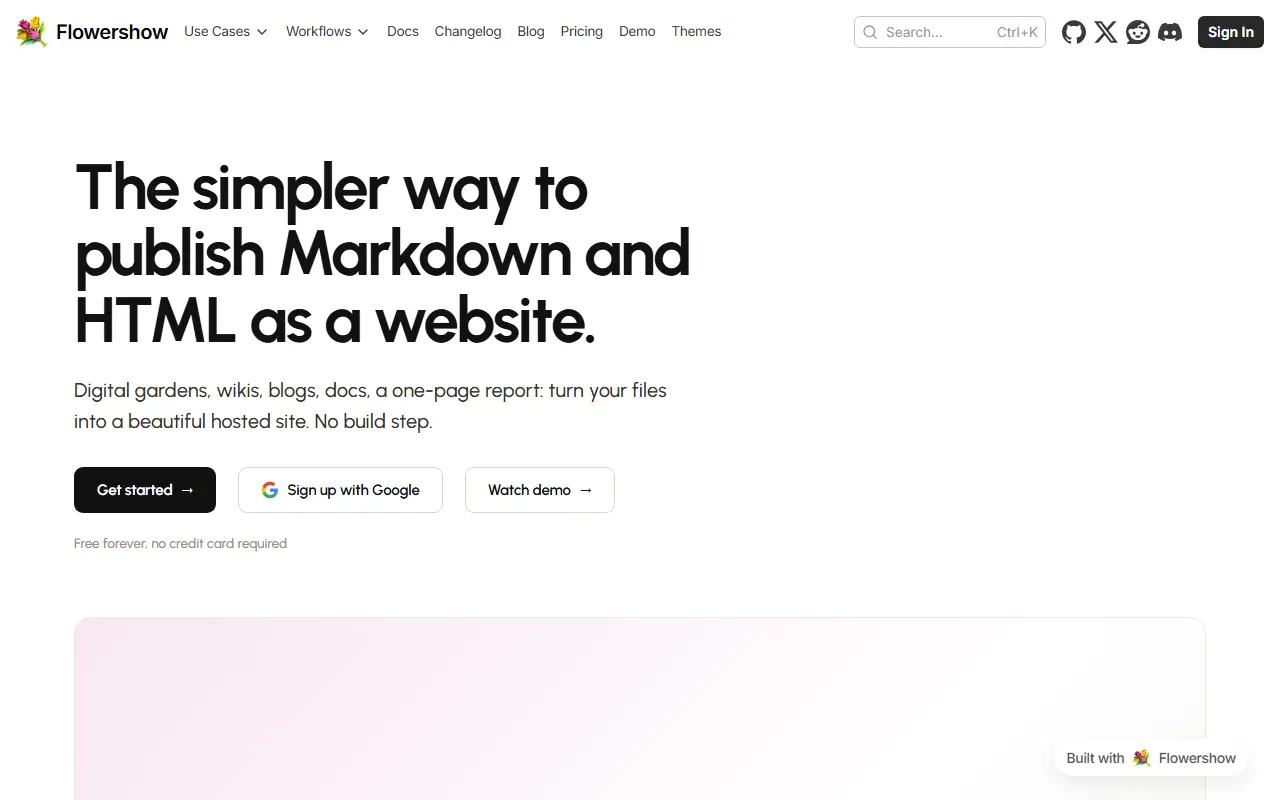
Flowershow publishes Markdown and HTML files as websites, docs, wikis and digital gardens, with Obsidian and AI integrations and a hosted service.

GitHub stars
1.1k
Last commit
today
Latest release
cli/v2.5.0
Licence
AGPL-3.0
Self-hosted
Yes
Hosted version
Available
flowershow.appFlowershow homepage screenshot

Flowershow is a tool for publishing Markdown, and HTML, quickly as websites, documentation, knowledge bases and digital gardens. It is built by Datopian, and the product site is itself built and published with Flowershow, which demonstrates the idea of turning a folder of notes into a site in seconds.

It integrates with Obsidian vaults for people who write in Markdown and offers a command-line tool aimed at AI workflows so agents can publish content. The monorepo uses Next.js, Turborepo and pnpm, with a web app, packages such as a wiki-link remark plugin, and end-to-end tests. Topics mention MDX, blogging and Tailwind CSS as part of the stack.

You can sign up for the hosted service at flowershow.app or run the open-source code yourself, which requires Node.js 22, pnpm and Docker for local development. Flowershow is licensed under AGPL-3.0. It suits writers, researchers and teams who keep content as Markdown and want to publish it without maintaining a custom site generator.

Key features

  • Publish Markdown and HTML as websites
  • Obsidian vault integration
  • Command-line tool for AI workflows
  • Wiki-link support
  • Hosted service and open-source code
  • Next.js and Tailwind based sites

Pricing: A free plan covers a site on a flowershow.me subdomain. Premium costs $5 per site per month or $50 per year, with discounts for additional sites; volume pricing is quoted on request.

Gramax

Gramax is a docs-as-code app for writing Markdown documentation in a visual editor, versioning it in Git and publishing it as a documentation site.

GitHub stars
608
Last commit
today
Licence
GPL-3.0
Self-hosted
Yes
Hosted version
Available

Gramax is a free, open-source application for creating, editing and publishing documentation as code. It stores all data locally in Markdown, so it works offline and files can be edited in any text editor, and it integrates with Git for version control and collaboration. It targets product documentation portals, internal knowledge bases, project documentation and personal notes.

A visual editor makes Markdown editing easier for technical and non-technical users. The app runs on Windows, macOS and Linux as a desktop app and as a web version. Editing features include tabs, tables, video embeds, code blocks, diagrams from Mermaid, Excalidraw and Diagrams.net, and Swagger API descriptions. Git repositories on GitHub, GitLab, Bitbucket, Gitea and others can be connected, catalogs can be published to a customizable documentation portal, documentation can be written in 17 languages, and content can be imported from Confluence and Notion.

Gramax is positioned as an alternative to GitBook, Mintlify and typical static site generators. It is written in TypeScript and Rust with Tauri, and licensed under GPL-3.0.

Key features

  • Visual Markdown editor
  • Git integration for versioning
  • Publish a documentation portal
  • Diagrams with Mermaid and Excalidraw
  • Import from Confluence and Notion
  • Desktop and web versions

Pricing: Free and open source under the GPL-3.0 license.

Raneto

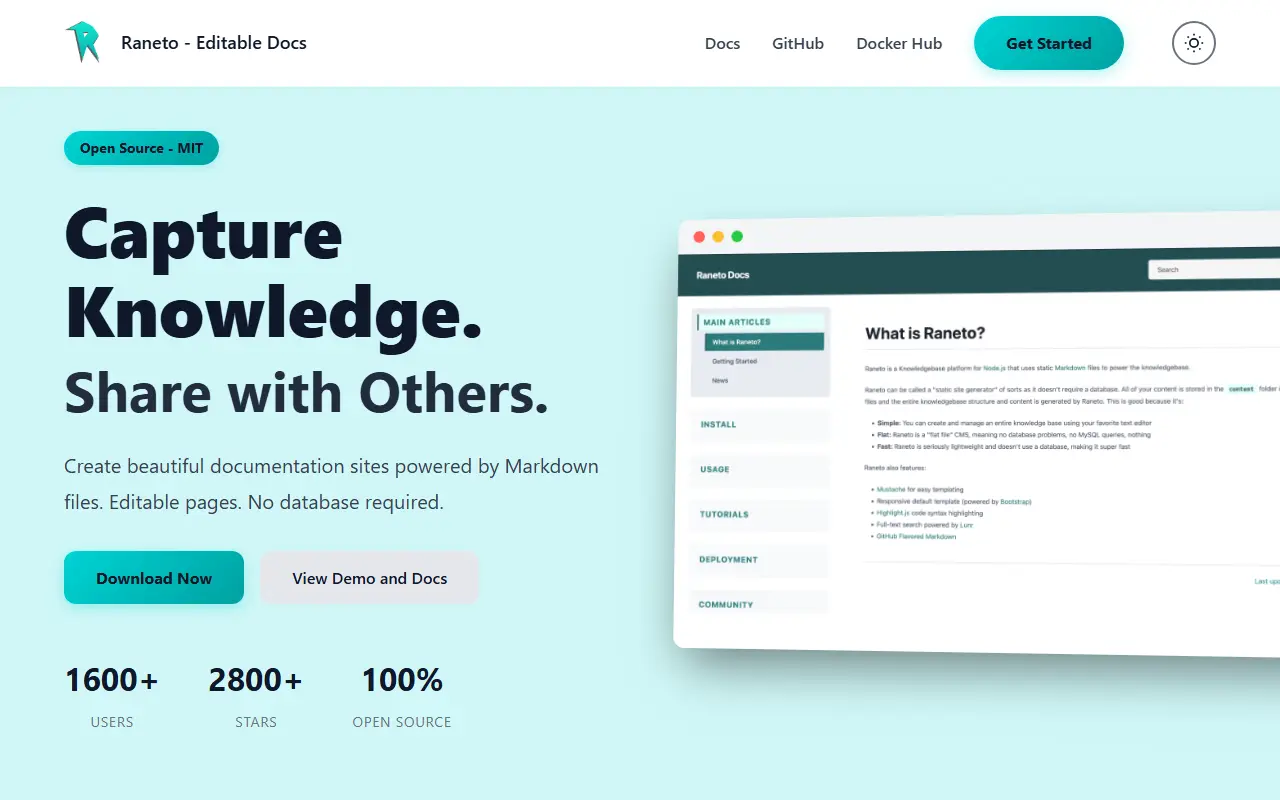
Simple Markdown-based knowledge base wiki for Node.js that serves file-based content with search, a browser editor and optional login.

GitHub stars
2.9k
Last commit
6 mo ago
Latest release
0.18.1
Licence
MIT
Self-hosted
Yes
raneto.comRaneto homepage screenshot

Raneto is a free, open-source knowledge base for Node.js that is powered by Markdown. All content lives in plain files on disk, so pages can be written in any editor, versioned with Git and moved around without exporting from a database.

Visitors can search both file names and page contents, and a Markdown editor is available in the browser. A login system protects editing, with admin credentials and a session secret set through environment variables or the config file. Further settings cover the content directory, base URL, site title, locale, Google Analytics ID and the address and port the server listens on.

The project positions itself as simple and lightweight, with a live demo, documentation and a mailing list for news and security alerts. It is written in JavaScript, tagged as self-hosted, and released under the MIT licence.

Key features

  • File-based Markdown content
  • Search across file names and contents
  • Markdown editor in the browser
  • Login system to protect editing
  • Configuration through environment variables
  • Locale and UI translation settings

Pricing: Free and open source under the MIT licence.

amWiki

amWiki is a lightweight Markdown wiki system that generates a static site from .md files, with no database or server-side code required.

GitHub stars
983
Last commit
5 yr ago
Latest release
v1.2.1
Licence
MIT
Self-hosted
Yes

amWiki is a lightweight, front-end wiki system written in JavaScript for personal and team documentation. You write pages in Markdown, keep them as local .md files and publish the result as a static site, so no database or server-side development is needed. Its documentation is written mainly in Chinese.

It can create a new wiki with one action, update the navigation tree automatically, handle nested directories and paste screenshots directly into a page as local PNG files. Pages adapt to different screen sizes, search runs entirely in the browser with scored results, and API documentation can be parsed to produce simple Ajax tests.

Editing happens through either the Atom editor plugin or an npm command-line module, and the two share the same wikis. Neither is needed to view the result because the output is plain static HTML that any web host can serve. amWiki is released under the MIT license.

Key features

  • Markdown pages stored as local files
  • No database or server code required
  • Automatic navigation tree updates
  • Multi-level directories
  • Paste screenshots straight into pages
  • Client-side search with ranked results
  • API docs with simple Ajax testing

Pricing: Free and open source under the MIT license.

GitBook alternatives: questions

What is the best open-source alternative to GitBook?
Wiki.js is the top-ranked open-source alternative to GitBook on Enlisted: Wiki.js is a Node.js-based open-source wiki; this repository holds the 3.0 beta, which is not intended for production use, while the stable 2.x line lives elsewhere. Other strong options are BookStack, PandaWiki, MrDoc and Gollum.
Are these GitBook alternatives free?
All 10 are open source, so the code is free to use under its licence, and all of them can be self-hosted on your own server or computer. 4 also offer a paid or managed cloud version if you'd rather not host it yourself.
How is this list of GitBook alternatives ranked?
By a score built from GitHub stars, star growth over the last 30 days and how recently the code changed. 7 of these projects shipped code in the last 30 days. Data is refreshed daily, and nobody can pay to move up.

People also look for alternatives to…

View all