#1
A fair-code workflow automation platform that mixes a visual canvas with custom code and AI agent features, for teams connecting apps and automating processes.
- GitHub stars
- 210k
- Last commit
- today
- Latest release
- n8n@2.47.5
- Self-hosted
- Yes
- Hosted version
- Available
n8n.io
n8n is a workflow automation platform for connecting apps, moving data between them and triggering actions without writing a full integration from scratch. Workflows are built on a visual canvas, and when a step needs more logic you can drop in JavaScript or Python and use npm packages. It is often compared with Zapier and Make, but the source is public and it can run on your own infrastructure.
Recent versions put a lot of weight on AI. You can build multi-step agents and LLM workflows that call OpenAI, Anthropic, Google or open-source models, add human approval steps, and inspect what happened afterward. The project advertises over a thousand integrations and a large library of ready-made workflow templates, and you can extend it with your own nodes.
n8n is distributed under a fair-code model: the Sustainable Use License, plus a separate enterprise license for additional features. The code is always visible and can be self-hosted, for example with Docker, but it is not an OSI-approved open-source license, so commercial redistribution is restricted. A managed cloud edition is available if you would rather not run it yourself.
Key features
- Visual workflow canvas with branching logic
- JavaScript and Python code steps with npm packages
- Multi-step AI agents with human approval
- Over 1,500 integrations plus reusable templates
- Connects to OpenAI, Anthropic, Google or local models
- Role-based access and audit trails
- Self-hosting with Docker or managed cloud
Pricing: Free self-hosted Community Edition. Hosted plans cost 20€ (Starter), 50€ (Pro) and 667€ (Business) per month billed annually, scaled by workflow executions; Enterprise is custom. Free trial available.
#2
An Apache workflow orchestration platform where data teams author, schedule and monitor pipelines as Python code, widely used for data engineering and ELT jobs.
- GitHub stars
- 47k
- Last commit
- today
- Latest release
- 3.4.0
- Licence
- Apache-2.0
- Self-hosted
- Yes
airflow.apache.org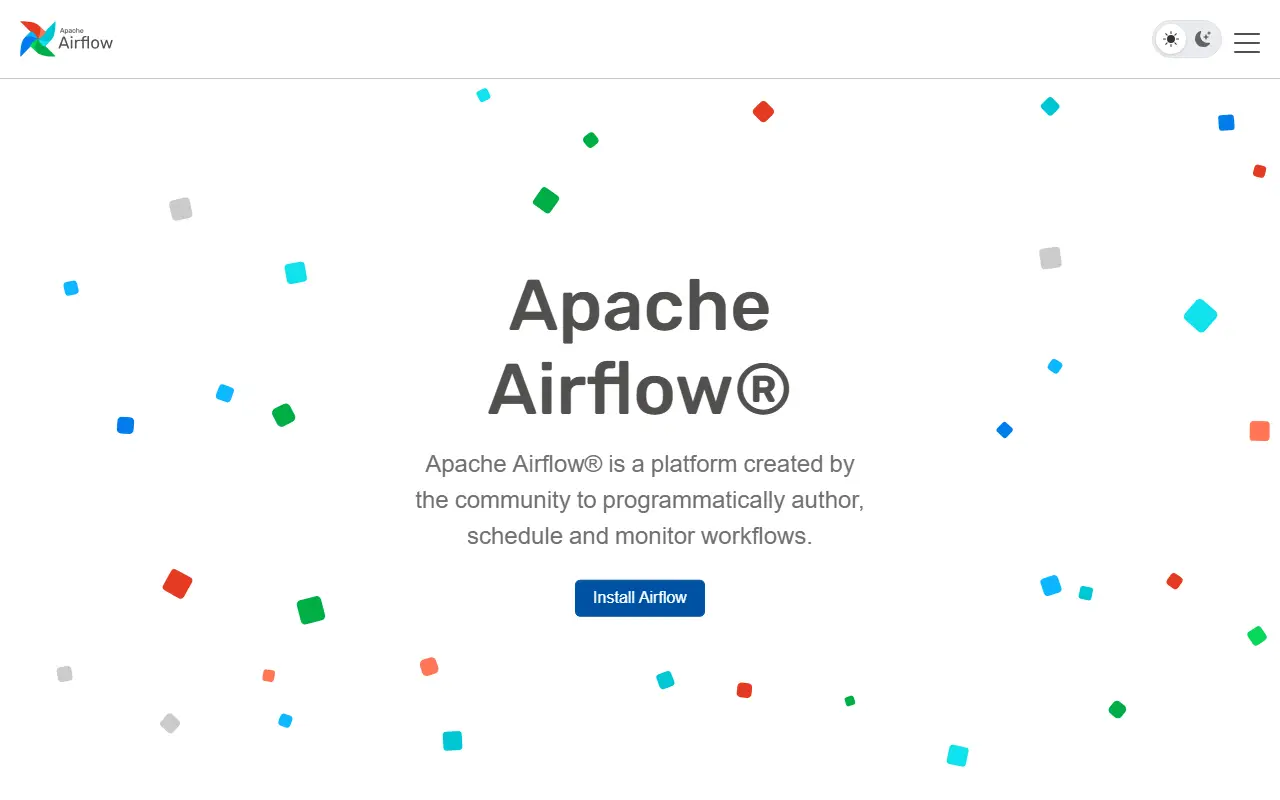
Apache Airflow is a workflow platform where you write, schedule and watch over pipelines in code. Workflows are defined as Python code in the form of directed acyclic graphs, or DAGs, where each task and its dependencies are explicit, so pipelines can be versioned, tested and reviewed like any other software.
A scheduler runs tasks on a defined cadence and workers execute them, while a web interface shows the status of each run, lets you inspect logs and retry failures. Airflow is used heavily in data engineering, including data integration, ELT and ETL pipelines, data orchestration and machine learning workflows, and its topics cover data science and automation. It has a large ecosystem of providers and operators for connecting to databases, cloud services and other systems, and the 3.x line is the current series.
Airflow is an Apache Software Foundation project under the Apache-2.0 license and runs on your own infrastructure, from a single machine to Kubernetes. Several vendors offer managed Airflow services, but the project itself is self-hosted software. It suits data engineers who prefer code-first orchestration over drag-and-drop tools.
Key features
- Workflows defined as Python DAGs
- Scheduler for recurring and dependent tasks
- Web UI for monitoring runs and logs
- Retries and task dependency management
- Large provider ecosystem of integrations
- Runs on single machines or Kubernetes
Pricing: Free and open source under the Apache-2.0 license.
#3
An open-source data movement platform with hundreds of connectors for ELT pipelines from APIs, databases and files into warehouses, lakes and AI applications.
- GitHub stars
- 22k
- Last commit
- today
- Latest release
- v2.0.0
- Self-hosted
- Yes
- Hosted version
- Available
airbyte.com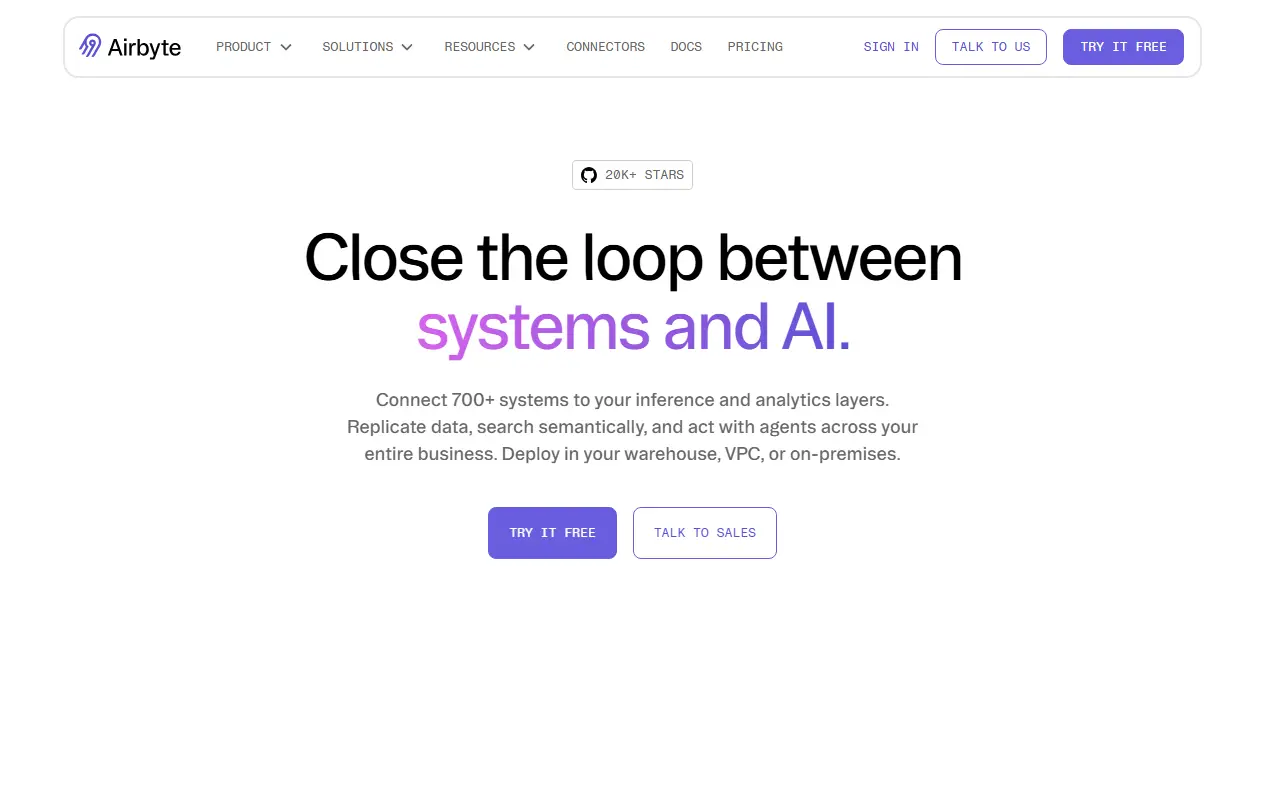
Airbyte is an open-source data movement platform for moving data from APIs, databases and files into data warehouses, data lakes and AI applications. Its premise is that only an open-source project can reach the long tail of data sources while letting engineers tailor existing connectors, with the aim of moving data from any source to any destination.
It offers a catalog of 600 or more connectors for APIs, databases, warehouses, lakes and AI applications, with warehouse destinations such as BigQuery, Redshift and Snowflake, and topics also mention change data capture. The README distinguishes products by job: Airbyte Open Source or Airbyte Cloud for ELT and ETL into warehouses, lakes or databases, and Airbyte Agents, a managed data and context layer, plus an open-source Agent SDK for giving AI agents and MCP clients real-time access to business data.
Airbyte is written in Python and Java, and its license is listed as 'Other' on GitHub because the project uses a mix of licenses, so review the terms for your use. It can be self-hosted or run as the managed Airbyte Cloud, and suits data teams that need many integrations without writing each pipeline by hand.
Key features
- 600+ source and destination connectors
- ELT pipelines into warehouses and lakes
- Change data capture support
- Customizable open-source connectors
- Agent SDK for AI agent data access
- Self-hosted or Airbyte Cloud
Pricing: The open-source Core edition is free to self-host. Managed cloud starts at $20 a month (Standard) or $189 a month for 40 credits (Plus); Pro and Enterprise Flex are custom. 30-day trial.
#4
An open-source ETL and ELT platform built on DuckDB that you deploy yourself, with visual or SQL pipelines, dbt, CDC, data quality and an MCP server.
- GitHub stars
- 1.6k
- Last commit
- today
- Latest release
- v0.8.0
- Licence
- Apache-2.0
- Self-hosted
- Yes
duckle.org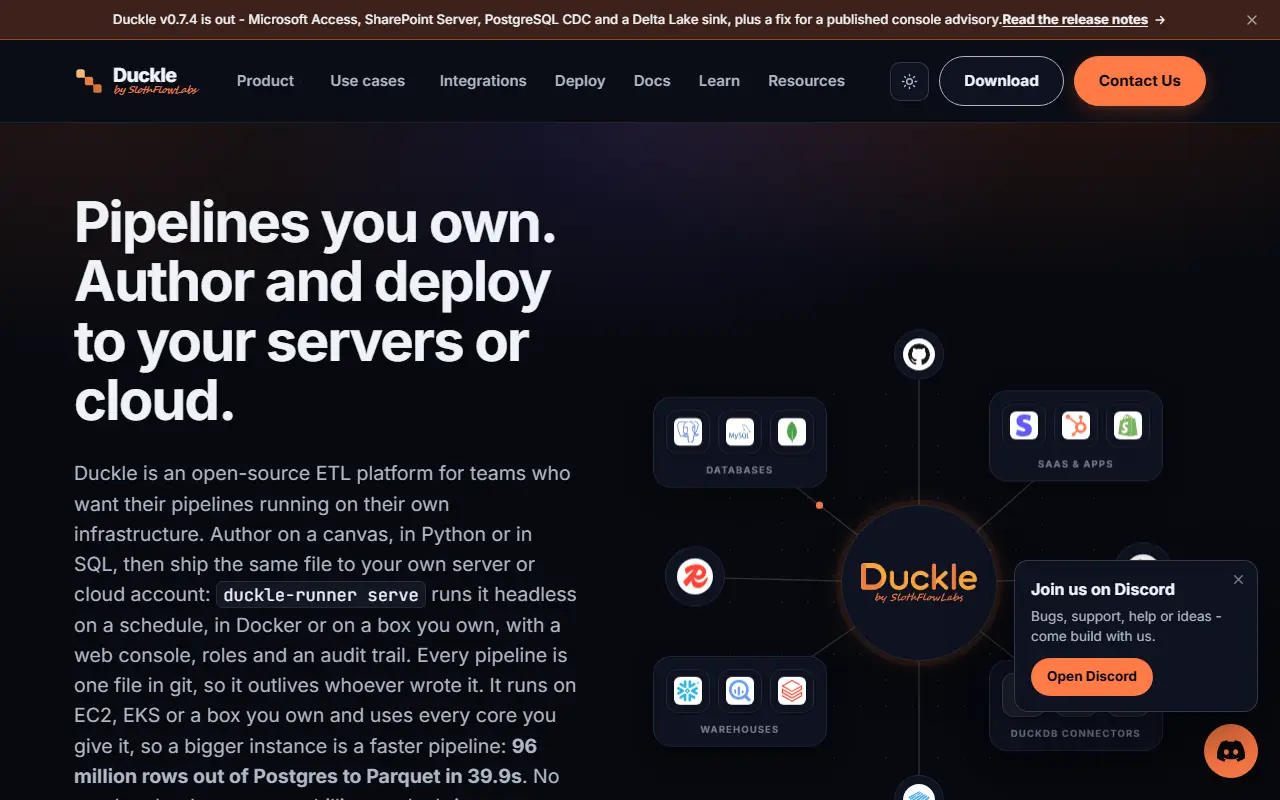
Duckle is an open-source ETL and ELT platform for teams that want their data pipelines running on their own infrastructure. You build pipelines on a visual canvas, in Python or in SQL, then ship the same file to your own server or cloud account, where a headless runner executes it on a schedule.
Pipelines compile to SQL on DuckDB and use all the cores available, so a larger machine runs them faster. The platform lists support for a large catalog of components, dbt, change data capture, data quality checks, reverse ETL and lineage, along with a web console, roles, an audit trail and an MCP server so AI agents such as Claude or Cursor can work with it. Each pipeline is a single file that can live in git.
Duckle is written in Rust and licensed under Apache-2.0, and it runs headless in Docker or on a plain server, with Kubernetes among its topics. It states there is no vendor cloud and no per-row billing. It is an independent project by SlothFlowLabs and is not affiliated with DuckDB Labs or MotherDuck. It suits data engineers who want a self-hosted alternative to managed pipeline services.
Key features
- Visual canvas, Python, or SQL pipeline authoring
- Runs on DuckDB across all CPU cores
- dbt, CDC, and reverse ETL support
- Data quality checks and lineage
- Web console with roles and audit trail
- MCP server for AI agents
Pricing: Free and open source under the Apache-2.0 licence, with no vendor cloud or per-row billing according to the README.
#5
Mage is an open-source data pipeline tool for building, scheduling and debugging ETL and transformation jobs in Python, SQL or R through a notebook-style UI.
- GitHub stars
- 8.8k
- Last commit
- 20 days ago
- Latest release
- 0.9.80
- Licence
- Apache-2.0
- Self-hosted
- Yes
- Hosted version
- Available
mage.ai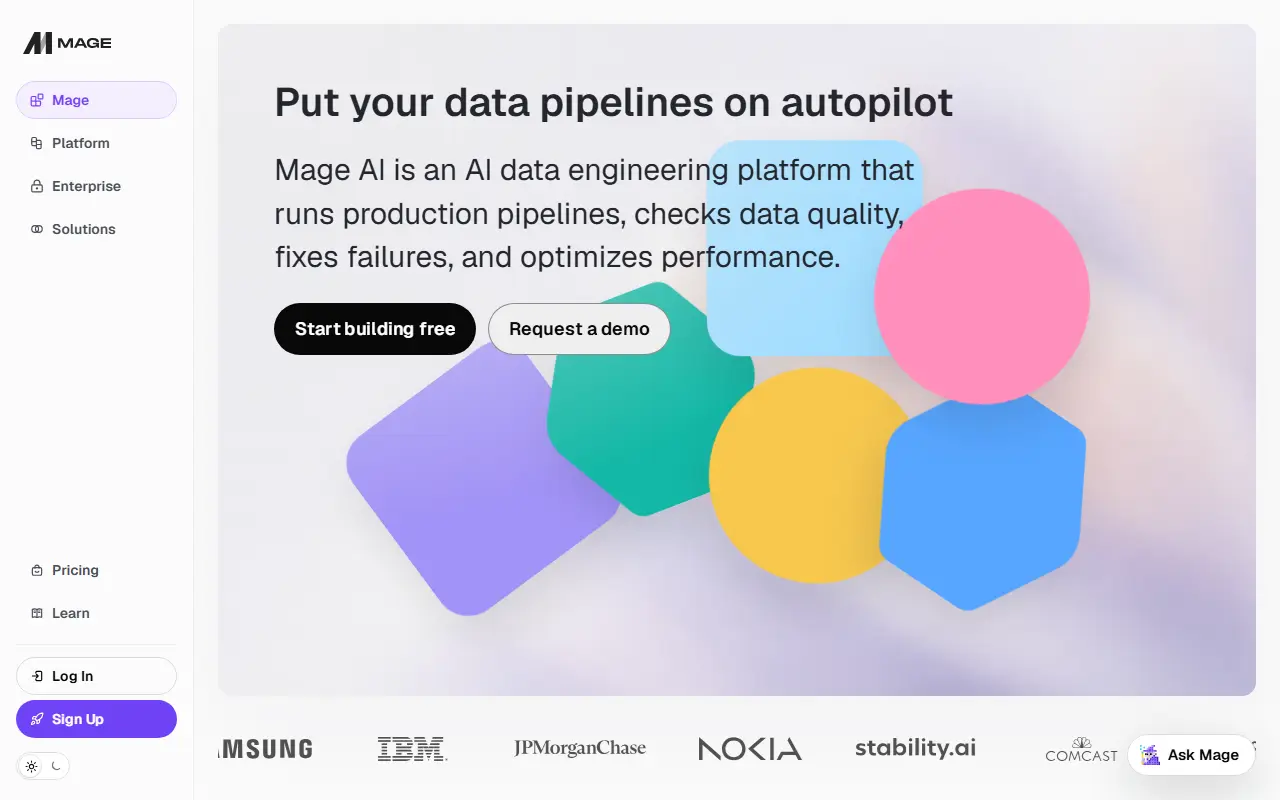
Mage, called Mage OSS in its README, is a self-hosted development environment for building data pipelines. It is meant for teams that automate ETL tasks, design data flows or orchestrate transformations, and it presents the work in a notebook-style interface made of modular blocks of code.
Pipelines are written block by block in Python, SQL or R. Jobs can be run manually or on a schedule, including cron expressions, and prebuilt connectors reach databases, APIs and cloud storage. Debugging is visual, with logs, live data previews and execution you can follow step by step, and dbt models can be built and run inside Mage. Topics on the repository also reference Spark, reverse ETL and machine learning workloads.
Mage OSS is licensed under Apache-2.0 and installs with Docker, pip or conda, with no cloud account required. For larger deployments the vendor offers Mage Pro, a commercial platform that adds enterprise orchestration, collaboration and AI-assisted workflows.
Key features
- Modular pipelines in Python, SQL or R
- Notebook-style interactive editor
- Prebuilt connectors for databases, APIs and storage
- Manual and cron-based scheduling
- Visual debugging with logs and previews
- dbt model support inside pipelines
Pricing: Managed Mage starts at $29 per month (Starter) and $100 per month (Team), plus $0.50 per CPU-hour, with a 7-day free trial. Enterprise is by contract.
#6
An open-source data pipeline tool that combines ingestion, SQL and Python transformations, and quality checks in one framework you can run locally or in CI.
- GitHub stars
- 1.8k
- Last commit
- today
- Latest release
- v0.11.821
- Licence
- Apache-2.0
- Self-hosted
- Yes
getbruin.com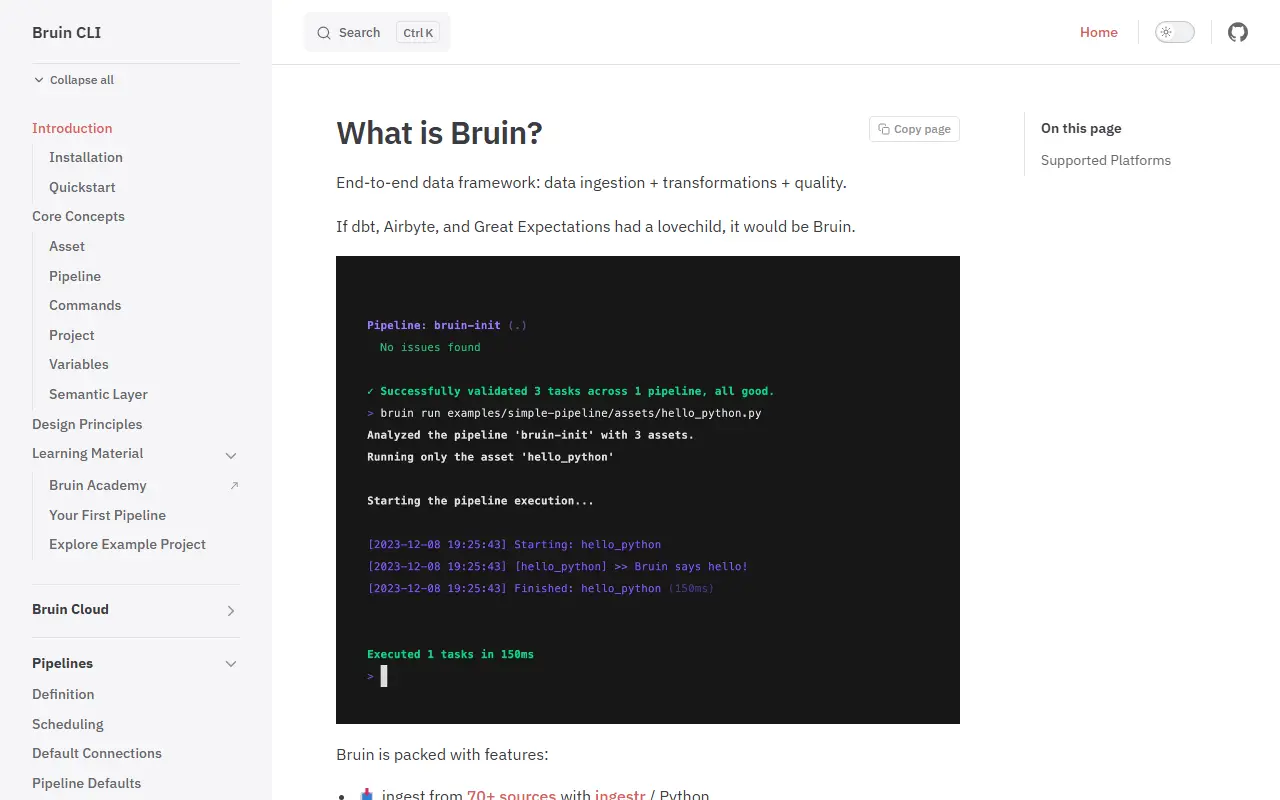
Bruin is a data pipeline tool that brings data ingestion, transformation and data quality into a single framework. Instead of stitching together separate tools for loading, modeling and testing, you describe a pipeline with SQL, Python or R assets and run it against the major data platforms, such as BigQuery and Snowflake.
Pipelines can ingest data from different sources, materialize tables and views, and build incremental tables. Python assets run in isolated environments using uv, Jinja templating cuts down on repetition, and built-in quality checks validate results. A dry-run mode validates a pipeline end to end, secrets are injected through environment variables, and a VS Code extension supports day-to-day development.
Bruin is written in Go, licensed under Apache-2.0 and distributed as a command-line tool that is easy to install. It runs on your local machine, an EC2 instance or GitHub Actions, so no dedicated orchestration server is required. It suits data engineers and analytics teams who want pipelines defined as code in a repository.
Key features
- SQL, Python, and R transformations
- Data ingestion from multiple sources
- Table and view materializations with incremental loads
- Built-in data quality checks
- Dry-run validation of whole pipelines
- VS Code extension for development
Pricing: Free and open source under the Apache-2.0 licence.
#7
Dremio OSS is a free, Apache-licensed, open-source data lakehouse platform in Java that provides fast SQL analytics directly on data stored in warehouses and lakes.
- GitHub stars
- 1.5k
- Last commit
- 1 yr ago
- Licence
- Apache-2.0
- Self-hosted
- Yes
dremio.com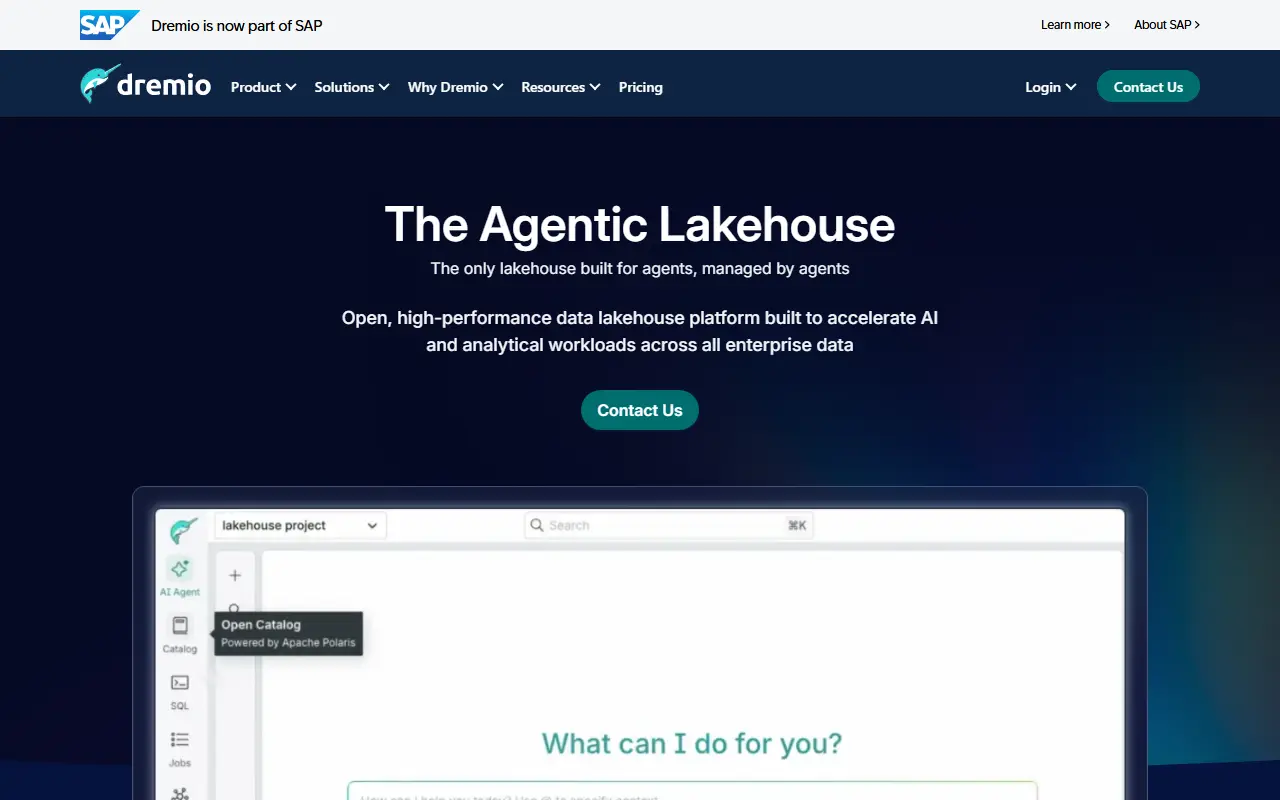
Dremio is a data analytics platform aimed at organizations that want to query and analyze large volumes of data without first moving or copying it into a separate, dedicated analytics database. It positions itself as filling a gap between raw data storage and the tools people need to get value out of that data.
The open-source edition can be built and run locally, exposing a web UI at localhost:9047 once started, or installed as a production tarball for server deployment, with an embedded mode also available. Building it requires a specific combination of JDK versions (21 as default, with 17 and 11 configured in the Maven toolchain for certain tests) plus Maven, reflecting a substantial, enterprise-grade Java codebase.
The README notes that to provide the best possible experience, the build includes some dependencies distributed under non-open-source licenses, so the fully open-source experience may differ slightly depending on build configuration. Dremio is written in Java and the open-source edition is released under the Apache-2.0 license, with full documentation hosted separately.
Key features
- SQL analytics directly on lake and warehouse data
- Web-based query interface
- Local and production deployment modes
- Built on a Java codebase with Maven tooling
- No data duplication required for analytics
Pricing: Dremio Cloud is pay-as-you-go at $0.20 per compute unit, with a 30-day trial that includes $400 in credit. Dremio Enterprise, which can be self-hosted, is priced through sales.
Funnel alternatives: questions
- What is the best open-source alternative to Funnel?
- n8n is the top-ranked open-source alternative to Funnel on Enlisted: A fair-code workflow automation platform that mixes a visual canvas with custom code and AI agent features, for teams connecting apps and automating processes. Other strong options are Airflow, Airbyte, Duckle and Mage AI.
- What are the best commercial alternatives to Funnel?
- Supermetrics, Coupler.io, Dataddo, Hightouch and Improvado are among the hosted, closed-source alternatives to Funnel listed on Enlisted, which lists 25 in total. Compare their pricing and features on each tool page.
- Are these Funnel alternatives free?
- All 7 are open source, so the code is free to use under its licence, and all of them can be self-hosted on your own server or computer. 3 also offer a paid or managed cloud version if you'd rather not host it yourself.
- How is this list of Funnel alternatives ranked?
- By a score built from GitHub stars, star growth over the last 30 days and how recently the code changed. 6 of these projects shipped code in the last 30 days. Data is refreshed daily, and nobody can pay to move up.
 TrackMedia
 TrackRev