6 open-source alternatives ranked by real activity

Open-source Float alternatives

A curated, ranked list of the 6 best open-source alternatives to Float.

The best open-source alternative to Float is OpenProject. If that doesn't suit you, other good options are ERPNext, Odoo, Worklenz and Redmine.

Commercial alternatives to Float include Runn, Kantata, Resource Guru and Productive. See all 16.

Float alternatives are mainly project management tools, but some are also ERP tools. 6 of them shipped code in the last 30 days, 6 can be self-hosted, and 1 uses a permissive licence.

Last updated November 13, 2026 · ranked by GitHub stars, growth and recent commits

OpenProject

OpenProject is open-source project management software for agile planning, Gantt charts, issue tracking and time tracking, positioned as a Jira alternative.

GitHub stars
17k
Last commit
yesterday
Latest release
v17.9.7
Licence
GPL-3.0
Self-hosted
Yes
Hosted version
Available
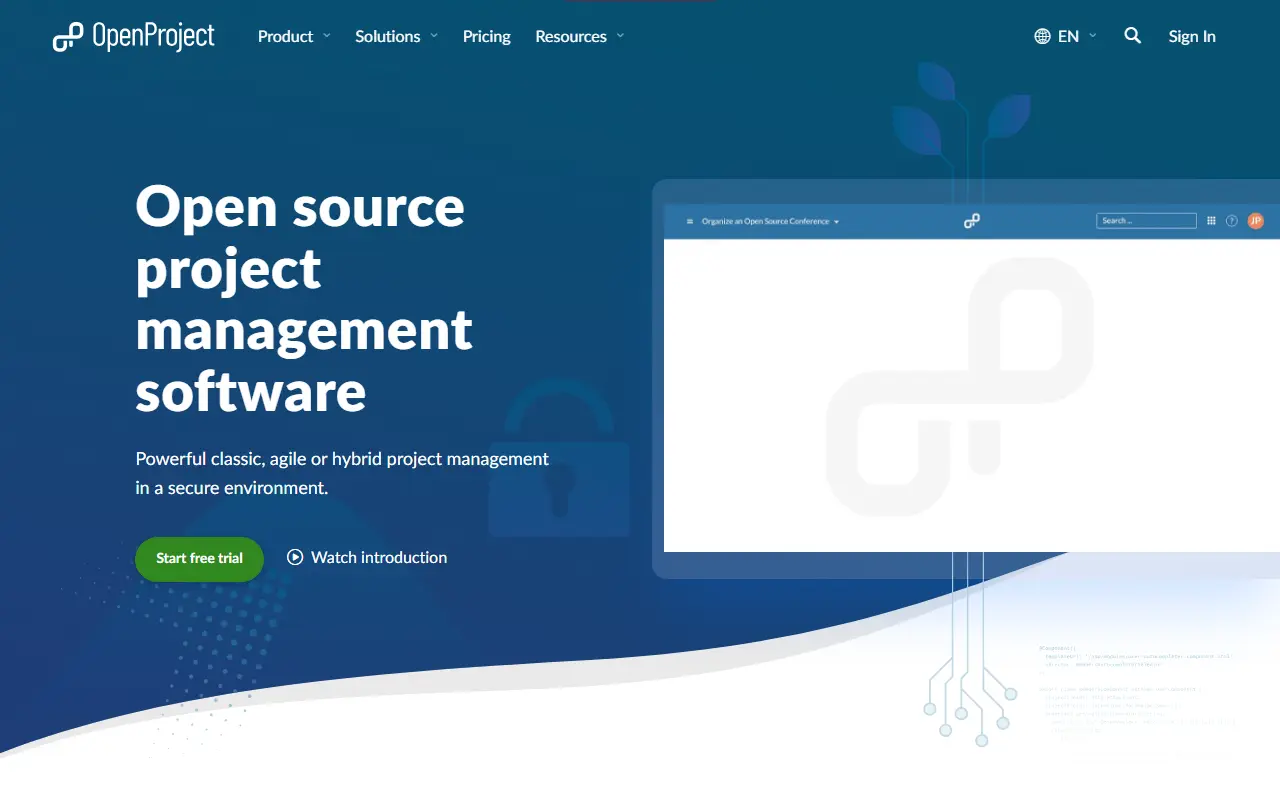
openproject.orgOpenProject homepage screenshot

OpenProject is a web-based project management application for teams and organizations that value transparency, flexibility and control over their data. It covers projects, portfolios, products, tasks, bugs, agile workflows, roadmaps and team collaboration in one platform, and it is built with Ruby and Angular under the GPL-3.0 license.

Key capabilities include agile boards with Kanban and Scrum, project planning and scheduling with Gantt charts, product and release planning, bug tracking, and time tracking with cost reporting and budgeting. Collaboration tools cover wikis, forums, news, and meeting agendas and minutes. Integrations are listed for Nextcloud, XWiki, GitHub and GitLab, among others.

The project presents itself as an open-source alternative to Jira and Asana, along with tools such as MS Project, Monday and YouTrack. It can be self-hosted, which suits organizations with data sovereignty requirements. A free Community Edition is available to download, a 14-day free trial exists, and an Enterprise Edition adds support and add-ons in the cloud or on-premises.

Key features

  • Agile boards for Kanban and Scrum
  • Gantt chart planning and scheduling
  • Roadmaps and release planning
  • Time tracking, cost reporting and budgets
  • Bug tracking and issue management
  • Wikis, forums and meeting minutes

Pricing: The Community edition is free. Paid Enterprise plans cost 5.95 (Basic), 10.95 (Professional) or 15.95 (Premium) euros per user per month with user minimums; Corporate is on request. 14-day free trial.

ERPNext

ERPNext, a free open-source ERP built on the Frappe framework, covering accounting, inventory, orders, manufacturing, assets and projects in one system.

GitHub stars
41k
Last commit
today
Latest release
v16.55.0
Licence
GPL-3.0
Self-hosted
Yes
Hosted version
Available
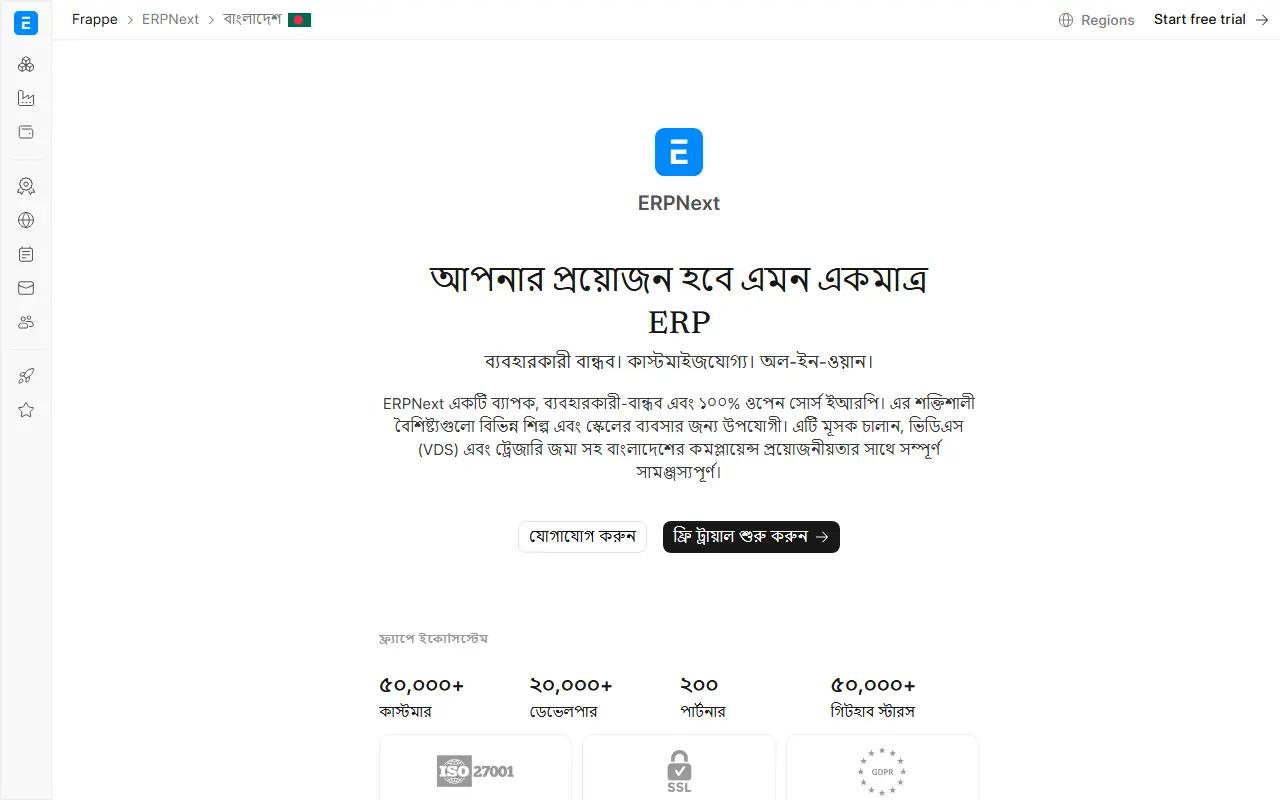
frappe.ioERPNext homepage screenshot

This entry points to ERPNext, the open-source enterprise resource planning system developed in the frappe/erpnext repository on top of the Frappe framework. It aims to replace the patchwork of separate programs a business often uses for invoices, stock, personnel and daily operations with a single integrated product.

Its modules include accounting for cash flow, transactions and financial reports; order management for inventory levels, replenishment, sales orders, customers, suppliers and shipments; manufacturing for production cycles, material consumption, capacity planning and subcontracting; asset management from purchase to disposal; and project delivery. Topics also list HR, CRM, procurement, retail, distribution, healthcare and support functions. It is written in Python, and a live demo is available.

ERPNext is GPL-3.0 licensed and can be self-hosted. The Frappe team also offers managed hosting, which suits companies that want the software without running servers. It is aimed at small and mid-size organizations that want an alternative to proprietary ERP suites.

Key features

  • Accounting and financial reporting
  • Inventory and order management
  • Manufacturing planning and subcontracting
  • Asset tracking across the organization
  • Project planning and delivery tracking
  • HR, CRM and procurement modules

Pricing: ERPNext software is free to self-host. Frappe Cloud hosting starts at $5 per month for a site and $20 per month for a server, not charged per user; a 14-day free trial is available.

Odoo

Odoo is an open source suite of business apps covering accounting, CRM, inventory, HR, websites and more on one platform.

GitHub stars
56k
Last commit
yesterday
odoo.comOdoo homepage screenshot

Odoo describes itself as open source ERP and CRM. The apps are grouped by area: finance, sales, websites, supply chain, human resources, marketing, services and productivity. Each one covers a single process, such as invoicing, point of sale, payroll, helpdesk or manufacturing, and apps can be added one at a time.

The site lists a large set of industry pages, from retail and restaurants to law firms, construction and nonprofits. A Studio app, third-party apps and an AI app are also listed. The pricing data shows a free plan limited to one app, plus Standard and Custom plans billed per seat each month, and the homepage offers a free start along with demos and an advisor.

Key features

  • Finance apps: accounting, invoicing, expenses
  • Sales apps including CRM, subscriptions and point of sale
  • Website, eCommerce, events and eLearning apps
  • Supply chain apps for inventory and manufacturing
  • HR apps for payroll, recruitment and time off
  • Marketing apps for email, SMS and automation
  • Service apps such as project, timesheets and helpdesk

Pricing: Published plans: One App Free at USD 0, Standard at USD 11.2 per month per seat, and Custom at USD 20.9 per month per seat.

Worklenz

Open-source project management tool with task management, time tracking, resource planning, reporting, and team collaboration, built on React and PostgreSQL.

GitHub stars
3.3k
Last commit
today
Latest release
v3.4.0
Licence
AGPL-3.0
Self-hosted
Yes
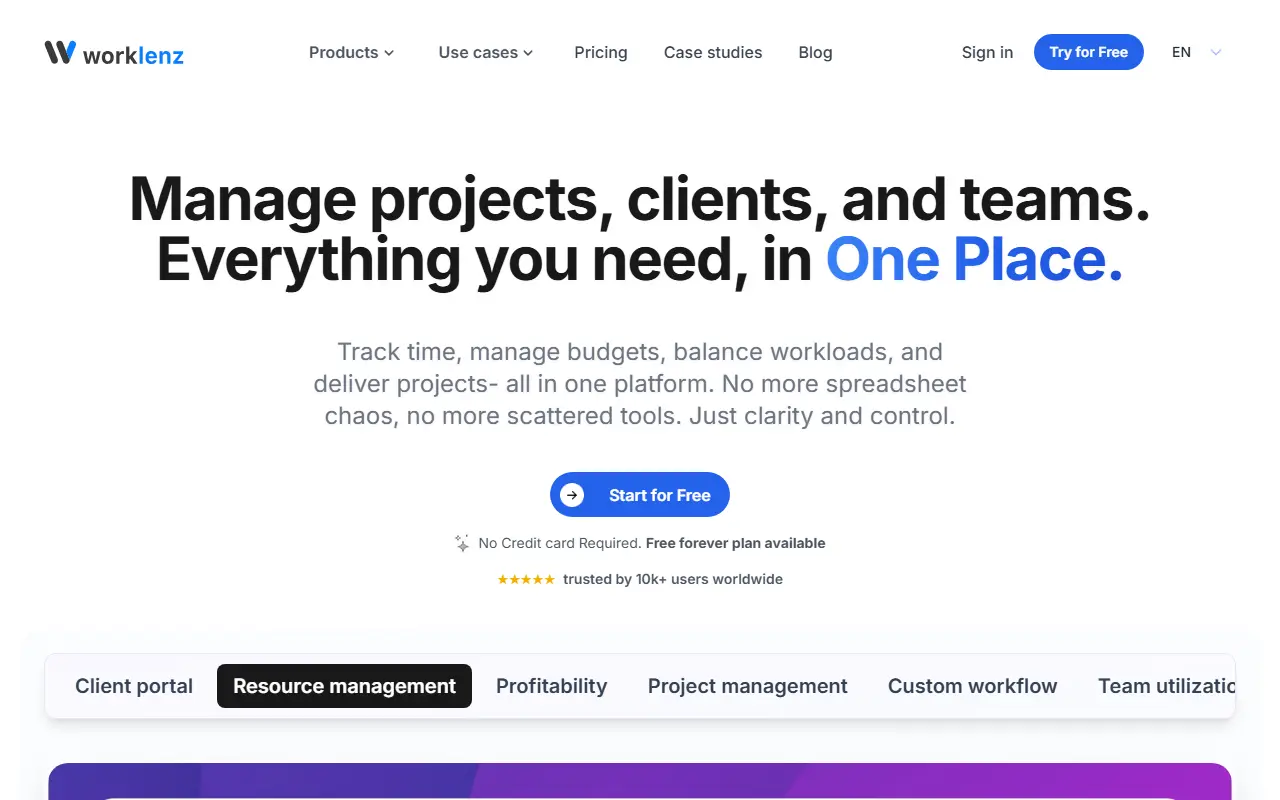
worklenz.comWorklenz homepage screenshot

Worklenz is a project management application intended to help organizations plan work, track progress, and collaborate in one place. Teams can create projects, break them into tasks with due dates and priorities, assign people, and follow status through reports. The code is released under the AGPL-3.0 license.

Beyond task tracking, it offers time tracking on tasks and projects for resource allocation and billing, resource management, project templates, file sharing and comments for collaboration, and reports on project status, team workload, and performance. Analytics and an integration with MinIO for file storage are also part of the repository.

The frontend is built with React and Ant Design, and the backend uses TypeScript, Express.js, and PostgreSQL. You need Node.js 18 or newer and PostgreSQL 15 or newer, or you can use the Docker Compose quick start. It suits agencies and small to mid-sized teams who want a project and time-tracking tool they can run on their own servers.

Key features

  • Project planning and task assignment
  • Task priorities, due dates, and progress tracking
  • Built-in time tracking
  • Resource management and project templates
  • Comments and file sharing for collaboration
  • Reports on workload and project status

Pricing: A free cloud plan has unlimited users and 3 active projects. Pro is $69 and Business $99 per month billed yearly, or $9.99 and $14.99 per user for small teams; self-hosting is free, with paid tiers at $99 and $499.

Redmine

Redmine is a flexible, self-hostable project management web application built on Ruby on Rails, with issue tracking, wikis, Gantt charts and time tracking.

GitHub stars
6.1k
Last commit
yesterday
Self-hosted
Yes
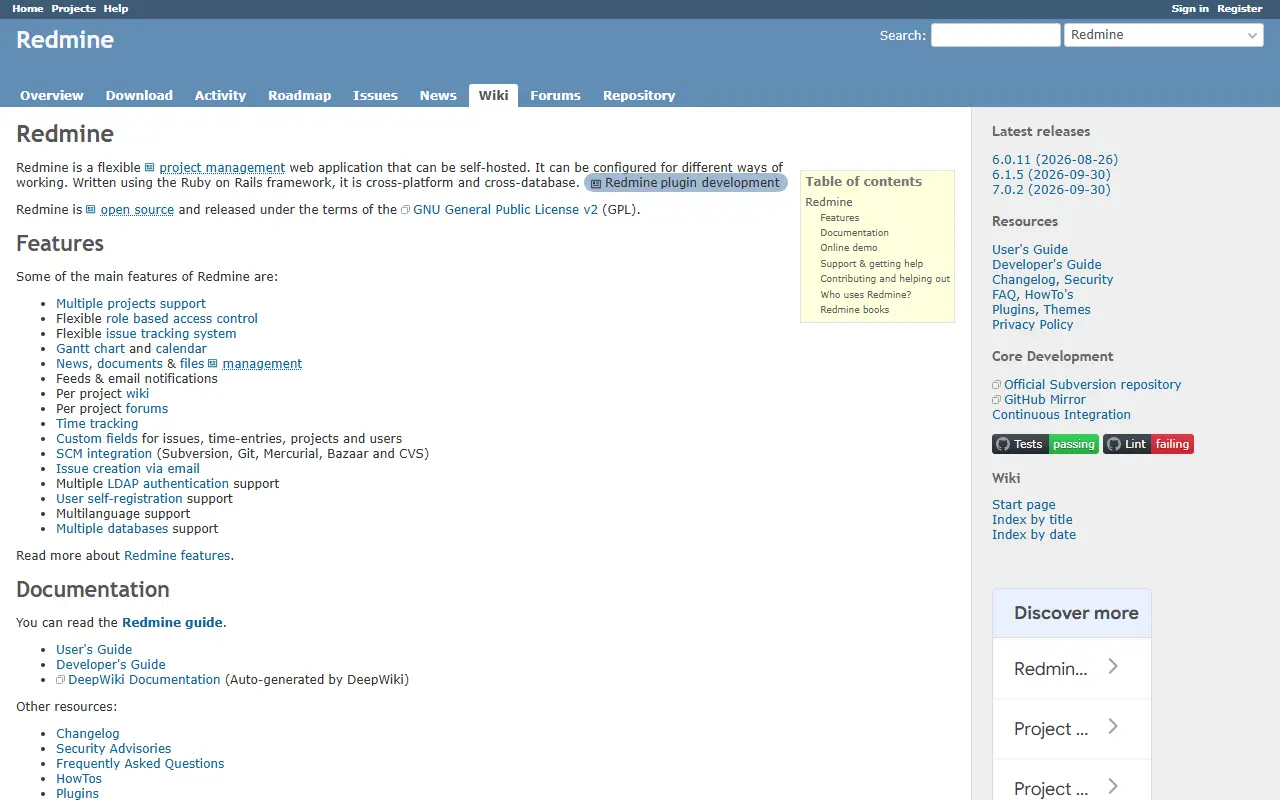
redmine.orgRedmine homepage screenshot

Redmine is a configurable project management web application that you can host yourself. It is written with the Ruby on Rails framework, is cross-platform and cross-database, and can be configured to fit different ways of working. This repository is a GitHub mirror of the official Subversion repository.

The project site lists the main features: support for multiple projects, flexible role-based access control, an issue tracking system, a Gantt chart and calendar, news, documents and file management, feeds and email notifications, a wiki and forums for each project, and time tracking. Custom fields can be added to issues, time entries, projects and users. Integration covers Subversion, Git, Mercurial, Bazaar and CVS, issues can be created by email, and LDAP authentication, user self-registration and multiple languages and databases are supported.

Redmine is open source software distributed under version 2 of the GNU General Public License. Plugins and themes extend it, and a user's guide, developer's guide, FAQ and online demo are available on the project site.

Key features

  • Multiple projects with role-based access control
  • Issue tracking system
  • Gantt chart and calendar
  • Per-project wiki and forums
  • Time tracking and custom fields
  • Git, Subversion and Mercurial integration
  • LDAP authentication

Pricing: Free and open source under the GNU GPL v2.

Taiga

Python backend of Taiga, the project management platform, providing the API and server logic you install on your own server.

GitHub stars
858
Last commit
10 days ago
Licence
MPL-2.0
Self-hosted
Yes

Taiga Back is the backend part of Taiga, a project management platform. It is a Python codebase that serves the data and logic used by the Taiga front end, and it exposes an API that developers can use to build on top of Taiga.

The project maintains separate documentation hubs: an API reference for developers, installation guides for people who want to run Taiga on their own server, and a resources page for end users. Bugs can be reported through Taiga's own issue tracker, GitHub issues or by email, and a community forum handles setup questions. Code contributions are accepted under the MPL-2.0 license.

Key features

  • Backend service powering the Taiga platform
  • Documented API for developers
  • Installable on your own server
  • Python codebase under the MPL-2.0 license
Read more about TaigaGitHub#6 Float alternative

Commercial Float alternatives

Hosted, closed-source products that compete with Float. Showing 12 of 16.

See every Float alternative on its tool page

Float alternatives: questions

What is the best open-source alternative to Float?
OpenProject is the top-ranked open-source alternative to Float on Enlisted: OpenProject is open-source project management software for agile planning, Gantt charts, issue tracking and time tracking, positioned as a Jira alternative. Other strong options are ERPNext, Odoo, Worklenz and Redmine.
What are the best commercial alternatives to Float?
Runn, Kantata, Resource Guru, Productive and Scoro are among the hosted, closed-source alternatives to Float listed on Enlisted, which lists 16 in total. Compare their pricing and features on each tool page.
Are these Float alternatives free?
All 6 are open source, so the code is free to use under its licence, and all of them can be self-hosted on your own server or computer. 2 also offer a paid or managed cloud version if you'd rather not host it yourself.
How is this list of Float alternatives ranked?
By a score built from GitHub stars, star growth over the last 30 days and how recently the code changed. 6 of these projects shipped code in the last 30 days. Data is refreshed daily, and nobody can pay to move up.

People also look for alternatives to…

View all