7,363 open-source and SaaS tools, with GitHub stats refreshed every day.

5 alternatives ranked by real activity

Open-source DealCloud alternatives

A curated, ranked list of the 5 best open-source alternatives to DealCloud.

The best open-source alternative to DealCloud is Twenty. If that doesn't suit you, other good options are EspoCRM, Corteza, Relaticle and Atomic CRM.

DealCloud alternatives are mainly CRM tools, but some are also low-code & internal tools. 5 of them shipped code in the last 30 days, 5 can be self-hosted, and 2 use a permissive licence.

Last updated October 3, 2026 · ranked by GitHub stars, growth and recent commits

Twenty

An open-source CRM built as a modular, code-extensible platform, positioned as an alternative to Salesforce for technical teams, with cloud and Docker self-hosting.

GitHub stars
58k
Last commit
yesterday
Latest release
twenty/v2.44.0
Self-hosted
Yes
Hosted version
Available
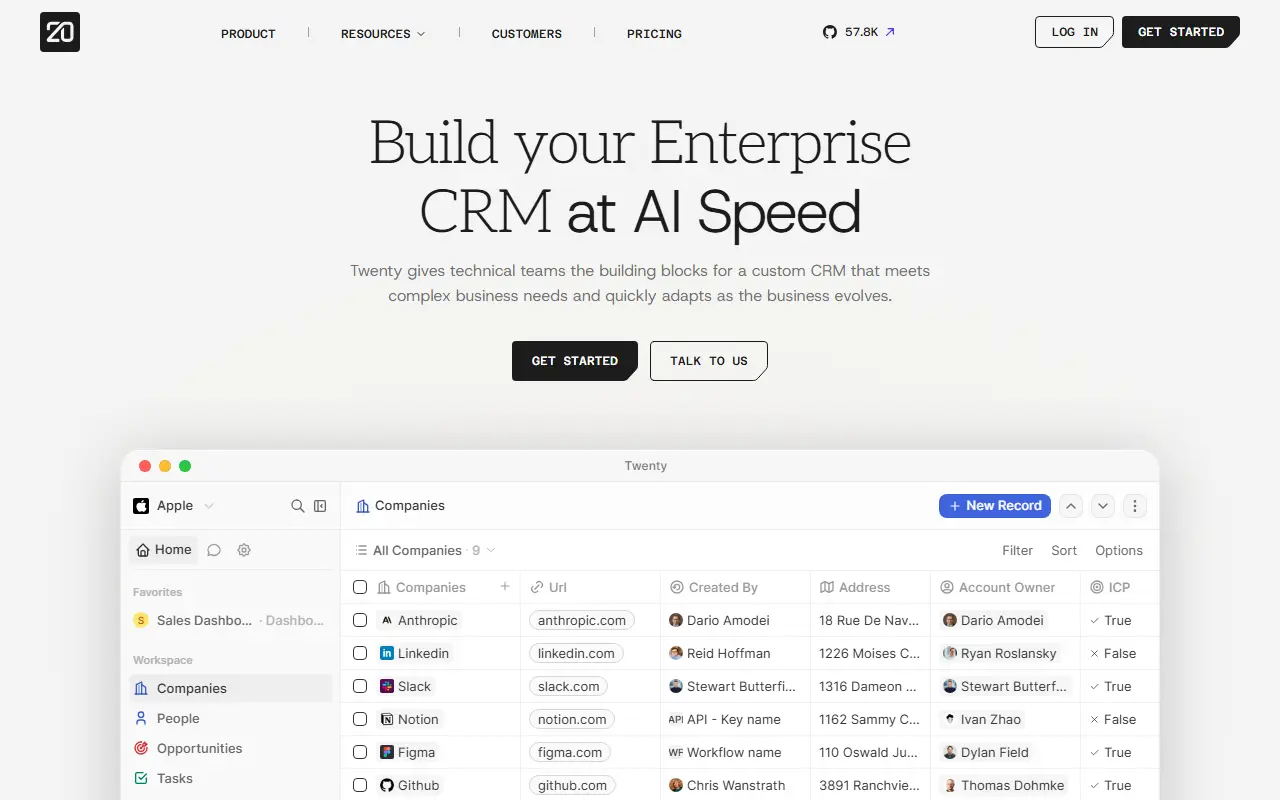
twenty.comTwenty homepage screenshot

Twenty is an open-source CRM presented as an open alternative to Salesforce and designed for AI. It supplies technical teams with the components to assemble a custom CRM that adapts as the business changes, and the idea is that you build, ship and version it like the rest of your software stack.

The core building blocks are objects, views, workflows and agents, and all of them can be extended as code. A Twenty CLI scaffolds new apps, where you define objects, fields and views as code and then publish them to your workspace, with a guide covering views, agents and logic functions. For people using coding agents, the project provides official skills that work with Claude Code, Codex, Cursor and other harnesses. The stack is TypeScript with NestJS, React, GraphQL and PostgreSQL.

You can sign up at twenty.com for the managed cloud, which needs no infrastructure, or self-host with Docker Compose. The repository's license is listed as 'Other', so review it before commercial redistribution. Twenty suits teams that want a CRM they can shape in code instead of being limited by a fixed SaaS data model.

Key features

  • Custom objects, fields and views
  • Workflows and agents extendable as code
  • CLI for scaffolding and publishing apps
  • Official skills for coding agents
  • GraphQL API on a PostgreSQL backend
  • Cloud workspace or Docker Compose self-hosting

Pricing: Cloud Pro costs $9 and Organization $19 per user per month on yearly billing, with a 30-day trial. Enterprise starts from $50k per year; Twenty can also be self-hosted.

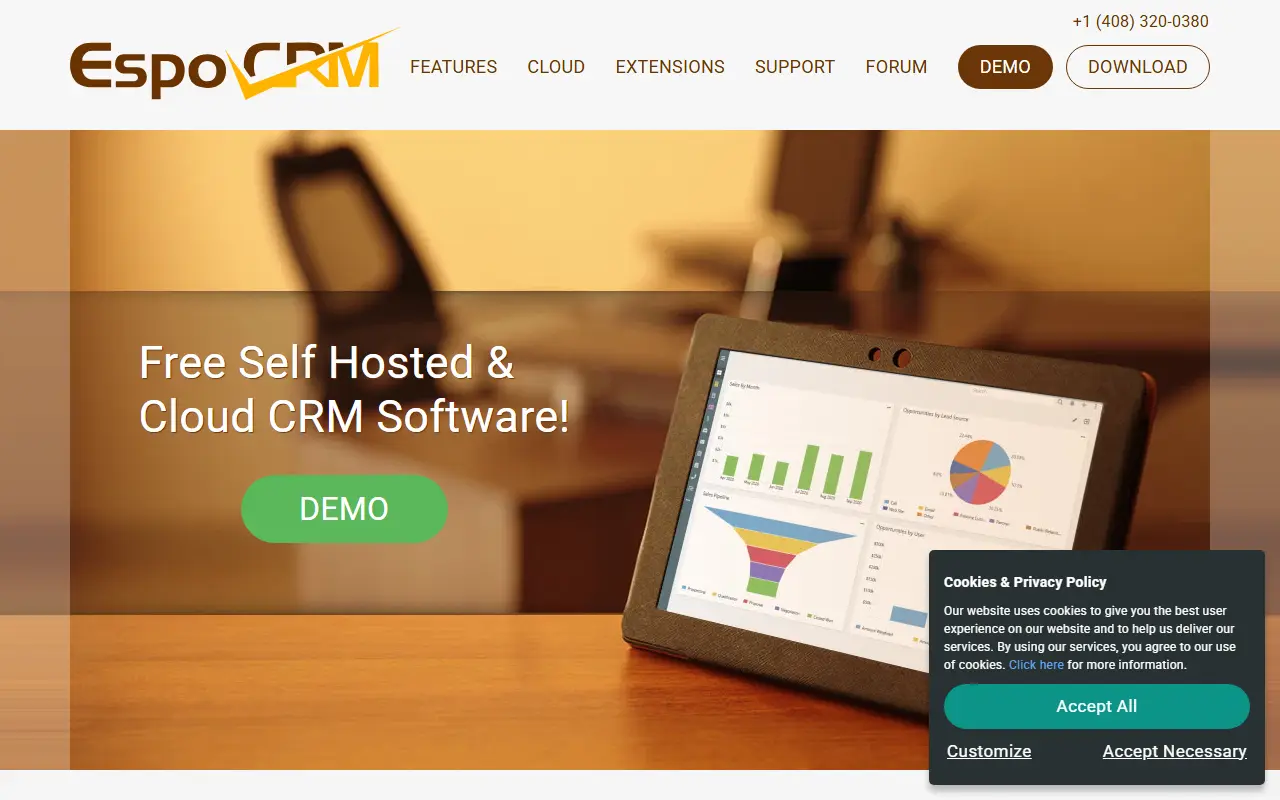
EspoCRM

Open-source CRM for managing leads, contacts, opportunities, marketing campaigns, and support cases, with a single-page web interface and a PHP REST API.

GitHub stars
3.4k
Last commit
yesterday
Latest release
10.0.9
Licence
AGPL-3.0
Self-hosted
Yes
Hosted version
Available
espocrm.comEspoCRM homepage screenshot

EspoCRM is a free, open-source customer relationship management platform that helps organizations store and manage leads, contacts, sales opportunities, marketing campaigns, and support cases in one web application. The project is released under the AGPL-3.0 license and has been developed since 2014.

The front end is a single-page application backed by a REST API written in PHP, which makes it easy to integrate with other systems. Its feature areas cover sales automation, email marketing, a calendar, kanban views, documents, a customer portal, and customer-support case handling. The data model can be customized to match different business processes.

EspoCRM runs on your own server with PHP 8.3 to 8.5 and MySQL 8, MariaDB 10.6 or later, or PostgreSQL 15 or later. An online demo is available for evaluation. It suits small and mid-sized organizations that want a configurable CRM they can host and modify themselves, and the vendor also sells paid extensions and hosting.

Key features

  • Lead, contact, and opportunity management
  • Sales automation workflows
  • Email marketing campaigns
  • Customer support case tracking
  • Calendar and kanban views
  • Customer portal for external users
  • Document storage linked to records
  • REST API for integrations

Pricing: Cloud plans are priced per user per month: Basic $15 (minimum 3 users), Enterprise $25 (minimum 5) and Ultimate $69 (minimum 10). Basic and Enterprise have a 30-day free trial.

Corteza

Open-source low-code platform for building CRM, business process, and structured data apps, with workflows, RBAC, privacy features, and data integrations.

GitHub stars
2.2k
Last commit
yesterday
Latest release
2024.9.10
Licence
Apache-2.0
Self-hosted
Yes
Hosted version
Available
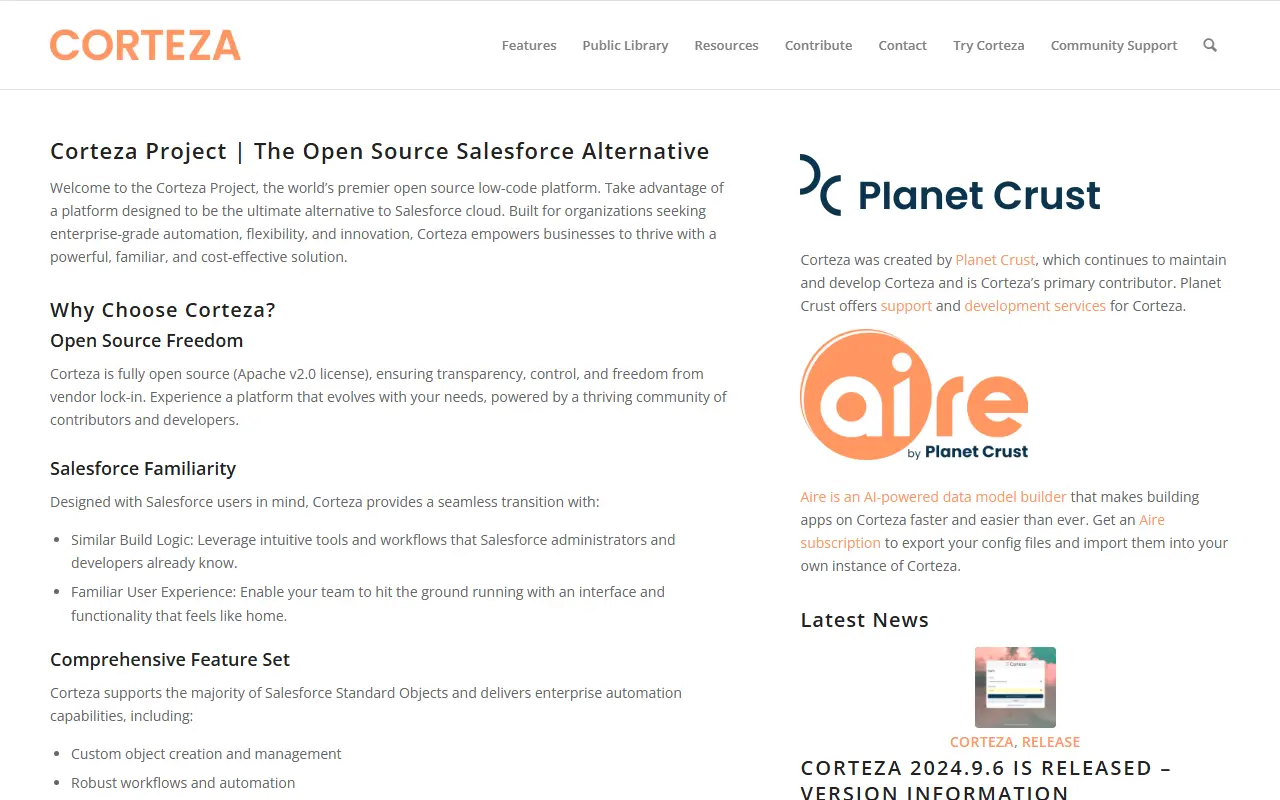
cortezaproject.orgCorteza homepage screenshot

Corteza is a low-code platform that lets teams build and iterate on CRM, business process, and other structured data applications quickly. It also supports intelligent business process workflows and connects to almost any data source. It is written in Go, with a Vue front end, and released under the Apache-2.0 license. It is maintained by Planet Crust, its founder.

Key characteristics include a standards-oriented approach using established data formats, flat role-based access control that supports complex internal security policies, privacy features that help comply with data protection regulations, accessibility following WCAG 2.1, and an API-centric design that makes integration with external services and other Corteza instances straightforward. Applications can be customized from translations and terminology up to entirely new low-code apps.

Planet Crust offers hosted Corteza cloud instances as the easiest way to start, and a DevOps guide covers self-hosting along with backup, restore, and email relay topics. Corteza suits organizations that want an open-source alternative to proprietary low-code CRM platforms and need control over their data.

Key features

  • Low-code builder for CRM and data apps
  • Workflow automation for business processes
  • Role-based access control
  • Privacy and data protection features
  • API-centric integration with data sources
  • WCAG 2.1 accessibility

Pricing: Free and open source under the Apache-2.0 license; Planet Crust offers hosted instances.

Relaticle

A self-hosted, open-source CRM built with Laravel and Filament, featuring an MCP server and REST API so AI agents can work with customer data.

GitHub stars
1.8k
Last commit
yesterday
Latest release
v3.6.0
Licence
AGPL-3.0
Self-hosted
Yes
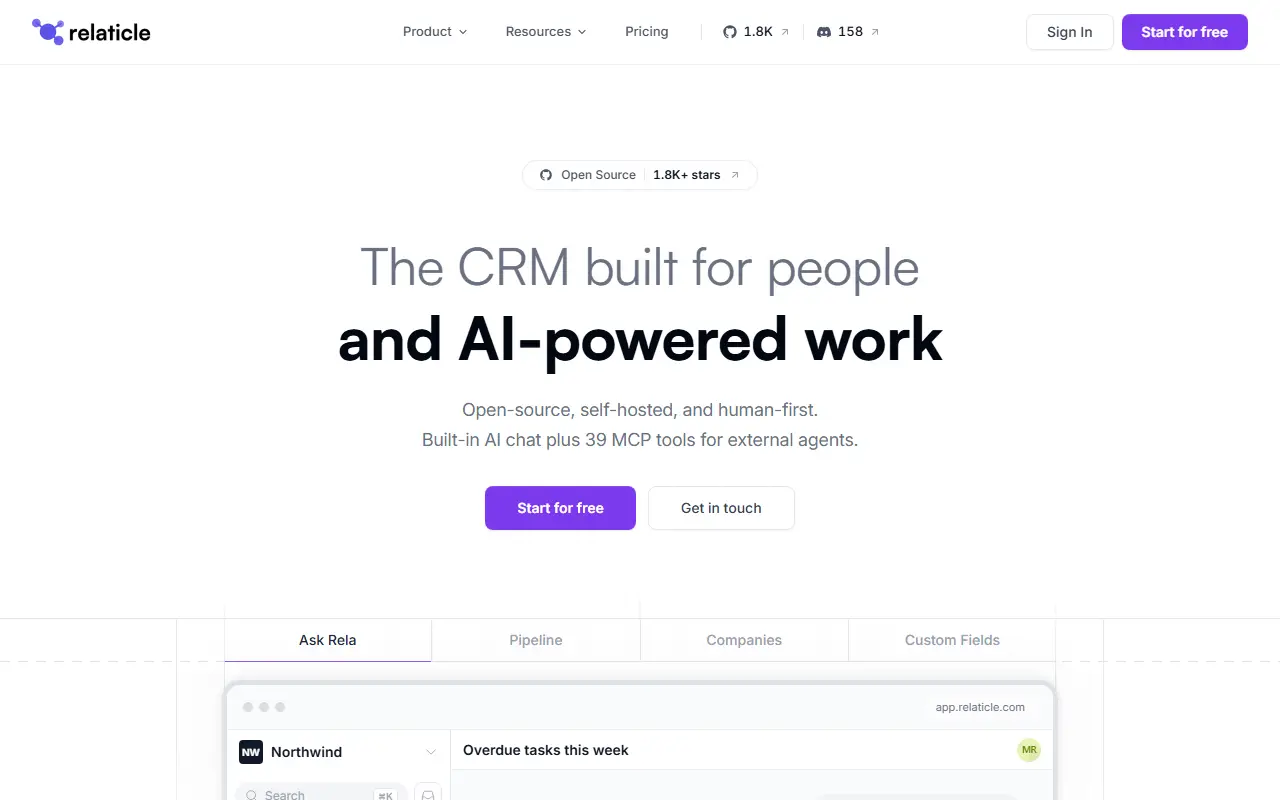
relaticle.comRelaticle homepage screenshot

Relaticle is an open-source customer relationship manager that you host yourself. It handles the usual CRM records, including contacts, companies, opportunities, tasks and notes, and is built with Laravel, Filament and Livewire. Its distinguishing angle is that it is designed to work with AI agents as well as people.

The project ships an MCP server that exposes dozens of CRM tools to agents such as Claude or GPT-based assistants, plus a REST API with full create, read, update and delete access, schema information, activity history and pipeline analysis. The data model is customizable, with many custom field types, relationships between entities and per-field encryption, and each workspace is isolated from the others.

Relaticle is licensed under AGPL-3.0, so your data stays on your own server. It requires PHP, PostgreSQL, Composer and Node.js, with Redis optional for queues, and a self-hosting guide covers Docker and manual setups. The project tags itself as an alternative to Attio, and it targets developer-led teams, startups and small businesses wanting AI integration without vendor lock-in.

Key features

  • Contacts, companies, and opportunities tracking
  • MCP server for AI agent access
  • REST API with full CRUD operations
  • Customizable fields with many field types
  • Multi-workspace data isolation
  • Docker and manual self-hosting

Pricing: Self-hosting is free. Cloud Pro costs $24 per workspace per month, or $19 per month billed yearly, with a 14-day trial; Enterprise starts at $20,000 per year.

Atomic CRM

Atomic CRM is a free, open-source CRM built with React, shadcn/ui and Supabase, with contacts, tasks, notes and a deals pipeline.

GitHub stars
1.3k
Last commit
yesterday
Latest release
v1.6.0
Licence
MIT
Self-hosted
Yes
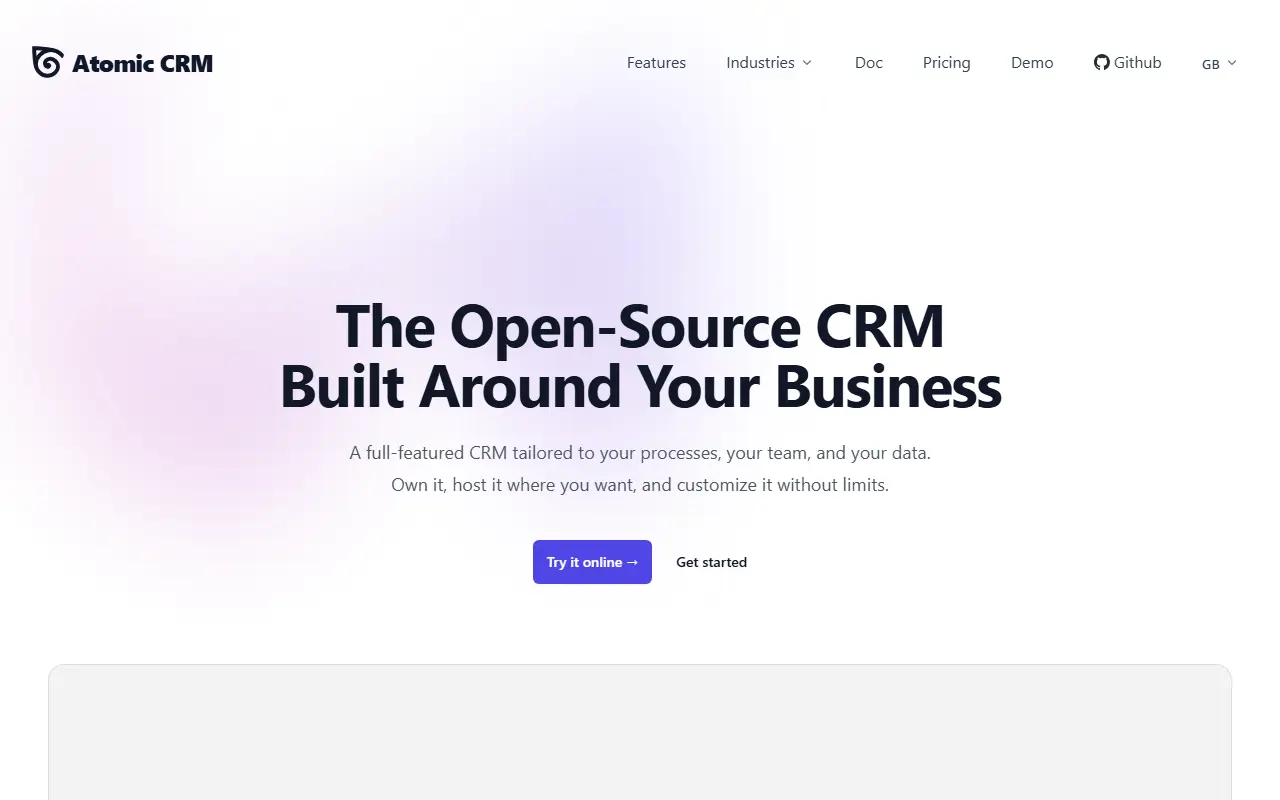
marmelab.comAtomic CRM homepage screenshot

Atomic CRM, published by Marmelab, is an open-source customer relationship manager built with React, shadcn admin components and Supabase. It is designed as a codebase you fork and customize, giving teams a working CRM they can adapt rather than a closed product, and an online demo is available to try.

Core features include organized contacts, tasks with reminders, notes, a Kanban board for managing deals through a sales pipeline, activity history, and import and export of contacts. Emails can be captured by copying the CRM address so conversations are saved as notes. Login is supported through Google, Azure, Keycloak and Auth0, an API allows integration with other systems, and custom fields, themes and components can be changed.

The project is written in TypeScript and licensed under MIT. It runs locally with Node, Make and Docker, which start a Vite front end and a local Supabase instance, and the codebase can be kept up to date through a shadcn registry. It suits small businesses and developers who want a self-managed CRM they can modify.

Key features

  • Contacts, tasks, and notes
  • Kanban deal pipeline
  • Email capture as notes
  • Import and export of contacts
  • Login via Google, Azure, Keycloak, Auth0
  • Custom fields and replaceable components

Pricing: Free and open source under the MIT licence.

DealCloud alternatives: questions

What is the best open-source alternative to DealCloud?
Twenty is the top-ranked open-source alternative to DealCloud on Enlisted: An open-source CRM built as a modular, code-extensible platform, positioned as an alternative to Salesforce for technical teams, with cloud and Docker self-hosting. Other strong options are EspoCRM, Corteza, Relaticle and Atomic CRM.
Are these DealCloud alternatives free?
All 5 are open source, so the code is free to use under its licence, and all of them can be self-hosted on your own server or computer. 3 also offer a paid or managed cloud version if you'd rather not host it yourself.
How is this list of DealCloud alternatives ranked?
By a score built from GitHub stars, star growth over the last 30 days and how recently the code changed. 5 of these projects shipped code in the last 30 days. Data is refreshed daily, and nobody can pay to move up.

People also look for alternatives to…

View all