4 open-source alternatives ranked by real activity

Open-source beehiiv alternatives

A curated, ranked list of the 4 best open-source alternatives to beehiiv.

The best open-source alternative to beehiiv is Ghost. If that doesn't suit you, other good options are Listmonk, Markdown Ninja and Pico.

Commercial alternatives to beehiiv include Buttondown, Flodesk, Substack and Kit (ConvertKit). See all 19.

beehiiv alternatives are mainly CMS tools, but some are also email marketing tools. 3 of them shipped code in the last 30 days, 4 can be self-hosted, and 2 use a permissive licence.

Last updated November 13, 2026 · ranked by GitHub stars, growth and recent commits

Ghost

An open-source publishing platform for blogs, newsletters, memberships and paid subscriptions, available as the Ghost(Pro) managed service or self-hosted on Node.js.

GitHub stars
56k
Last commit
today
Latest release
v6.77.0
Licence
MIT
Self-hosted
Yes
Hosted version
Available
ghost.orgGhost homepage screenshot

Ghost is a publishing platform for independent writers and media businesses. It handles blogging, newsletters, memberships and subscriptions in one product, so a creator can publish articles, email them to subscribers and charge for access without stitching several tools together.

The project is written in JavaScript and TypeScript on Node.js. The official way to get a production site running is the Ghost(Pro) managed service, which launches a site with a worldwide CDN, backups, security and maintenance handled for you, and the maintainers state that all revenue from it funds the nonprofit Ghost Foundation. If you prefer to run your own instance, a CLI tool installs Ghost locally in about a minute or on a server with automatic SSL through Let's Encrypt.

Ghost is MIT licensed and comes with official documentation, a forum and an active contributor community. It suits journalists, bloggers and publishers who want a focused publishing and membership tool rather than a general-purpose CMS.

Key features

  • Publishing editor for blogs and articles
  • Built-in newsletters sent to subscribers
  • Memberships and paid subscriptions
  • CLI installer with automatic SSL
  • Managed hosting with CDN and backups
  • Extensible through documented APIs and themes

Pricing: Ghost(Pro) managed hosting starts at $18 per month billed yearly for Starter, then $29 for Publisher and $199 for Business; Custom is quoted. Plans can be tried free.


Listmonk

A self-hosted newsletter and mailing list manager shipped as a single Go binary with PostgreSQL storage, a web dashboard and campaign management.

GitHub stars
24k
Last commit
yesterday
Latest release
v7.0.0-beta.2
Licence
AGPL-3.0
Self-hosted
Yes
listmonk.appListmonk homepage screenshot

listmonk is a self-hosted application for managing newsletters and mailing lists. It is distributed as a single binary, backed by a PostgreSQL database, and gives you a modern web dashboard for managing subscribers, lists and email campaigns. A live demo and documentation on listmonk.app let you look around before installing.

Topics show the scope: email marketing, newsletter management, campaign management, SMTP delivery, transactional emails and SMS gateway use. Installation is straightforward. With Docker you use the published image and a sample compose file and then visit port 9000. With the binary you generate a config file, run the install step to set up the database, or run an idempotent upgrade, and start the server.

Its server side is Go, while the interface is built with Vue and the Buefy component library. The project is free software under the AGPL-3.0 license, and a developer setup guide helps contributors. It suits creators, organizations and developers who want to send newsletters through their own SMTP provider without per-subscriber fees from a hosted email service.

Key features

  • Newsletter and campaign management
  • Subscriber and list management
  • Single-binary Go application
  • PostgreSQL data store
  • SMTP delivery and transactional email support
  • Docker and binary installation

Pricing: Free and open source under the AGPL-3.0 license; you host it yourself.

Markdown Ninja

Markdown-first CMS written in Go for blogs, documentation sites and newsletters, positioned as an open-source alternative to Medium, Mailchimp and Substack.

GitHub stars
419
Last commit
yesterday
Licence
AGPL-3.0
Self-hosted
Yes
Hosted version
Available

Markdown Ninja is a Markdown-first content management system for bloggers, minimalists and startups. It lets you publish websites, blogs, documentation sites and newsletters from Markdown content, and it positions itself as the simple alternative to hacking together a static site generator, a theme, a CI/CD pipeline and a cloud platform. The project names Medium, Mailchimp and Substack as the services it replaces.

According to the README, publishing a site takes one command and getting started takes about two minutes. Topics include headless CMS, JAMstack and email. Usage documentation is at docs.markdown.ninja, while a dev folder in the repository covers development. There is also a hosted service at markdown.ninja, and the README invites you to try it for free.

The code is written in Go and licensed under AGPL-3.0, with documentation and assets under Creative Commons BY-SA 4.0. The copyright holder is Arcane Services, which offers other licensing terms on request. Security issues should be reported through the contact page on the project site.

Key features

  • Markdown-based websites and blogs
  • Newsletter publishing
  • Headless CMS approach
  • One-command publishing
  • Documentation site support
  • Written in Go

Pricing: Code is AGPL-3.0. A hosted service exists and the README invites you to try it for free; see markdown.ninja for current plans.

Pico

Pico is a flat file CMS that builds pages from Markdown files without a database, but its maintainers have declared it end of life.

GitHub stars
3.9k
Last commit
4 mo ago
Latest release
v2.1.4
Licence
MIT
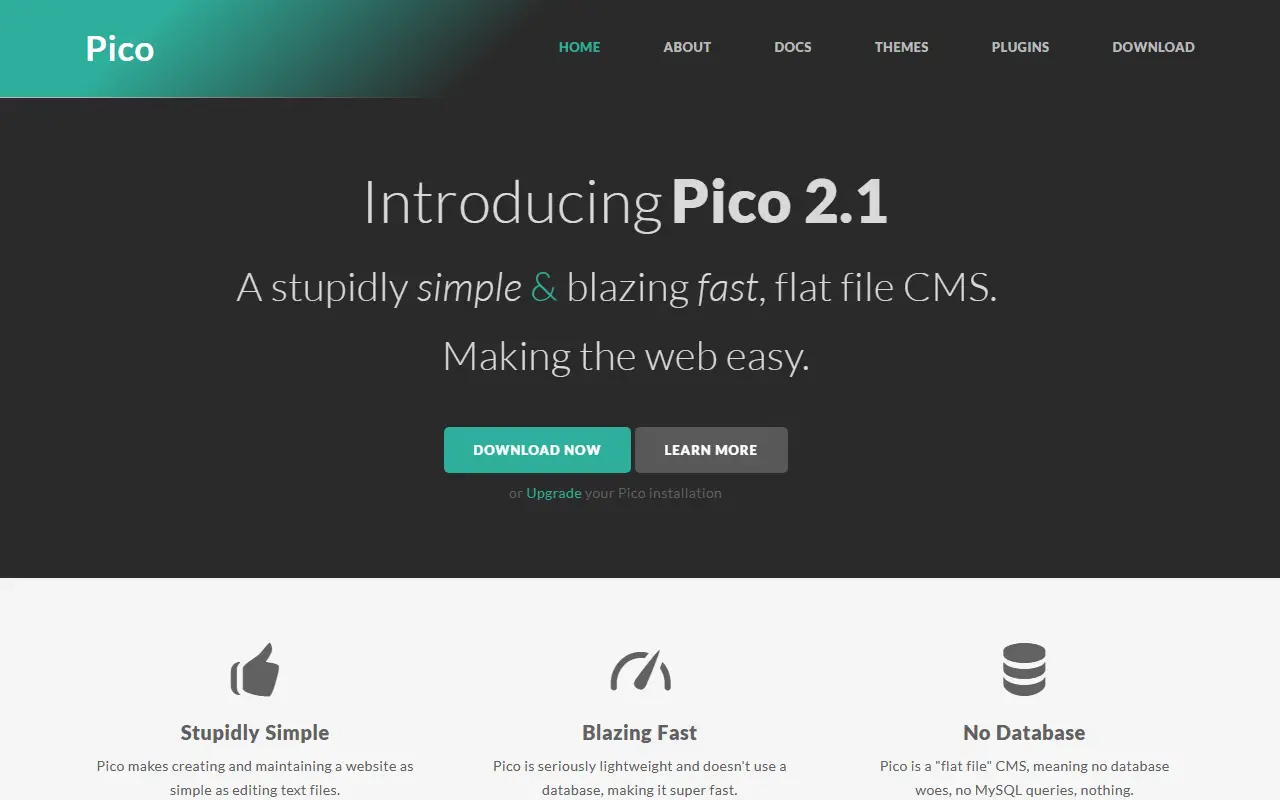
picocms.orgPico homepage screenshot

Pico is a flat file CMS written in PHP and released under the MIT licence. There is no admin backend or database. Pages come from Markdown files placed in a content folder, metadata is written in YAML, and themes use the Twig templating engine, while plugins extend its PHP. Its site calls it a stupidly simple, blazing fast CMS.

The README opens with an end of life notice. Development stopped long ago, and the maintainers advise against using Pico for new websites, although they report no known security issues for existing ones. It was not designed for modern PHP versions, so problems are expected over time. They suggest alternatives such as Grav CMS, HTMLy, Automad and Typemill, and invite anyone willing to take over development to open an issue.

Key features

  • No database, which keeps it lightweight
  • Pages written as Markdown files
  • Twig templates for themes
  • No server write access needed to run
  • Composer or pre-bundled release installation
Read more about PicoWebsiteGitHub#4 beehiiv alternative

Commercial beehiiv alternatives

Hosted, closed-source products that compete with beehiiv. Showing 12 of 19.

See every beehiiv alternative on its tool page

beehiiv alternatives: questions

What is the best open-source alternative to beehiiv?
Ghost is the top-ranked open-source alternative to beehiiv on Enlisted: An open-source publishing platform for blogs, newsletters, memberships and paid subscriptions, available as the Ghost(Pro) managed service or self-hosted on Node.js. Other strong options are Listmonk, Markdown Ninja and Pico.
What are the best commercial alternatives to beehiiv?
Buttondown, Flodesk, Substack, Kit (ConvertKit) and Memo are among the hosted, closed-source alternatives to beehiiv listed on Enlisted, which lists 19 in total. Compare their pricing and features on each tool page.
Are these beehiiv alternatives free?
All 4 are open source, so the code is free to use under its licence, and all of them can be self-hosted on your own server or computer. 2 also offer a paid or managed cloud version if you'd rather not host it yourself.
How is this list of beehiiv alternatives ranked?
By a score built from GitHub stars, star growth over the last 30 days and how recently the code changed. 3 of these projects shipped code in the last 30 days. Data is refreshed daily, and nobody can pay to move up.

People also look for alternatives to…

View all