7,363 open-source and SaaS tools, with GitHub stats refreshed every day.

5 alternatives ranked by real activity

Open-source Bear alternatives

A curated, ranked list of the 5 best open-source alternatives to Bear.

The best open-source alternative to Bear is FSNotes. If that doesn't suit you, other good options are Hubble.md, WitNote, Lumen and TakeNote.

Bear alternatives are mainly note-taking tools. 2 of them shipped code in the last 30 days, 5 can be self-hosted, and 4 use a permissive licence.

Last updated October 2, 2026 · ranked by GitHub stars, growth and recent commits

FSNotes

A fast, native Markdown notes app for macOS and iOS that keeps every note as a plain Markdown or text file, with tags, wiki-style links and encryption.

GitHub stars
7.5k
Last commit
12 days ago
Latest release
v7.3.4
Licence
MIT
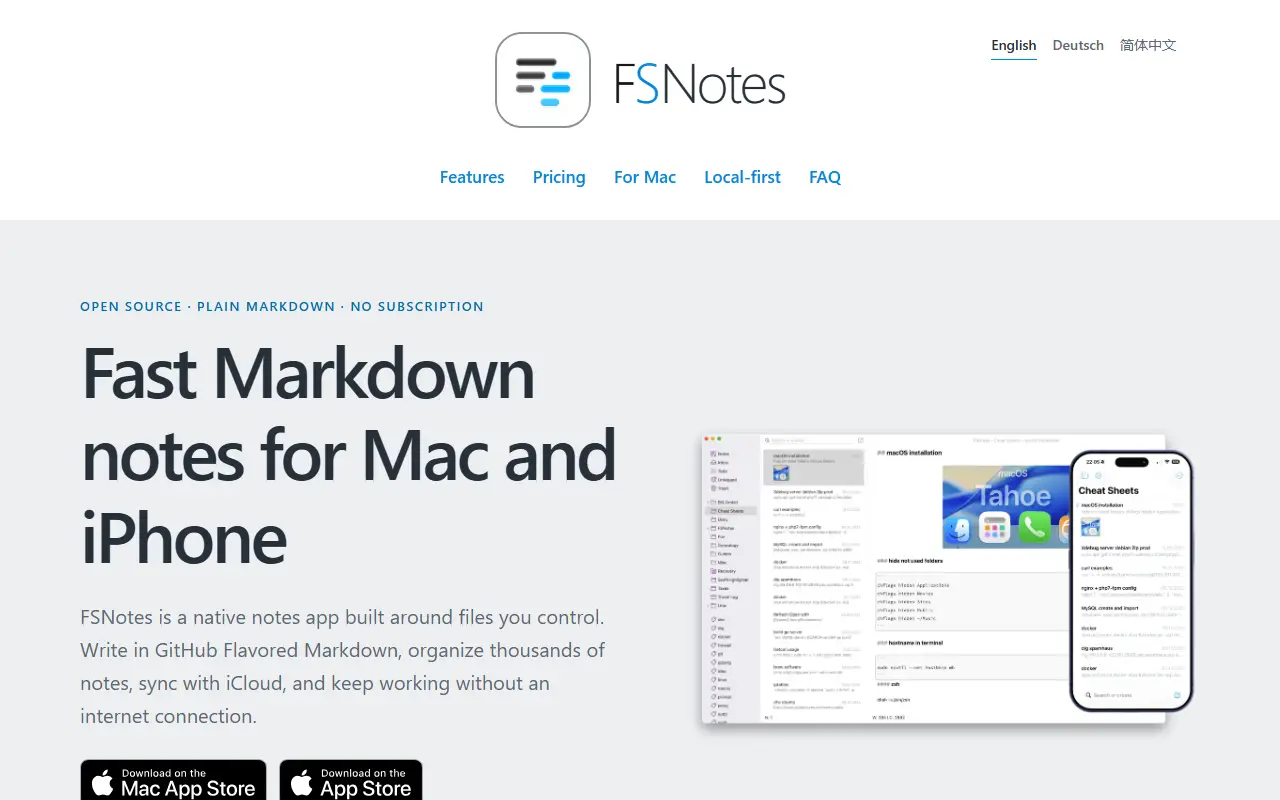
fsnot.esFSNotes homepage screenshot

FSNotes is a native notes app for macOS and iOS built around the idea of owning your notes. Each note is stored as a portable Markdown or plain-text file rather than in a proprietary database, so the notes can be opened with any compatible app now or years later.

The app focuses on writing and quick retrieval. It handles several folders, external editors, sync through iCloud Drive or Dropbox, and Git backups if you want them, and connects ideas with tags and double-bracket links. Private notes can be protected with AES-256 encryption, and it renders code blocks, Mermaid diagrams and MathJax math. Search and navigation are designed to stay smooth across large note collections.

FSNotes is written in Swift and released under the MIT licence. The apps are sold through the App Store, and those purchases support continued development, while the source code is open. It suits Apple users who want local Markdown notes with sync through their own storage service.

Key features

  • Notes stored as Markdown or text files
  • Tags and wiki-style note links
  • AES-256 encryption for private notes
  • iCloud Drive, Dropbox and Git backups
  • Mermaid diagrams and MathJax rendering
  • Native macOS and iOS apps

Pricing: Source code is MIT licensed; App Store purchases support development.

Hubble.md

A free desktop notepad for Markdown that feels like Notion or Apple Notes and is designed so AI agents can read, edit and build views on your notes.

GitHub stars
1.5k
Last commit
yesterday
Latest release
desktop-v0.2.1
Licence
MIT
Self-hosted
Yes
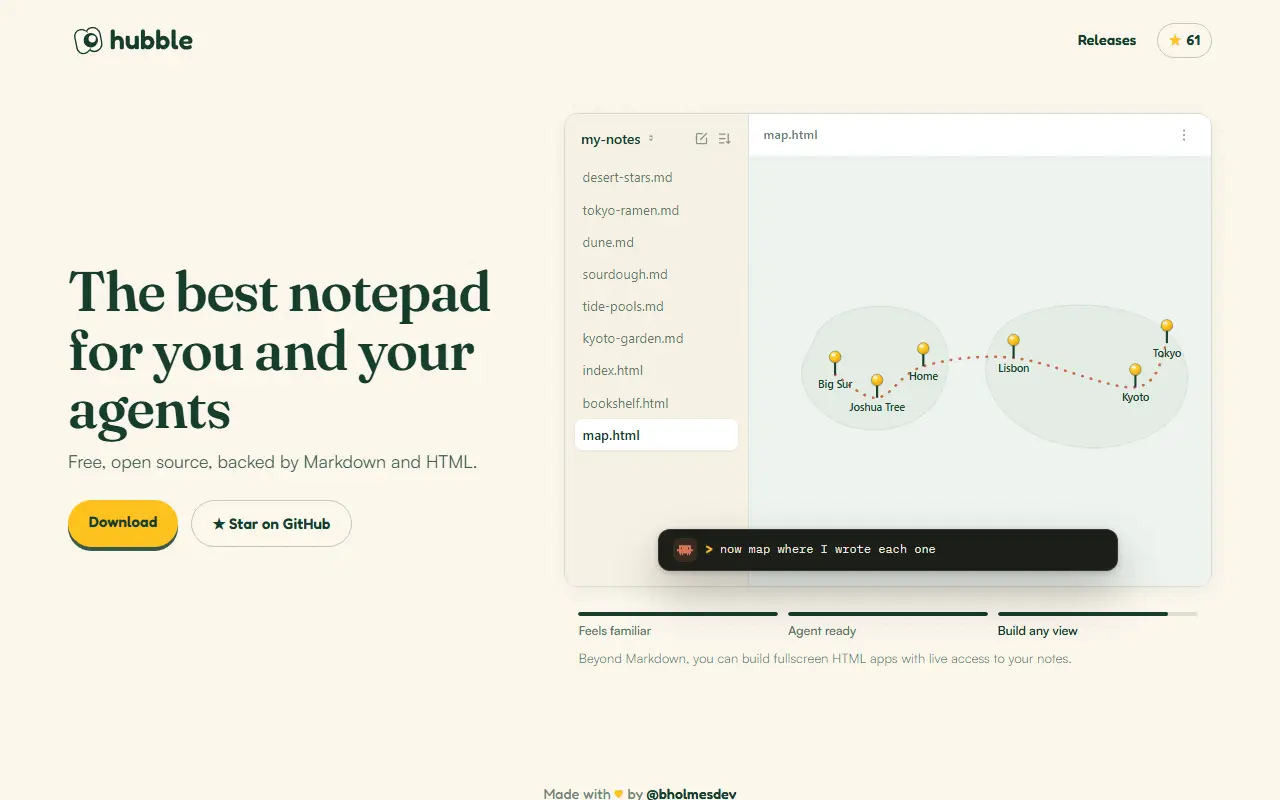
hubble.mdHubble.md homepage screenshot

Hubble is a free, open-source note-taking app that stores notes as Markdown and HTML files in a folder you control. It aims to feel familiar to people used to Notion or Apple Notes, with slash commands, Markdown shortcuts and support for file properties and frontmatter, while keeping everything as plain files.

A key idea is working alongside AI agents. You can point a coding agent at your notes folder, and Hubble reloads live as the agent edits files. Beyond text, the app can display HTML-based apps, so with the right skills installed an agent can turn a folder of notes into a table, a bookshelf or a map, depending on what you ask for.

Hubble ships as a desktop app for macOS, Windows and Linux, with signed builds on macOS and unsigned builds elsewhere. It is written in TypeScript and licensed under MIT, and it can be compiled from source with Node.js and pnpm. It suits people who keep their notes in Markdown and want an editor that works smoothly with AI coding agents.

Key features

  • Markdown editing with slash commands
  • Frontmatter and file properties support
  • Live reload when agents edit files
  • HTML apps rendered from notes folders
  • Desktop apps for macOS, Windows, Linux
  • Notes stored as plain files

Pricing: Free and open source under the MIT licence.

WitNote

Local-first Markdown editor with a live preview pane and a lightweight offline AI helper for writing and translation, for macOS and Windows.

GitHub stars
570
Last commit
1 mo ago
Latest release
v2.0.1
Self-hosted
Yes
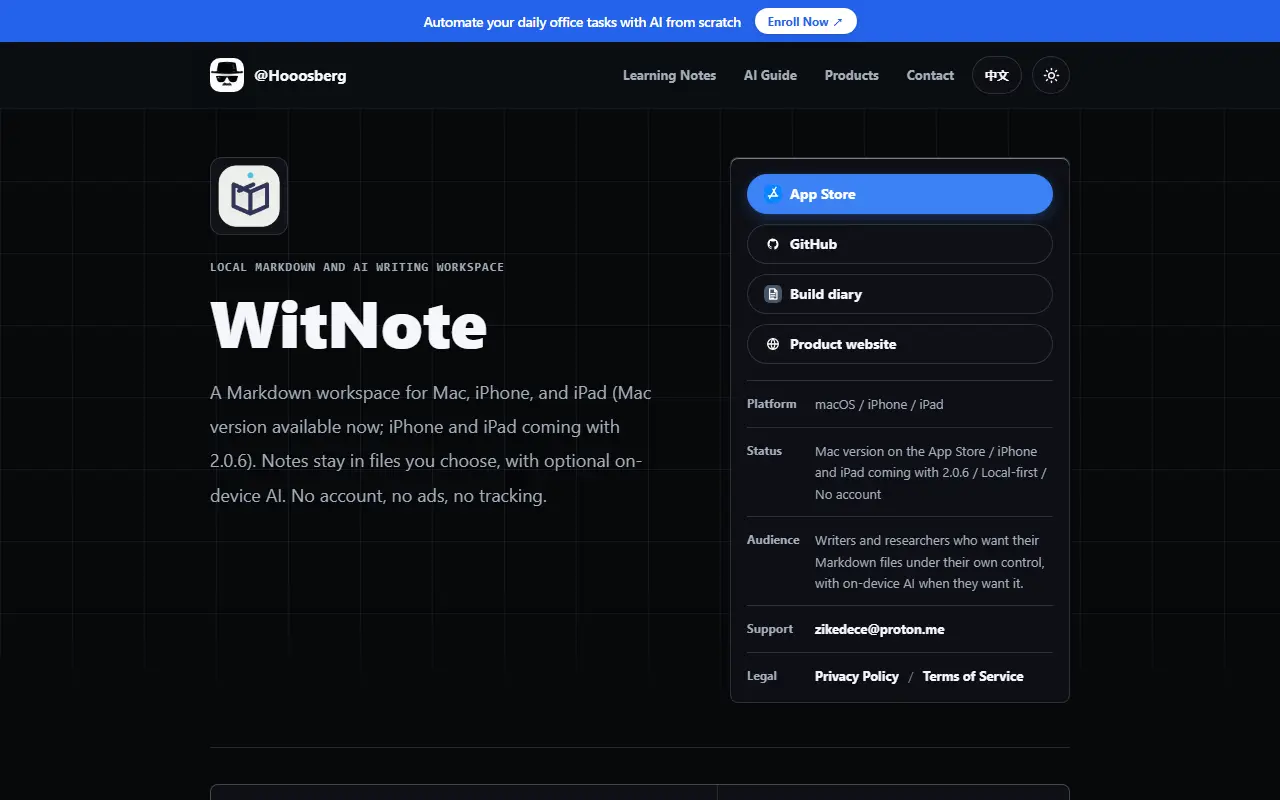
hooosberg.comWitNote homepage screenshot

WitNote is a lightweight, local-first Markdown companion for macOS and Windows. Its philosophy is to stay simple: open any local Markdown or text file or a folder instantly, write on the left, and see the rendered result on the right, with GitHub-flavored Markdown and LaTeX math supported. All files stay on your local disk. It is aimed at writers and note-takers who want a quiet, fast editor rather than a heavy workspace.

The AI element is deliberately modest. Rather than an intrusive agent, it works as an offline encyclopedia, translator and writing assistant, and the repository topics point to local models through Ollama. The README says the Apple versions have moved to a native Swift and SwiftUI architecture, available from the Mac App Store, with iOS and iPadOS versions still in development. The open-source edition for Windows and Linux continues as an Electron build.

Mac users who prefer the open-source build can compile it from source. The interface supports multiple languages, including English and Simplified Chinese. The repository metadata does not specify a license, so check the repository before reuse.

Key features

  • Dual-pane Markdown editing with live preview
  • GitHub-flavored Markdown and LaTeX math
  • Offline-first local file storage
  • Lightweight AI writing and translation helper
  • Native Swift edition for Apple platforms
  • Electron open-source edition for Windows

Lumen

Lumen is a free, open-source note-taking app that stores notes as markdown files and syncs them with a GitHub repository, built local-first.

GitHub stars
721
Last commit
7 mo ago
Licence
MIT
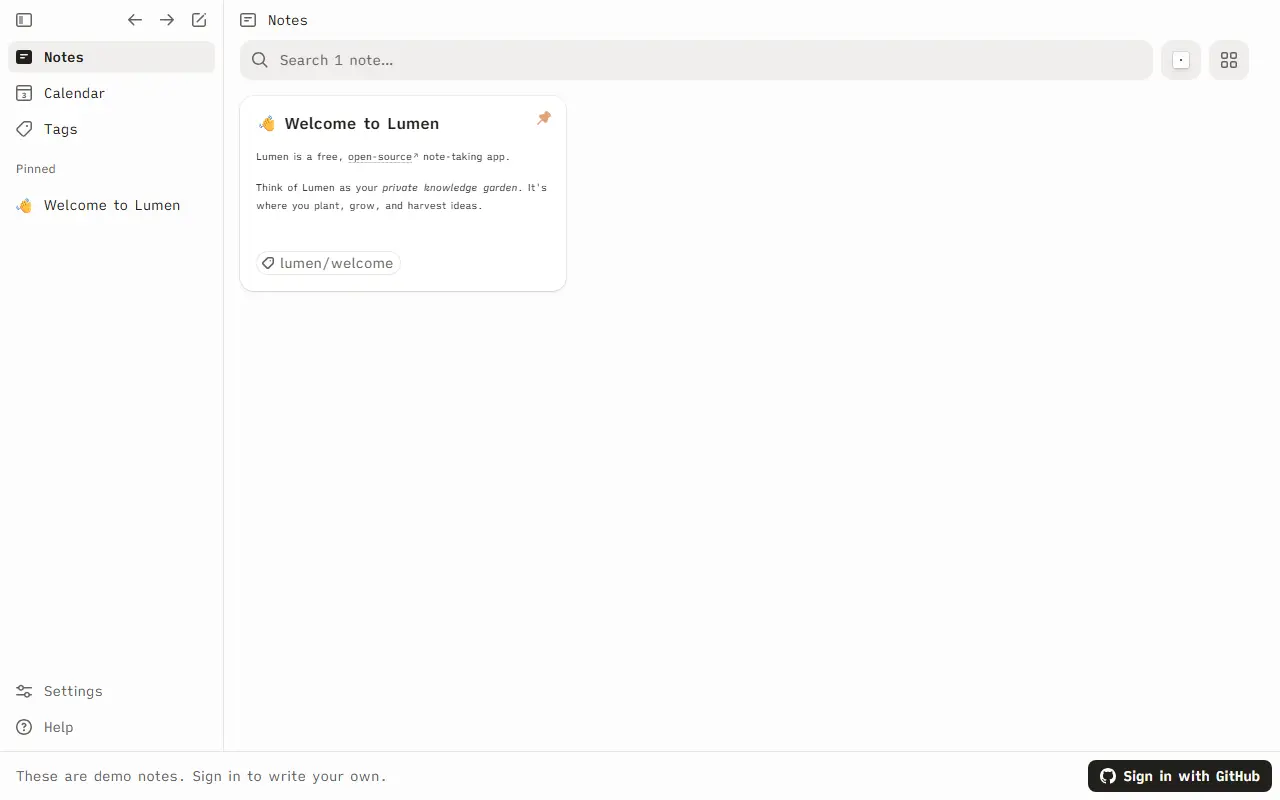
uselumen.comLumen homepage screenshot

Lumen is a free, open-source note-taking app written in TypeScript. Instead of keeping notes in a proprietary database, it syncs with markdown files stored in a GitHub repository, so your notes remain plain text files that you own and can read with any other tool.

The repository topics describe it as local-first, personal knowledge management and zettelkasten software that works with git. It is released under the MIT license, and the project site is uselumen.com. The repository README is very brief, so any further detail is best checked on the project site.

Key features

  • Notes stored as plain markdown files
  • Sync with a GitHub repository
  • Local-first note storage
  • Distraction-free writing interface

Pricing: Free and open source under the MIT license.

TakeNote

TakeNote is an MIT-licensed, web-based Markdown notes app for developers that stores notes locally in the browser, with an optional self-hosted GitHub sync.

GitHub stars
7.1k
Last commit
2 yr ago
Latest release
v0.7.1
Licence
MIT
Self-hosted
Yes
Hosted version
Available

TakeNote is a web-based note-taking app built specifically for developers. Rather than a WYSIWYG editor, it offers a plain-text, IDE-like writing environment with Markdown preview, syntax highlighting, and keyboard shortcuts for common tasks such as creating notes and categories.

Notes support linking to one another with a UUID syntax, drag-and-drop organization into categories or favorites, multi-cursor editing through CodeMirror, search across all notes or within a category, and on-the-fly formatting with Prettier. The public demo app at takenote.dev is a static site with no database: notes persist only in the browser's local storage, can be exported as a Markdown zip, and the app performs no tracking or analytics.

A hidden alternate version of the code includes a Node and Express server with GitHub OAuth integration, letting a self-hosted deployment back up notes to a private GitHub repository called takenote-data instead of relying on local storage alone. TakeNote is written in TypeScript and released under the MIT license.

Key features

  • IDE-style plain-text note editor
  • Markdown preview and Prettier formatting
  • Note-to-note linking with UUID syntax
  • Drag-and-drop categories and favorites
  • Local storage only, with Markdown export
  • Optional self-hosted GitHub sync version

Pricing: Free and open source under the MIT license; a free hosted demo is available at takenote.dev.

Bear alternatives: questions

What is the best open-source alternative to Bear?
FSNotes is the top-ranked open-source alternative to Bear on Enlisted: A fast, native Markdown notes app for macOS and iOS that keeps every note as a plain Markdown or text file, with tags, wiki-style links and encryption. Other strong options are Hubble.md, WitNote, Lumen and TakeNote.
Are these Bear alternatives free?
All 5 are open source, so the code is free to use under its licence, and all of them can be self-hosted on your own server or computer. 1 also offers a paid or managed cloud version if you'd rather not host it yourself.
How is this list of Bear alternatives ranked?
By a score built from GitHub stars, star growth over the last 30 days and how recently the code changed. 2 of these projects shipped code in the last 30 days. Data is refreshed daily, and nobody can pay to move up.

People also look for alternatives to…

View all