 TrackMedia
 TrackRev

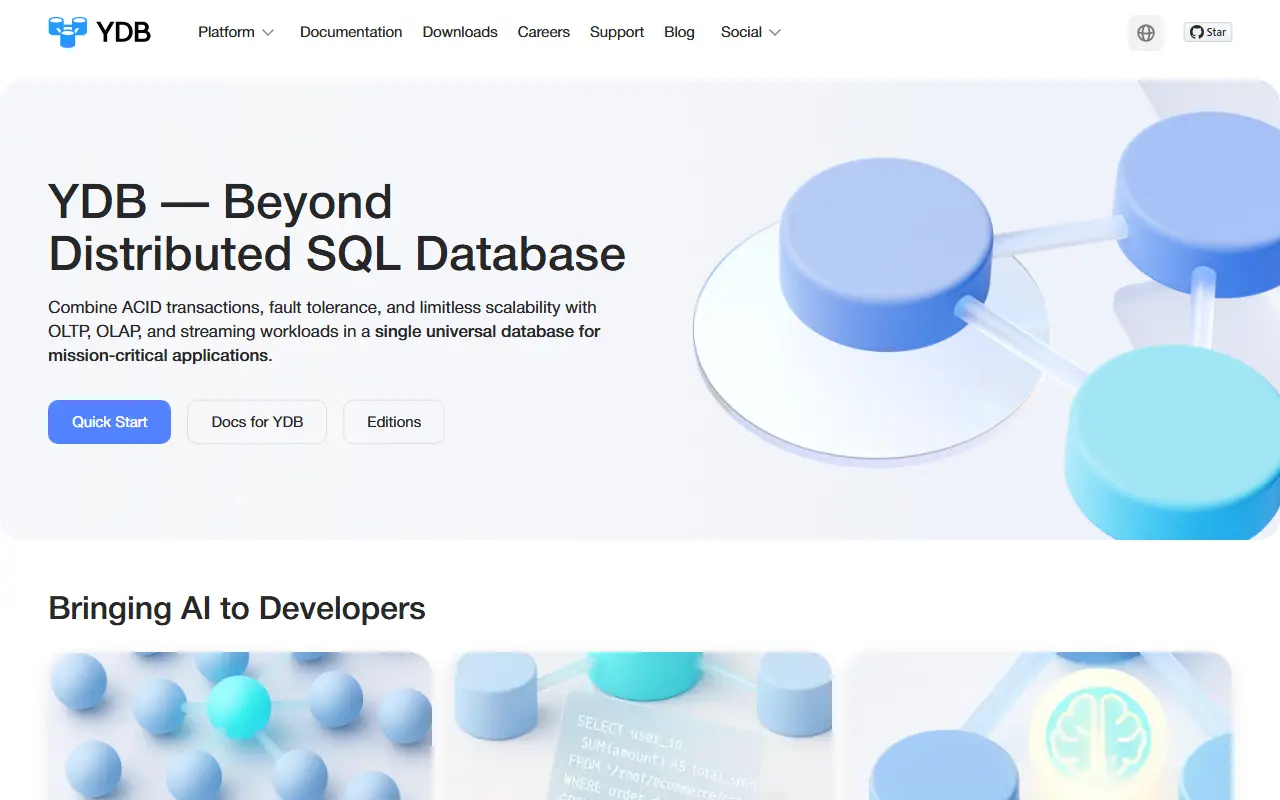
About YDB
YDB is a distributed SQL database for workloads that need scale without giving up consistency. It offers high availability and scalability along with strict consistency and ACID transactions, and it was designed from scratch for scalable interactive web services with an OLTP-like profile, where effective transactions across rows are essential.
The README says the project was built by people with a deep background in databases and distributed systems, with experience building a NoSQL database and a MapReduce system at a very large search company. The code base is written in C++ and described as cloud-native, with documentation, a blog and community channels on Discord and Telegram.
YDB is licensed under Apache-2.0 and can be deployed on your own infrastructure. It suits teams that want a horizontally scalable relational-style database with strong transactional guarantees, for example for large online services, and are willing to run a distributed system.
Key features
- Distributed SQL query layer
- ACID transactions across rows
- Strong consistency guarantees
- High availability across nodes
- Horizontal scale-out across nodes
- Cloud-native C++ implementation
Good fit for
- Scalable OLTP backends for web services
- Replacing sharded relational setups
YDB: questions and answers
- What is YDB used for?
- YDB is a distributed SQL database, open source under Apache-2.0, offering high availability, horizontal scale and ACID transactions with strong consistency. It is a good fit for scalable OLTP backends for web services and replacing sharded relational setups.
- Is YDB open source?
- Yes. YDB is open source under the Apache-2.0 licence. Its source code is on GitHub at ydb-platform/ydb and is written mainly in C++.
- Is YDB free?
- Yes. YDB is open source, so the software itself is free to use.
- Can I self-host YDB?
- Yes. YDB can be self-hosted on your own server or infrastructure.
- What is YDB an alternative to?
- YDB is an open-source alternative to Google Cloud Spanner and CockroachDB. Other open-source alternatives to Google Cloud Spanner include YugabyteDB, TiDB and OceanBase.
- Is YDB actively maintained?
- Yes. The most recent commit to YDB was on 13 November 2026, and the latest release is 26.2.1.14, published on 17 September 2026. The project has 4.8k stars on GitHub, with 9 added in the last 30 days.
Open-source alternatives to YDB
See all
YugabyteDB
Databases
YugabyteDB - the cloud native distributed SQL database for mission-critical applications.
OSSvs Google Cloud Spanner★ 11k
TiDB
Databases
TiDB is built for agentic workloads that grow unpredictably, with ACID guarantees and nati
Apache-2.0vs Amazon Aurora★ 41k
OceanBase
Databases
OceanBase is the unified distributed database for the AI era — open-source, multi-model, o
Apache-2.0vs Oracle Database★ 10k
CockroachDB
Databases
CockroachDB — the cloud native, distributed SQL database designed for high availability, e
OSSvs Google Cloud Spanner★ 33k
MySQL
Databases
MySQL Server, the world's most popular open source database, and MySQL Cluster, a real-tim
OSSvs Oracle Database★ 13k
Apache Cassandra
Databases
Open source transactional distributed database. Linear scalability and proven fault-tolera
Apache-2.0vs Amazon DynamoDB★ 10k
SaaS alternatives to YDB
See all
Google Cloud Spanner
Databases
Google horizontally scalable relational database with strong consistency
SaaS
CockroachDB
Databases
Distributed SQL database with horizontal scaling, available as a managed cloud service
SaaS
Oracle Autonomous Database
Databases
Self-managing cloud database from Oracle with automated tuning, patching and scaling
SaaS
Oracle Database
Databases
Oracle relational database for enterprise transactional and analytical workloads
SaaS
Aerospike
Databases
Real-time NoSQL database for low-latency, high-throughput applications
SaaS
AlloyDB for PostgreSQL
Databases
PostgreSQL-compatible managed database service on Google Cloud
SaaS