
About Xlings
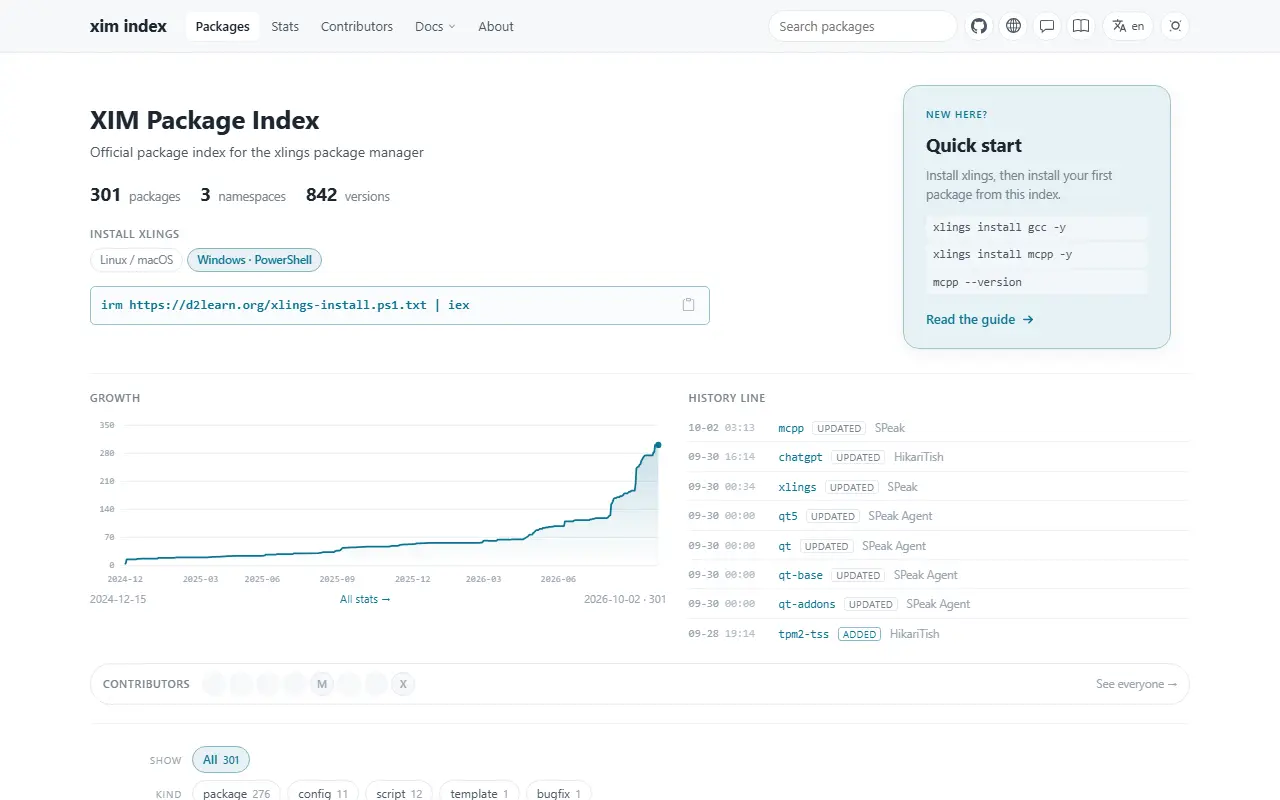
xlings describes itself as universal package infrastructure with OS-like SubOS isolation. The goal is a single tool to install any version of anything, run it without root privileges and isolate it, across Linux, macOS and Windows, with a decentralized package index and readiness for use by AI agents.
The README distinguishes three separate questions about support: whether xlings itself has a release for a platform, whether a given package has an artifact for that architecture, and how much isolation the sandbox option provides. Linux x86_64 has the fullest support, with filesystem isolation through bwrap or proot, while Linux aarch64, macOS 14 and later on arm64 and Windows x86_64 have partial package coverage. On macOS and Windows the sandbox only redirects the home directory so tools write their dotfiles somewhere isolated and is explicitly not a security boundary.
Package coverage depends on each recipe, and installation refuses a target only when the recipe lists architectures that exclude yours. xlings is written in C++, licensed under Apache-2.0, comes with documentation, a package index and a forum, and is used by projects such as MCPP.
Key features
- Install multiple versions of any tool
- Rootless installation
- SubOS isolated environments
- Decentralized package index
- Linux, macOS and Windows support
- Agent-ready command-line workflow
Good fit for
- →Managing toolchains and versions without root
- →Isolated development environments per project
- Built with
- C++
- Tags
- package-manager
- version-manager
- rootless
- sandbox
- cpp
- cross-platform
- tooling
Xlings: questions and answers
- What is Xlings used for?
- xlings is a C++ package manager and runtime that installs multiple versions of tools rootless and isolates them in OS-like SubOS environments. It is a good fit for managing toolchains and versions without root, and isolated development environments per project.
- Is Xlings open source?
- Yes. Xlings is open source under the Apache-2.0 licence. Its source code is on GitHub at openxlings/xlings and is written mainly in C++.
- Is Xlings free?
- Yes. Xlings is open source, so the software itself is free to use.
- What are some alternatives to Xlings?
- Similar open-source tools in the Developer Tools category include Godot, Windows Terminal and Neovim. SaaS products in the same category include Qt, Beyond Compare and Browserwire.
- Is Xlings actively maintained?
- Yes. The most recent commit to Xlings was on 29 September 2026, and the latest release is v2026.9.30.1, published on 29 September 2026. The project has 613 stars on GitHub.
Open-source alternatives to Xlings
See all
Godot
Developer Tools
Godot Engine – Multi-platform 2D and 3D game engine
MITvs Unity★ 118k
Windows Terminal
Developer Tools
The new Windows Terminal and the original Windows console host, all in the same place!
MITvs Warp★ 105k
Neovim
Developer Tools
Vim-fork focused on extensibility and usability
OSSvs Sublime Text★ 103kTesseract
Developer Tools
Tesseract Open Source OCR Engine (main repository)
Apache-2.0★ 77k
Tabby
Developer Tools
A terminal for a more modern age
MITvs Warp★ 75k
Ghostty
Developer Tools
👻 Ghostty is a fast, feature-rich, and cross-platform terminal emulator that uses platfor
MITvs Warp★ 62k
SaaS alternatives to Xlings
See all
Qt
Developer Tools
Cross-platform application framework and tooling for desktop, embedded and mobile UIs
SaaS
Beyond Compare
Developer Tools
File and folder comparison and merge tool for Windows, Mac and Linux
SaaS
Browserwire
Developer Tools
Developer API that gives AI agents and engineers structured, deterministic access to managed sandboxed browsers
SaaS
CLion
Developer Tools
Cross-platform IDE for C and C++ development from JetBrains
SaaSCodeSandbox
Developer Tools
Cloud development environments and browser-based sandboxes for web projects
SaaS
GitKraken
Developer Tools
Cross-platform Git desktop client with a visual commit graph and pull request tools
SaaS