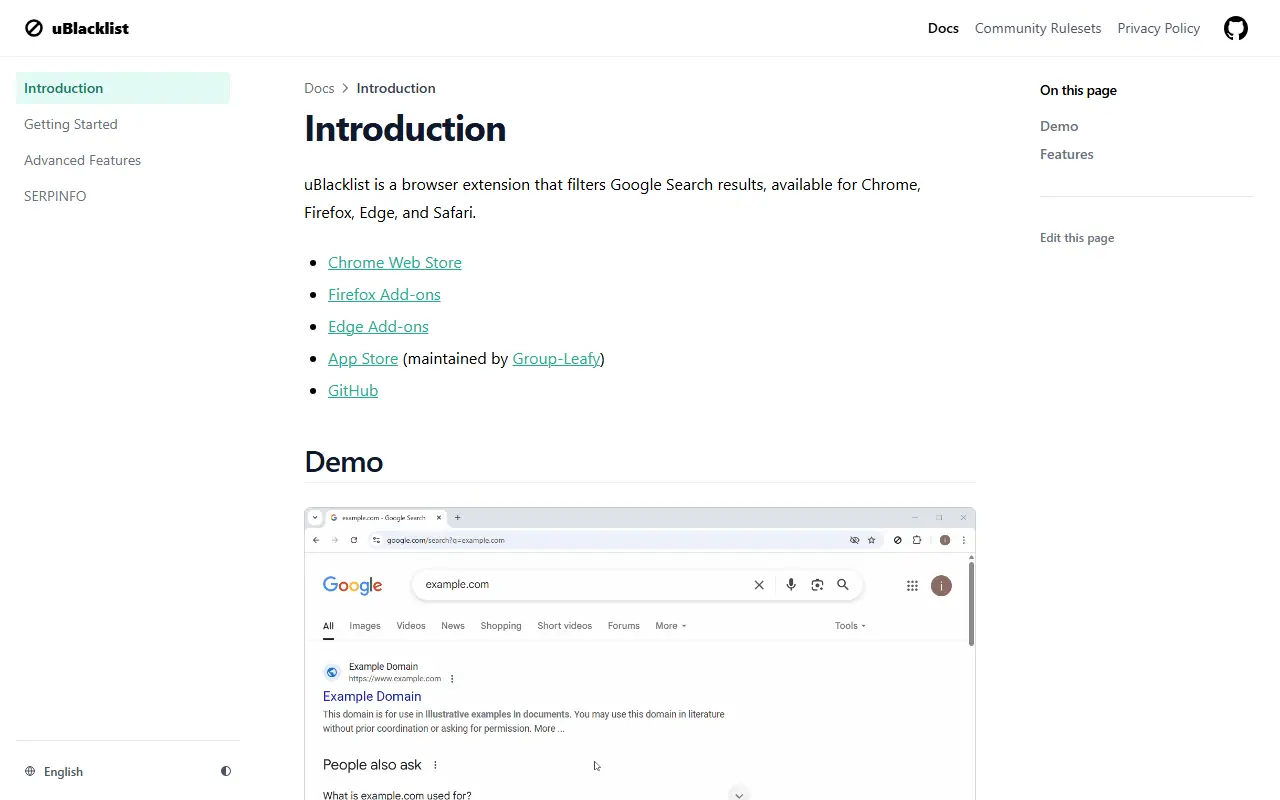
About uBlacklist
uBlacklist is a browser extension that keeps sites you specify out of search results. It works on Google and also on Bing, Brave, DuckDuckGo and other search engines, across web, image, video and news results, and rules can be added on search pages or from the toolbar icon while visiting a site.
Rules can be match patterns, such as a URL wildcard, or expressions that include regular expressions, variables and string matchers, so you can filter by domain, path, title or category. Rulesets can be synchronized across devices through Google Drive, Dropbox, OneDrive, WebDAV or browser sync, and you can subscribe to public rulesets that the community lists on its website.
uBlacklist is available for Chrome, Firefox, Edge and Safari on macOS and iOS, with a stated policy of supporting the latest stable versions. It is written in TypeScript and licensed under MIT. It suits people who want to cut out low-quality, spammy or irrelevant sites from their searches.
Key features
- Blocks chosen sites in search results
- Match patterns and regular expression rules
- Rule sync via cloud storage or browser sync
- Subscriptions to public rulesets
- Works with Google, Bing, Brave and DuckDuckGo
- Chrome, Firefox, Edge and Safari support
Good fit for
- →Removing content farms from search results
- →Sharing blocklists across devices
- →Cleaner research and shopping searches
- Built with
- TypeScript
- Tags
- browser-extension
- search
- blocklist
- google-search
- privacy
- chrome-extension
- firefox-addon
- typescript
uBlacklist: questions and answers
- What is uBlacklist used for?
- uBlacklist is a browser extension that blocks sites you choose from appearing in Google and other search results, with pattern and regex rules, sync and shareable rulesets. It is a good fit for removing content farms from search results, sharing blocklists across devices, and cleaner research and shopping searches.
- Is uBlacklist open source?
- Yes. uBlacklist is open source under the MIT licence. Its source code is on GitHub at iorate/ublacklist and is written mainly in TypeScript.
- Is uBlacklist free?
- Yes. uBlacklist is open source, so the software itself is free to use.
- Can I self-host uBlacklist?
- Yes. uBlacklist can be self-hosted on your own server or infrastructure.
- What are some alternatives to uBlacklist?
- Similar open-source tools in the Search category include SearchJumper, SearXNG and Degoog. SaaS products in the same category include Ecosia, Amazon OpenSearch Service and Azure AI Search.
- Is uBlacklist actively maintained?
- Yes. The most recent commit to uBlacklist was on 1 October 2026, and the latest release is v10.1.1, published on 19 September 2026. The project has 6.7k stars on GitHub.
Open-source alternatives to uBlacklist
See all
SearchJumper
Search
Yet another awesome browser extension for switching search engines, search everything (sel
GPL-3.0★ 1.1k
SearXNG
Search
SearXNG is a free internet metasearch engine which aggregates results from various search
AGPL-3.0vs DuckDuckGo★ 38k
Degoog
Search
Search engine aggregator with a comprehensive plugin/extension system
AGPL-3.0vs Startpage★ 2.2k
Wigolo
Search
The go-to web for your AI coding agent — local-first search, fetch, crawl & research over
OSSvs Tavily★ 5.4k
Meilisearch UI
Search
😎 Open-source, pretty, simple and fast ⚡ Meilisearch admin dashboard UI for managing your
Apache-2.0★ 781
Morphic
Search
An AI-powered search engine with a generative UI
Apache-2.0vs Perplexity★ 9.2k
SaaS alternatives to uBlacklist
See all
Ecosia
Search
Search engine that funds tree planting from advertising revenue
SaaS
Amazon OpenSearch Service
Search
Managed AWS service for running OpenSearch clusters for search and log analytics
SaaS
Azure AI Search
Search
Azure managed search with full-text, vector and hybrid retrieval
SaaS
Brave Search
Search
Search engine running on Brave's own web index with a privacy focus
SaaS
CarScout
Search
Tracks car listings against your criteria and notifies you when matches appear
SaaS
Coveo
Search
AI search and relevance platform for commerce, service and workplace sites
SaaS