
 Ecosia
 Yahoo Search
 Qwant
Qwant Yandex Search
 Baidu
Baidu Naver
Naver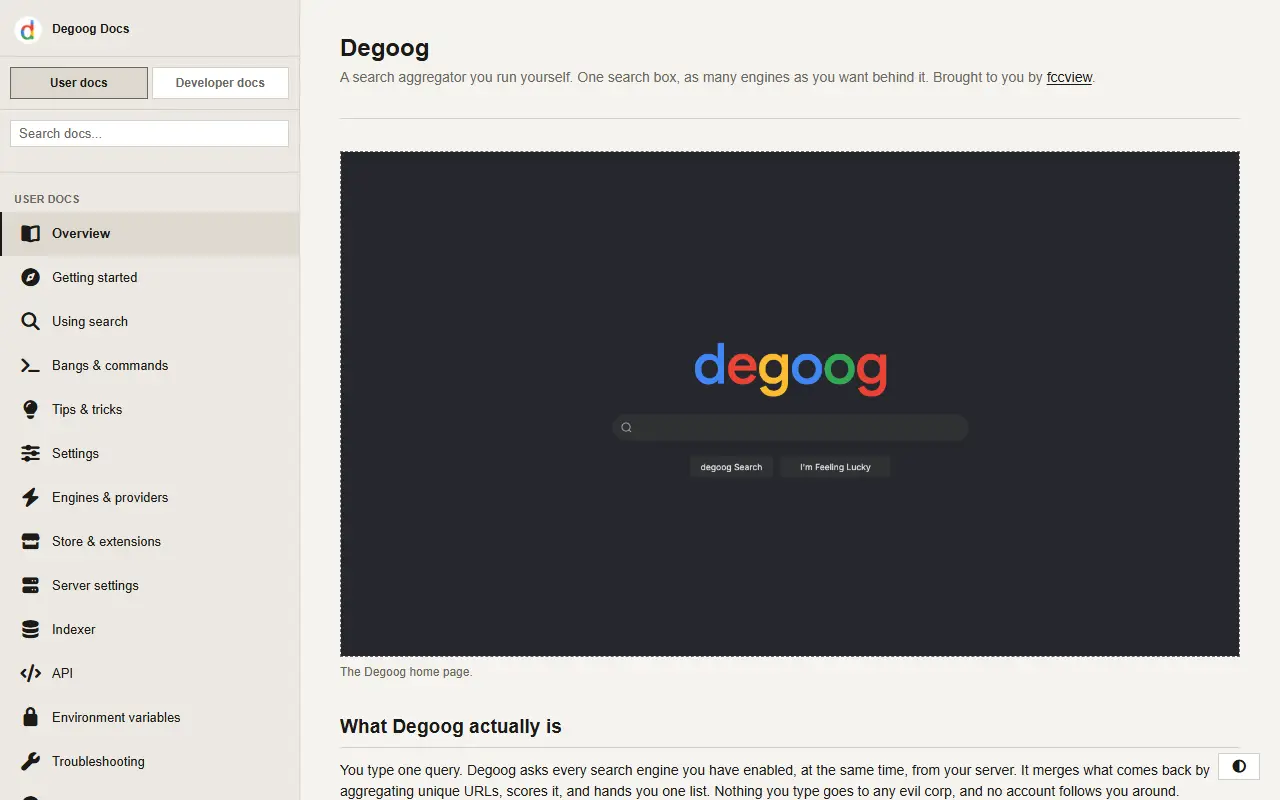
About Degoog
degoog is a search engine aggregator that sends your query to several search engines and shows the combined results in one place. It is aimed at people who want to reduce dependence on a single large search provider and is self-hosted, with a TypeScript code base released under the AGPL-3.0 license. The project is in a stable beta, usable in production but with some inconsistent behavior possible.
A plugin system is its defining feature. You can add custom search engines, bang-command plugins, slot plugins that show query-triggered panels above, below, or beside the results, and transports that define custom HTTP fetch strategies, such as curl, FlareSolverr, or your own. The author hopes for a community marketplace for plugins and engines in the future.
By default the app runs on port 4444 under user 1000, with environment variables documented on the project site, and there is a Discord community. degoog suits privacy-minded users, homelab operators, and developers who want a customizable personal search front end.
Key features
- Aggregates results from multiple search engines
- Custom search engine definitions
- Bang-command plugins
- Slot plugins for panels around results
- Custom transports such as curl or FlareSolverr
- Self-hosted with environment variable configuration
Good fit for
- →Personal private search front end
- →Combining several engines with custom panels
- Built with
- TypeScript
- Tags
- search-engine
- metasearch
- aggregator
- self-hosted
- privacy
- plugins
- typescript
- degoogle
Degoog: questions and answers
- What is Degoog used for?
- Degoog is a self-hosted search aggregator that queries multiple engines at once and extends through custom engines, bang commands, slot plugins, and transports. It is a good fit for personal private search front end and combining several engines with custom panels.
- Is Degoog open source?
- Yes. Degoog is open source under the AGPL-3.0 licence. Its source code is on GitHub at degoog-org/degoog and is written mainly in TypeScript.
- Is Degoog free?
- Yes. Degoog is open source, so the software itself is free to use.
- Can I self-host Degoog?
- Yes. Degoog can be self-hosted on your own server or infrastructure; there is no official hosted version.
- What is Degoog an alternative to?
- Degoog is an open-source alternative to Startpage, DuckDuckGo, Google Search and Bing. Other open-source alternatives to Startpage include SearXNG, SearX and YaCy.
- Is Degoog actively maintained?
- Yes. The most recent commit to Degoog was on 1 October 2026, and the latest release is 0.26.0, published on 13 September 2026. The project has 2.2k stars on GitHub.
Open-source alternatives to Degoog
See all
SearXNG
Search
SearXNG is a free internet metasearch engine which aggregates results from various search
AGPL-3.0vs DuckDuckGo★ 38k
SearX
Search
Privacy-respecting metasearch engine
AGPL-3.0vs Startpage★ 14k
YaCy
Search
Distributed Peer-to-Peer Web Search Engine and Intranet Search Appliance
OSSvs DuckDuckGo★ 4.1k
Mwmbl
Search
An open source, non-profit web search engine
AGPL-3.0vs DuckDuckGo★ 1.9k
Marginalia Search
Search
Internet search engine for text-oriented websites. Indexing the small, old and weird web.
OSSvs Mojeek★ 2.2k
Morphic
Search
An AI-powered search engine with a generative UI
Apache-2.0vs Perplexity★ 9.2k
SaaS alternatives to Degoog
See all
Startpage
Search
Search engine that proxies Google results to keep queries private
SaaS
DuckDuckGo
Search
Privacy-focused web search engine that does not track searches
SaaS
Google Search
Search
Web search engine from Google with image, news, maps and AI answers
SaaS
Bing
Search
Microsoft web search engine with image search and Copilot answers
SaaS
Kagi
Search
Subscription search engine with no ads and per-site ranking controls
SaaS
Brave Search
Search
Search engine running on Brave's own web index with a privacy focus
SaaS