7,363 open-source and SaaS tools, with GitHub stats refreshed every day.

6 alternatives ranked by real activity

Open-source Google Search alternatives

A curated, ranked list of the 6 best open-source alternatives to Google Search.

The best open-source alternative to Google Search is SearXNG. If that doesn't suit you, other good options are YaCy, Degoog, Marginalia Search and SearX.

Google Search alternatives are mainly search tools. 5 of them shipped code in the last 30 days, 6 can be self-hosted, and none uses a permissive licence.

Last updated October 2, 2026 · ranked by GitHub stars, growth and recent commits

SearXNG

A free, privacy-respecting metasearch engine that aggregates results from many search services without tracking or profiling users, designed for self-hosting.

GitHub stars
38k
Last commit
yesterday
Licence
AGPL-3.0
Self-hosted
Yes
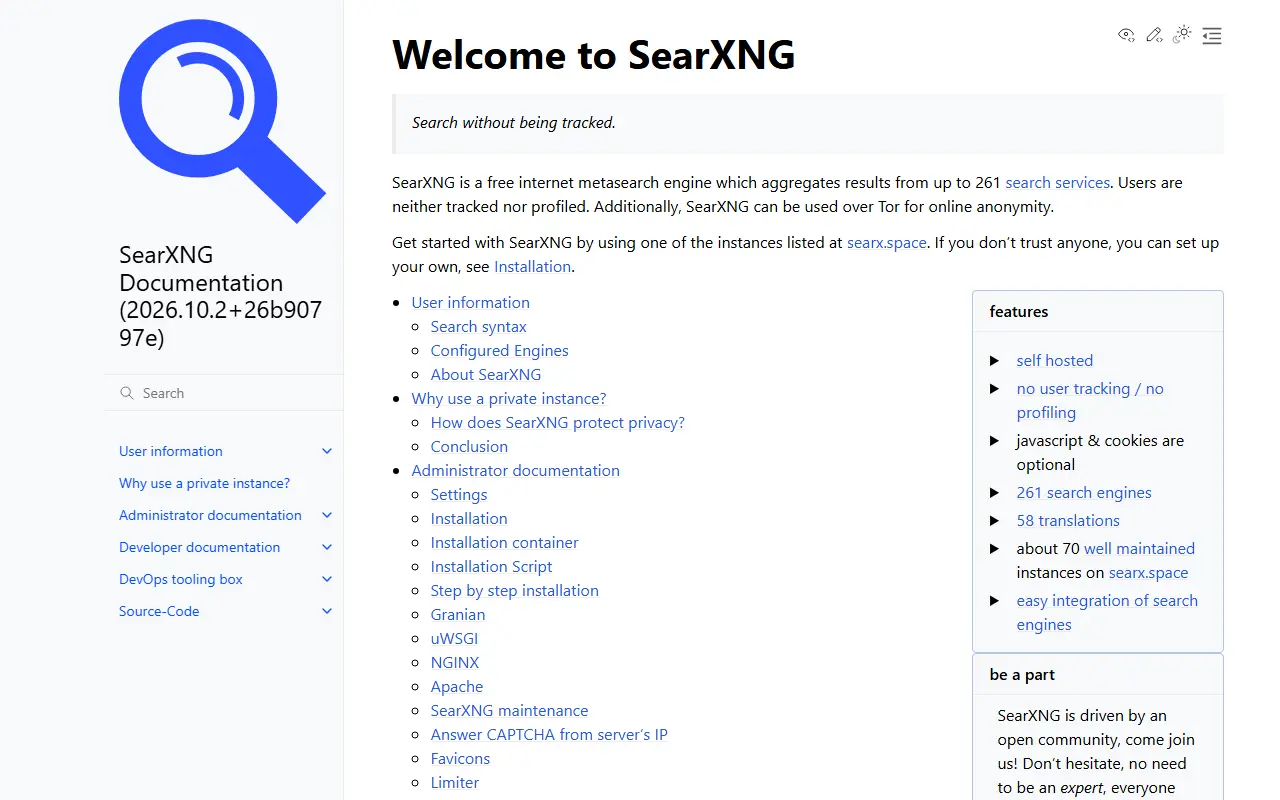
docs.searxng.orgSearXNG homepage screenshot

SearXNG is a free internet metasearch engine. It sends your query to many search services and databases, merges the results into one page, and does so without tracking or profiling the people who use it. Topics list engines such as Google, Bing, Brave, DuckDuckGo, Qwant and Startpage among the sources it can combine.

The documentation is organized for both users and administrators. Users get search syntax, a list of configured engines and an explanation of why a private instance matters. Administrators get settings in settings.yml, engine configuration, plugins, a bot-protection limiter, optional Redis or Valkey storage, and installation guides covering containers, an installation script and step-by-step setups with Granian or uWSGI behind NGINX or Apache. A long catalog of engines extends beyond web search to sources such as arXiv, Crossref, GitHub and Mastodon.

SearXNG is written in Python under the AGPL-3.0 license. Because it is meant to be self-hosted, you can run your own instance for yourself or a group; many volunteers also publicly host instances. It appeals to people who want to reduce reliance on any one search engine and keep their queries private.

Key features

  • Aggregates results from many search engines
  • No user tracking or profiling
  • Configurable engines and plugins
  • Container and script-based installation
  • Optional Redis or Valkey integration
  • Bot protection limiter

Pricing: Free and open source under the AGPL-3.0 license.

Read more about SearXNGWebsite GitHub

YaCy

YaCy is a decentralized search engine with its own crawler and index that you can run privately, on an intranet or as part of a peer-to-peer network.

GitHub stars
4.1k
Last commit
10 days ago
Self-hosted
Yes
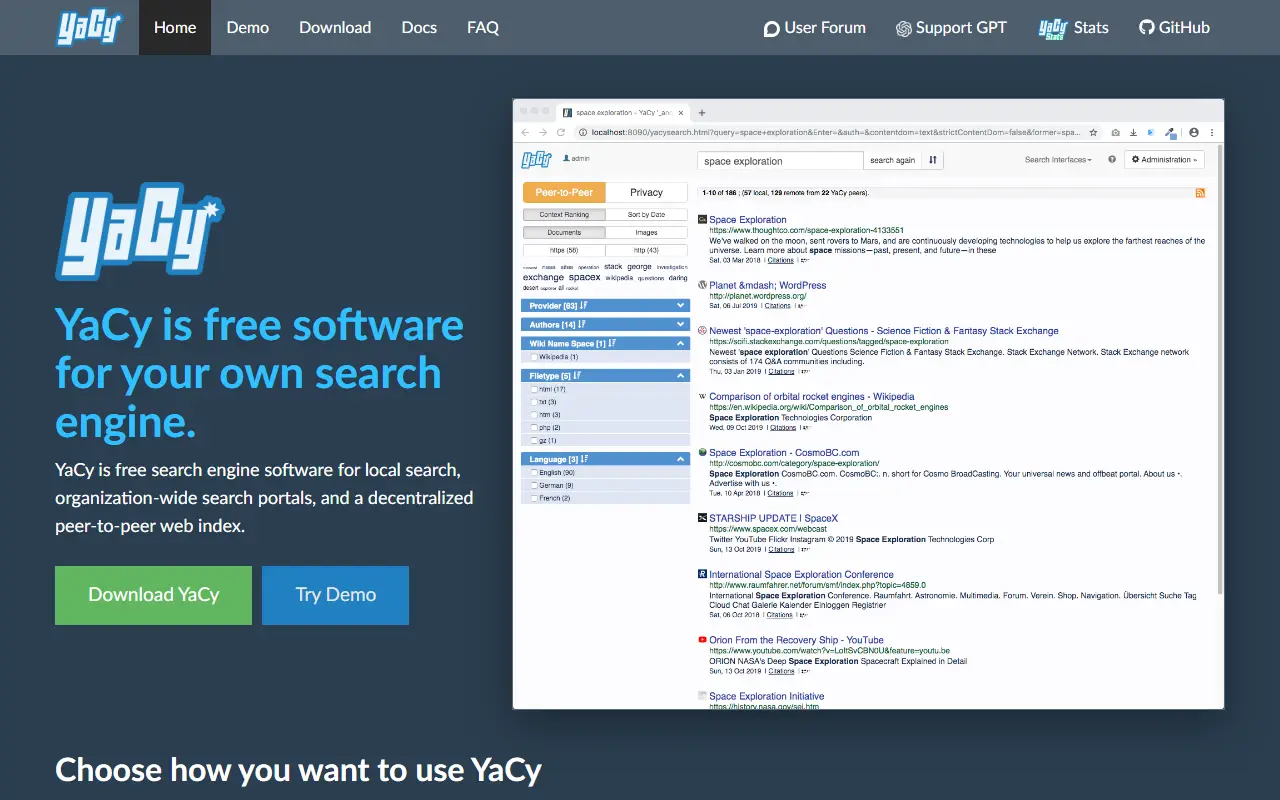
yacy.netYaCy homepage screenshot

YaCy is a complete search engine application: a server that hosts a search index, a web interface for searching and creating the index, and a production-ready crawler with a scheduler to keep the index fresh. It can run as a node in a distributed peer-to-peer network or as a private search portal.

YaCy search portals can also be placed inside an intranet, where the README says they can replace commercial enterprise search products, and a network scanner helps discover HTTP, FTP and SMB servers to index. The project was created with privacy as a primary motivation, and running a personal search engine avoids handing queries to a central provider. It is written in Java and tagged for decentralized search and privacy protection.

The repository license is shown as 'Other' on GitHub, reflecting the GPL family of licenses, so check the terms. YaCy is self-hosted on your own machine or server. It suits privacy-minded users, organizations that need intranet search and communities that want a decentralized alternative to commercial search.

Key features

  • Web crawler with scheduler
  • Peer-to-peer distributed search index
  • Web interface for search and indexing
  • Intranet search portal mode
  • Network scanner for HTTP, FTP and SMB
  • Designed with privacy as priority

Pricing: Free and open source software.

Read more about YaCyWebsite GitHub

Degoog

Self-hosted search aggregator that queries multiple engines at once and extends through custom engines, bang commands, slot plugins, and transports.

GitHub stars
2.2k
Last commit
yesterday
Latest release
0.26.0
Licence
AGPL-3.0
Self-hosted
Yes
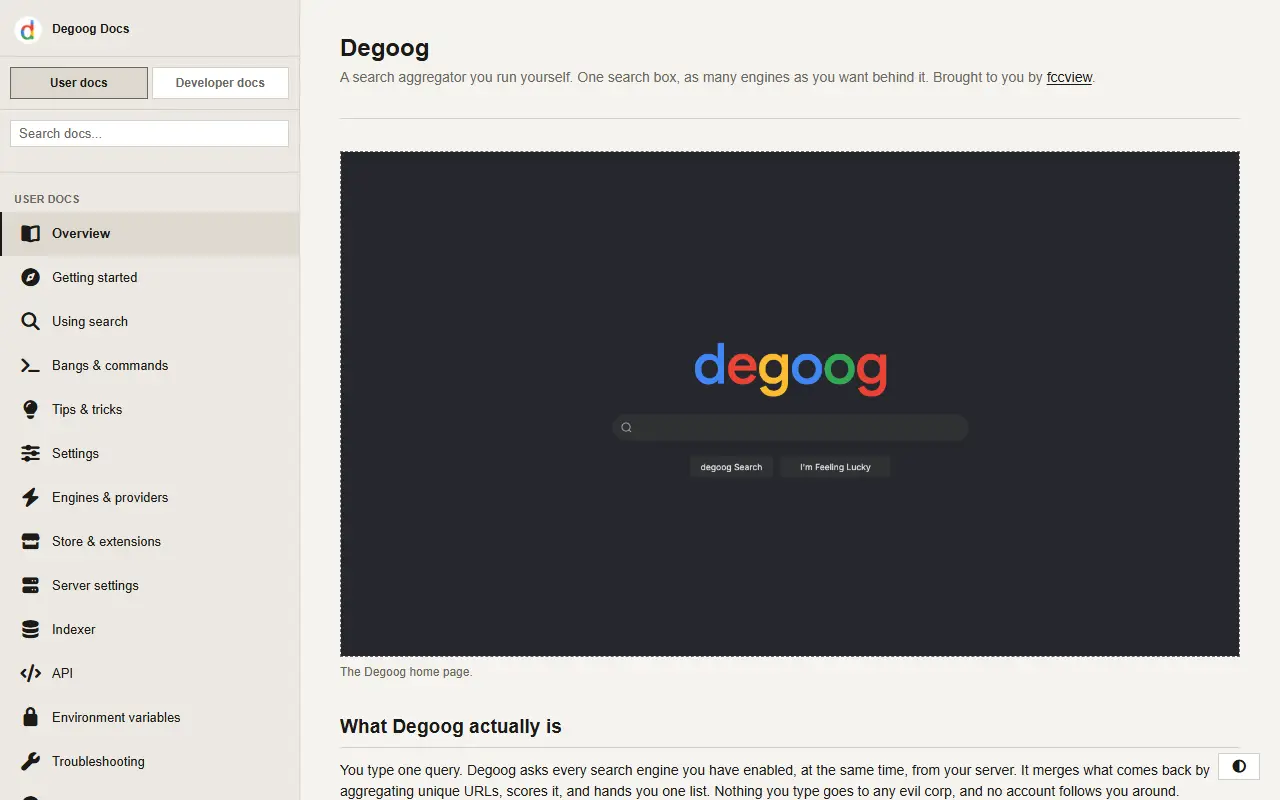
degoog-org.github.ioDegoog homepage screenshot

degoog is a search engine aggregator that sends your query to several search engines and shows the combined results in one place. It is aimed at people who want to reduce dependence on a single large search provider and is self-hosted, with a TypeScript code base released under the AGPL-3.0 license. The project is in a stable beta, usable in production but with some inconsistent behavior possible.

A plugin system is its defining feature. You can add custom search engines, bang-command plugins, slot plugins that show query-triggered panels above, below, or beside the results, and transports that define custom HTTP fetch strategies, such as curl, FlareSolverr, or your own. The author hopes for a community marketplace for plugins and engines in the future.

By default the app runs on port 4444 under user 1000, with environment variables documented on the project site, and there is a Discord community. degoog suits privacy-minded users, homelab operators, and developers who want a customizable personal search front end.

Key features

  • Aggregates results from multiple search engines
  • Custom search engine definitions
  • Bang-command plugins
  • Slot plugins for panels around results
  • Custom transports such as curl or FlareSolverr
  • Self-hosted with environment variable configuration

Pricing: Free and open source under the AGPL-3.0 license.
Read more about DegoogWebsite GitHub

SearX

Privacy-respecting metasearch engine that queries many search services at once without tracking users; the listed website now points to the related Hister project.

GitHub stars
14k
Last commit
4 mo ago
Latest release
v1.1.0
Licence
AGPL-3.0
Self-hosted
Yes
hister.orgSearX homepage screenshot

Searx is a self-hostable metasearch engine written in Python. It sends a user's query to many search services at once and presents the combined results without storing or profiling the person searching. It is released under the AGPL-3.0 license, and the repository carries only a short description.

The website listed for this entry, hister.org, actually belongs to Hister, a different project that describes itself as a private, self-hosted search engine for the pages you visit and the files you keep, searchable from the web, a terminal, the command line, or MCP. It is not the Searx site. Searx development has also largely continued in forks, so check the repository for the current maintenance state before choosing it.

Metasearch tools like Searx suit privacy-minded individuals and organizations that want to run their own search front end, reduce reliance on a single provider, and avoid advertising-driven result tracking.

Key features

  • Aggregates results from many search engines
  • Does not track or profile users
  • Self-hostable Python application
  • Runs your own private search instance

Pricing: Free and open source under the AGPL-3.0 license.

Read more about SearXWebsite GitHub

Mwmbl

Non-profit, open-source web search engine with no ads or tracking, where a volunteer community crawls the web and shapes the rankings.

GitHub stars
1.9k
Last commit
yesterday
Licence
AGPL-3.0
Hosted version
Available

Mwmbl is a non-profit, open-source search engine that aims to replace commercial engines such as Google and Bing with a community-run alternative. It promises no ads, no tracking, and no profit, and it lets the community determine rankings. The code is written in Python and released under the AGPL-3.0 license.

The index is centralized, but the crawling is distributed across servers run by volunteers, who also help curate search results. The README is candid that the index is currently much smaller than those of commercial search engines and invites people to help it grow by contributing crawling capacity.

The main community gathers on Matrix, with a Discord server for non-development discussion. Mwmbl suits privacy-minded users and developers who want to experiment with independent search, and who are willing to accept more limited coverage in exchange for a transparent, non-commercial project.

Key features

  • No ads or tracking
  • Community-determined rankings
  • Distributed crawling by volunteers
  • Open-source search index
  • Non-profit governance
  • Matrix and Discord communities

Pricing: Free to use as a non-profit service; the code is open source under the AGPL-3.0 license.
Read more about MwmblWebsite GitHub

Google Search alternatives: questions

What is the best open-source alternative to Google Search?
SearXNG is the top-ranked open-source alternative to Google Search on Enlisted: A free, privacy-respecting metasearch engine that aggregates results from many search services without tracking or profiling users, designed for self-hosting. Other strong options are YaCy, Degoog, Marginalia Search and SearX.
Are these Google Search alternatives free?
All 6 are open source, so the code is free to use under its licence, and all of them can be self-hosted on your own server or computer. 2 also offer a paid or managed cloud version if you'd rather not host it yourself.
How is this list of Google Search alternatives ranked?
By a score built from GitHub stars, star growth over the last 30 days and how recently the code changed. 5 of these projects shipped code in the last 30 days. Data is refreshed daily, and nobody can pay to move up.

People also look for alternatives to…

View all