
About Tokenwise
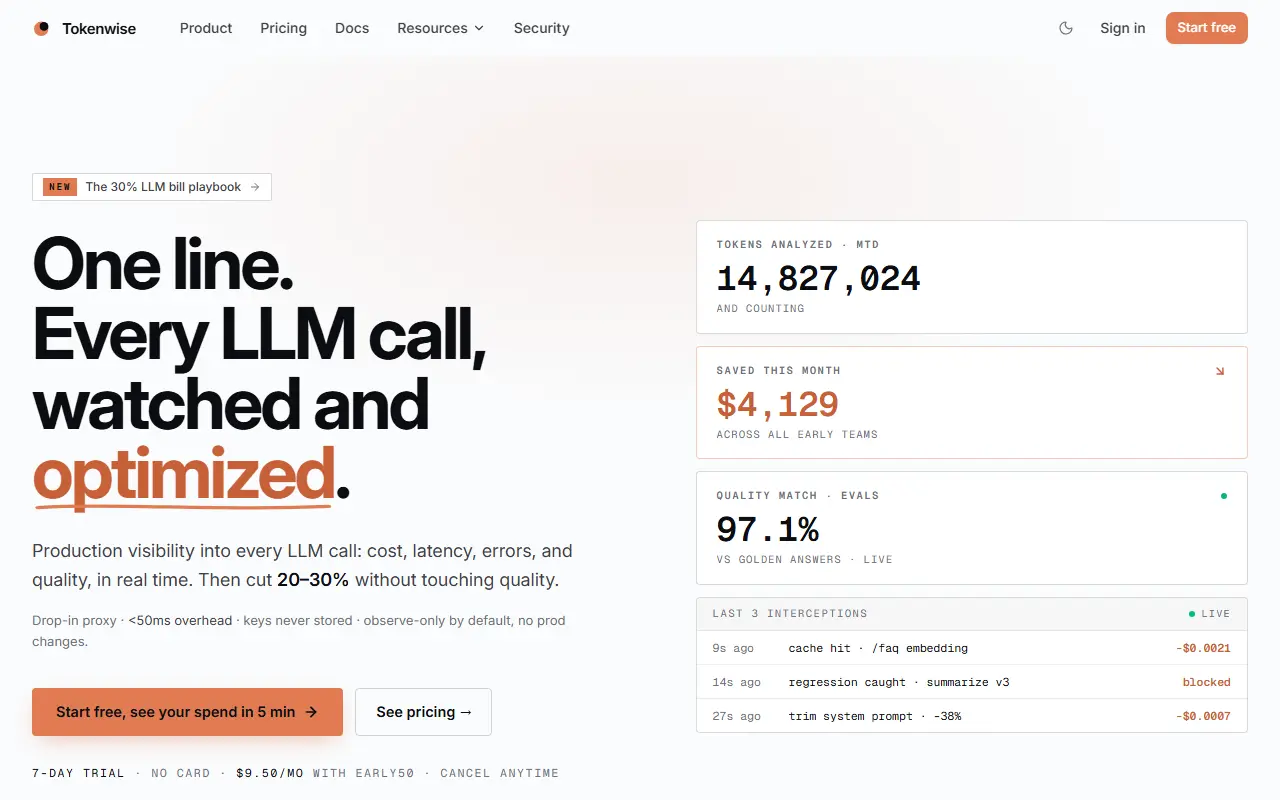
Tokenwise sits between your application and your LLM provider as a drop-in proxy that you adopt by changing one line, with no SDK rewrite. Every call is logged with its cost, token count, latency, errors and quality, and can be sliced by model, app or tag. It is observe-only by default, so nothing in production changes until you switch optimizations on, and provider keys are not stored.
The product looks for waste: oversized system prompts sent on every call, cache misses and prefix invalidations, and expensive models doing work a cheaper one can handle. It then proposes fixes such as semantic caching, prompt trims and model swaps. Each suggestion is tested by replaying your traffic against a quality threshold you set before it reaches you, and you either apply or ignore it, so nothing changes silently.
The dashboard includes a spend forecast, comparison and optimization views, tags, and alerts, and the site claims typical savings of 20 to 30 percent with under 50ms of added overhead. It is a hosted commercial service with a 7-day trial that needs no card.
Key features
- Drop-in LLM proxy with one-line setup
- Per-call cost, token, latency and error tracking
- Spend sliced by model, app or tag
- Detects oversized prompts and cache misses
- One-click model swaps, caching and prompt trims
- Replay checks against your quality bar
- Alerts and spend forecast
Good fit for
- Finding where an LLM bill is leaking
- Swapping to cheaper models without losing quality
- Watching agent and app spend in production
Tokenwise: questions and answers
- What is Tokenwise used for?
- Tokenwise is an LLM proxy and observability tool that tracks cost, latency and errors for every model call and suggests one-click fixes such as caching, prompt trimming and model swaps. It is a good fit for finding where an LLM bill is leaking, swapping to cheaper models without losing quality, and watching agent and app spend in production.
- Is Tokenwise open source?
- No. Tokenwise is proprietary (closed-source) software and can't be self-hosted. In the AI Infrastructure category, open-source options include Pezzo, Dify and LiteLLM.
- What are some alternatives to Tokenwise?
- Tokenwise competes with Portkey, OpenRouter and LangSmith.
Open-source alternatives to Tokenwise
See all
Pezzo
AI Infrastructure
🕹️ Open-source, developer-first LLMOps platform designed to streamline prompt design, ver
Apache-2.0vs Weights & Biases★ 3.3k
Dify
AI Infrastructure
Build Agentic workflows, RAG pipelines, with rich AI model and tool support on one collabo
OSSvs Gumloop★ 158k
LiteLLM
AI Infrastructure
The fastest, litest AI Gateway. Rust core with Python SDK. Call 100+ LLM APIs in OpenAI (o
OSSvs Amazon Bedrock★ 60k
SGLang
AI Infrastructure
SGLang is a high-performance serving framework for large language models and multimodal mo
Apache-2.0vs Amazon Bedrock★ 37k
Langfuse
AI Infrastructure
Trace, evaluate, and improve AI agents with one open platform. Use production data to unde
OSSvs Weights & Biases★ 35k
One API
AI Infrastructure
LLM API 管理 & 分发系统,支持 OpenAI、Azure、Anthropic Claude、Google Gemini、DeepSeek、字节豆包、ChatGLM、文心一
MITvs OpenRouter★ 37k
SaaS alternatives to Tokenwise
See all
Portkey
AI Infrastructure
AI gateway and observability platform for managing LLM requests
SaaS
OpenRouter
AI Infrastructure
Unified API gateway for accessing many large language models from one endpoint
SaaS
LangSmith
AI Infrastructure
Observability, tracing and evaluation platform for LLM applications
SaaS
api-hub.ai
AI Infrastructure
Single API for accessing many AI models behind one endpoint
SaaS
Costbase
AI Infrastructure
Aggregates the costs of AI providers into one dashboard for developers of AI products
SaaS
Polyrouter
AI Infrastructure
Routes your AI traffic through a single endpoint
SaaS