
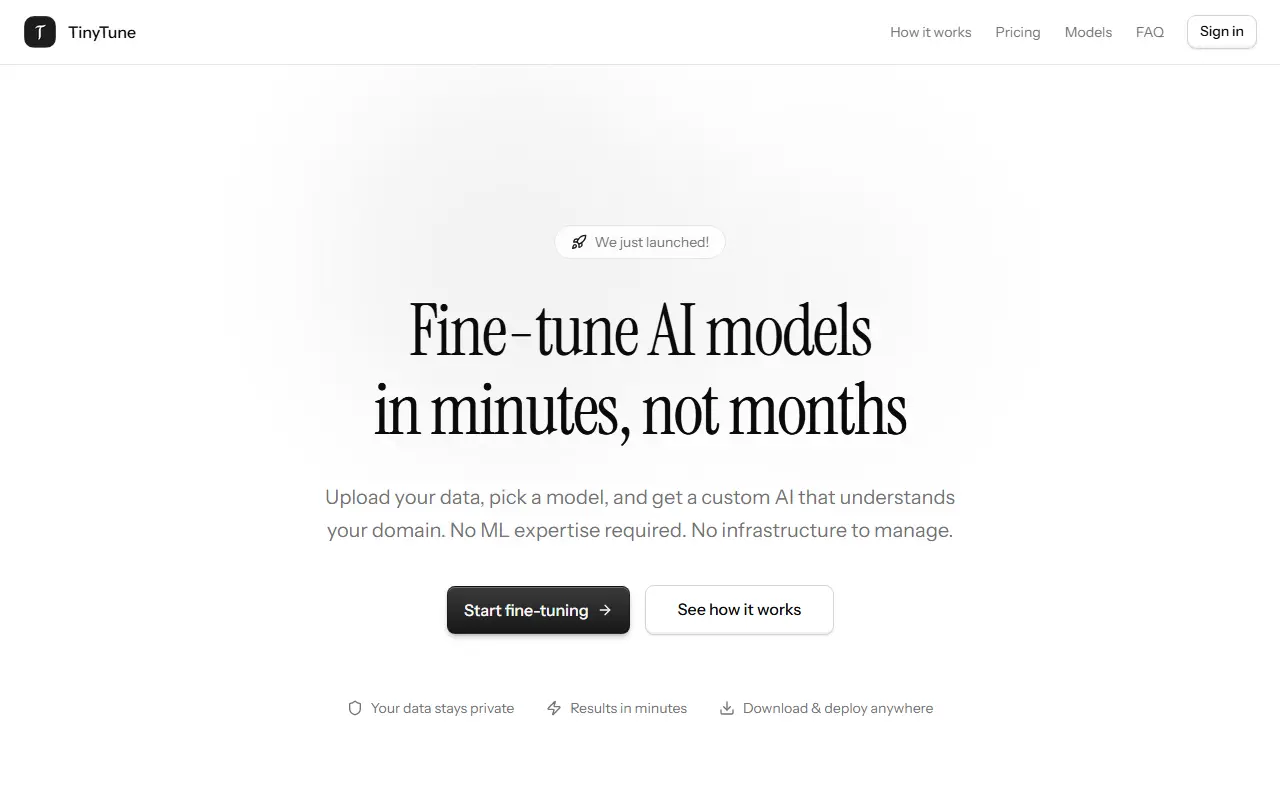
About TinyTune
TinyTune lets people fine-tune open-source language models without writing code or managing infrastructure. You choose a base model from a catalog of more than 40, upload training examples as CSV, JSON or JSONL files, and the platform detects the format and runs the training. The site says it uses LoRA, which keeps training times to minutes rather than hours.
When training finishes you can download the model and run it anywhere, or push it to Hugging Face in one click. Uploaded data is described as private and never used to train other models. Suggested uses include customer support assistants trained on tickets and documentation, content generation in a brand style, domain assistants for fields such as legal or medical work, and models that analyze research material.
Pricing is credit based and one-time rather than a subscription: Starter at $10 for 50 credits, Pro at $45 for 250 credits and Enterprise at $80 for 500 credits, with roughly one fine-tuning job per ten credits. Credits do not expire.
Key features
- 40+ open-source base models to choose from
- Upload CSV, JSON or JSONL training data
- LoRA-based fine-tuning in minutes
- One-click deploy to Hugging Face
- Download the finished model to run anywhere
- Training data kept private
Good fit for
- Training a support assistant on your own tickets
- Matching a brand writing style with a custom model
- Building domain-specific assistants
TinyTune: questions and answers
- What is TinyTune used for?
- TinyTune is a no-code platform for fine-tuning open-source LLMs such as Gemma, Qwen and Mistral on your own CSV or JSONL data, then downloading or deploying the result. It is a good fit for training a support assistant on your own tickets, matching a brand writing style with a custom model and building domain-specific assistants.
- How much does TinyTune cost?
- TinyTune is a paid product with no free plan. Prepaid credits: $10 for 50, $45 for 250 or $80 for 500, roughly 10 credits per fine-tuning job. One-time purchase and credits never expire.
- Is TinyTune open source?
- No. TinyTune is proprietary (closed-source) software and can't be self-hosted. In the AI Infrastructure category, open-source options include Unsloth, RD-Agent and Ollama.
- What are some alternatives to TinyTune?
- TinyTune competes with Together AI, Fireworks AI and Hugging Face.
Open-source alternatives to TinyTune
See all
Unsloth
AI Infrastructure
Unsloth is an open-source framework for running and training LLMs.
Apache-2.0vs Together AI★ 77k
RD-Agent
AI Infrastructure
Research and development (R&D) is crucial for the enhancement of industrial productivity,
MIT★ 15k
Ollama
AI Infrastructure
Get up and running with Kimi, GLM, MiniMax, DeepSeek, gpt-oss, Qwen, Gemma and other model
MITvs ChatGPT★ 182k
Dify
AI Infrastructure
Build Agentic workflows, RAG pipelines, with rich AI model and tool support on one collabo
OSSvs Gumloop★ 158k
Langflow
AI Infrastructure
Langflow is a powerful tool for building and deploying AI-powered agents and workflows.
MITvs Gumloop★ 156k
llama.cpp
AI Infrastructure
LLM inference in C/C++
MITvs OpenAI API Platform★ 130k
SaaS alternatives to TinyTune
See all
Together AI
AI Infrastructure
Cloud platform for running, fine-tuning and training open and custom AI models
SaaS
Fireworks AI
AI Infrastructure
Inference platform for running and fine-tuning generative AI models at low latency
SaaS
Hugging Face
AI Infrastructure
Hub for hosting and sharing machine learning models, datasets and demo apps
SaaS
OpenAI API Platform
AI Infrastructure
Developer API and platform for accessing OpenAI models like GPT for text, vision and audio
SaaS
Lightning AI
AI Infrastructure
Cloud platform for building, training and deploying AI models with studios and GPUs
SaaS
Baseten
AI Infrastructure
Inference platform for deploying and scaling AI models in production
SaaS